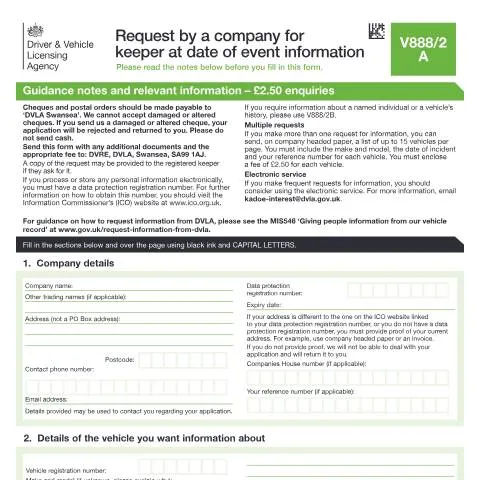
When Companies Need Historical Vehicle Keeper Information: Understanding the V888/2A Process
In the aftermath of a road traffic incident or when dealing with vehicle-related disputes, businesses often find themselves needing to identify who was responsible for a particular vehicle at a specific point in time. The V888/2A form serves as the official gateway for companies to obtain keeper at date of event information directly from DVLA's comprehensive vehicle records. This specialised request mechanism enables legitimate business enquiries whilst maintaining strict data protection standards under UK GDPR requirements.
Unlike individual requests for vehicle information, the V888/2A caters specifically to commercial entities operating within defined sectors where such data proves essential for resolving disputes, pursuing claims, or fulfilling legal obligations. The form represents a carefully balanced approach between business necessity and privacy protection, requiring companies to demonstrate both legitimate purpose and proper data handling credentials before accessing sensitive keeper details.
Qualifying Business Scenarios and Sector-Specific Applications
The V888/2A form accommodates six distinct categories of commercial enquiry, each governed by specific evidence requirements and justification criteria. Understanding these categories proves crucial for determining whether your business enquiry qualifies for DVLA's keeper information service.
Accident-Related Investigations
Solicitors, insurance companies, and loss adjusters represent the most frequent users of this category. When pursuing personal injury claims or property damage settlements, these professionals require definitive identification of the vehicle keeper at the time of incident. The form demands comprehensive incident details including precise location data, preferably with postcode accuracy, and for motorway incidents, the nearest junction reference.
Crucially, applicants must provide their client's vehicle registration number alongside the target vehicle details. This cross-referencing requirement helps DVLA verify the legitimacy of the enquiry whilst ensuring the requesting party has genuine involvement in the incident under investigation.
Debt Recovery Operations
Debt collection agencies pursuing parking charge notices or similar vehicle-related debts must navigate additional authentication hurdles. The V888/2A requires a signed letter of authority from the original parking company, establishing the agency's legitimate right to pursue the debt on behalf of the principal creditor.
This safeguard prevents unauthorised fishing expeditions whilst enabling legitimate debt recovery operations to identify liable parties. The authority letter must clearly specify the incident details, the debt amount, and the agency's scope of authority.
Fuel Theft Investigations
Petrol forecourt operators dealing with drive-off incidents face stringent documentation requirements. Beyond the standard V888/2A form, operators must supply a fully completed drive-off report, the relevant till receipt, and proof of address through a storage certificate.
When third-party security companies or management firms act on behalf of forecourt operators, a signed authorisation letter becomes mandatory. This multi-layered approach reflects the serious nature of fuel theft allegations whilst protecting innocent parties from unsubstantiated claims.
Abandoned and Persistently Parked Vehicles
Local authorities, private landowners, and their appointed agents can request keeper information for vehicles causing obstruction or abandonment issues. The form distinguishes between outright abandonment and persistent parking problems, with different evidence thresholds applying to each scenario.
For persistently parked vehicles, applicants must provide the date the vehicle was last observed, helping DVLA assess the timeline and severity of the parking issue. Landowners must confirm their legal status, whilst agents require written authority from the property owner.
A critical requirement involves supplying an unaltered photograph showing the vehicle in its original position with the registration number clearly visible. This photographic evidence serves multiple purposes: confirming the vehicle's location, verifying the registration number, and providing a timestamp for the incident.
Navigating the Application Form Structure
The V888/2A form follows a logical progression from company credentials through vehicle details to specific enquiry categories. Each section builds upon the previous one, creating a comprehensive picture of both the requesting entity and the underlying circumstances necessitating the enquiry.
Company Authentication Requirements
Section 1 demands comprehensive company details extending beyond basic contact information. The form requires the data protection registration number and its expiry date, reflecting DVLA's commitment to ensuring only properly authorised entities handle personal data.
Companies operating under multiple trading names must declare all relevant identities, preventing confusion and ensuring proper identification. The prohibition on PO Box addresses reflects DVLA's need to verify genuine business premises rather than accommodation addresses or mail forwarding services.
When a company's registered address differs from that listed on the Information Commissioner's Office website, additional proof of current address becomes mandatory. Company headed paper or recent invoices typically satisfy this requirement, providing independent verification of the business's operational location.
Vehicle Identification Challenges
Section 2 addresses the fundamental challenge of accurate vehicle identification. Beyond the obvious registration number requirement, the form requests make and model details, recognising that incident witnesses may not always capture complete vehicle information accurately.
The exact date of event field proves particularly crucial, as DVLA's records track keeper changes chronologically. A vehicle's keeper on the incident date may differ significantly from the current registered keeper, making temporal precision essential for accurate data retrieval.
When make and model information remains unknown, applicants must explain the circumstances preventing this identification. Common scenarios include hit-and-run incidents where only partial vehicle details were observed, or cases where damage obscured identifying features.
Documentary Evidence and Supporting Materials
Each enquiry category within the V888/2A demands specific supporting documentation, creating a comprehensive evidence framework that validates the request's legitimacy whilst providing DVLA with sufficient context for informed decision-making.
| Enquiry Type | Mandatory Documents | Additional Requirements |
|---|---|---|
| Accident Claims | Incident details, location data | Client vehicle registration |
| Debt Collection | Signed authority letter | Principal creditor identification |
| Fuel Theft | Drive-off report, till receipt, storage certificate | Authorisation if acting for third party |
| Abandoned Vehicles | Unaltered photograph, location details | Landowner authority if applicable |
| Garage Work | Invoice for work carried out | Clear vehicle identification |
| Property Damage | Repair quote/invoice, damage photograph | Incident circumstances |
Photographic Evidence Standards
For abandoned vehicle enquiries and property damage claims, photographic evidence must meet specific quality and authenticity standards. Images must remain unaltered, showing the vehicle or damage in its original state without digital enhancement or manipulation.
Registration numbers must appear clearly legible within the photograph, eliminating any ambiguity about vehicle identification. For property damage scenarios, photographs should demonstrate both the extent of damage and its relationship to the alleged vehicle involvement.
Invoice and Receipt Requirements
Garage work enquiries and property damage claims rely heavily on financial documentation proving legitimate business transactions. Invoices must detail the specific work undertaken, relating directly to the vehicle in question and the timeframe relevant to the keeper information request.
For fuel theft investigations, till receipts provide crucial timestamp evidence, correlating the transaction time with the alleged drive-off incident. These documents help establish the precise moment when the keeper information becomes legally relevant.
Fee Structure and Payment Mechanisms
DVLA charges £2.50 per vehicle enquiry processed through the V888/2A system, reflecting the administrative costs associated with manual record searches and data protection compliance. This fee structure applies uniformly across all enquiry categories, regardless of complexity or supporting documentation requirements.
Payment must accompany the application through cheque or postal order made payable to 'DVLA Swansea'. The agency maintains strict policies regarding payment condition, rejecting damaged or altered cheques automatically. Such rejections result in complete application return, necessitating resubmission with replacement payment.
Cash payments face absolute prohibition, reflecting both security concerns and audit trail requirements. This policy ensures proper financial record-keeping whilst reducing risks associated with postal cash transmission.
Multiple Request Procedures
Companies requiring information about multiple vehicles can streamline the process through batch submissions on company headed paper. Each page accommodates up to 15 vehicle enquiries, provided each entry includes make and model details, incident date, and unique reference number.
The £2.50 fee applies to each vehicle within the batch, requiring careful calculation of total payment amounts. This system particularly benefits insurance companies and legal firms handling multiple incident investigations simultaneously.
Electronic Services and High-Volume Users
Businesses making frequent keeper information requests should consider DVLA's electronic service alternative, designed for high-volume commercial users requiring streamlined access to vehicle records. This system offers significant efficiency gains over manual form submission, particularly for companies processing dozens of enquiries monthly.
Initial enquiries about electronic service access should be directed to [email protected], where DVLA specialists assess eligibility based on enquiry volume, business sector, and data protection compliance standards. The electronic system maintains identical evidence requirements whilst accelerating processing times and reducing administrative overhead.
Companies considering electronic access must demonstrate robust data protection measures, including secure storage systems, access controls, and staff training programmes. DVLA conducts periodic audits of electronic service users, ensuring ongoing compliance with data protection obligations.
Integration with Business Systems
Electronic service users can integrate DVLA data feeds directly into existing case management systems, enabling automated record updates and reducing manual data entry requirements. This integration proves particularly valuable for large insurance companies and legal practices handling substantial caseloads.
However, integration requires careful consideration of data retention policies, ensuring compliance with both DVLA's terms of service and broader data protection regulations. Companies must implement automatic deletion protocols for expired data whilst maintaining audit trails for regulatory purposes.
Processing Timelines and Application Tracking
DVLA processes V888/2A applications through its DVRE (Driver and Vehicle Records Enquiries) department at the Swansea facility. Standard processing times vary depending on application completeness, supporting documentation quality, and seasonal demand fluctuations.
Applications lacking required documentation or containing ambiguous information face automatic rejection, with complete packages returned to the sender alongside explanatory correspondence. This rejection process, whilst potentially frustrating, ensures data protection compliance and prevents inappropriate information disclosure.
Successful applications generate responses containing the requested keeper information as it appeared on DVLA records at the specified event date. This historical data may differ significantly from current keeper details, particularly for vehicles that have changed ownership multiple times since the incident.
Data Protection Transparency
Under data protection legislation, DVLA may provide copies of information requests to the affected registered keeper upon request. This transparency mechanism enables individuals to understand who has accessed their personal data and for what purposes.
Companies should factor this transparency requirement into their operational procedures, ensuring staff can respond appropriately to enquiries from individuals whose data has been accessed through V888/2A requests. Maintaining detailed records of the business justification for each enquiry proves essential for demonstrating compliance with legitimate interest requirements.
Compliance Framework and Regulatory Considerations
The V888/2A system operates within a complex regulatory framework encompassing data protection law, motor insurance requirements, and sector-specific regulations governing debt collection, legal practice, and local authority powers. Companies must navigate these overlapping requirements whilst ensuring their use of obtained information remains within authorised parameters.
Data protection registration represents more than a bureaucratic requirement; it demonstrates the company's commitment to proper personal data handling and provides regulatory oversight of commercial data processing activities. Companies must ensure their registration covers the specific purposes for which they request vehicle keeper information.
The Information Commissioner's Office maintains detailed guidance on legitimate interests for vehicle data requests, helping companies assess whether their intended use justifies accessing personal information. Regular review of ICO guidance ensures ongoing compliance as regulatory interpretations evolve.
Furthermore, companies must implement appropriate technical and organisational measures to protect obtained keeper information, including secure storage, limited access controls, and defined retention periods. These measures extend beyond initial data receipt, covering the entire lifecycle of information use within business processes.