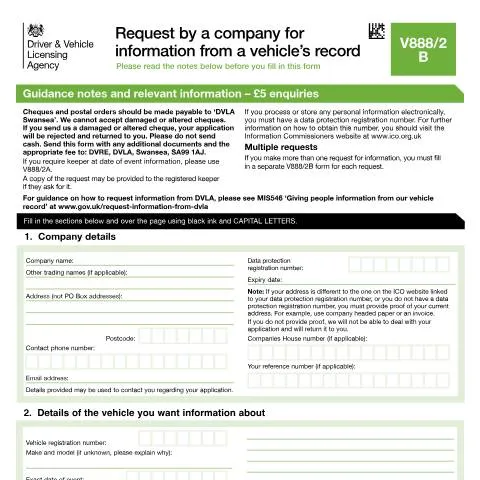
Corporate Vehicle Information Requests: Navigating DVLA's V888/2B Framework
When businesses encounter vehicle-related incidents, insurance claims, or legal proceedings, accessing accurate vehicle records becomes paramount. The Driver and Vehicle Licensing Agency's V888/2B form serves as the designated gateway for companies seeking specific information from vehicle records, distinct from individual enquiries handled through separate channels. This corporate-focused application process requires careful navigation of data protection requirements, precise documentation, and clear justification for information access.
Unlike standard vehicle enquiries, the V888/2B process acknowledges that businesses operate within complex regulatory frameworks where vehicle information supports legitimate commercial activities. From insurance investigations to bankruptcy proceedings, the form accommodates diverse corporate scenarios whilst maintaining strict safeguards around personal data access.
Who Can Submit Corporate Vehicle Information Requests
The V888/2B form exclusively serves companies and organisations with legitimate business reasons for accessing vehicle records. Individual members of the public cannot use this form – they must utilise the V888 series designed for personal enquiries.
Eligible applicants include:
- Insurance companies and loss adjusters investigating claims or suspected fraud
- Solicitors' firms requiring vehicle history for litigation purposes
- Liquidators and bankruptcy trustees with court-appointed authority
- Executors of estates dealing with deceased persons' vehicle assets
- Companies with county court judgments seeking enforcement information
Critically, all corporate applicants must hold a current data protection registration number issued by the Information Commissioner's Office (ICO). This requirement reflects the form's access to personal data within vehicle records. Companies processing personal information electronically must maintain valid registration – applications without valid ICO registration numbers face automatic rejection.
Data Protection Compliance Requirements
The ICO registration requirement extends beyond mere possession of a registration number. Companies must ensure their registration covers the specific type of data processing involved in vehicle record enquiries. The registration must remain current throughout the application process, with applicants required to provide both the registration number and expiry date on the form.
Where a company's registered address differs from the ICO records, additional verification becomes necessary. Applicants must provide proof of current address through company headed paper or recent invoices, ensuring DVLA can verify the requesting organisation's legitimacy.
Understanding the Six Request Categories
The V888/2B form structures requests into six distinct categories, each requiring specific supporting documentation and justification. Understanding these categories prevents misplaced applications and ensures appropriate information disclosure.
| Category | Primary Users | Key Requirements |
|---|---|---|
| Full/Partial History | Solicitors, insurers, loss adjusters | Incident details, fraud evidence if applicable |
| Bankruptcy/Liquidation | Licensed insolvency practitioners | Court appointment certificates |
| Judgment | Judgment creditors | Court-stamped judgment orders |
| Client Validation | Insurance companies | Client details, incident circumstances |
| Executor Requests | Estate representatives | Death certificates, probate documentation |
| Other Scenarios | Varied | Case-specific requirements |
Insurance and Legal Investigation Requests
Insurance companies and solicitors frequently require comprehensive vehicle histories when investigating claims or preparing litigation. These requests demand detailed incident descriptions, including precise locations with postcodes. For motorway incidents, applicants must specify the nearest junction, enabling DVLA to correlate records with specific events.
When fraud suspicions exist, applicants must provide substantial evidence supporting their concerns. DVLA scrutinises fraud-related requests carefully, requiring detailed explanations of suspicious circumstances and supporting documentation where available.
Insolvency and Estate Administration
Bankruptcy trustees and liquidators access vehicle records as part of asset recovery processes. These applications require court-issued appointment certificates, demonstrating legal authority to act on behalf of insolvent entities. Similarly, estate executors must provide death certificates alongside probate documentation or letters of administration.
These categories often involve complex ownership structures, particularly where vehicles form part of business assets or deceased estates with multiple beneficiaries. DVLA may request additional clarification where ownership structures appear unclear or disputed.
Application Submission and Processing Requirements
The V888/2B submission process demands attention to specific administrative requirements that, if overlooked, result in automatic rejection and return of applications. Understanding these requirements prevents costly delays and resubmission cycles.
Payment and Documentation Standards
All applications require a £5 fee accompanying the completed form. DVLA accepts cheques and postal orders made payable to 'DVLA Swansea' but explicitly prohibits cash payments. Damaged or altered cheques trigger automatic rejection – even minor alterations or unclear signatures can invalidate payment instruments.
Form completion must use black ink throughout, with all text in capital letters. This requirement ensures optical character recognition systems can process applications efficiently, reducing manual intervention and processing delays.
Applications require posting to: DVRE, DVLA, Swansea, SA99 1AJ. This dedicated processing address handles corporate information requests separately from standard vehicle licensing correspondence.
Multiple Request Protocols
Companies requiring information about several vehicles must submit separate V888/2B forms for each enquiry. DVLA cannot process multiple vehicle enquiries on single forms, even where the requesting company and circumstances remain identical across requests.
This requirement reflects data protection principles ensuring each information disclosure receives individual assessment. Companies planning multiple enquiries should budget accordingly, calculating both fees and administrative time for each separate application.
Critical Differences from Related DVLA Forms
The DVLA vehicle information request system includes several related forms that serve different purposes, and selecting the wrong form leads to rejection and delays. Understanding these distinctions ensures appropriate form selection from the outset.
The V888/2A form specifically handles requests for "keeper at date of event" information – a distinct requirement from the general vehicle information accessed through V888/2B. Companies needing historical keeper details at specific dates must use the 2A variant, whilst those requiring broader vehicle history information use the 2B form.
Standard V888 forms serve individual enquiries and cannot accommodate corporate requests requiring data protection registration numbers. Individuals attempting to use V888/2B face rejection, whilst companies using individual-focused forms encounter similar problems due to missing corporate verification requirements.
Information Scope and Limitations
V888/2B applications access vehicle records maintained by DVLA, but this information has specific limitations that applicants must understand. The system provides registration history, keeper changes, and vehicle details but cannot access information held by other agencies such as police collision records or insurance databases.
Companies requiring comprehensive incident information often need to coordinate V888/2B requests with separate enquiries to police forces, insurance databases, or court records. The DVLA information provides one component of broader investigative processes rather than complete incident documentation.
Processing Timescales and Response Management
DVLA processes V888/2B applications within standard administrative timescales, though specific processing times can vary depending on application complexity and supporting documentation quality. Companies should plan information requests well in advance of critical deadlines, particularly for legal proceedings with fixed court dates.
The agency may contact applicants for clarification or additional documentation where initial submissions appear incomplete or unclear. Providing comprehensive contact details including telephone numbers and email addresses facilitates efficient communication during processing.
Information Disclosure and Confidentiality
Successful applications result in DVLA providing requested vehicle information directly to the applying company. However, the agency maintains transparency with vehicle keepers by potentially sharing copies of information requests when keepers enquire about data access to their records.
This disclosure possibility reinforces the importance of accurate, justified applications. Companies must ensure their stated information use purposes remain legitimate and defensible, as vehicle keepers may challenge inappropriate or excessive information requests.
The declaration section of the V888/2B form creates legal obligations regarding information use and onward disclosure. Companies must restrict information use to stated purposes and cannot share obtained information with third parties without specific DVLA permission. Breaching these conditions constitutes criminal offences under data protection legislation, with penalties including substantial fines through magistrates' or crown court proceedings.
Handling Rejections and Application Issues
Understanding common rejection reasons enables companies to submit successful applications from the outset. DVLA rejection letters typically specify exact reasons for refusal, allowing targeted resubmission addressing identified deficiencies.
Frequent rejection triggers include expired or invalid ICO registration numbers, insufficient supporting documentation for specific request categories, and incomplete incident details for insurance investigations. Companies should verify all requirements before submission rather than relying on resubmission cycles to address deficiencies.
Where applications face rejection due to unclear or complex circumstances, companies may benefit from preliminary consultation with DVLA's information request guidance published as MIS546 on the gov.uk website. This guidance document provides detailed explanations of acceptable request scenarios and required supporting evidence.
Appeal and Escalation Procedures
Companies disagreeing with DVLA rejection decisions can challenge these through formal complaint procedures. However, successful appeals typically require demonstrating that applications met all published criteria and that rejections resulted from administrative error rather than legitimate policy application.
The Information Commissioner's Office provides additional recourse where companies believe DVLA has inappropriately restricted access to information covered by legitimate business interests. However, ICO involvement typically follows exhaustion of DVLA's internal complaint procedures rather than providing immediate alternative access routes.
Common Scenarios Where Companies Request Vehicle Information
Understanding when form V888/2B proves essential helps companies determine whether their circumstances warrant submitting this official request. Debt recovery operations represent one of the most frequent applications, where creditors need to trace vehicle ownership following unpaid finance agreements or outstanding judgements. When a debtor defaults on vehicle finance, the creditor company must establish current registered keeper details to initiate recovery proceedings or repossession actions.
Insurance claim investigations constitute another primary use case, particularly where hit-and-run incidents or disputed liability claims require verification of vehicle ownership at specific dates. Insurance companies may need historical keeper information to establish patterns of ownership transfer that could indicate potential fraud or to verify policy holder declarations about vehicle acquisition dates.
Commercial fleet management companies frequently utilise V888/2B when conducting due diligence on vehicles being considered for lease or purchase arrangements. This includes verifying that the seller legitimately owns the vehicle and checking for any outstanding finance agreements that could complicate the transaction. Fleet operators also use this information when investigating incidents involving their managed vehicles where third-party claims arise.
Parking enforcement companies operating under contractual arrangements with private landowners regularly submit V888/2B requests to identify vehicle keepers for penalty charge notice processing. However, these companies must demonstrate they hold proper authority from the land owner and that their enforcement activities comply with British Parking Association codes of practice or equivalent industry standards.
Legal firms representing clients in civil litigation often require vehicle ownership verification to serve court documents or to identify defendants in road traffic accident claims. The firm must clearly establish the connection between their legal proceedings and the specific vehicle information requested, demonstrating legitimate interest rather than speculative enquiry.
Manufacturing companies occasionally need V888/2B data when conducting product recall campaigns, particularly for vehicles fitted with potentially defective components. The request must specify the safety-related nature of the enquiry and demonstrate that the company has legitimate responsibility for the component or system in question.
Detailed Application Process and Required Documentation
The V888/2B application process demands meticulous attention to documentary evidence and procedural requirements. Companies must first establish their legal standing to request the information by providing comprehensive business registration documentation. This includes the certificate of incorporation, recent Companies House filing confirmations, and evidence of trading activities relevant to the request purpose.
Authorisation documentation varies significantly depending on the request circumstances. Debt recovery companies must provide copies of the original credit agreement, default notices served, and court judgements obtained where applicable. Insurance companies need policy documentation, claim reference numbers, and evidence of their legitimate interest in the specific vehicle incident or claim.
For parking enforcement requests, companies must supply land owner authority documentation, including signed contracts or formal appointments demonstrating their legitimate right to enforce parking restrictions on the specified property. The documentation must clearly identify the vehicle registration number, the date and location of the alleged parking contravention, and photographic evidence where available.
Legal representative applications require additional authentication, including Law Society registration confirmation for solicitors or equivalent professional body membership for other legal practitioners. The application must specify the court case reference number where proceedings have commenced, or provide detailed explanation of the intended legal action where proceedings are contemplated.
The DVLA scrutinises data protection compliance documentation particularly carefully, requiring companies to demonstrate appropriate technical and organisational measures for protecting personal data received. This includes privacy policies, staff training records on data handling, and evidence of data retention and disposal procedures that comply with UK GDPR requirements.
Payment processing for V888/2B applications typically requires advance settlement, though the DVLA may establish credit accounts for organisations submitting regular requests. Companies must budget for potential additional costs where multiple vehicle enquiries relate to the same underlying matter, as each vehicle registration requires a separate application and fee payment.
Processing timelines vary considerably depending on application complexity and the DVLA's current workload. Standard applications typically receive responses within 10 working days, though complex requests requiring additional verification may extend to several weeks. Companies should factor these timelines into their operational planning, particularly where urgent legal deadlines or enforcement actions depend on receiving the vehicle information.
Legal Compliance Framework and Data Protection Obligations
Companies receiving vehicle information through V888/2B applications operate under strict legal frameworks that extend far beyond the initial request approval. The Data Protection Act 2018 and UK GDPR impose comprehensive obligations on how companies process, store, and ultimately dispose of personal data obtained from DVLA records.
Lawful basis establishment requires companies to identify specific legal grounds justifying their data processing activities. Debt recovery operations typically rely on legitimate interests provisions, though they must demonstrate that their interests override the data subject's privacy rights. Insurance companies often process data for contract performance purposes where policy holders have agreed to claim investigation procedures, though legitimate interests may apply for third-party vehicle enquiries.
Data minimisation principles demand that companies request only information directly relevant to their stated purpose. The DVLA may reject applications where the requested data scope appears excessive relative to the declared business need. Companies must clearly articulate why specific data elements prove necessary for their legitimate business activities rather than submitting broad-brush requests for comprehensive vehicle histories.
Retention period limitations vary according to the underlying business purpose and applicable sector regulations. Debt recovery companies typically retain data until the debt resolution concludes, including any subsequent legal proceedings, though they must regularly review necessity for continued retention. Insurance companies may retain claim-related data for extended periods to defend against potential future litigation, but must establish clear retention schedules aligned with their business needs and regulatory requirements.
Third-party sharing restrictions significantly limit companies' ability to disclose received vehicle information to other organisations or individuals. Companies must obtain explicit consent for any sharing beyond their immediate business purpose, except where legal obligations or court orders mandate disclosure. This includes restrictions on sharing information with subsidiary companies or business partners unless clearly justified within the original request purpose.
Individual rights compliance requires companies to establish procedures for handling data subject requests regarding their vehicle information. This includes subject access requests, rectification demands where data appears inaccurate, and erasure requests where the retention period expires or the processing purpose concludes. Companies must respond to such requests within statutory timelines while verifying the requester's identity and entitlement to the information.
Security measure implementation must reflect the sensitive nature of vehicle ownership data and potential risks from unauthorised access or disclosure. Companies should implement role-based access controls, encryption for data transmission and storage, and comprehensive audit trails documenting all access to and use of DVLA-provided information. Regular security assessments help ensure continued compliance with evolving cyber security threats and regulatory expectations.
Breach notification obligations apply where vehicle data security incidents occur, requiring companies to assess risks to individual privacy rights and report significant breaches to the Information Commissioner's Office within 72 hours where feasible. Companies must also notify affected individuals where high privacy risks arise from the security incident.