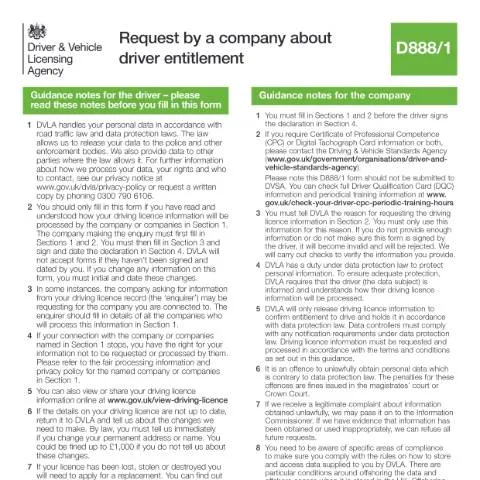
When Employers Need to Check: The Corporate Gateway to Driver Records
Every day across the UK, thousands of companies face a critical decision: can they trust their employees behind the wheel? Whether it's a delivery driver navigating London's congested streets, a sales representative covering the Scottish Highlands, or a care worker making home visits in rural Wales, employers increasingly need concrete evidence of their staff's driving credentials. The D888/1 form represents the official channel through which businesses can access driver entitlement information directly from the Driver and Vehicle Licensing Agency.
This corporate inquiry system addresses a fundamental workplace challenge. Unlike personal driving licence checks that individuals can perform online, employers require a formal mechanism to verify their workforce's driving qualifications. The D888/1 bridges this gap, providing companies with legitimate access to DVLA records while maintaining strict data protection standards.
The Corporate Landscape: Which Businesses Deploy This Process
The range of organisations utilising form D888/1 spans virtually every sector of the UK economy. Transport and logistics companies represent the most obvious users, from international freight operators to local courier services. These businesses face direct liability if an unqualified driver causes an accident whilst operating company vehicles.
Insurance companies deploy this form extensively when assessing risk profiles for fleet policies. A single driver with undisclosed convictions can invalidate entire corporate insurance arrangements, making thorough verification essential. Similarly, car rental agencies use the process to verify customer entitlements, particularly for commercial vehicle rentals where standard driving licences may prove insufficient.
Healthcare organisations present another significant user category. NHS trusts, private care providers, and domiciliary care agencies must ensure their mobile workforce maintains valid driving credentials. A district nurse or care worker losing their licence can disrupt service delivery across entire geographical areas.
The financial sector increasingly recognises driving record verification as a component of employee vetting. Banks and building societies with mobile banking units or cash collection services require absolute certainty about their drivers' qualifications. Even seemingly office-based roles may involve occasional driving, making verification prudent risk management.
Specialist Sectors with Enhanced Requirements
Certain industries face additional complexity when using form D888/1. Companies requiring Certificate of Professional Competence (CPC) or Digital Tachograph Card information must specifically request these details, as standard driving licence checks won't reveal professional driving qualifications. The form's guidance notes direct such enquiries to the Driver and Vehicle Standards Agency for comprehensive verification.
Educational institutions employing minibus drivers, construction companies with on-site vehicle operators, and emergency services all represent sectors where driving record verification carries heightened importance due to public safety implications.
The Three-Way Process: Company, Employee, and DVLA Interaction
Form D888/1 operates through a carefully orchestrated three-party process designed to balance employer needs with individual privacy rights. The system requires active participation from all parties, preventing unauthorised access to personal driving data.
| Stage | Responsible Party | Key Actions | Critical Requirements |
|---|---|---|---|
| 1. Initiation | Company | Complete Sections 1 and 2 | Data protection registration number, clear justification for enquiry |
| 2. Consent | Driver/Employee | Complete Section 3, sign declaration | Full personal details, current address, understanding of data sharing |
| 3. Processing | DVLA | Verify information, release relevant data | £5 fee payment, valid signatures on all sections |
This staged approach ensures compliance with Data Protection Act 2018 requirements while providing employers with necessary verification. The driver's signature in Section 4 represents more than simple consent—it acknowledges that their driving information will be shared and commits them to notify DVLA of any subsequent changes to their circumstances.
The Corporate Declaration Requirements
Section 1 demands comprehensive corporate identification beyond simple business names. Companies must provide their data protection registration number, and those claiming exemption must justify their position. This requirement reflects DVLA's obligation to ensure only legitimate data controllers access personal driving information.
The "reason for enquiry" section requires specific justification rather than generic statements. Responses like "employment verification" or "insurance purposes" provide insufficient detail. DVLA expects explanations such as "verification of HGV entitlement for warehouse operative position involving forklift operation" or "assessment of penalty points for corporate insurance renewal affecting 15-vehicle fleet".
Critical Timing and the Three-Month Rule
One of form D888/1's most significant features involves its temporal limitations, specifically the three-month expiry provision embedded within the driver's declaration. This clause states that the authorisation expires when the driver ceases employment with the requesting company or three months from signature, whichever occurs first.
This timing constraint creates both opportunities and challenges for employers. Companies conducting recruitment drives can gather multiple D888/1 forms simultaneously, but must ensure processing occurs within the three-month window. For seasonal businesses or those with extended recruitment processes, this limitation may necessitate multiple form submissions.
The three-month rule also impacts ongoing employment relationships. Employers cannot use a single D888/1 form for repeated enquiries throughout an employee's tenure. Each verification request requires a fresh form with current signatures, ensuring continued consent for data sharing.
Processing Timescales and Payment Requirements
DVLA charges £5 per enquiry, payable by cheque or postal order made out to "DVLA Swansea". This fee structure reflects the administrative costs of manual verification processes, as D888/1 requests cannot be processed through automated systems.
Payment must accompany each submission to the DACT Team in Swansea. The requirement for traditional payment methods (no card payments accepted) can create administrative burden for companies accustomed to electronic transactions, necessitating cheque-writing facilities or postal order procurement.
Data Protection Implications and Offshore Considerations
Form D888/1 operates within a complex data protection framework that extends beyond UK borders. The form specifically addresses offshore data processing, requiring companies to declare whether they intend transferring driver information outside the UK. This provision reflects post-Brexit data sovereignty concerns and GDPR compliance requirements.
Companies planning offshore data transfer must provide additional justification and demonstrate adequate data protection measures in destination countries. This requirement particularly affects multinational corporations with centralised HR systems or those using overseas data processing services.
The form's data protection guidance emphasises that drivers retain rights regarding their personal information even after consenting to employer access. Employees can request details of how their data will be processed and stored, and companies must comply with subject access requests under UK GDPR provisions.
Compliance Obligations for Data Controllers
Companies receiving driver information through D888/1 submissions assume full data controller responsibilities. This includes implementing appropriate technical and organisational measures to protect the information, limiting access to authorised personnel, and ensuring secure storage and eventual deletion.
DVLA's guidance notes warn that unlawful obtaining of personal data constitutes a criminal offence, with potential fines issued by magistrates' courts or the Crown Court. Companies must therefore ensure their D888/1 usage aligns with legitimate business purposes and complies with data minimisation principles.
Navigating Complex Employment Scenarios
The D888/1 process encounters particular complexity in non-standard employment arrangements. Agency workers, contractors, and temporary staff present challenges regarding which entity should submit the form and assume data controller responsibilities.
For agency workers, the employing agency typically submits the D888/1, as they hold the direct employment relationship and face primary liability for the worker's actions. However, client companies may also require verification, potentially necessitating multiple form submissions for the same individual.
Consultants and freelance contractors operating through personal service companies create additional complexity. The engaging organisation may lack sufficient relationship depth to justify D888/1 submission, while the contractor's own company may not require such verification for self-employed individuals.
International Drivers and Licence Recognition
Form D888/1 applies specifically to UK driving licences issued by DVLA. Companies employing drivers with European Union licences or international permits cannot use this process for verification. Such cases require alternative verification methods, potentially including direct contact with issuing authorities or reliance on physical licence examination.
Brexit implications further complicate EU licence verification. Companies must understand which EU licences remain valid for UK driving and for how long, as these timeframes affect the relevance of D888/1 verification for employees transitioning between licence systems.
When Verification Reveals Concerning Information
The D888/1 process occasionally uncovers information that creates employment dilemmas. Discovering undisclosed penalty points, driving ban periods, or licence category restrictions can fundamentally alter employment relationships, particularly where driving represents a core job requirement.
Companies must navigate these discoveries carefully, considering both employment law obligations and duty of care responsibilities. Immediate suspension pending investigation may prove necessary where serious driving offences emerge, while minor infractions might warrant performance management approaches rather than disciplinary action.
The form's guidance emphasises that drivers should disclose relevant information proactively rather than waiting for employer verification. However, many employees remain unaware of minor penalty points or fail to understand their employment implications, creating genuine cases of inadvertent non-disclosure rather than deliberate deception.
Insurance and Liability Considerations
Information obtained through D888/1 submissions directly impacts corporate insurance arrangements. Insurers increasingly require comprehensive driver verification as a policy condition, making the form's results potentially determinative of coverage validity.
Companies discovering previously unknown driving convictions must notify their insurers immediately, as failure to disclose material information can void entire policies. This requirement creates urgency around D888/1 processing, particularly for businesses with immediate driving requirements or upcoming insurance renewals.
The £5 processing fee represents minimal cost compared to potential insurance implications, making systematic D888/1 usage a prudent risk management investment for any organisation with driving employees.
Understanding the Legal Framework Behind Employer Driver Checks
The D888/1 form operates within a complex web of UK legislation that balances employer rights, employee privacy, and road safety considerations. The primary legal foundation stems from the Road Traffic Act 1988 and subsequent amendments, which establish the framework for driving licence administration and the circumstances under which information may be disclosed.
Under the Data Protection Act 2018 and UK GDPR, the DVLA must ensure that any disclosure of personal data serves a legitimate interest whilst respecting individual privacy rights. For employers, this creates a specific pathway: they can only request driver entitlement information where they have a genuine business need, typically related to roles involving company vehicles, delivery services, or positions where driving forms part of the job description.
The legal basis for processing extends beyond simple employment verification. Employers in certain sectors face additional regulatory requirements that necessitate ongoing monitoring of driver entitlements. Transport operators holding Operator's Licences under the Goods Vehicles (Licensing of Operators) Act 1995 have explicit obligations to maintain awareness of their drivers' licensing status. Similarly, companies providing services to local authorities or government departments may find driver verification requirements embedded within their contractual obligations.
Crucially, the consent mechanism built into the D888/1 process reflects the legal requirement for explicit, informed agreement from the data subject. The employee's signature on the form constitutes more than administrative procedure—it represents their understanding that their licensing information will be disclosed to their employer and acknowledgement of how this data will be used within the employment relationship.
Recent case law has reinforced that employers cannot use blanket policies requiring all staff to consent to driver checks unless driving genuinely relates to their role. This proportionality principle means that office-based employees with no driving responsibilities cannot typically be compelled to complete D888/1 forms, even if the employer's business involves significant transport operations.
Sector-Specific Applications and Industry Requirements
Different industries utilise the D888/1 form to meet varying regulatory and operational needs, each bringing unique considerations and compliance requirements. The transport and logistics sector represents the most obvious application, but the form's utility extends far beyond traditional haulage companies.
In the construction industry, employers frequently require D888/1 checks for operatives who drive company vehicles to multiple sites or operate mobile plant equipment. Site managers, quantity surveyors, and trades personnel often need clean driving records not just for insurance purposes, but to meet principal contractor requirements on major projects. Many construction companies implement ongoing monitoring programmes, submitting D888/1 forms annually to ensure continued compliance with site access requirements.
Healthcare organisations present another significant user category, particularly NHS trusts and private healthcare providers whose staff make community visits. District nurses, health visitors, occupational therapists, and social workers regularly drive between appointments, often carrying valuable medical equipment or accessing vulnerable patients' homes. The duty of care obligations in healthcare create heightened scrutiny around driver fitness, making regular D888/1 monitoring essential for risk management.
The financial services sector increasingly relies on D888/1 checks, especially for roles involving cash collection, ATM maintenance, or client visits. Insurance companies use the process both for their own staff and as part of underwriting assessments for commercial vehicle policies. Some insurers require quarterly D888/1 submissions for high-risk driver categories or fleets exceeding certain size thresholds.
Emergency services and security companies face particularly stringent requirements, often needing immediate notification of any changes to driver entitlements. Private security firms providing services to airports, nuclear facilities, or government sites may find D888/1 monitoring mandated within their security clearance protocols. The form becomes part of ongoing vetting processes rather than simple pre-employment screening.
Retail chains with delivery operations have increasingly adopted D888/1 procedures, particularly following the growth in online shopping and last-mile delivery services. Even employees who occasionally cover delivery routes may need verification, creating administrative challenges for HR departments managing mixed-role workforces.
Administrative Challenges and Best Practice Implementation
Successfully implementing D888/1 procedures requires careful attention to administrative detail and robust systems to manage the ongoing relationship between employers, employees, and the DVLA. Many organisations underestimate the administrative burden involved in maintaining compliant driver monitoring programmes.
Data security represents a primary concern throughout the D888/1 process. The information disclosed by DVLA contains sensitive personal data that must be handled according to strict data protection principles. Employers must establish secure storage systems, limit access to authorised personnel, and implement clear retention schedules. Many organisations struggle with the balance between accessibility for legitimate business purposes and maintaining appropriate security controls.
The timing of submissions requires strategic planning, particularly for large organisations with multiple drivers. DVLA processing times can vary, and employers must factor in potential delays when planning driver deployments or recruitment timescales. Some companies stagger their submission schedules to avoid overwhelming their administrative systems with responses arriving simultaneously.
Record-keeping obligations extend beyond simply filing DVLA responses. Employers must maintain audit trails showing when checks were requested, employee consent obtained, and how disclosed information was used in employment decisions. This documentation becomes crucial if employment disputes arise or regulatory inspections occur.
Training requirements for staff handling D888/1 processes often prove more extensive than initially anticipated. HR personnel must understand not only the practical completion procedures but also the legal implications of the information received. They need clear guidance on interpreting penalty point disclosures, understanding disqualification periods, and making proportionate employment decisions based on driving record information.
Integration with existing HR systems presents ongoing challenges for many organisations. The D888/1 process operates outside standard employment screening procedures, requiring separate workflows and decision-making protocols. Some companies develop bespoke tracking systems to monitor submission dates, renewal requirements, and employee compliance status.
Cost management becomes significant for organisations with large driver populations. While individual D888/1 submissions incur modest fees, annual monitoring programmes for hundreds of employees represent substantial ongoing expenditure. Budget planning must account not only for DVLA fees but also internal administrative costs and potential system development expenses.
Communication strategies with employees require careful consideration to maintain positive relationships while ensuring compliance. Staff may feel uncomfortable about ongoing monitoring of their driving records, particularly if their roles only occasionally involve driving. Clear explanation of the business rationale, legal requirements, and data protection measures helps maintain trust while ensuring continued cooperation with monitoring programmes.