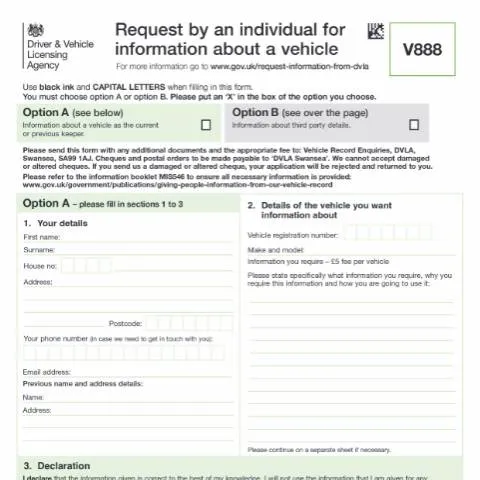
Accessing Vehicle Records: When Data Matters More Than Ownership
Whether you've purchased a second-hand car with suspicious history, witnessed a hit-and-run incident, or need to trace a vehicle that's been persistently parking on your property, form V888 serves as your gateway to DVLA-held vehicle information. This official request mechanism bridges the gap between legitimate public interest and data protection requirements, offering two distinct pathways depending on whether you're seeking information as a current or former keeper, or requesting details about third-party vehicles.
The V888 process operates under strict regulatory frameworks, balancing transparency with privacy protection. Unlike straightforward vehicle registration queries, this form requires detailed justification and supporting evidence, making it essential to understand both the scope of available information and the specific requirements for each type of request.
Two Pathways: Current Keepers Versus Third-Party Enquiries
Form V888 presents two fundamentally different options, each with distinct requirements and fee structures. Option A caters to individuals seeking information about vehicles they currently keep or have previously registered in their name. This pathway typically involves straightforward identity verification and costs £5 per vehicle enquiry.
Option B addresses third-party enquiries, where the applicant seeks information about vehicles they neither own nor keep. This route demands comprehensive justification and supporting documentation, with fees varying according to the specific type of information requested. The distinction matters significantly—choosing the wrong option can result in application rejection and fee forfeiture.
| Enquiry Type | Fee Structure | Key Requirements | Processing Considerations |
|---|---|---|---|
| Option A (Current/Former Keeper) | £5 per vehicle | Identity verification, previous address details if applicable | Generally straightforward processing |
| Option B (Third Party - Incident) | £2.50 per vehicle | Incident documentation, photographs, repair estimates | Requires substantial evidence |
| Option B (Persistent Parking) | £2.50 per vehicle | Photographic evidence, property connection proof | Must demonstrate repeated occurrences |
| Option B (Executor Enquiry) | £5 per vehicle | Death certificate, probate documentation | Legal authority verification essential |
Incident-Related Requests: Building Your Evidence Portfolio
When pursuing information following a road traffic incident, the strength of your supporting documentation determines application success. The DVLA requires comprehensive evidence demonstrating both the incident's occurrence and your legitimate interest in obtaining vehicle details.
Essential documentation includes photographs showing vehicle damage or property impact, copies of repair estimates or invoices, and detailed incident descriptions specifying exact locations and circumstances. For hit-and-run scenarios, police incident reference numbers significantly strengthen applications, though they're not always mandatory if other evidence sufficiently establishes the incident's credibility.
The form specifically requests vehicle registration numbers and incident dates, but partial information doesn't automatically disqualify applications. If you've noted only partial registration details or approximate timeframes, include this information alongside explanations of visibility or memory constraints. The DVLA may still process requests where reasonable attempts at accuracy are evident.
Multi-Vehicle Incidents
Complex incidents involving multiple vehicles require separate fee payments for each registration enquiry. However, you can submit a single V888 form covering multiple vehicles, provided you clearly differentiate between vehicles and supply distinct supporting evidence for each registration number requested.
Persistent Parking Disputes: Establishing Pattern and Property Rights
Persistent parking enquiries demand evidence of repeated unauthorised parking rather than isolated incidents. The DVLA expects applicants to demonstrate both the pattern of behaviour and their legitimate connection to the affected property.
Photographic evidence should span multiple dates, clearly showing registration numbers and the vehicle's position relative to your property boundaries. Include timestamps where possible, and supplement photographs with written logs detailing dates, times, and any attempts to contact the vehicle owner directly.
Property connection proof varies according to your relationship with the affected land. Property owners should include recent council tax bills or mortgage statements, while tenants need tenancy agreements or rental receipts. Business premises require commercial property documentation or utility bills demonstrating occupancy rights.
Private Land Versus Public Highway
The DVLA distinguishes between parking issues on private property and public highway disputes. Private land parking typically receives more straightforward processing, while public highway complaints may require additional justification explaining why standard traffic enforcement mechanisms haven't resolved the issue.
Executor and Estate Administration Enquiries
Following a death, vehicle information requests require specific legal documentation establishing your authority to act on behalf of the deceased's estate. The DVLA accepts applications from appointed executors, administrators, and next of kin with appropriate legal standing.
Required documentation includes certified copies of death certificates and either grant of probate or letters of administration. Where formal probate hasn't been obtained, next of kin may submit statutory declarations alongside birth certificates or marriage certificates establishing their relationship to the deceased.
Estate-related enquiries often involve multiple vehicles, particularly for deceased individuals who operated businesses or collected vehicles. The £5 per vehicle fee applies regardless of the number of vehicles registered to the deceased, making comprehensive estate vehicle audits potentially costly.
Timing Considerations for Estate Enquiries
Vehicle information becomes particularly crucial during estate administration, as undisclosed vehicles can significantly impact inheritance calculations and tax obligations. However, the DVLA cannot provide information until proper legal authority documentation is submitted, potentially creating delays in estate settlement processes.
Court Proceedings and Legal Enforcement Applications
Legal proceedings involving vehicles often require DVLA-held information for defendant identification or asset tracing. Form V888 accommodates these requirements through specific provisions for court judgment documentation and legal enforcement activities.
Applications based on court judgments require stamped court documents clearly identifying the vehicles in question and establishing your legal interest in obtaining owner information. The DVLA particularly scrutinises these applications to ensure compliance with data protection obligations and legitimate legal process requirements.
Civil enforcement agents and debt recovery professionals frequently use V888 for asset location purposes. However, applications must demonstrate clear legal authority, typically through court orders or statutory powers, rather than general commercial debt collection activities.
Administrative Processing and Response Timeframes
DVLA processing times for V888 applications vary significantly depending on the complexity and completeness of submitted documentation. Straightforward Option A requests typically receive responses within 10-15 working days, while Option B enquiries involving extensive documentation review may require 4-6 weeks.
Incomplete applications face rejection and fee forfeiture, making thorough preparation essential. The DVLA doesn't provide partial refunds for applications missing required documentation, even if some elements meet requirements. This particularly affects multi-vehicle enquiries where individual vehicle requests within the same application may have varying documentation standards.
Payment methods are restricted to cheques and postal orders made payable to 'DVLA Swansea'. The agency explicitly refuses damaged or altered payment instruments, and applications accompanied by inappropriate payment methods face automatic rejection.
Information Disclosure Scope
Successful V888 applications receive information limited to registered keeper details at the time of registration, rather than comprehensive vehicle histories or current owner status. The DVLA doesn't disclose personal financial information, insurance details, or enforcement action records through this process.
For ongoing investigations or legal proceedings requiring more comprehensive vehicle information, alternative processes through law enforcement agencies or court-ordered disclosure may prove more appropriate than V888 applications.
Data Protection Compliance and Declaration Requirements
Every V888 application includes mandatory declarations confirming information accuracy and appropriate use intentions. These declarations carry legal weight under data protection legislation, with false statements potentially constituting criminal offences.
The declaration specifically prohibits using obtained information for purposes beyond those stated in the application, with particular emphasis on preventing commercial exploitation or harassment activities. Applicants must acknowledge their legal obligations regarding information handling and disposal once their legitimate purposes are fulfilled.
Information retention by applicants should align with data protection principles, meaning personal details should be destroyed once the stated purpose is achieved. The DVLA may audit information usage in cases of suspected misuse, making proper record-keeping and disposal practices essential for compliance.
Recent updates to data protection frameworks have strengthened individual rights regarding personal information disclosure, potentially affecting V888 processing where data subjects raise objections to information release. While legitimate interests may override such objections, the DVLA increasingly scrutinises applications to ensure proportionate responses to genuine requirements rather than speculative enquiries.
Specific Scenarios and Eligibility Criteria for V888 Applications
The V888 form accommodates various legitimate circumstances where individuals require vehicle information, though each scenario carries distinct requirements and limitations. Understanding your specific situation helps ensure your application meets DVLA's stringent criteria and avoids unnecessary delays or rejections.
Legal proceedings represent one of the most common grounds for V888 requests. If you're involved in civil litigation following a road traffic accident, you'll need to provide comprehensive documentation including your solicitor's letterhead confirmation, case reference numbers, and a clear explanation of how the vehicle information relates to your claim. The DVLA scrutinises these applications particularly carefully, as they must balance transparency with data protection obligations under UK GDPR.
Insurance-related enquiries form another substantial category. Following an accident where the other party's insurance details remain unclear, you may request keeper information to pursue a claim. However, you cannot use V888 simply to verify insurance status – this requires demonstrating a direct financial interest or legal obligation. Motor insurers themselves cannot use V888 on behalf of policyholders; the affected individual must make the request personally.
Parking enforcement scenarios present unique challenges. If your vehicle was damaged on private property and you need to identify the responsible party's vehicle, V888 may be appropriate. However, parking companies and private landowners cannot use this form to pursue parking charges – they must follow separate enforcement procedures under the Protection of Freedoms Act 2012.
Commercial disputes involving delivery vehicles or contractor vehicles may justify V888 applications, provided you can demonstrate direct financial loss or property damage. The key criterion remains establishing a clear, legitimate interest that outweighs the registered keeper's privacy rights.
Vulnerable road users, including cyclists and pedestrians, often face particular challenges gathering evidence after traffic incidents. The DVLA recognises these difficulties but still requires the same evidential standards. Police incident numbers, witness statements, or hospital records can strengthen applications where formal police reports weren't filed.
Documentation Requirements and Supporting Evidence
Success with V888 applications hinges on providing compelling, relevant documentation that satisfies the DVLA's assessment criteria. The quality and comprehensiveness of your supporting evidence often determines whether your request receives approval or faces rejection.
Photographic evidence carries significant weight in most applications. Clear images showing vehicle registration numbers, damage patterns, and incident locations help establish the factual basis for your request. However, photographs alone rarely suffice – they must be accompanied by contextual documentation explaining the circumstances and your legitimate interest in obtaining keeper details.
Police documentation varies considerably in availability and detail. A formal police report (usually referenced by a CAD number or incident reference) provides strong support for V888 applications. However, many minor traffic incidents don't warrant police attendance, leaving applicants to compile alternative evidence. In such cases, witness statements become crucial – these should include contact details and be signed and dated.
Medical evidence may be relevant where personal injury claims underpin your V888 request. Hospital attendance records, GP notes, or physiotherapy referrals can demonstrate the impact of an incident, though you should redact sensitive medical details unrelated to the traffic incident itself.
Financial documentation proves particularly important for property damage claims. Repair estimates, insurance correspondence, or receipts for emergency repairs help establish the monetary value of your claim and demonstrate genuine financial interest. The DVLA expects proportionality – minor damage claims may not justify releasing personal data.
Legal correspondence adds weight to applications, though it's not mandatory. Solicitors' letters, insurance company acknowledgements, or court documents referencing the incident provide independent verification of your claim's legitimacy. However, the DVLA won't accept generic template letters or documents that appear manufactured solely for the V888 application.
Timeline documentation becomes critical when significant delays occur between incidents and V888 applications. The DVLA may question why you waited months to request keeper details, so diary entries, insurance claim timelines, or correspondence showing ongoing attempts to resolve matters informally can explain legitimate delays.
Third-party statements from independent witnesses, security personnel, or property owners can corroborate your version of events. These should be detailed, specific, and include the witness's relationship to the incident – casual acquaintances carry less weight than independent business owners or security professionals.
Data Protection Implications and Applicant Responsibilities
V888 applications operate within a complex data protection framework that places significant responsibilities on both the DVLA and successful applicants. Understanding these obligations helps ensure compliant use of any information received and protects against potential legal challenges.
The Data Protection Act 2018 and UK GDPR establish strict principles governing personal data processing. When the DVLA releases keeper information via V888, they're transferring personal data to you as a data controller. This transition carries legal obligations that extend far beyond simply receiving the information – you become responsible for ensuring its lawful, fair, and transparent use.
Purpose limitation represents a fundamental principle you must observe. Information obtained through V888 can only be used for the specific purpose outlined in your application. If you requested details to pursue an insurance claim, you cannot subsequently use that information for debt recovery, private investigation, or any unrelated purpose. Misuse could result in enforcement action by the Information Commissioner's Office.
Data retention obligations require careful consideration. You cannot retain keeper information indefinitely – it should be deleted once your legitimate purpose concludes. For legal proceedings, this typically means disposal after final court resolution or settlement. Insurance claims may require longer retention to accommodate potential future disputes, but indefinite storage without justification breaches data protection principles.
Disclosure to third parties requires explicit consideration. Sharing V888-obtained information with solicitors, insurers, or expert witnesses may be necessary and lawful, but casual disclosure to friends, family, or social media platforms almost certainly breaches your data protection obligations. Each disclosure should be assessed against the original purpose and proportionality principles.
Security measures become your responsibility once you receive keeper information. This includes secure storage (whether physical or electronic), access controls, and protection against unauthorised disclosure. Simple measures like password-protecting documents or storing papers in locked drawers demonstrate compliance with security obligations.
Individual rights of the registered keeper continue even after information disclosure. They retain rights to access information about your processing, request corrections if data proves inaccurate, and in some circumstances, demand erasure. You should be prepared to respond to such requests and maintain records of how you've processed their information.
Transparency obligations may require you to inform the registered keeper about your data processing activities, depending on circumstances. While this isn't always practical (particularly in contentious situations), you should consider whether direct contact might satisfy both legal obligations and practical resolution of disputes.
Accountability requirements mean maintaining records of your data processing decisions and demonstrating compliance with protection principles. This includes documenting retention periods, security measures, and any third-party disclosures. Such records prove invaluable if questions arise about your data handling practices.