The Gateway to Legal Status: Understanding Part 1 Vessel Registration
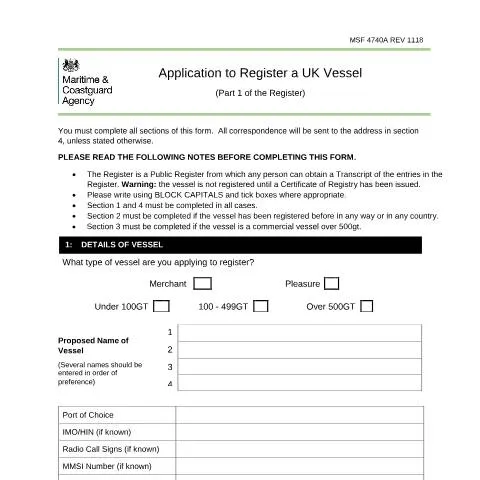
When a vessel owner receives their Certificate of Registry from the Maritime and Coastguard Agency, they hold more than just an official document—they possess legal proof of their vessel's British identity. Yet this crucial milestone begins with form MSF 4740A, the application that transforms an unregistered craft into a legitimate part of the UK fleet. The distinction between merchant and pleasure vessels shapes every aspect of this process, from documentation requirements to survey obligations, creating pathways that diverge significantly based on your vessel's intended purpose.
The Part 1 register represents the principal register for UK vessels, distinguished from the simpler Part 3 register by its comprehensive legal protections and international recognition. This registration confers the right to fly the Red Ensign, establishes legal ownership recognised in courts worldwide, and enables commercial operations under British maritime law. However, the application process demands precision—incomplete submissions routinely face rejection, delaying registration by weeks or months.
Merchant Versus Pleasure: Two Distinct Registration Pathways
The fundamental choice between merchant and pleasure vessel registration determines not only your documentation burden but also your ongoing regulatory obligations. Merchant vessels, regardless of size, enter a framework of commercial maritime law with associated safety requirements, crew certification standards, and operational restrictions. Pleasure craft, by contrast, face lighter regulatory touch provided they remain genuinely recreational in use.
This distinction carries practical consequences beyond the initial application. Merchant vessels require commercial insurance meeting specific standards, must comply with Maritime Labour Convention requirements for crew welfare, and face periodic safety inspections. Pleasure vessels registered on Part 1 gain prestige and enhanced legal protection but avoid the commercial regulatory framework—unless they subsequently engage in trade or charter activities.
Tonnage Categories and Their Implications
The form's tonnage categories—under 100GT, 100-499GT, and over 500GT—trigger different procedural requirements and ongoing obligations. Vessels over 500GT entering merchant service must complete section 3, providing details of classification societies and International Safety Management compliance. This reflects their integration into the international shipping framework governed by IMO conventions.
| Tonnage Range | Survey Requirements | Documentation Level | Ongoing Obligations |
|---|---|---|---|
| Under 100GT | Basic tonnage survey | Standard builder's certificate | Minimal reporting |
| 100-499GT | Full measurement survey | Enhanced documentation | Periodic safety checks |
| Over 500GT (Commercial) | Classification survey | ISM certification required | Full commercial compliance |
Navigating Previous Registration Complications
Section 2's requirement for previous registration details often proves more complex than applicants anticipate. Vessels with EU registration history face particular scrutiny following Brexit, with the Registry of Shipping and Seamen requiring evidence of proper deregistration from previous flags. Outstanding mortgages on foreign registers can block UK registration entirely until resolved, creating unexpected delays for purchasers of second-hand vessels.
The distinction between UK, EU/EEA, and elsewhere registration categories reflects different evidentiary standards. Former UK registered vessels may have their previous Official Numbers reinstated, while EU vessels require formal closure certificates from their previous flag state. Vessels from non-EU jurisdictions often face the most stringent documentation requirements, particularly regarding proof of deletion from previous registers.
The Outstanding Mortgage Trap
The simple yes/no question about outstanding registered mortgages conceals significant complexity. Maritime mortgages registered on foreign flags often survive vessel sales, creating legal clouds that prevent clean UK registration. Purchasers discovering mortgage issues post-completion face difficult choices: pursuing sellers for resolution, accepting delayed registration, or potentially losing their investment if mortgagees exercise their rights.
Professional vessel purchasers increasingly conduct mortgage searches on previous registers before completion, but private buyers often overlook this crucial step. The Registry cannot register vessels with unresolved mortgage complications, regardless of the applicant's good faith purchase.
The Critical Survey and Measurement Process
Every Part 1 registration requires a survey for tonnage and measurement, yet this requirement catches many applicants unprepared. Unlike simpler registration schemes, Part 1 demands precise measurement by qualified surveyors, establishing the vessel's official dimensions and tonnage figures that govern its regulatory treatment throughout its life.
The survey process varies significantly based on vessel type and size. Purpose-built commercial vessels may rely on builder's measurements if properly certified, while converted or modified craft require fresh surveys. Pleasure vessels over 24 metres face particular complexity, as their measurements determine whether they fall under large yacht regulations or commercial vessel requirements.
Timing and Coordination Challenges
Survey scheduling often becomes the registration bottleneck, particularly during peak seasons when qualified surveyors face heavy demand. Vessels stored ashore may require lifting for hull measurement, while those afloat need suitable weather windows for accurate measurement. The Registry cannot progress applications without completed survey certificates, making early survey booking essential for timely registration.
Some applicants attempt to accelerate the process by submitting forms before surveys are complete, but this approach typically backfires. Incomplete applications receive rejection letters requiring resubmission with correct fees, extending rather than shortening the overall timeline.
Documentation Standards and Common Deficiencies
The Registry's requirement for Builder's Certificate and/or Bills of Sale demands careful attention to document authenticity and completeness. Home-built vessels present particular challenges, as their builders must provide certificates meeting specific format requirements that amateur builders often struggle to satisfy. Professional boatyard certificates generally meet standards, but small-scale or foreign builders may produce documentation requiring supplementary evidence.
Bills of sale establishing ownership chains must demonstrate unbroken title from original builder to current applicant. Missing links in ownership history, particularly common in older vessels with multiple previous owners, can require statutory declarations or court proceedings to establish clear title. The Registry maintains strict standards here, as registration confers legal ownership recognition that must withstand challenge.
Corporate Applicants and Incorporation Evidence
Companies registering vessels must provide Certificate of Incorporation copies, but the requirement extends beyond simple company existence. The Registry verifies that companies possess legal capacity to own vessels and that their incorporation jurisdiction recognises maritime ownership rights. Offshore companies face enhanced scrutiny, particularly those from jurisdictions with limited transparency requirements.
Corporate name changes or restructuring between vessel purchase and registration application can create documentation gaps requiring legal opinion or additional corporate evidence. The Registry's commercial team increasingly encounters complex corporate structures requiring careful analysis of beneficial ownership and control.
Managing Correspondence and Agent Relationships
Section 4's provisions for correspondence routing and agent designation carry practical importance often underestimated by applicants. The default position sends all Registry communication to registered owners, but vessel management realities frequently require professional intermediaries to handle correspondence efficiently.
Designated agents receive all Registry correspondence including certificates, renewal notices, and enforcement communications. This arrangement suits owners preferring professional management but can create confusion when agent relationships change or terminate. The Registry requires formal notification of agent changes, and interim periods without designated agents can disrupt important communications.
International Owners and Permanent Agents
Non-resident owners often rely on permanent agents for UK registration compliance, but this relationship carries legal obligations extending beyond simple correspondence handling. Permanent agents may face liability for owner defaults and must maintain current contact information with the Registry. Changes in agent arrangements require formal documentation, and gaps in agent coverage can trigger Registry compliance actions.
The checkbox for permanent agent designation appears simple but establishes a formal legal relationship governed by maritime law. Agents accepting this role should understand their ongoing obligations, including potential service of legal process and compliance monitoring responsibilities.
Fees, Submission Channels, and Processing Timelines
The Registry operates separate processing channels for commercial and pleasure vessel applications, reflected in different telephone numbers and email addresses for enquiries. Commercial applications typically face longer processing times due to enhanced documentation requirements and safety compliance verification, while pleasure craft applications generally proceed more swiftly through streamlined procedures.
Fee structures vary based on vessel type, tonnage, and registration complexity, with the Registry publishing current rates on their website. However, applicants should verify fee amounts at submission time, as rates change annually and incorrect fees trigger automatic rejection requiring resubmission with additional delay.
The Cardiff Processing Hub
All applications funnel through the Registry of Shipping and Seamen in Cardiff, where specialist teams handle different vessel categories. The Anchor Court facility processes thousands of applications annually, but staffing constraints can extend processing times during peak periods or following regulatory changes requiring enhanced scrutiny.
Direct contact with Registry staff proves valuable for complex applications, but their availability varies based on workload and seasonal patterns. The commercial team generally provides more detailed guidance for complex merchant vessel registrations, while pleasure craft enquiries receive efficient but necessarily brief responses reflecting their typically straightforward nature.
Privacy Implications and Public Register Access
The form's privacy notice highlights a crucial reality often overlooked by applicants: Part 1 registration creates public records accessible to anyone requesting transcripts. This transparency serves legitimate maritime commerce needs but can surprise private owners expecting confidentiality. Vessel ownership, mortgage details, and contact information become matters of public record upon registration.
The Registry's privacy policy governs personal data handling within their internal processes, but cannot restrict public access to register entries as required by maritime law. Owners seeking privacy may consider corporate ownership structures or Part 3 registration alternatives, though each approach carries different implications for legal protection and operational flexibility.
Understanding these privacy implications proves particularly important for high-profile individuals or security-sensitive operations, where public register access might create unwanted exposure. The Registry cannot provide confidential registration options, making careful consideration of ownership structures essential before application submission.
Part I Registration Requirements for Different Vessel Categories
The Part I register accommodates various vessel types, each with specific documentation and eligibility criteria. Understanding these distinctions ensures you select the correct registration pathway and prepare appropriate supporting evidence.
Commercial Fishing Vessels
Fishing vessels must demonstrate their commercial intent through specific documentation. The Maritime and Coastguard Agency requires evidence of your fishing licence or permit from the Marine Management Organisation (MMO) for English waters, Marine Scotland for Scottish waters, or Natural Resources Wales for Welsh waters. Your application must include vessel construction details, particularly engine specifications and fish hold capacity.
For vessels over 10 metres, you'll need a valid Commercial Fishing Vessel Certificate issued under the Fishing Vessels (Safety Provisions) Act 1970. Smaller fishing vessels require compliance with local harbour authority regulations, evidenced through harbour master certification or mooring agreements.
The registration process considers your vessel's fishing method—trawlers, netters, or static gear vessels may require different safety equipment specifications. Include details of fish room refrigeration systems, winch capacities, and deck machinery in your application. The MCA cross-references this information with your fishing licence conditions to ensure regulatory compliance.
Passenger Vessels and Charter Operations
Vessels intended for passenger carriage require additional certification before Part I registration. You must obtain a Passenger Certificate from the MCA, specifying maximum passenger numbers and operational limits. This certificate depends on your vessel's construction standard, safety equipment, and crew qualifications.
Charter vessels operating commercially need evidence of appropriate insurance coverage—typically minimum £2 million public liability insurance. Your application should include details of intended operating areas, whether coastal waters within 20 miles of safe haven, or categorised areas under the MCA's Commercial Yacht Code.
For vessels carrying more than 12 passengers, additional requirements apply under the Safety of Life at Sea (SOLAS) Convention. Include evidence of radio equipment certification, life-saving appliances, and fire-fighting systems. The MCA may require survey reports from approved Recognised Organisations before completing registration.
Recreational Vessels with Commercial Use
Many recreational vessels occasionally undertake commercial activities—yacht charters, sailing instruction, or corporate hospitality. Part I registration enables this dual use but requires careful documentation of your intended operations.
Include evidence of your skipper's commercial endorsement to their RYA qualifications or MCA Certificate of Competency. For sailing instruction, provide details of your training organisation approval from the Royal Yachting Association or similar recognised body.
Corporate charter operations require evidence of your commercial insurance policy, covering both recreational and commercial use scenarios. Your application should specify operational limitations—maximum passenger numbers, operating areas, and seasonal restrictions. The MCA uses this information to determine appropriate survey requirements and certification conditions.
Understanding Survey Classifications and Certification Pathways
Part I registration often requires professional surveys to verify your vessel's seaworthiness and compliance with construction standards. The survey type depends on your vessel's intended use, size, and operating area.
MCA Category Coding System
The Maritime and Coastguard Agency classifies commercial vessels into operational categories, each requiring specific survey standards. Category 0 vessels operate without geographic restriction, requiring full commercial vessel surveys to international standards. Category 1 through 6 vessels have progressively limited operating areas, with correspondingly reduced survey requirements.
Your registration application must specify the intended MCA category. Category 2 vessels, for example, operate up to 20 miles from safe haven with commercial survey requirements but reduced structural standards compared to Category 0. Include evidence of your intended operating pattern—seasonal operations, maximum sea states, or passenger limitations affect category determination.
The MCA's guidance notes MGN 280 detail specific requirements for each category. Review these carefully before submitting your application, as incorrect category selection delays registration and may require additional surveys or equipment modifications.
Recognised Organisation Surveys
Larger commercial vessels require surveys from MCA-recognised classification societies—Lloyd's Register, DNV GL, or Bureau Veritas. These organisations conduct structural surveys, machinery inspections, and safety equipment verification according to international standards.
Schedule your survey well before registration application, as recognised organisation availability varies seasonally. The survey report becomes a crucial component of your Part I application, providing independent verification of your vessel's compliance with construction and safety standards.
Include survey scheduling in your registration timeline—initial surveys for new vessels typically require 2-4 weeks notice, while existing vessel surveys may need haul-out arrangements and specialised inspection facilities. The survey cost varies significantly based on vessel size and complexity, typically ranging from several hundred pounds for smaller vessels to several thousand for larger commercial operations.
Alternative Survey Pathways
Certain vessels may qualify for alternative survey arrangements. Vessels under 24 metres operating in restricted areas may use MCA-approved surveyors rather than full classification society surveys. These arrangements reduce costs while maintaining safety standards appropriate to the vessel's operation.
Your application should demonstrate eligibility for alternative survey pathways through operational evidence—restricted geographic areas, seasonal limitations, or specific commercial activities. Include supporting documentation from harbour authorities or port operators confirming your operational restrictions.
The MCA maintains lists of approved surveyors for different vessel types and operational categories. Contact the MCA's Survey Operations team to confirm surveyor approval before commissioning surveys, as non-approved surveys delay registration and may require repetition by qualified personnel.
Financial Obligations and Ongoing Compliance Costs
Part I registration involves significant financial commitments beyond initial registration fees. Understanding these ongoing costs enables proper budgeting and ensures continued compliance with registration requirements.
Annual Survey and Certification Costs
Commercial vessels require regular surveys to maintain their certificates and registration validity. Annual safety inspections typically cost between £200-£800 depending on vessel size and survey scope. Intermediate surveys, required every 2.5 years for most commercial vessels, involve more comprehensive inspections costing £500-£2,000.
Special surveys, required every five years, include hull inspection, machinery overhaul, and complete safety equipment testing. These surveys often require dry-docking, adding significant costs for larger vessels. Budget £2,000-£10,000 for special surveys, depending on vessel size and any remedial work identified.
Survey timing affects costs significantly—scheduling during peak summer months increases surveyor fees and dry-dock availability. Plan survey schedules during shoulder seasons where possible, and maintain survey date records to avoid certificate expiry and potential registration suspension.
Insurance Requirements and Costs
Part I registered vessels must maintain appropriate insurance coverage throughout their registration period. Commercial operations require public liability insurance, typically minimum £2 million coverage, costing £800-£3,000 annually depending on vessel type and operation.
Hull and machinery insurance protects your vessel investment, with premiums varying based on vessel value, operating area, and claims history. Coastal commercial operations typically pay 1-3% of vessel value annually, while offshore operations may exceed 5% in high-risk areas.
Include crew insurance considerations in your budget planning. Employer's liability insurance becomes mandatory when employing crew, even on casual basis. Professional indemnity insurance may be required for charter operations or training activities, adding further annual costs typically ranging £300-£1,500.
Regulatory Compliance and Documentation Costs
Maintaining Part I registration requires ongoing regulatory compliance involving various documentation and certification costs. Radio licence renewal costs £20 annually, while safety equipment certification may require annual or bi-annual testing costing £100-£500.
Crew certification represents a significant ongoing cost for commercial operations. Skipper licence renewals, medical certificates, and mandatory training updates typically cost £200-£800 per crew member annually. Include these costs in operational budgets, as non-compliant crew certification affects vessel operation legality.
Document management systems help track certification expiry dates and renewal requirements. Consider digital document storage and reminder systems to avoid costly certificate lapses. The MCA may suspend vessel operations for expired certifications, potentially resulting in lost income and emergency re-certification costs.
Port State Control inspections, while free, may identify deficiencies requiring immediate rectification. Budget contingency funds for unexpected compliance costs—safety equipment replacement, structural repairs, or additional training requirements identified during inspections.