The Gateway to Britain's Number Plate Trade: Understanding V940 Registration Requirements
Behind every personalised number plate adorning a luxury car or every standard registration displayed on commercial vehicles lies a complex regulatory framework that governs who can legally supply these essential vehicle identifiers. The V940 application form serves as the mandatory gateway for businesses seeking to enter the legitimate number plate supply chain in the United Kingdom, establishing a crucial barrier between authorised suppliers and potential rogue operators.
This DVLA-administered registration process affects thousands of businesses across the automotive sector, from independent garages fitting replacement plates to specialist dealerships offering personalised registrations. The form's significance extends beyond mere bureaucracy—it represents the government's commitment to maintaining standards in vehicle identification, preventing fraud, and ensuring that every number plate meets stringent manufacturing and display requirements.
Regulatory Framework Behind Number Plate Supply Control
The requirement for businesses to register as number plate suppliers stems from the Road Vehicles (Display of Registration Marks) Regulations 2001, which established comprehensive controls over who can manufacture, supply, and fit vehicle registration plates. This regulatory framework emerged following concerns about substandard plates, illegal spacing modifications, and the potential for criminal exploitation of unregulated suppliers.
Under current legislation, any business that supplies number plates must hold DVLA registration, regardless of whether they manufacture plates themselves or source them from approved manufacturers. This requirement applies equally to motor dealers fitting plates to new vehicles, garage owners replacing damaged plates, and specialist retailers offering personalised registration transfers.
The DVLA maintains a comprehensive register of all approved suppliers, accessible to enforcement agencies and the public. This transparency enables vehicle owners to verify supplier credentials and helps authorities identify unauthorised operators. Registration creates legal obligations for suppliers, including maintaining customer records, verifying entitlement to registration marks, and ensuring plates meet British Standard specifications.
Compliance Monitoring and Enforcement
Registered suppliers face ongoing obligations beyond initial registration. The DVLA conducts periodic compliance checks, examining customer records, plate specifications, and business practices. Suppliers must retain detailed records of all transactions for three years, including evidence of customers' entitlement to specific registration marks.
Enforcement action against unregistered suppliers can result in prosecution, with penalties including fines up to £1,000 for individuals and unlimited fines for companies. The DVLA also pursues civil recovery of unpaid registration fees and can prohibit future applications from persistent offenders.
Decoding Business Eligibility: Who Must Apply Using Form V940
The V940 form caters to diverse business models within the automotive sector, each with specific registration requirements and operational constraints. Understanding these distinctions proves essential for determining application scope and ongoing compliance obligations.
| Business Type | Registration Requirement | Typical Operations |
|---|---|---|
| Motor Dealers | Mandatory if supplying plates | New vehicle registration, replacement plates |
| Independent Garages | Required for plate supply services | MOT testing, vehicle repairs, plate replacement |
| Personalised Plate Specialists | Essential for business operation | Custom plates, registration transfers, cherished numbers |
| Fleet Operators | Only if supplying to external customers | Internal fleet management, third-party services |
Trade vs Public Supply Distinction
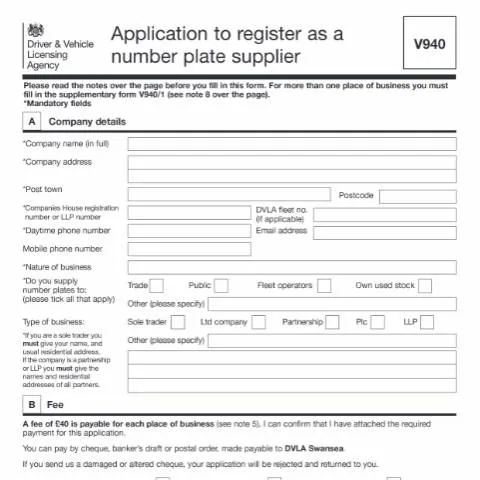
The form's Section A requires applicants to specify their customer base through tick-box options covering trade customers, public customers, fleet operators, and own used stock. This classification affects regulatory obligations and customer verification requirements.
Trade suppliers typically serve motor dealers, garage networks, or fleet management companies, requiring less stringent customer verification but maintaining detailed business-to-business transaction records. Public suppliers face enhanced obligations, including verifying customer identity, checking vehicle ownership documentation, and maintaining comprehensive audit trails for individual transactions.
Businesses serving fleet operators must understand specific requirements for commercial vehicle registrations, including weight restrictions, operator licensing considerations, and bulk registration procedures. Those dealing with own used stock require registration when supplying plates for vehicles sold from their inventory.
Navigating the V940 Application Structure: Section-by-Section Requirements
The V940 form's three-section structure reflects the DVLA's systematic approach to supplier registration, progressing from basic business identification through financial obligations to formal declarations of compliance.
Section A: Company Details and Business Classification
The opening section demands comprehensive business identification, starting with full company names that must match Companies House registrations exactly. Sole traders face specific requirements, providing both business names and personal residential addresses, while partnerships must detail all partners' names and addresses.
The Companies House registration number field proves mandatory for limited companies, with the adjacent DVLA fleet number box applying only to businesses already registered for fleet services. This dual identification system enables cross-referencing between different DVLA databases and external regulatory bodies.
Contact information requirements extend beyond basic details, requiring both daytime and mobile telephone numbers plus email addresses. These multiple contact methods reflect the DVLA's need for rapid communication regarding compliance issues, application queries, or regulatory updates.
Business Nature and Customer Base Definition
The "Nature of business" field requires specific description beyond generic terms, with the DVLA expecting detailed explanations covering actual operations. Motor dealers should specify new car sales, used vehicle trading, or specialist marques. Garage operators might describe MOT testing, accident repair, or fleet maintenance services.
Customer base tick-boxes enable multiple selections, reflecting modern business models serving diverse markets. A garage might supply trade customers (other motor businesses), public customers (individual vehicle owners), and fleet operators (commercial vehicle managers) simultaneously, requiring comprehensive understanding of different regulatory obligations for each customer type.
Financial Obligations and Payment Processing Through DVLA Swansea
Section B establishes the financial framework for supplier registration, with fees structured per business location rather than per company. The £40 fee applies to each place of business, requiring separate applications for companies operating from multiple locations.
This location-based fee structure recognises that number plate supply often occurs across geographically distributed operations. A motor dealer group with showrooms in Manchester, Birmingham, and London requires three separate V940 applications, each accompanied by individual £40 payments.
Payment Method Requirements and Processing
The DVLA accepts three payment methods, each with specific requirements and processing implications. Cheques must be made payable to "DVLA Swansea" with company names and addresses printed clearly on the reverse. Banker's drafts provide guaranteed payment but require advance arrangement with banking institutions.
Postal orders offer an alternative for businesses without company banking facilities, though their limited availability and value restrictions make them less practical for most commercial applications. The form explicitly warns against damaged, altered, or post-dated cheques, which result in automatic application rejection and return.
The DVLA's strict payment requirements reflect the need for clear audit trails and fraud prevention in the registration process. Rejected payments delay applications significantly, as returned forms require complete resubmission with corrected payment methods.
Declaration Requirements and Legal Implications of Form Submission
Section C transforms the application from administrative process into legal commitment through formal declaration requirements. The declaration statement requires applicants to confirm information accuracy "to the best of my knowledge and belief," establishing personal liability for false or misleading submissions.
Signature requirements vary according to business structure, with company directors, partners, or sole traders bearing personal responsibility for declaration accuracy. The "Position held in company" field must reflect actual authority to bind the business legally, preventing unauthorised applications by employees lacking proper authorisation.
Legal Consequences of False Declarations
The form's warning regarding false statements carries serious implications, with potential penalties including fines up to £1,000, prosecution under fraud legislation, and prohibition from future applications for up to five years. These penalties reflect the DVLA's determination to maintain registration system integrity and prevent exploitation by unscrupulous operators.
Beyond immediate penalties, false declarations can affect business insurance, professional licences, and commercial relationships. Motor trade insurance policies often exclude claims arising from regulatory violations, while trade association memberships may be suspended following DVLA sanctions.
Multiple Location Operations and Supplementary Form Requirements
Businesses operating from multiple locations face additional complexity through the supplementary V940/1 form requirement mentioned in the header instructions. Each additional business location requires separate registration, reflecting the DVLA's location-specific approach to supplier oversight.
This requirement particularly affects franchise operations, dealer networks, and garage chains operating across multiple sites. Each location must demonstrate independent capability to supply number plates legally, maintain customer records, and comply with regulatory obligations.
Head Office Responsibilities for Multi-Site Operations
While individual locations require separate registrations, head office operations retain overall responsibility for group compliance. The primary V940 application establishes corporate credentials, with supplementary forms extending registration to additional trading locations.
Multi-site operators must ensure consistent procedures across all locations, including staff training, record-keeping systems, and customer verification processes. The DVLA may inspect any registered location without notice, expecting uniform compliance standards regardless of site size or transaction volume.
Post-Application Process and Ongoing Supplier Obligations
Successful V940 applications trigger a comprehensive response from the DVLA's Register of Number Plate Suppliers in Swansea. Applicants receive acknowledgment letter V942, confirming application receipt and providing a unique Supplier Identification (SID) number for all future correspondence.
The SID number becomes essential for business operations, required for ordering number plates from manufacturers, responding to DVLA enquiries, and accessing online supplier services. This identifier links all supplier activities to the original V940 application, enabling comprehensive audit trails and compliance monitoring.
Information Leaflet INF195/2 and Legal Obligations
Alongside registration confirmation, suppliers receive information leaflet INF195/2 detailing ongoing legal obligations. These obligations include maintaining customer records for three years, verifying customer entitlement to registration marks, and ensuring plates meet British Standard BS AU 145e specifications.
Suppliers must also understand display regulations covering legal spacing, font requirements, and background specifications. The DVLA provides detailed guidance on acceptable variations, regional identifiers, and special category plates for disabled drivers, diplomatic vehicles, and temporary registrations.
Record-keeping requirements extend beyond basic transaction details to include customer identification verification, vehicle ownership documentation, and plate specification compliance. These records support enforcement activities, fraud investigations, and regulatory compliance audits conducted by DVLA inspection teams.
The registration system ultimately serves vehicle owners, enforcement agencies, and legitimate businesses by maintaining standards, preventing fraud, and ensuring that every number plate contributes to effective vehicle identification across Britain's road network.
Understanding the Different Categories of Number Plate Supply
The V940 application form distinguishes between several categories of number plate suppliers, each with specific requirements and operational parameters. Understanding which category applies to your business is crucial for completing the application correctly and ensuring you receive the appropriate authorisation level.
Motor factor suppliers represent the most common category, typically serving garages, dealerships, and other automotive businesses. These suppliers must demonstrate established trade relationships and provide evidence of their customer base within the motor industry. The DVLA expects motor factors to have robust systems for verifying customer credentials and maintaining detailed records of all plate supplies.
Direct retail suppliers operate differently, selling number plates directly to vehicle keepers. This category requires more stringent security measures, as retail suppliers must verify each customer's entitlement to specific registration marks. The application process for retail suppliers involves additional scrutiny of premises security, staff training procedures, and customer verification systems.
Specialist suppliers serve specific market segments, such as motorcycle dealerships, agricultural vehicle suppliers, or vintage car specialists. These businesses often require tailored approaches to customer verification and may need to demonstrate expertise in their particular vehicle category. The DVLA may impose specific conditions based on the type of vehicles primarily served.
Each category carries different responsibilities regarding record-keeping, security measures, and customer verification procedures. The V940 form requires detailed information about your intended supply category, including projected annual volumes, customer types, and distribution methods. Misrepresenting your intended category can result in application rejection or future compliance issues.
Security Requirements and Premises Standards
The physical security of your premises plays a crucial role in the V940 application assessment. The DVLA mandates specific security standards to prevent unauthorised access to number plate manufacturing equipment and materials, protecting against potential fraud and misuse.
Premises security assessment begins with the location itself. Ground floor premises require enhanced security measures compared to upper-floor locations, particularly regarding window protection and entry points. The DVLA expects burglar alarms connected to monitoring stations, CCTV coverage of all manufacturing and storage areas, and secure storage for both finished plates and manufacturing materials.
Access control systems must restrict entry to authorised personnel only. This typically involves key-holder lists, staff identification procedures, and visitor management protocols. The application requires detailed descriptions of who holds keys, how access is monitored, and procedures for reporting security breaches or suspicious activities.
Manufacturing equipment security extends beyond general premises protection. Plate-making machinery, computer systems containing customer data, and stocks of reflective materials must be secured against theft or unauthorised use. Some suppliers implement additional measures such as equipment immobilisation systems or secure equipment storage when premises are unattended.
Digital security considerations have become increasingly important as plate suppliers adopt computerised systems for customer verification and record-keeping. The DVLA expects robust data protection measures, secure internet connections for accessing verification databases, and backup systems to prevent data loss. Regular software updates and staff training on cybersecurity form part of the ongoing compliance requirements.
The V940 form includes detailed questions about each security aspect, often requiring supporting documentation such as security company certificates, equipment specifications, or professional security assessments. Inadequate security arrangements represent one of the most common reasons for application rejection.
Staff Training and Competency Requirements
The human element of number plate supply carries significant responsibility, making staff competency a critical component of the V940 application process. The DVLA requires evidence that all personnel involved in plate manufacture, customer service, and verification procedures possess appropriate knowledge and training.
Initial staff training programmes must cover legal requirements, customer verification procedures, security protocols, and fraud prevention techniques. The training should address the legal significance of vehicle registration documents, how to identify genuine documentation, and procedures for handling suspicious requests or problematic customers. Many successful applicants develop comprehensive training manuals and maintain training records for all staff members.
Ongoing competency maintenance ensures staff remain current with regulatory changes and emerging fraud techniques. This might involve regular refresher sessions, updates on new security features in vehicle documents, or participation in industry training programmes. The DVLA expects suppliers to demonstrate continuous staff development rather than one-off initial training.
Supervision and quality control procedures help ensure consistent application of verification standards across all staff members. This typically involves senior staff oversight of customer interactions, regular review of completed transactions, and clear escalation procedures for unusual or complex cases. The V940 application should detail these supervisory arrangements and quality assurance measures.
Staff vetting considerations may apply depending on the sensitivity of the supplier's operations and customer base. While not universally required, some suppliers implement background checking procedures for staff with access to customer data or manufacturing systems. The application form allows space to describe any additional staff security measures implemented.
Documentation supporting staff competency might include training certificates, competency assessment records, staff handbook extracts, or evidence of participation in relevant professional development activities. The DVLA views comprehensive staff training as indicative of a supplier's commitment to regulatory compliance and fraud prevention.