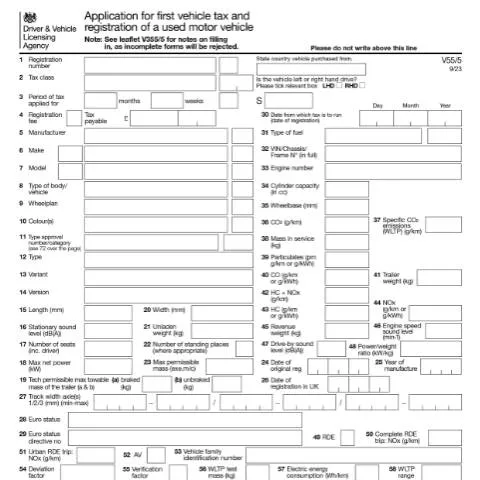
When Your Previously Unregistered Vehicle Enters the UK System
Thousands of vehicles enter the UK market each year without having been previously registered with the DVLA—imported cars from European dealers, classic vehicles returning from long-term storage abroad, or motorcycles purchased privately from overseas sellers. The V55/5 form serves as the gateway for these vehicles to obtain their first UK registration, establishing their legal status on British roads and triggering their entry into the vehicle taxation system.
Unlike the more familiar V5C registration certificate transfers between existing keepers, the V55/5 addresses a fundamentally different scenario: vehicles that have never been part of the UK's administrative framework. This distinction carries significant implications for documentation requirements, inspection procedures, and the information that must be provided to satisfy DVLA's registration criteria.
Navigating the Complex Landscape of First-Time Registration
The process begins when someone acquires legal ownership of an unregistered vehicle, whether through purchase, inheritance, or importation. Personal importers represent the largest category—individuals bringing vehicles from EU countries where they previously resided, or purchasing specialist vehicles not available through UK dealers. These applicants must demonstrate both legal ownership and compliance with UK construction and use regulations.
Motor traders handling imported stock face additional complexities, as they must register vehicles before offering them for retail sale. The V55/5 allows them to establish the vehicle's UK identity while simultaneously declaring their intention to use it commercially. This dual function affects both the taxation class and the ongoing obligations attached to the registration.
A particularly nuanced situation involves diplomatic personnel and military families returning to the UK with vehicles acquired during overseas postings. These cases often benefit from specific exemptions or modified procedures, but still require the V55/5 as the foundation document to establish UK registration.
Special Circumstances Requiring Additional Documentation
Certain vehicle categories trigger enhanced scrutiny during the V55/5 process. Vehicles over 40 years old may qualify for historic vehicle status, potentially exempting them from MOT requirements and vehicle excise duty. However, this status must be explicitly requested and substantiated with evidence of the vehicle's age and original specification.
Commercial vehicles exceeding 3,500kg revenue weight face additional regulatory layers, including operator licensing considerations and enhanced environmental standards verification. The V55/5 form captures these distinctions through specific sections addressing goods vehicle operations and trailer-drawing capabilities.
Decoding the Technical Specification Requirements
The V55/5 form demands comprehensive technical data that goes far beyond basic identification details. Engine specifications must be recorded with precision—not merely engine size, but specific power outputs, emission characteristics, and fuel consumption figures that determine the vehicle's tax band and regulatory compliance status.
The distinction between cylinder capacity in cubic centimetres and engine power in kilowatts reflects the UK's transition between different taxation methodologies. Older vehicles may fall under capacity-based taxation, while newer models face CO2 emissions-based charging. The V55/5 captures both metrics to ensure correct classification regardless of the vehicle's age or type.
| Vehicle Category | Key Specification Fields | Additional Requirements |
|---|---|---|
| Passenger Cars | CO2 emissions, fuel type, mass in service | Euro emissions standard verification |
| Motorcycles | Engine capacity, power output, unladen weight | Noise emission certificate if applicable |
| Goods Vehicles | Revenue weight, axle configuration, trailer capacity | Plating certificate for vehicles over 3,500kg |
| Motor Caravans | Conversion specifications, sleeping capacity | Gas installation certification |
Environmental and Safety Standards Verification
Modern vehicles must demonstrate compliance with UK environmental standards through detailed emissions data. The form requires specific CO2 output figures measured in grams per kilometre, alongside particulate emissions for diesel vehicles and NOx levels for both petrol and diesel engines. These measurements directly influence the vehicle's first-year tax rate and ongoing annual liability.
For imported vehicles, this often necessitates obtaining a Certificate of Conformity from the manufacturer or an approved testing station. European vehicles typically possess EU-wide type approval, but this must be verified and translated into UK-equivalent standards for DVLA acceptance.
The Documentation Ecosystem Supporting V55/5 Applications
Successful V55/5 completion relies on assembling supporting documents that vary significantly based on the vehicle's origin and circumstances. Proof of ownership represents the fundamental requirement, but its form differs dramatically between scenarios—a sales invoice for recently purchased vehicles, inheritance documentation for family transfers, or customs declarations for personal imports.
The previous registration document from the country of origin serves dual purposes: establishing the vehicle's history and providing technical specifications that may not be readily available elsewhere. However, these documents often require official translation, particularly for vehicles from non-English speaking countries, adding time and cost to the registration process.
Insurance and MOT Considerations During Registration
A critical timing issue emerges around insurance coverage during the registration process. The vehicle cannot be legally driven on UK roads without both insurance and registration, yet many insurers require registration details before providing coverage. The DVLA addresses this through temporary registration procedures that allow limited movement for MOT testing and insurance verification purposes.
Vehicles over three years old must present a valid MOT certificate alongside their V55/5 application. This creates a logistical challenge for imported vehicles, which may require transportation to MOT testing stations before registration completion. Some applicants opt for mobile MOT services or specialist importers who can coordinate these requirements seamlessly.
Navigating Dealer Codes and Commercial Registration Pathways
The V55/5 form accommodates both private individuals and commercial entities through distinct processing pathways. Motor dealers possess specific DVLA-issued codes that streamline their applications and enable bulk processing of multiple vehicles. These codes appear in dedicated sections of the form and trigger different validation procedures within DVLA systems.
Independent dealers and smaller traders without established DVLA relationships face more intensive scrutiny of their applications. They must provide additional documentation establishing their legitimate business operations and demonstrate appropriate trade insurance coverage. This enhanced verification process can extend processing times significantly compared to recognised dealers.
The Role of Vehicle Identification Numbers in Registration
Vehicle Identification Number (VIN) verification represents a critical anti-fraud measure within the V55/5 process. The 17-character VIN must be physically verified and recorded accurately, as it forms the primary key linking the vehicle to manufacturer databases and international registration systems. Discrepancies between stated and actual VINs trigger immediate investigation procedures.
For older vehicles predating standardised VIN systems, alternative identification methods apply. Chassis numbers or engine numbers may serve as primary identifiers, but these require additional verification through manufacturer records or specialist authentication services.
Understanding Tax Classifications and Their Long-Term Implications
The tax class selection within the V55/5 form determines not only immediate payment obligations but also establishes the vehicle's ongoing relationship with the UK taxation system. Private light goods vehicles face different rates compared to private/light goods dual-purpose vehicles, and this distinction affects both annual tax liability and permissible usage patterns.
Commercial vehicle classifications carry additional complexity, with revenue weight thresholds triggering different regulatory frameworks. A vehicle classified as exceeding 3,500kg revenue weight enters the Heavy Goods Vehicle regulatory environment, requiring operator licensing and enhanced driver qualification standards. The V55/5 captures these distinctions through detailed weight and configuration specifications.
Euro Status and Emissions Compliance Verification
The form's Euro status sections reflect the UK's adoption of European emissions standards, even post-Brexit. Vehicles must demonstrate compliance with appropriate Euro standards based on their age and type, with Euro 6 compliance increasingly becoming a prerequisite for certain urban driving privileges and Low Emission Zone access.
This compliance extends beyond simple declarations—vehicles may require testing or certification from approved bodies to verify their emissions performance. The V55/5 process integrates with these verification systems, potentially triggering additional inspections or documentation requirements based on the declared Euro status.
Processing Timelines and Administrative Outcomes
DVLA processing of V55/5 applications typically requires between two and six weeks, depending on the complexity of verification requirements and the completeness of submitted documentation. Straightforward cases—recent European vehicles with clear ownership chains and complete documentation—often process within the shorter timeframe.
More complex scenarios, such as vintage vehicle imports or vehicles with unclear ownership histories, may require additional investigation periods. DVLA may request supplementary evidence, arrange physical inspections, or consult with other agencies before approving registration. These extended procedures can push processing times to several months in exceptional cases.
What Happens After Successful Registration
Upon successful processing, DVLA issues the vehicle's first V5C registration certificate, establishing its permanent UK identity. This document enables the vehicle's legal use on UK roads and triggers ongoing obligations including annual tax payments, MOT testing requirements, and insurance compliance.
The registration also integrates the vehicle into various enforcement systems, including automatic number plate recognition networks and insurance databases. This integration supports road traffic enforcement while enabling access to services such as congestion charge payments and parking applications.
Importantly, the initial registration establishes baseline data that influences future valuations, insurance assessments, and resale procedures. Accuracy during the V55/5 process therefore carries long-term implications extending far beyond the immediate registration requirement.
Special Circumstances and Complex Registration Scenarios
While the standard V55/5 process covers most used vehicle registrations, certain circumstances require additional documentation or follow alternative procedures. Understanding these special cases can prevent delays and ensure your registration proceeds smoothly.
Vehicles Previously Registered Outside the UK
If you're registering a used vehicle that was previously registered in another country, the V55/5 form alone won't suffice. You'll need to complete Form V55/4 (Application to register an imported vehicle) alongside additional documentation. This includes the vehicle's original registration document from the country of origin, a valid UK MOT certificate if the vehicle is over three years old, and evidence of UK insurance.
For vehicles from EU countries, you may also need a Certificate of Conformity or Individual Vehicle Approval (IVA) certificate, depending on when the vehicle was first registered and its compliance with UK safety and environmental standards. The DVLA will assess whether the vehicle meets UK requirements before issuing registration documents.
Kit Cars and Substantially Modified Vehicles
Vehicles that have been substantially modified or built from kits present unique registration challenges. If modifications affect the vehicle's original specification significantly—such as engine swaps, chassis alterations, or bodywork changes—you may need to apply for a Q-plate registration or undergo Individual Vehicle Approval testing.
The DVLA considers modifications substantial if they affect the vehicle's mass, dimensions, or number of wheels, or if the engine type or fuel system has been changed. In such cases, you'll need engineering reports, receipts for major components, and potentially an inspection by a qualified engineer before the V55/5 application can proceed.
Historic and Classic Vehicle Considerations
Vehicles over 40 years old may qualify for historic vehicle status, exempting them from MOT testing and Vehicle Excise Duty. However, when registering such vehicles for the first time using V55/5, you'll need to provide substantial evidence of the vehicle's age and authenticity. This might include heritage certificates from manufacturers, dating certificates from relevant clubs, or expert valuations.
Be aware that claiming historic status requires the vehicle to remain largely original in specification. Significant modifications may disqualify the vehicle from these exemptions, reverting it to standard registration requirements including annual MOT tests.
Understanding Registration Documents and Legal Implications
The documents you receive following a successful V55/5 application carry significant legal weight and responsibilities. Understanding these implications helps ensure you remain compliant with UK motoring law.
The V5C Registration Certificate Explained
Upon successful registration, you'll receive a V5C registration certificate (logbook), which serves as proof of your legal relationship with the vehicle. Contrary to common belief, the V5C doesn't prove ownership—it identifies the registered keeper, who has day-to-day responsibility for the vehicle.
The V5C contains crucial information including the vehicle identification number (VIN), engine number, and technical specifications. Any discrepancies between the V5C and the actual vehicle could indicate potential issues with the vehicle's history or identity. Always verify that details match exactly, as errors can complicate future transactions or legal matters.
The registered keeper named on the V5C is legally responsible for ensuring the vehicle is properly insured, has valid MOT certification where required, and that any penalties or fines are addressed. This responsibility continues until the V5C is properly transferred to a new keeper or the vehicle is officially taken off the road through a Statutory Off Road Notification (SORN).
Digital Integration and Online Services
Modern vehicle registration increasingly integrates with DVLA's digital services. Once your V55/5 application is processed, your vehicle details become part of the DVLA's electronic database, enabling online services such as tax renewal, SORN declarations, and address changes.
The 11-digit reference number on your V5C enables access to various online services without needing to complete paper forms. However, certain transactions still require postal applications, particularly those involving significant changes to vehicle specifications or ownership structures.
Data Protection and Privacy Considerations
The information provided on Form V55/5 becomes part of DVLA's records and is subject to the Data Protection Act 2018 and UK GDPR. While DVLA maintains strict controls over access to this data, certain information may be shared with approved organisations for legitimate purposes, including law enforcement, insurance companies, and parking enforcement authorities.
You have rights regarding your personal data held by DVLA, including the right to request corrections to inaccurate information and, in certain circumstances, to request data deletion. However, DVLA's legal obligations to maintain vehicle records mean that some data retention is mandatory regardless of individual preferences.
Financial Obligations and Tax Implications
Registering a vehicle through V55/5 triggers various financial obligations that extend beyond the initial registration fee. Understanding these ongoing costs helps budget effectively and ensures legal compliance.
Vehicle Excise Duty Calculations and Exemptions
Most vehicles require Vehicle Excise Duty (VED) payment before they can be legally driven on public roads. The amount depends on factors including the vehicle's CO2 emissions, fuel type, and date of first registration. Vehicles registered before March 2001 are taxed based on engine size, while newer vehicles follow emissions-based bandings.
Certain vehicles qualify for VED exemptions or reductions. Electric vehicles typically receive zero-rate VED, while vehicles with very low emissions may qualify for reduced rates. Historic vehicles over 40 years old are exempt from VED entirely, provided they're used primarily for historic purposes rather than daily transportation.
When completing Form V55/5, ensure you understand your vehicle's VED obligations. The DVLA will calculate the appropriate rate based on the technical information provided, but errors in the form could result in incorrect tax bandings that may be difficult to rectify later.
Insurance Requirements and Continuous Insurance Enforcement
UK law requires continuous insurance coverage for all registered vehicles unless they're officially declared off-road through SORN. The Motor Insurance Database (MID) automatically checks insurance status, and penalties apply for uninsured vehicles even if they're not being driven.
When registering through V55/5, ensure valid insurance is in place before the vehicle is registered. Insurance companies require the vehicle registration number to provide coverage, creating a potential timing challenge. Many insurers offer temporary cover based on the chassis number or previous registration details while the V55/5 application is processed.
Be aware that insurance requirements vary based on vehicle use. Commercial vehicles, those used for driving instruction, or vehicles with unusual modifications may require specialist insurance policies that standard providers don't offer.
MOT Testing Requirements and Timing
Most vehicles over three years old require annual MOT certificates to remain road-legal. When registering a used vehicle, you must ensure current MOT certification is in place or arrange testing before driving the vehicle.
The MOT requirement is based on the vehicle's date of first registration, not when you acquired it. A vehicle first registered in 2019 would require its first MOT by 2022, regardless of when you complete the V55/5 application. The DVLA's records will reflect the correct MOT due date based on the information provided in your registration application.
Some vehicles are exempt from MOT requirements, including those over 40 years old (if used without substantial modification), vehicles under 3,500kg used for agriculture, forestry, or fisheries, and vehicles designed for speeds not exceeding 25mph. However, even exempt vehicles must be roadworthy when used on public roads.