Understanding the Small Islands Goods Vehicle Tax Declaration Framework
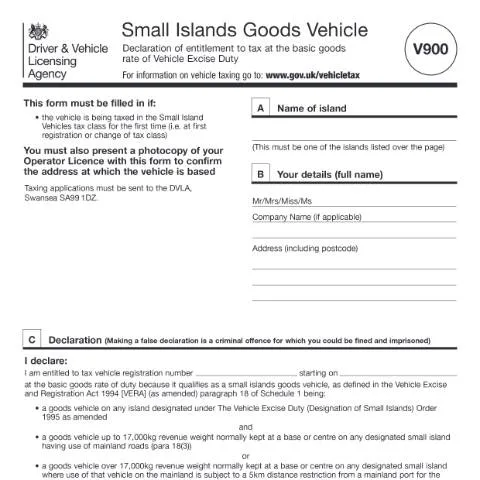
Commercial operators running goods vehicles on Britain's remote islands face a unique taxation landscape that reflects both geographical realities and practical logistics challenges. The V900 form serves as the gateway for businesses seeking to tax their commercial vehicles at the reduced basic goods rate rather than the standard Vehicle Excise Duty rates that apply to mainland operations.
This declaration system recognises that goods vehicles operating exclusively or primarily within designated small island communities face fundamentally different operating conditions from their mainland counterparts. Limited road networks, restricted mileage potential, and isolation from major distribution hubs create economic circumstances that warrant differential tax treatment under the Vehicle Excise and Registration Act 1994.
The form represents more than a simple tax application—it's a formal declaration that triggers criminal liability if completed dishonestly. Vehicle operators must certify that their commercial vehicle meets strict criteria relating to island designation, weight classifications, and operational base requirements.
Geographical Scope and Island Designations Under VERA
The Vehicle Excise Duty (Designation of Small Islands) Order 1995 establishes a comprehensive list of qualifying territories across Scotland's island chains and other remote UK locations. Understanding which islands qualify proves crucial, as the tax relief applies exclusively to vehicles based and operating within these designated areas.
| Island Group | Key Locations | Notable Inclusions |
|---|---|---|
| Shetland Islands | Mainland, Bressay, Fetlar, Foula | Includes Out Skerries and Yell |
| Orkney Islands | Mainland, Eday, Hoy, Westray | Covers Pentland Skerries |
| Inner Hebrides | Canna, Eigg, Muck, Rum | Extends to Tiree and Colonsay |
| Scilly Isles | Bryher, St Agnes, St Martins | Cornwall's offshore archipelago |
The designation extends beyond major populated islands to include smaller inhabited and uninhabited territories. For instance, the Outer Hebrides encompasses locations from Barra and Benbecula through to North Uist and Harris and Lewis. Even tiny islands like Inch Marnock and Little Cumbrae qualify, reflecting the legislation's comprehensive approach to remote island taxation.
Crucially, the vehicle must be "normally kept at a base or centre" on one of these designated islands. This requirement goes beyond occasional visits or seasonal operations—it demands genuine operational headquarters within the qualifying territory.
Weight Categories and Operational Restrictions
The V900 declaration system operates on a tiered approach based on vehicle weight and operational scope. These classifications directly impact both tax liability and operational permissions, creating distinct categories of island goods vehicle operation.
Vehicles Up to 17,000kg Revenue Weight
Lighter commercial vehicles—those not exceeding 17 tonnes revenue weight—qualify for basic goods rate taxation without additional restrictions. This category covers the majority of island delivery vehicles, small lorries, and medium-sized commercial trucks that form the backbone of island supply chains.
These vehicles enjoy complete freedom of movement, able to access mainland roads for supply runs, inter-island services, and broader distribution activities while maintaining their preferential tax status. The only requirement remains that their normal operational base stays within the designated small island.
Vehicles Over 17,000kg Revenue Weight
Heavier goods vehicles face additional operational constraints that reflect their greater impact on limited island infrastructure. While they qualify for the same basic goods rate taxation, they become subject to a 5km distance restriction from a mainland port for loading and unloading purposes.
This restriction acknowledges the practical reality that large goods vehicles must access mainland ports for cargo operations while preventing their use as general mainland haulage vehicles. The 5km limit typically encompasses port facilities and immediate hinterland areas, allowing essential cargo handling while maintaining the island-focused nature of the tax relief.
Documentation Requirements and Address Verification
The V900 application process demands specific documentation that establishes both personal identity and genuine island-based operations. These requirements reflect DVLA's need to prevent tax avoidance through false island residency claims.
Operator Licence Presentation: Applicants must present a photocopy of their Operator Licence alongside the V900 form. This requirement serves dual purposes: it confirms the applicant holds proper commercial vehicle operating permissions, and critically, it verifies the address where the vehicle operates.
The address verification aspect proves particularly important given the tax advantages at stake. DVLA cross-references the Operator Licence address against the declared island location, ensuring consistency between official records and the small islands goods vehicle claim.
Company vs Individual Applications
The form accommodates both individual operators and corporate entities. Individual applicants complete standard personal details including full name and address, while company applications require additional corporate information and authorised signatory details.
When signing on behalf of a company or partnership, the signatory must clearly state their position within the organisation. This requirement establishes clear accountability for the declaration's accuracy and provides DVLA with appropriate contact points for any subsequent queries or investigations.
Criminal Liability and Declaration Accuracy
The V900 form carries significant legal weight through its prominent criminal liability warning. The declaration states explicitly: "Making a false declaration is a criminal offence for which you could be fined and imprisoned."
This warning reflects the substantial tax savings available through small islands goods vehicle classification. The basic goods rate typically represents significant savings compared to standard Vehicle Excise Duty rates, creating strong incentives for fraudulent applications.
Common Scenarios Risking Criminal Liability
- False Island Residency: Claiming island-based operations while actually running mainland-focused services
- Weight Misrepresentation: Incorrectly declaring vehicle weight to avoid operational restrictions
- Operational Base Deception: Maintaining mainland operational headquarters while claiming island basing
- Distance Violations: Using heavy goods vehicles beyond the 5km mainland restriction without proper authority
DVLA's enforcement capabilities include cross-referencing Operator Licence records, conducting operational audits, and liaising with other enforcement agencies. The criminal liability extends beyond simple fines to potential imprisonment, reflecting the seriousness with which vehicle taxation fraud is treated.
Legislative Framework and Vehicle Excise Duty Context
The small islands goods vehicle system operates within the broader Vehicle Excise and Registration Act 1994 framework, specifically under paragraph 18 of Schedule 1. This legislative foundation establishes the legal basis for differential taxation based on geographical and operational factors.
The Vehicle Excise Duty (Designation of Small Islands) Order 1995 provides the detailed island listings that define qualifying territories. This secondary legislation allows for updates and modifications without requiring primary legislative changes, ensuring the system can adapt to changing circumstances or administrative needs.
Integration with Broader Vehicle Taxation
The basic goods rate represents one element within a complex vehicle taxation structure that includes different rates for private cars, motorcycles, and various commercial vehicle categories. Small islands goods vehicle relief recognises that standard taxation levels may prove disproportionate for operations constrained by geographical isolation.
This relief system parallels other geographical considerations within UK vehicle taxation, such as different arrangements for Northern Ireland or special provisions for agricultural vehicles. It reflects policy recognition that uniform taxation may not suit diverse operational circumstances across the UK's varied geography.
Application Processing and Administrative Procedures
V900 applications follow DVLA's standard processing procedures through the Swansea SA99 1DZ address. This centralised approach ensures consistent application of small islands goods vehicle criteria across all qualifying territories.
The requirement to submit both the completed V900 form and Operator Licence photocopy creates a two-document verification system. DVLA staff can cross-reference the declared information against existing operator records, identifying any inconsistencies or potential issues before approving the application.
Processing Timescales and Expectations
While the form doesn't specify processing times, DVLA typically handles vehicle taxation applications within standard administrative timescales. However, small islands applications may require additional verification steps, particularly for first-time applicants or complex operational arrangements.
Applicants should ensure their Operator Licence remains current throughout the application process, as any changes to operating authority could affect their small islands goods vehicle eligibility. Similarly, any changes to operational base or vehicle specifications may require fresh declarations or amendments to existing arrangements.
Data Protection and Information Sharing Arrangements
The V900 form operates under comprehensive data protection arrangements that balance administrative efficiency with privacy protection. DVLA handles personal data in accordance with road vehicle law and data protection legislation, including the Data Protection Act 2018 and UK GDPR requirements.
Information sharing arrangements extend beyond simple record-keeping to include disclosure to police and other enforcement bodies where legally required. This sharing capability supports the system's integrity by enabling cross-agency verification and enforcement activities.
Applicants concerned about data handling can access DVLA's privacy policy through their official website, which provides detailed information about data processing, retention periods, and individual rights under data protection legislation. This transparency supports informed decision-making about participation in the small islands goods vehicle system while maintaining necessary administrative capabilities.
Eligibility Criteria and Classification Requirements
The classification of your vehicle as a small islands goods vehicle hinges on meeting specific statutory criteria that extend beyond simple geographical considerations. Your vehicle must primarily serve commercial purposes within the designated small islands areas, with the DVLA requiring clear evidence of this operational pattern through supporting documentation.
Commercial use encompasses a broad spectrum of activities, from traditional freight transport to specialised services unique to island communities. This includes vehicles used for delivering essential supplies, construction materials, medical equipment, or agricultural products between mainland ports and island destinations. However, the vehicle cannot be classified as a small islands goods vehicle if it's primarily used for passenger transport, even if it occasionally carries goods.
Weight restrictions play a crucial role in determining eligibility, with different thresholds applying depending on your vehicle's construction date and intended use. Vehicles exceeding certain gross vehicle weight limits may require additional certifications or fall under different taxation categories entirely. The DVLA maintains detailed technical specifications that outline these parameters, taking into account factors such as axle configuration, trailer compatibility, and load distribution capabilities.
Geographic restrictions are more nuanced than simply operating "on islands." The legislation specifically defines which territories qualify, including the Isle of Wight, Anglesey, the Scottish islands (Hebrides, Orkney, Shetland), and various smaller inhabited islands with regular ferry services. Crucially, your vehicle must demonstrate a genuine operational need to serve these communities rather than using the classification as a convenient tax advantage for mainland operations.
Seasonal operators face particular scrutiny, as the DVLA recognises that some businesses only serve island routes during peak tourism periods or specific harvest seasons. In such cases, you'll need to provide detailed operational schedules and demonstrate that the vehicle isn't used for standard mainland commercial activities during off-season periods. This might involve providing ferry booking records, customer contracts, or detailed logbooks showing vehicle deployment patterns.
Documentation and Supporting Evidence Requirements
Form V900 demands comprehensive supporting documentation that substantiates your claim for small islands goods vehicle status. The quality and completeness of this evidence directly impact processing times and approval likelihood, making thorough preparation essential before submission.
Business registration documents form the foundation of your application, requiring current certificates from Companies House or equivalent regulatory bodies. Sole traders must provide HMRC registration evidence, including your Unique Taxpayer Reference and any relevant VAT registration details. These documents establish your legal authority to operate commercial vehicles and demonstrate ongoing compliance with business regulations.
Operational evidence carries significant weight in the assessment process, with ferry booking confirmations serving as primary proof of island service patterns. These records should span at least the previous twelve months where possible, showing consistent service to qualifying island destinations. The DVLA particularly values documentation that demonstrates regular scheduled services rather than occasional or opportunistic island visits.
Insurance documentation must explicitly cover commercial operations in the specified island areas, with particular attention to any geographic limitations or exclusions within your policy terms. Standard commercial vehicle insurance may not automatically extend to island operations, particularly where ferry transport is involved, so reviewing and potentially updating your coverage becomes essential.
Vehicle specification documents, including the V5C registration certificate, manufacturer's certificate of conformity, and any modification records, help establish technical compliance with small islands goods vehicle parameters. Where vehicles have been adapted for specific island operations—such as enhanced corrosion protection for marine environments or specialised loading equipment—detailed modification records strengthen your application.
Customer contracts or service agreements provide additional context for your island operations, particularly where you provide regular services to island businesses or communities. These documents should clearly identify the island destinations served and the nature of goods transported, helping establish the genuine commercial need for your vehicle classification.
Common Application Pitfalls and Processing Challenges
Understanding frequent application errors significantly improves your chances of successful form V900 processing while avoiding costly delays and potential rejection. The DVLA identifies several recurring issues that consistently complicate applications, most of which stem from incomplete preparation or misunderstanding of the classification requirements.
Geographic misinterpretation represents the most common error, with applicants incorrectly assuming that any vehicle serving coastal areas or crossing water qualifies for small islands status. The legislation specifically defines qualifying islands, and vehicles serving areas connected by bridges, causeways, or tunnels typically don't qualify regardless of their island geography. Similarly, vehicles primarily serving offshore installations, oil rigs, or temporary marine structures fall under different regulatory frameworks.
Timing-related issues frequently arise when applicants submit forms without considering the relationship between application dates and vehicle tax renewal periods. The DVLA cannot backdate small islands goods vehicle status, meaning any period between your current tax expiry and approval remains subject to standard commercial vehicle rates. Strategic timing of your application, ideally submitted well before your current tax period expires, prevents unnecessary additional payments.
Documentation quality problems often stem from providing generic business documents rather than specific evidence of island operations. Bank statements showing general business activity don't substitute for ferry receipts or island customer invoices. The DVLA requires evidence directly linking your vehicle to qualifying island services, not merely proof that your business operates in coastal areas.
Vehicle modification oversights can complicate applications where operators have adapted vehicles for island use without properly documenting changes. Undeclared modifications, particularly those affecting weight distribution or cargo capacity, may invalidate your original vehicle registration details and require separate approval processes before the V900 application can proceed.
Multi-vehicle fleet applications present unique challenges, as each vehicle requires individual assessment regardless of shared operational patterns. Attempting to apply small islands status to entire fleets without demonstrating individual vehicle necessity often results in partial approvals or requests for additional evidence. The DVLA evaluates each vehicle's specific contribution to island operations rather than accepting blanket fleet classifications.
Seasonal operation complications arise when applicants fail to clearly explain how vehicles are used during off-season periods. The DVLA expects detailed explanations of year-round vehicle deployment, particularly for businesses with significant seasonal variations. Vague descriptions of "storage" or "maintenance" periods may trigger requests for additional information or site inspections.