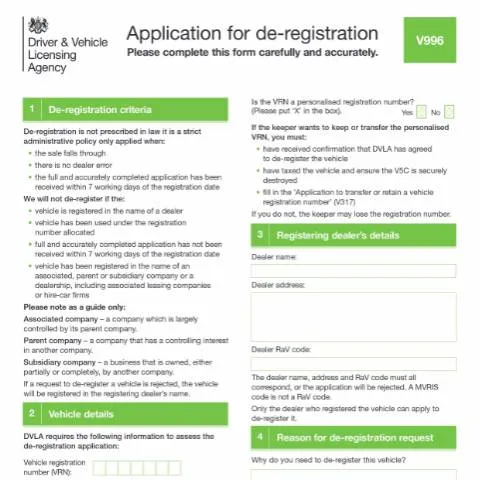
When a Vehicle Sale Falls Through: Understanding the V996 De-registration Process
Motor dealers face a peculiar administrative challenge when a vehicle sale collapses after registration paperwork has already been submitted to the DVLA. Unlike private sellers who can simply transfer ownership, dealers must navigate the V996 Application for de-registration process to remove vehicles from their allocated registration numbers when transactions fail to complete. This specialised DVLA form addresses the gap between initial vehicle registration and actual customer delivery, protecting dealers from ongoing liability for vehicles they no longer control.
The V996 serves as the formal mechanism for dealers to reverse vehicle registrations that have become problematic. Whether due to financing rejections, customer withdrawal, or delivery complications, this form ensures that registration numbers return to the DVLA pool whilst maintaining accurate records of vehicle ownership chains. Understanding its proper application can save dealers considerable administrative headaches and potential legal complications.
Strict Administrative Policy Behind De-registration Eligibility
The DVLA operates de-registration under strict administrative policy rather than legal prescription, meaning each application undergoes individual assessment against specific criteria. This policy-based approach allows for flexibility whilst maintaining stringent controls over the vehicle registration system.
Primary Qualifying Circumstances
De-registration applications succeed only when specific conditions are met:
- Sale failure: The transaction has definitively collapsed, with no prospect of completion
- Dealer error absence: No mistakes on the dealer's part contributed to the registration issue
- Timely submission: The complete V996 application reaches DVLA within seven working days of the original registration date
Automatic Rejection Scenarios
Certain circumstances guarantee application rejection, regardless of other factors:
| Rejection Trigger | Explanation | Alternative Action Required |
|---|---|---|
| Vehicle registered to dealer name | Registration shows dealer as keeper | Use V317 transfer form instead |
| Vehicle already in use | Registration number has been utilised | Standard ownership transfer procedures |
| Late submission | Application received after seven working days | Proceed with normal sale completion or transfer |
| Complex ownership structures | Associated companies, parent/subsidiary relationships | Detailed documentation of corporate relationships |
Navigating Complex Dealer Relationships and Corporate Structures
The V996 form acknowledges the intricate nature of modern motor trade operations, where vehicles might be registered through various corporate entities. Section 3 specifically addresses registering dealer details, recognising that the entity applying for de-registration may differ from the original registering party.
Associated Company Complications
When dealing with associated companies - defined as entities largely controlled by parent companies - the V996 process becomes more complex. The form requires comprehensive dealer information including:
- Full legal business name as registered with Companies House
- Complete trading address, not just correspondence addresses
- Valid RaV (Registration and Vehicle) code linking the dealer to DVLA systems
Crucially, applications involving parent companies, subsidiary relationships, or associated leasing companies face additional scrutiny. The DVLA may request supplementary documentation proving corporate relationships and authority to act on behalf of the registered entity.
RaV Code Verification Requirements
The dealer RaV code serves as a critical validation mechanism. Applications featuring incorrect or invalid RaV codes face automatic rejection, emphasising the importance of maintaining current DVLA dealer registration details. Only dealers who originally registered vehicles can apply for de-registration through V996, preventing unauthorised third-party applications.
Detailed Vehicle Information and Documentation Requirements
Section 2 of the V996 demands precise vehicle identification data, reflecting the DVLA's need to locate and modify specific registration records within their comprehensive database systems.
Essential Vehicle Identifiers
The form requires multiple vehicle identifiers to ensure accurate record matching:
- Vehicle Registration Number (VRN): The allocated number plate designation
- Vehicle Identification Number (VIN): The unique chassis identifier
- Make and Model: Manufacturer specifications as recorded during registration
- Registration Route: Whether processed via RaV system or V55/1 application
- Registration Date: The specific date when initial registration occurred
Personalised Registration Number Considerations
Applications involving personalised registration numbers require additional attention. The form specifically asks whether the VRN represents a personalised number, triggering different processing procedures. If keepers wish to retain personalised registrations, they must:
- Obtain written DVLA confirmation agreeing to de-register the vehicle
- Ensure secure destruction of the V5C registration certificate
- Complete V317 transfer documentation if retaining the personalised number
Failure to properly handle personalised registrations can result in keepers losing valuable registration numbers permanently.
Customer Communication and Supporting Documentation
The V996 process extends beyond simple form completion, requiring comprehensive customer communication and supporting evidence. Section 4 mandates detailed explanations of de-registration necessity, whilst Section 5 demands specific customer documentation.
Customer Letter Requirements
Every V996 application must include a signed and dated letter or email from the recorded keeper providing:
- Full name and address matching registration records
- Vehicle registration number and VIN confirmation
- Explicit confirmation that the sale has not proceeded
- Clear reasoning explaining why the transaction failed
Missing or incomplete customer correspondence guarantees application rejection. The DVLA emphasises that customer letters must demonstrate genuine transaction failure rather than simple buyer's remorse or minor delays.
Acceptable Failure Explanations
Valid reasons for sale failure typically include:
- Finance rejection: Customer unable to secure approved funding
- Vehicle defects: Undisclosed problems discovered during delivery preparation
- Specification errors: Wrong colour, trim, or equipment supplied
- Delivery damage: Vehicle damaged on dealer premises or during transport
- Customer withdrawal: Legitimate change of circumstances preventing completion
Processing Timelines and Post-Application Procedures
The DVLA commits to contacting applicants within ten working days of receiving complete V996 submissions. This timeline reflects the complexity of verifying dealer credentials, customer correspondence, and vehicle registration records before making de-registration decisions.
Successful De-registration Outcomes
When applications succeed, the DVLA removes vehicles from registration records, returning allocated numbers to available pools. However, dealers must understand that registration fees are not refunded during de-registration. Should vehicles subsequently require re-registration under new numbers, fresh fees apply regardless of previous payments.
Future Re-registration Considerations
De-registered vehicles entering new transactions require careful handling:
- VRN selection: Original registration numbers cannot be reused
- V55/1 applications: May require manufacturer documentation for re-registration
- Personalised registrations: Previous personalised numbers need specific handling through V317 processes
- RaV service limitations: De-registered vehicles may require alternative registration routes
Alternative Scenarios and Cancelled Sale Procedures
Section 7 of the V996 addresses situations where sales fail but vehicles don't meet strict de-registration criteria. These cancelled sale scenarios require different approaches, typically involving standard transfer procedures rather than de-registration.
When V996 Applications Are Inappropriate
Certain circumstances render V996 applications unsuitable:
- Specification disputes: Wrong colour or equipment ordered but vehicle remains viable for sale
- Delivery delays: Customer impatience rather than fundamental transaction failure
- Minor damage: Repairable issues occurring on dealer forecourts
- Used vehicle scenarios: Vehicles previously driven under assigned registration numbers
In these cases, dealers should pursue standard ownership transfer procedures using V317 documentation rather than attempting de-registration through V996.
Submission Methods and Contact Procedures
The DVLA provides multiple submission routes for V996 applications, each with specific requirements and processing implications:
| Submission Method | Address/Contact | Processing Notes |
|---|---|---|
| Email submission | [email protected] | Requires customer email consent confirmation |
| Postal application | De-registration Team, DVLA, Swansea, SA99 1ZZ | Must arrive within seven working days of registration |
| Company headed paper | Same postal address | Required for cancelled sales not meeting de-registration criteria |
Email submissions require explicit customer consent for electronic communication, documented through additional confirmation checkboxes on the V996 form. Customers uncomfortable with email processing must use postal submission routes, potentially impacting processing timelines given the seven-day submission deadline.
Understanding Registration Fee Implications and Financial Considerations
The V996 process carries significant financial implications that dealers must understand before pursuing de-registration. The DVLA's policy of non-refunding registration fees means that de-registration represents a complete loss of initial registration costs, with additional fees required for any subsequent re-registration under new numbers.
This financial reality makes V996 applications most suitable for genuine transaction failures where alternative resolution proves impossible. Dealers facing minor delivery issues or temporary customer concerns should carefully weigh the permanent loss of registration fees against the administrative convenience of de-registration. The form's emphasis on exceptional circumstances reflects the DVLA's recognition that de-registration should serve as a last resort rather than a routine administrative tool.
Successfully navigating the V996 process requires meticulous attention to documentation requirements, strict adherence to submission timelines, and clear understanding of the circumstances warranting de-registration versus standard transfer procedures. Dealers who master these requirements can effectively manage problematic registrations whilst maintaining compliance with DVLA administrative policies.
Specific Circumstances Requiring V996 Deregistration
Beyond standard disposal scenarios, several specific circumstances necessitate using form V996 to deregister your vehicle from DVLA records. Understanding these situations helps ensure you follow the correct legal pathway and avoid potential complications with vehicle registration status.
Export situations represent one of the most common V996 applications. When permanently exporting a vehicle outside the UK, you must complete the deregistration process even if the vehicle remains roadworthy. This applies whether you're relocating abroad permanently, selling to an overseas buyer, or donating the vehicle to someone in another country. The DVLA requires proof of export, typically through shipping documentation or customs declarations, which should accompany your V996 application.
For vehicles being broken for parts or scrap, the V996 serves a different purpose than standard scrapping procedures. While most scrap vehicles go through Authorised Treatment Facilities (ATFs) that handle deregistration automatically, some circumstances require manual deregistration. This might occur when dismantling a vehicle yourself for parts, when the ATF cannot complete the process due to missing documentation, or when dealing with vehicles that have been off-road for extended periods without valid SORN.
Insurance write-offs sometimes require V996 deregistration, particularly for Category A vehicles that must be destroyed completely. While insurance companies typically handle much of the administrative process, vehicle keepers may need to submit V996 forms when there are delays in the insurer's notification to DVLA or when disputing the write-off category assigned to the vehicle.
Military personnel face unique circumstances when deploying overseas for extended periods. Vehicles left in the UK during deployment may require deregistration if they cannot be maintained with valid insurance and MOT certificates. The V996 provides a formal method to remove the vehicle from DVLA records, avoiding ongoing legal obligations while stationed abroad.
Classic and vintage vehicle owners occasionally use V996 deregistration when undertaking extensive restoration projects. Some choose to deregister vehicles that will be off-road for several years, particularly when the restoration involves significant structural changes that might affect the vehicle's original classification or when planning to re-register under different criteria upon completion.
Vehicles involved in legal disputes may require deregistration while ownership questions are resolved. This might occur during divorce proceedings, business partnership dissolutions, or inheritance disputes where the rightful keeper cannot be definitively established. The V996 allows temporary removal from active registration while legal matters are settled.
Documentation Requirements and Supporting Evidence
Successful V996 processing depends heavily on providing appropriate supporting documentation alongside the completed form. The DVLA's requirements vary depending on your specific circumstances, and understanding these nuances can prevent delays or rejections in your application.
Essential documents for all applications include the vehicle's V5C registration certificate (log book) where available. If you cannot locate the V5C, you must explain the circumstances on form V996 and may need to provide additional evidence of your legal right to deregister the vehicle. This might include purchase receipts, insurance policies naming you as the keeper, or statutory declarations confirming your ownership status.
For export scenarios, supporting evidence requirements are particularly stringent. Acceptable documentation includes shipping bills of lading showing the vehicle's departure from a UK port, customs export declarations with official stamps, or transport company receipts confirming international shipment. Screenshots of online tracking systems or informal shipping arrangements typically do not meet DVLA standards. The documentation must clearly identify the vehicle by registration number or VIN and demonstrate that export has actually occurred, not merely been arranged.
Scrap and disposal situations require different evidence types. Authorised Treatment Facility certificates provide the strongest documentation, but when unavailing through normal ATF channels, you might need receipts from metal dealers, certificates of destruction from approved facilities, or photographic evidence of the vehicle's condition if scrapped privately on your property. The DVLA may request additional verification for high-value vehicles or those with outstanding finance agreements.
When dealing with insurance write-offs, your supporting documentation should include the insurer's total loss settlement letter, correspondence confirming the write-off category (A, B, S, or N), and any engineer's reports detailing the extent of damage. If disputing the insurer's decision or timeline, include relevant correspondence demonstrating your position and any independent assessments obtained.
Military deployment scenarios benefit from official documentation confirming overseas posting. Military movement orders, deployment confirmations from commanding officers, or official correspondence detailing assignment duration strengthen your application. Include evidence of your attempts to maintain legal compliance, such as correspondence with insurance providers about coverage limitations during extended absence.
For restoration projects, document the scope and expected duration of work through detailed project plans, correspondence with restoration specialists, or planning permission for workshop facilities if relevant. Photographs showing the vehicle's current condition help establish the legitimacy of long-term deregistration needs.
Legal dispute situations require careful documentation to demonstrate the complexity preventing normal registration maintenance. Court documents, solicitor correspondence, probate papers, or official mediation records help establish that deregistration represents the most appropriate interim measure while disputes resolve.
Remember that photocopies and digital submissions are generally acceptable for most supporting documents, though the DVLA reserves the right to request original documents for verification. Keep copies of everything you submit, as the DVLA does not return supporting documentation. If submitting irreplaceable original documents, consider using recorded delivery services and include a covering letter requesting their return after processing.
Post-Deregistration Obligations and Reinstatement Procedures
Completing form V996 successfully removes your vehicle from DVLA records, but this action creates ongoing obligations and affects your future options should circumstances change. Understanding these post-deregistration implications helps you make informed decisions and avoid unintended legal complications.
Immediate legal effects of deregistration include the cessation of requirements for road tax, MOT certificates, and insurance coverage from the effective deregistration date. However, you remain liable for any outstanding obligations up to that point, including unpaid vehicle excise duty, penalty charge notices, or insurance requirements that were active before deregistration took effect. The DVLA does not automatically cancel existing direct debits for vehicle tax, so you must contact them separately to stop ongoing payments.
Disposal obligations continue even after deregistration in certain circumstances. If you deregistered a vehicle for export but the export subsequently fails to materialise, you become responsible for either completing the export or re-registering the vehicle for UK use. Similarly, vehicles deregistered for scrapping must actually be disposed of properly - simply removing them from DVLA records does not eliminate your environmental responsibilities under waste disposal legislation.
For vehicles temporarily deregistered during restoration projects or extended storage, you must consider the reinstatement process well before planning to return the vehicle to road use. Reinstatement requirements have become more stringent in recent years, particularly for vehicles that have been deregistered for extended periods or have undergone significant modifications during their off-road time.
Reinstatement procedures typically require completing form V55/5 (Application for a First Licence and Registration of a Motor Vehicle) rather than simply reversing the V996 deregistration. This process treats your vehicle as a new registration in many respects, requiring fresh documentation including valid MOT certificates (for vehicles over three years old), current insurance policies, and evidence of your legal ownership. The reinstatement process may also trigger inspection requirements if the DVLA has concerns about the vehicle's identity or condition.
Age-related letter requirements apply to older vehicles seeking reinstatement. Vehicles manufactured before 1980 typically need age-related number plates, while those from 1980 onwards require registration numbers appropriate to their age. If your original registration number has been reassigned during the deregistration period, you may receive a new registration mark that reflects the reinstatement date rather than the vehicle's original registration period.
Vehicles undergoing significant modifications during deregistration may face additional scrutiny during reinstatement. Engine swaps, chassis modifications, or changes to vehicle classification (such as converting a car to a motor caravan) often require Individual Vehicle Approval (IVA) testing or other certification processes before reinstatement can proceed. These requirements can add substantial time and cost to bringing your vehicle back onto the road.
Historic vehicle considerations become particularly important for vehicles approaching or exceeding 40 years of age. Deregistration may affect eligibility for historic vehicle exemptions from MOT testing and vehicle excise duty. Upon reinstatement, you may need to provide additional documentation establishing the vehicle's historic status, particularly if modifications have been made during the deregistration period.
Insurance implications of deregistration and reinstatement extend beyond basic legal requirements. Many insurers treat reinstated vehicles as higher risk, potentially affecting premium calculations or policy availability. Some specialist classic car insurers may not provide cover for vehicles with gaps in their registration history, while others may require additional inspections or valuations before offering coverage.
The timing of reinstatement applications can significantly impact the process complexity and requirements. Vehicles deregistered for short periods (under 12 months) typically face fewer complications than those off-road for several years. Extended deregistration periods may trigger additional DVLA verification procedures, particularly for valuable or rare vehicles where identity confirmation becomes more critical.
Record-keeping during deregistration becomes crucial for smooth reinstatement. Maintain comprehensive documentation of any work performed, parts replaced, or modifications made while the vehicle was deregistered. This information may be essential for reinstatement applications, insurance valuations, or addressing any DVLA queries about the vehicle's condition or identity upon return to road use.