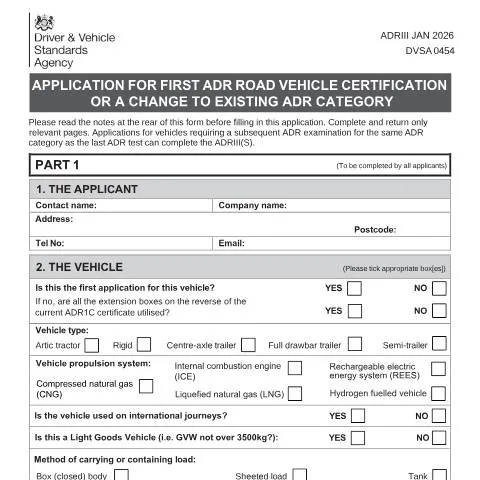
When Heavy Goods Meet Hazardous Loads: The Gateway to ADR Certification
Every day across Britain's motorways, specialised vehicles transport substances that could spell disaster if improperly handled—from explosive materials to toxic chemicals, flammable liquids to radioactive waste. The DVSA 0454 application form stands as the critical gateway between a standard commercial vehicle and one certified to carry dangerous goods under the European Agreement concerning the International Carriage of Dangerous Goods by Road (ADR). This comprehensive certification process transforms ordinary lorries, trailers, and tank vehicles into ADR-compliant transport units, each bearing the distinctive orange plates that signal their specialised purpose to emergency services and fellow road users.
The stakes couldn't be higher. A vehicle carrying Class 1 explosives requires fundamentally different safety systems than one transporting corrosive chemicals or radioactive materials. The DVSA's rigorous approval process ensures that every component—from the vehicle's electrical systems to its body construction—meets exacting international standards designed to prevent catastrophic incidents during transport.
The Regulatory Framework Behind ADR Vehicle Certification
ADR certification in the UK operates within a complex web of European and domestic regulations that have evolved significantly since the original 1957 agreement. The Driver and Vehicle Standards Agency administers this system under powers derived from the Carriage of Dangerous Goods and Use of Transportable Pressure Equipment Regulations 2009, which transpose European Directive 2008/68/EC into British law.
The certification process recognises several distinct vehicle categories, each with specific technical requirements. Type EX/II vehicles feature closed bodies or sheeted loads designed for Class 1 explosive substances, while Type EX/III vehicles require solidly constructed bodies made from non-flammable materials for the most hazardous explosive materials. Perhaps most specialised are Mobile Explosives Manufacturing Units (MEMU)—purpose-built vehicles that manufacture and charge explosives from non-explosive dangerous goods at remote locations like quarries or construction sites.
Tank vehicles present their own certification challenges, with requirements varying dramatically based on the substances they'll carry. A tank designed for petroleum products operates under entirely different specifications than one intended for liquid oxygen or compressed gases. The technical codes governing tank construction—found in ADR sections 4.3.3.1 and 4.3.4.1—specify everything from shell thickness to valve configurations.
International Journey Implications
Vehicles intended for international dangerous goods transport face additional scrutiny. Cross-border movements require compliance not just with UK standards but with the ADR requirements of destination countries. This international dimension affects everything from documentation requirements to technical specifications, as some European nations impose stricter standards for certain dangerous goods categories.
Navigating the Application Categories and Vehicle Classifications
The DVSA 0454 form accommodates an impressive range of vehicle configurations, each presenting unique certification challenges. Articulated tractors pulling tank semi-trailers require coordination between the power unit and trailer specifications, while rigid vehicles with integrated tanks undergo assessment as complete units.
| Vehicle Configuration | Key Assessment Areas | Typical Applications |
|---|---|---|
| Tank vehicles | Tank construction, valve systems, earthing arrangements | Petroleum products, chemicals, gases |
| Box body (closed) | Body construction, ventilation, electrical safety | Packaged dangerous goods, explosives |
| Skeletal trailers | Container securing, electrical compatibility | Tank containers, portable tanks |
| MEMU units | Manufacturing equipment, safety systems, tank specifications | Remote explosive manufacturing |
Light goods vehicles—those with gross vehicle weights not exceeding 3,500kg—represent a growing segment of the ADR market. These smaller units often serve specialised applications like laboratory sample transport or small-scale chemical distribution, but they must meet the same stringent safety standards as their heavyweight counterparts.
Propulsion System Considerations
Modern ADR applications increasingly involve alternative fuel vehicles. Compressed Natural Gas (CNG) and Liquefied Natural Gas (LNG) vehicles require additional safety assessments covering their fuel systems' interaction with dangerous goods. Electric vehicles present novel challenges, particularly regarding their high-voltage systems' compatibility with explosive atmospheres or electromagnetic interference with sensitive dangerous goods.
The Technical Assessment Process and Testing Requirements
Once submitted, applications trigger a comprehensive technical evaluation that can take several months to complete. The DVSA must verify that every aspect of the vehicle meets ADR requirements before scheduling the crucial physical inspection. This preliminary assessment examines the application against technical standards, manufacturer certifications, and any special provisions required for specific dangerous goods categories.
The physical test represents the culmination of the certification process. Conducted at DVSA facilities or Authorised Testing Facilities (ATFs), these examinations involve detailed inspections of electrical systems, body construction, safety equipment, and documentation. Inspectors pay particular attention to earthing arrangements—critical for preventing static electricity buildup during fuel handling—and the proper installation of ADR-specific equipment like emergency switches and hazard warning systems.
Applicants face a crucial decision regarding test presentation: whether to present their vehicle laden with dangerous goods. While this option provides the most realistic assessment of the vehicle's operational configuration, it requires careful coordination with test facilities and may limit scheduling flexibility. Many test stations cannot accommodate certain dangerous goods categories, necessitating alternative arrangements.
MOT Integration Complexities
Heavy goods vehicles require valid MOT certificates alongside their ADR approvals, creating scheduling challenges for operators. The DVSA offers to coordinate ADR tests with MOT examinations at their own facilities, but this service has limitations. Existing MOT bookings may not be compatible with ADR test scheduling, and some Authorised Testing Facilities cannot perform both examinations simultaneously.
Financial Implications and Payment Infrastructure
ADR certification costs vary significantly based on vehicle type and testing requirements, with fees regularly updated to reflect the DVSA's operational costs. The agency operates a sophisticated payment infrastructure designed to accommodate different operator needs and payment preferences.
Pre-funded accounts represent the most efficient payment method for regular users of the ADR system. Fleet operators and logistics companies often maintain these accounts to streamline their certification processes, avoiding payment delays that could disrupt operational schedules. However, establishing a pre-funded account requires careful delegation of signing authorities, as only authorised delegates can commit account funds.
Credit and debit card payments offer flexibility for occasional users, though they introduce a procedural delay. Once the DVSA receives an application specifying card payment, they contact the applicant with secure payment instructions. This process typically adds several days to the application timeline, potentially affecting test scheduling.
The Six-Month Rule
Perhaps the most critical timing constraint involves the six-month validity period for accepted applications. Once the DVSA accepts an application, operators have exactly six months to complete their ADR test. Applications exceeding this timeframe face automatic cancellation, requiring complete resubmission with fresh fees. This rule prevents the accumulation of stale applications but can catch operators off-guard, particularly those facing unexpected vehicle preparation delays.
Special Circumstances and Complex Applications
The ADR certification landscape includes numerous special cases that demand careful attention to detail. Vehicles with existing ADR type approval benefit from streamlined processing, provided no significant alterations have occurred since approval. However, even minor modifications—such as additional equipment installation or body repairs—can trigger comprehensive re-evaluation requirements.
International operators face additional complexity when their vehicles require certification in multiple jurisdictions. While ADR represents a harmonised European standard, individual countries may impose supplementary requirements or interpretation variations. Operators planning extensive European operations often benefit from consulting with specialist advisers familiar with destination country requirements.
Battery Vehicle Complications
Battery vehicles—those carrying multiple dangerous goods receptacles as a complete load—present unique identification challenges. The DVSA requires detailed identification of all battery elements, which can result in extensive documentation for complex loads. Some applications require separate attachment sheets listing dozens of individual components, each requiring specific certification details.
Tank vehicles with capacities exceeding 1,000 litres face enhanced scrutiny, particularly when integrated into MEMU configurations. These large-capacity systems require additional safety systems and may trigger requirements for specialised testing procedures that standard facilities cannot accommodate.
Digital Transformation and Submission Methods
The DVSA has modernised its ADR application process through digital transformation initiatives, though the system retains traditional postal options for operators preferring paper-based processes. The "Apply for a vehicle test or certificate for a lorry or trailer" online service represents the preferred submission method, offering faster processing times and automated acknowledgment systems.
Electronic submissions accept typed signatures, recognising the practical realities of modern business operations. However, this convenience comes with enhanced verification requirements, as the DVSA must ensure application authenticity without physical signature comparison capabilities.
Postal applications continue serving operators in remote locations or those preferring traditional processes. The Swansea processing centre receives thousands of applications annually, though postal submissions typically experience longer processing times due to manual handling requirements.
Document Management Challenges
ADR applications generate substantial documentation trails, from initial submissions through test certificates and ongoing compliance records. Operators must maintain comprehensive records not just for DVSA purposes but for insurance, customer requirements, and potential incident investigations. The complexity increases for fleet operators managing multiple vehicle certifications with varying renewal schedules.
Beyond Certification: Operational Realities and Ongoing Compliance
ADR certification represents just the beginning of a complex ongoing compliance relationship. Certified vehicles require regular inspections—annually for most categories, more frequently for certain high-risk applications. These subsequent examinations can utilise the simplified ADRIII(S) form, provided no category changes are required and the vehicle remains in substantially the same configuration.
The distinctive ADR certificate becomes a crucial operational document, required during transport operations and subject to inspection by enforcement authorities. The certificate's extension boxes accommodate minor modifications or additional approvals, but significant changes trigger complete recertification requirements.
Operators must navigate the complex interaction between ADR certification and other regulatory requirements. Driver licensing, load documentation, route planning, and emergency response procedures all interconnect with the vehicle certification framework, creating comprehensive compliance obligations that extend far beyond the initial DVSA approval.
The investment in ADR certification—encompassing application fees, testing costs, vehicle modifications, and ongoing compliance expenses—reflects the critical importance of safe dangerous goods transport. For operators in this specialised sector, the DVSA 0454 form represents not just a bureaucratic requirement but the foundation of professional credibility and operational legitimacy in one of transport's most demanding sectors.
Understanding ADR Certificate Categories and Vehicle Classifications
The ADR framework operates on a sophisticated classification system that determines both the type of certificate your vehicle requires and the specific safety equipment it must carry. Understanding these categories is crucial before submitting your application, as selecting the wrong classification can result in delays or rejection.
Class-specific requirements vary significantly across the nine UN hazard classes. Class 1 (explosives) vehicles need the most stringent approvals, including specific routing restrictions and additional security measures. Your vehicle's construction must meet enhanced structural standards, with reinforced floors and sides capable of withstanding potential blast effects. Class 3 (flammable liquids) transport requires different considerations—primarily focused on static electricity prevention and vapour containment systems.
Tank vehicles face particularly complex requirements. Fixed tanks, demountable tanks, and battery vehicles each follow distinct approval pathways. Fixed tank approvals integrate the tank design with the vehicle chassis approval, meaning modifications to either component may invalidate your certificate. Demountable tanks offer more flexibility but require separate tank approvals that must be compatible with your vehicle's mounting systems.
Vehicle weight categories also influence your approval requirements. Vehicles exceeding 12 tonnes gross vehicle weight face additional structural testing, particularly for the chassis and suspension systems. The DVSA examines load distribution calculations to ensure the vehicle can safely handle maximum permitted loads without compromising braking performance or stability.
Combination vehicles present unique challenges. The approval covers the complete vehicle combination, meaning you cannot simply attach any approved trailer to an approved tractor unit. The electrical compatibility between units, air brake synchronisation, and combined braking performance all fall under scrutiny during the approval process.
Conversion considerations apply when modifying existing vehicles for ADR use. Converting a standard commercial vehicle typically requires more extensive documentation than purchasing a purpose-built ADR vehicle. You'll need to demonstrate that modifications don't compromise the vehicle's original type approval and that all ADR-specific additions integrate safely with existing systems.
Essential Safety Equipment and Installation Requirements
ADR vehicle approval extends far beyond basic construction standards to encompass a comprehensive range of mandatory safety equipment. Each piece of equipment must meet specific technical standards and undergo proper installation procedures that comply with both ADR regulations and UK vehicle construction requirements.
Fire suppression systems represent one of the most critical safety components. The type and capacity of fire extinguishers depend on your vehicle's gross weight and the hazard classes it will transport. Vehicles up to 7.5 tonnes typically require two 2kg dry powder extinguishers, while heavier vehicles need additional capacity. Installation points must be easily accessible from both the cab and the loading area, with mounting brackets designed to withstand the forces generated during emergency braking or collision scenarios.
Electrical system modifications often prove the most technically challenging aspect of ADR compliance. The entire electrical installation must prevent ignition sources in areas where flammable vapours might accumulate. This involves installing intrinsically safe equipment, proper earthing systems, and explosion-proof enclosures for electrical components. Battery installations require specific ventilation arrangements and disconnect switches accessible from outside the vehicle.
Exhaust system positioning demands careful attention, particularly for vehicles transporting flammable substances. The exhaust outlet must be positioned to prevent hot gases from coming into contact with the load or creating ignition risks during loading operations. Heat shields and deflectors may be necessary, and some vehicle configurations require exhaust gas temperature monitoring systems.
Emergency equipment storage follows strict accessibility requirements. The emergency kit, including spillage materials, protective equipment, and emergency information, must be stored in weatherproof compartments with external access. Tool requirements vary by hazard class—vehicles carrying corrosive substances need non-sparking tools, while those transporting explosives require specialised equipment that won't generate static electricity.
Lighting and marking systems extend beyond standard vehicle lighting to include ADR-specific orange warning lights and hazard identification panels. The positioning and visibility of these systems undergo detailed examination during approval inspections. Side marker lights must maintain specific spacing intervals, and rear identification lighting must remain visible even when loading equipment is deployed.
Communication equipment requirements have evolved with modern safety standards. Many ADR operations now require hands-free communication systems that allow drivers to maintain contact with control centres without creating ignition risks. The installation must integrate with the vehicle's electrical systems while maintaining the required safety standards for the transported hazard classes.
Compliance Monitoring and Ongoing Responsibilities
Obtaining ADR vehicle approval marks the beginning rather than the end of your compliance obligations. The DVSA operates a comprehensive monitoring system that tracks approved vehicles throughout their operational lifespan, with specific requirements for maintenance, modification reporting, and periodic re-inspection.
Annual testing requirements go beyond standard MOT inspections to include ADR-specific safety system checks. These examinations verify that all safety equipment remains functional and properly maintained. Fire extinguisher servicing must follow manufacturer specifications with documented service records, while electrical system integrity requires testing by qualified technicians familiar with intrinsically safe installations.
Modification notifications represent a critical ongoing responsibility that many operators overlook. Any changes to approved vehicles—including seemingly minor modifications like additional storage compartments or communication equipment—require prior DVSA notification. Unauthorised modifications can invalidate your approval certificate immediately, potentially exposing you to prosecution and insurance complications.
Record keeping obligations extend throughout the vehicle's operational life. Maintenance records must demonstrate compliance with manufacturer specifications and ADR requirements. This includes detailed logs of safety equipment servicing, electrical system inspections, and any repairs or replacements affecting ADR-related components. The DVSA can request these records during routine inspections or following incident investigations.
Driver qualification coordination forms another crucial compliance element. While vehicle approval and driver ADR training are separate processes, operators must ensure that only properly qualified drivers operate approved vehicles. This includes maintaining current ADR driver training certificates and ensuring drivers understand the specific safety systems installed on each approved vehicle.
Incident reporting requirements activate automatically when ADR-approved vehicles are involved in accidents or safety incidents. The DVSA must receive immediate notification of any incidents involving dangerous goods spillage, fire, or equipment failure. These reports trigger inspection procedures that may affect the vehicle's continued approval status.
Insurance implications often surprise new operators. Standard commercial vehicle insurance typically excludes ADR operations, requiring specialised dangerous goods transport coverage. Your insurance provider will need confirmation of current ADR vehicle approval, and any changes to approval status must be reported immediately to maintain coverage validity.
Cross-border operations introduce additional complexity for UK-approved vehicles. While ADR approval provides European recognition, Brexit has created new administrative requirements for vehicles operating between the UK and EU member states. Operators must understand customs procedures, additional documentation requirements, and potential restrictions that may apply to specific dangerous goods categories when crossing international borders.