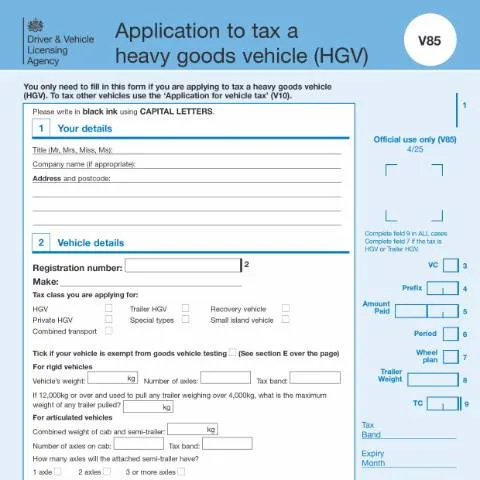
The Heavy Goods Vehicle Tax Journey: Understanding Form V85's Critical Role
When you're operating a heavy goods vehicle on UK roads, the moment arrives when you must engage with the DVLA's taxation system. Form V85 represents a specialised gateway into the world of HGV taxation, distinct from standard vehicle tax procedures. Unlike the familiar V10 form used for cars and lighter commercial vehicles, V85 caters exclusively to vehicles exceeding 3,500kg gross weight—a threshold that fundamentally changes both the complexity and the cost structure of road taxation.
The form emerges from a practical necessity: heavy goods vehicles place significantly greater demands on road infrastructure, require different enforcement approaches, and operate under distinct regulatory frameworks. Whether you're taxing a rigid lorry for local deliveries, an articulated unit for long-distance haulage, or a specialist recovery vehicle, V85 captures the technical specifications that determine your tax liability under the complex HGV taxation bands.
Decoding the Technical Architecture of HGV Tax Classification
Form V85's structure reflects the intricate nature of heavy vehicle taxation, where weight, axle configuration, and vehicle purpose combine to determine tax liability. The form distinguishes between rigid vehicles and articulated combinations, each requiring different technical data points that directly influence the final tax calculation.
Weight and Axle Considerations for Rigid Vehicles
For rigid HGVs, the form captures the vehicle's unladen weight alongside its maximum permissible gross weight. The number of axles becomes crucial, as this affects both the tax band and the vehicle's legal operating parameters. A two-axle rigid vehicle faces different taxation than a three-axle equivalent, even with identical gross weights, reflecting the varying impact on road surfaces and infrastructure.
The form specifically addresses vehicles weighing 12,000kg or over that pull trailers exceeding 4,000kg, requiring declaration of the maximum trailer weight. This provision acknowledges that many rigid vehicles operate with substantial trailing loads, fundamentally altering their road impact and appropriate tax liability.
Articulated Vehicle Complexities
Articulated vehicles present additional complexity through the combined weight calculation of tractor unit and semi-trailer. The form requires the combined weight of cab and semi-trailer alongside separate axle counts for each component. The number of axles on the attached semi-trailer—whether one, two, or three or more—directly influences the tax band, recognising that axle distribution affects road wear patterns.
| Vehicle Type | Key Technical Requirements | Tax Determination Factors |
|---|---|---|
| Rigid HGV | Vehicle weight, axle count, trailer capacity | Gross weight band, axle configuration |
| Articulated | Combined cab/trailer weight, separate axle counts | Total weight, trailer axle distribution |
| Special Types | Specific operational parameters | Specialised band structure |
Navigating the Specialist Vehicle Categories and Exemptions
Beyond standard HGVs, Form V85 accommodates several specialist categories that operate under modified taxation regimes. Recovery vehicles benefit from specific provisions recognising their emergency service role, while small island vehicles receive consideration for their unique operational constraints in geographically isolated communities.
The goods vehicle testing exemption represents a critical pathway for certain vehicles. Those exempt from mandatory testing—typically due to age, limited use, or specific operational parameters—must declare this status on the form. The exemption affects not only immediate taxation but also ongoing compliance obligations, making accurate declaration essential for long-term operational legality.
Private HGV Operations
Private HGV taxation acknowledges that not all heavy vehicles operate commercially. Private users—whether transporting personal goods, supporting private estates, or serving non-commercial organisations—face different tax structures. The form captures this distinction, ensuring appropriate tax liability while recognising the different economic impact of private versus commercial heavy vehicle use.
Timing Strategies and Tax Period Selection
Form V85 offers flexibility in tax duration, with six-month and twelve-month options reflecting the diverse operational patterns of heavy vehicle users. Seasonal operators, project-based contractors, or businesses with fluctuating vehicle requirements can select appropriate tax periods, optimising cash flow while maintaining legal compliance.
The start date selection carries particular significance for HGV operations. Unlike standard vehicle tax that typically aligns with registration dates, HGV tax can commence from the first day of any month, provided the application reaches DVLA before that date. This flexibility accommodates the operational realities of commercial vehicle deployment, where business needs rather than arbitrary dates drive taxation timing.
The form explicitly prohibits backdating, preventing applicants from securing tax coverage for periods when vehicles operated without valid taxation. This provision protects both revenue integrity and ensures that all road users contribute appropriately to infrastructure costs during their actual usage periods.
Documentation Requirements and Evidence Standards
The supporting documentation for Form V85 reflects the enhanced scrutiny appropriate for high-value, high-impact vehicles. The V5C registration certificate remains fundamental, but HGV taxation demands additional evidence layers that standard car taxation doesn't require.
MOT and Testing Certificates
Valid MOT certification or goods vehicle test certificates provide essential safety and roadworthiness verification. The form accepts electronic copies, acknowledging modern testing systems while maintaining verification standards. For Northern Ireland vehicles, the DVA certificate serves equivalent purposes, ensuring consistent standards across UK jurisdictions while respecting devolved administrative arrangements.
Vehicles claiming testing exemptions must provide specific supporting evidence. Age-related exemptions require historical documentation, while use-based exemptions demand operational evidence demonstrating compliance with exemption criteria. The DVLA's verification process for these exemptions can extend processing times, making early application advisable for time-sensitive operations.
Disability-Related Exemptions and Reductions
HGV operations supporting disabled persons can access significant tax relief through various disability-related schemes. The form accommodates applications for complete exemptions or 50% reductions, requiring appropriate certification from recognised authorities. These provisions extend beyond personal use to encompass commercial operations providing disability support services, recognising the social value of accessible transportation.
Required certificates include DLA, PIP, and various adult disability payments, with specific requirements varying by jurisdiction within the UK. The documentation must be current and specifically name the vehicle or registered keeper, preventing misuse while ensuring legitimate claims receive appropriate consideration.
Payment Methods and Processing Considerations
HGV tax payment options reflect the substantial sums involved and the business context of most applications. Direct Debit, credit cards, and debit cards provide immediate processing, while cheques and postal orders accommodate traditional business accounting practices. The form specifically warns against bounced cheques, which void tax coverage and can result in prosecution for untaxed vehicle use.
Payment timing intersects critically with operational requirements. Unlike personal vehicles where brief tax lapses might pass unnoticed, commercial HGVs face routine enforcement attention, making continuous tax coverage essential. The form's payment options accommodate urgent applications while providing cost-effective solutions for routine renewals.
Tax Band Determination and Rate Structures
The complexity of HGV tax bands means that Form V85 serves partly as a classification exercise, with technical specifications determining appropriate rates. The DVLA's online rate tables provide current pricing, but the form's technical data directly influences band allocation and final liability.
Tax bands consider not just weight but also environmental impact, axle configuration, and operational type. Euro emission standards, while not explicitly captured on V85, influence tax liability through the broader regulatory framework, making accurate vehicle specification essential for correct tax calculation.
Post-Submission Processing and Compliance Monitoring
Once submitted, Form V85 enters the DVLA's specialised HGV processing stream, distinct from standard vehicle taxation. Processing times reflect the additional verification required for complex vehicle specifications and higher-value transactions. The technical review process may identify discrepancies requiring applicant clarification, potentially extending processing periods beyond standard timeframes.
The form generates ongoing compliance obligations extending beyond initial tax payment. HGV operators must maintain accurate records, respond to DVLA queries, and ensure continuous insurance coverage as explicitly referenced in the form's legal warnings. Failure to maintain these standards can result in prosecution under multiple regulatory frameworks.
Enforcement and Penalty Frameworks
Form V85's warnings about prosecution reflect the serious enforcement approach to HGV taxation. The combination of high tax values, commercial operation, and infrastructure impact means that HGV tax evasion attracts significant penalties and potential criminal proceedings. The form's legal warnings serve both informational and deterrent purposes, emphasising the importance of continuous compliance.
The Statutory Off Road Notification (SORN) provisions, while available for HGVs, carry different implications than for private vehicles. Commercial operators using SORN must demonstrate genuine off-road storage while maintaining vehicle security and preventing unauthorised use. The administrative burden often makes continuous taxation more practical than SORN for active commercial fleets.
Integration with Broader Commercial Vehicle Compliance
Form V85 represents just one element in the comprehensive regulatory framework governing commercial vehicle operations. Operator licensing, driver certification, and vehicle testing create an interconnected compliance web where V85 taxation sits alongside multiple other obligations.
The form's data flows into broader DVLA systems supporting enforcement activities, vehicle tracking, and compliance monitoring. This integration means that V85 information influences not just taxation but also the broader regulatory relationship between operators and transport authorities. Accurate completion therefore serves long-term compliance interests beyond immediate tax requirements.
The relationship between V85 taxation and insurance requirements creates particular complexity for commercial operators. The form's insurance warnings reflect legal requirements, but commercial vehicle insurance often involves multiple policies, fleet arrangements, and specialist provisions that standard car insurance doesn't address. Ensuring alignment between tax periods and insurance coverage requires careful coordination, particularly for operations with multiple vehicles and varying usage patterns.
For operators managing substantial HGV fleets, Form V85 becomes part of systematic compliance management involving multiple vehicles, varying specifications, and coordinated renewal schedules. The form's individual vehicle focus requires multiplication across entire fleets, making systematic approaches essential for maintaining continuous legal operation while managing administrative burdens effectively.
Special Circumstances and Exemptions for HGV Taxation
Certain heavy goods vehicles qualify for reduced rates or complete exemptions from vehicle excise duty under specific circumstances. Understanding these provisions can significantly impact your tax liability and operational costs.
Disabled Person's Vehicle Exemptions
HGVs used solely for the carriage of disabled persons may qualify for exemption from vehicle excise duty. The vehicle must be registered in the name of a disabled person who holds a valid blue badge, or an organisation concerned with the care of disabled people. The exemption applies when the vehicle is used exclusively for the transport of disabled individuals, their equipment, or both.
To claim this exemption, you must provide evidence of the disabled person's entitlement, such as a copy of their blue badge or relevant medical documentation. The DVLA may request additional verification, including proof that the vehicle's primary purpose aligns with the exemption criteria.
Historic Vehicle Considerations
Heavy goods vehicles manufactured before 1 January 1973 automatically qualify as historic vehicles and are exempt from vehicle excise duty. However, you must still tax the vehicle annually using the appropriate DVLA forms, declaring the historic vehicle exemption.
For HGVs manufactured between 1973 and 1983, you may need to provide additional documentation proving the vehicle's age and original specification. The DVLA maintains strict criteria for historic vehicle classification, particularly for commercial vehicles that may have undergone significant modifications.
Temporary Exemptions and Seasonal Operations
Agricultural contractors operating heavy goods vehicles for seasonal work may qualify for reduced taxation periods. These vehicles, used primarily for agricultural purposes during specific seasons, can be taxed for shorter periods rather than the full year, provided they remain off public roads during untaxed periods.
Construction and demolition companies may also benefit from temporary exemptions when HGVs are used exclusively on private land or construction sites. However, any movement on public highways requires valid taxation, regardless of the distance travelled.
Cross-Border Operations and International Compliance
Operating heavy goods vehicles across UK borders involves additional taxation considerations and international agreements that affect both domestic and foreign operators.
Northern Ireland Specific Requirements
Heavy goods vehicles operating between Great Britain and Northern Ireland face unique taxation requirements following Brexit arrangements. The Northern Ireland Protocol affects how vehicle taxation is applied, particularly for vehicles registered in Northern Ireland but operating throughout the UK.
Operators must ensure their HGV taxation covers all intended operational areas. Vehicles primarily based in Northern Ireland but regularly travelling to Great Britain may require additional documentation to demonstrate compliance with both UK and EU regulations, depending on their operational scope.
International Operators and Temporary Imports
Foreign-registered heavy goods vehicles entering the UK must comply with temporary importation rules. EU-registered HGVs can operate in the UK for limited periods without UK taxation, provided they hold valid registration and taxation in their country of origin.
Non-EU operators face stricter requirements and may need to pay UK vehicle excise duty depending on their operational duration and frequency. The DVLA works with international transport organisations to monitor compliance and prevent tax avoidance through jurisdiction shopping.
Cabotage Operations and Tax Implications
International operators conducting cabotage operations (domestic transport within the UK using foreign-registered vehicles) must understand the taxation implications of extended UK operations. While short-term cabotage may not require UK vehicle taxation, extended operations trigger domestic tax obligations.
The definition of temporary versus permanent operation affects taxation requirements. Operators should maintain detailed records of their UK activities, including dates, routes, and cargo details, to demonstrate compliance with international operating agreements and domestic tax obligations.
Compliance Monitoring and Enforcement Mechanisms
The DVLA employs sophisticated monitoring systems to ensure HGV taxation compliance, with significant penalties for non-compliance affecting both individual operators and fleet managers.
Automatic Number Plate Recognition (ANPR) Systems
The UK's extensive ANPR network continuously monitors heavy goods vehicle movements, automatically checking taxation status against DVLA databases. These systems operate at strategic locations including motorway service areas, ports, and major transport hubs.
When an untaxed HGV is detected, the system generates immediate alerts to enforcement agencies. The vehicle's registered keeper receives automatic penalty notices, and the vehicle may be immobilised or removed from public roads. Fleet operators should implement robust systems to track taxation expiry dates across their entire fleet to avoid ANPR-triggered penalties.
Roadside Enforcement and Inspection Powers
DVLA enforcement officers and police traffic units have extensive powers to stop and inspect heavy goods vehicles for taxation compliance. During roadside checks, officers verify not only current taxation but also historical compliance and operator licensing.
Enforcement officers can issue immediate prohibition notices preventing vehicle movement until taxation issues are resolved. They may also conduct detailed inspections of vehicle documentation, operator records, and digital tachograph data to identify systematic non-compliance patterns.
Fleet-Wide Compliance Audits
Large fleet operators face periodic compliance audits examining taxation patterns across their entire vehicle inventory. The DVLA cross-references operator licensing data with vehicle taxation records to identify discrepancies or potential systematic avoidance.
These audits may trigger investigations into related areas including fuel duty compliance, international operating permits, and driver licensing. Operators with poor compliance records face increased scrutiny and may lose operating licence privileges, affecting their entire business operation beyond simple taxation issues.
The audit process typically involves detailed examination of fleet management systems, maintenance records, and operational procedures. Companies demonstrating robust compliance systems may qualify for reduced audit frequency, while those with compliance failures face enhanced monitoring and potential prosecution.