When Standard Vehicle Tax Routes Don't Apply: The V10 Alternative
Most vehicle owners in the UK receive their annual vehicle tax renewal notice automatically and can tax their vehicle through the standard online portal or at the Post Office using their V11 reminder. However, there are numerous circumstances where this straightforward process breaks down, leaving drivers without the usual documentation needed to renew their vehicle tax. The V10 Application for Vehicle Tax form serves as the essential fallback mechanism when the standard renewal system cannot accommodate your particular situation.
This paper-based application becomes necessary when you haven't received the expected renewal reminder, when vehicle details have changed, when there's been a break in taxing, or when you're applying for specific exemptions or reductions. Unlike the streamlined online system that relies on existing DVLA records, the V10 requires you to provide comprehensive vehicle and personal information from scratch, along with supporting documentation to verify your eligibility for taxation.
Decoding the Three-Part Structure: Personal, Vehicle, and Tax Components
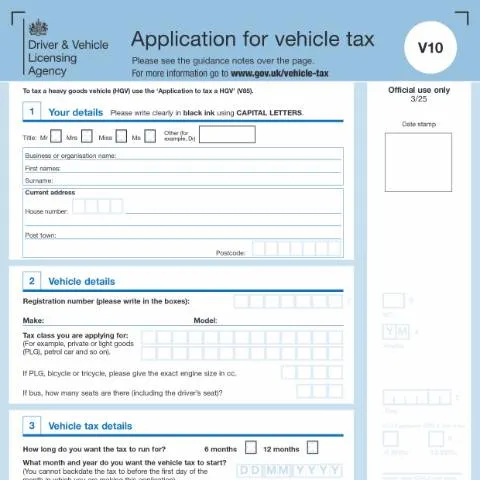
The V10 form follows a logical progression through three distinct sections, each serving a specific administrative purpose in the vehicle taxation process. Understanding this structure helps ensure accurate completion and reduces processing delays.
Section 1: Your Details - Beyond Basic Contact Information
The personal details section requires more than standard contact information. The form specifically asks for titles including options beyond the conventional Mr, Mrs, Miss, and Ms, with an "Other" field for alternative titles such as Dr, Rev, or professional designations. Business or organisation names must be completed if the vehicle is being taxed under a company or organisational umbrella, which affects both the legal responsibility for the vehicle and potential tax implications.
The address requirements are particularly stringent, with separate fields for house number, post town, and postcode. This detailed breakdown ensures accurate delivery of future correspondence and helps prevent the very communication failures that may have necessitated using the V10 in the first place. The DVLA emphasises writing clearly in black ink using capital letters, as this form may be processed through optical character recognition systems.
Section 2: Vehicle Details - Precision in Technical Specifications
The vehicle details section demands specific technical information that goes beyond what many owners typically know about their vehicles. The registration number must be entered in designated boxes, ensuring clear character separation for processing accuracy. Make and model fields require the exact manufacturer designations rather than common names or abbreviations.
The tax class specification proves crucial for determining the correct taxation rate. The form provides examples including private or light goods (PLG), petrol car categories, but owners must identify their specific classification. For PLG, bicycle, or tricycle categories, exact engine size in cubic centimetres becomes mandatory. Bus owners must specify seating capacity including the driver's seat, as this directly affects the taxation band.
These technical requirements reflect the DVLA's need to accurately categorise vehicles within the complex UK vehicle taxation structure, where rates vary significantly based on engine size, fuel type, emissions, and intended use.
Section 3: Vehicle Tax Details - Duration and Timing Considerations
The taxation period selection between six and twelve months carries financial implications beyond the obvious pro-rata calculation. Six-month taxation typically costs approximately 10% more than half the annual rate, making it a premium option for short-term needs. The form requires specific start dates, formatted as DD.MM.YYYY, with the critical restriction that backdating before the first day of the application month is prohibited.
The insurance reminder embedded in this section serves a legal compliance purpose, as vehicle taxation and insurance requirements are intrinsically linked. The form explicitly states that failure to tax and insure may result in fines or prosecution, reflecting the DVLA's integration with insurance database systems for enforcement purposes.
Navigating the Documentation Maze: Evidence Requirements by Scenario
The V10 process demands substantial supporting documentation, with requirements varying significantly based on your specific circumstances. Understanding these evidence requirements before beginning the application prevents delays and rejection.
| Scenario | Primary Document | Additional Requirements | Special Considerations |
|---|---|---|---|
| Standard renewal without V11 | V5C Registration Certificate | Valid MOT certificate | Must be original documents |
| New keeper without V5C | Green new keeper slip | V62 application form | Cannot tax until V5C issued |
| SORN vehicle return | V5C or V778 | Valid MOT (if applicable) | Must declare end of SORN period |
| Exemption claims | Relevant certificate | V112 or V112G form | Must be current and valid |
The V5C Registration Certificate: Your Primary Evidence
The Vehicle Registration Certificate, commonly known as the logbook, serves as the fundamental proof of your legal relationship with the vehicle. The DVLA accepts only the original V5C document, not photocopies, which means temporarily parting with this crucial document during postal applications. For vehicles registered in Northern Ireland, additional address verification may be required due to different administrative processes.
If your V5C has been lost, stolen, damaged, or destroyed, you cannot proceed with the V10 until obtaining a replacement. This requires completing a separate V62 application, paying the replacement fee, and waiting for processing before you can tax your vehicle. This sequential requirement often catches owners off-guard, particularly when facing deadline pressures.
MOT and Goods Vehicle Testing: Beyond Basic Compliance
MOT requirements extend beyond simply having a valid certificate. The document must demonstrate continuous validity from the last taxation period, and any gaps in MOT coverage may require additional explanation or documentation. For vehicles requiring Goods Vehicle Test certificates, the V10 specifically references V112 and V112G exemption declarations, indicating the complex interplay between different vehicle categories and testing requirements.
Electronic MOT certificates present particular challenges for postal applications, as the DVLA systems may not immediately reflect recent tests. In such cases, providing both the electronic reference number and any paper documentation helps expedite processing.
The Insurance Verification Paradox: Timing and Documentation
Vehicle insurance requirements create a complex timing challenge within the V10 process. You must have valid insurance before taxing your vehicle, but many insurers require confirmation of current taxation before providing cover. This circular dependency particularly affects vehicles returning from SORN status or those with gaps in coverage.
The form accepts various insurance documentation formats, including cover notes, but these must clearly show the policy start date, vehicle registration, and coverage type. Downloadable insurance certificates are acceptable if they contain all required information and are printed on quality paper that won't degrade during postal handling.
For vehicles with modified insurance arrangements, such as fleet policies or trade insurance, additional documentation may be necessary to demonstrate coverage validity. The DVLA's insurance database integration means that discrepancies between your declared insurance and database records can trigger verification delays.
Payment Pathways: From Post Office Counters to Postal Orders
The V10 payment system operates differently from online vehicle taxation, with specific procedures depending on your chosen submission method. Understanding these payment mechanisms prevents processing delays and ensures your application reaches the correct destination.
Post Office Branch Processing: The Immediate Option
Post Office branches equipped with vehicle tax services can process V10 applications immediately, accepting cash, debit cards, credit cards, cheques, or postal orders. The electronic transmission system means your information reaches the DVLA instantly, with tax discs historically issued on the spot, though the current system provides electronic confirmation of taxation status.
When using Post Office services, staff will complete a Direct Debit application (VDD1) if you're setting up future automatic payments. This dual-purpose visit can establish ongoing payment arrangements while resolving your immediate taxation needs. However, not all Post Office branches offer vehicle tax services, making verification of service availability essential before visiting.
Postal Submission: Documentation and Payment Security
Postal submissions require careful attention to payment security and documentation handling. Cheques must be made payable to 'DVLA, Swansea', with damaged or altered cheques facing automatic rejection. Cash submissions are explicitly prohibited, reflecting both security concerns and processing limitations within the postal system.
The form specifically warns against sending blank postal orders, as these cannot be processed if damaged during transit. Postal orders should be completed with the payee information before submission, and keeping receipt numbers helps track payments if queries arise.
Processing Timelines and Status Tracking: Managing Expectations
V10 processing operates on different timelines compared to online applications, with various factors affecting speed and requiring different approaches to status monitoring. Understanding these timelines helps plan vehicle use and manage compliance requirements.
Applications for 50% vehicle tax reductions require postal submission to DVLA Swansea, with processing typically taking four weeks from receipt. This extended timeline reflects the manual verification required for disability-related exemptions and reductions, where supporting documentation must be individually assessed against eligibility criteria.
Standard V10 applications processed through Post Office branches receive immediate confirmation, but the updated vehicle record may take 24-48 hours to appear in enforcement databases. This timing gap means that immediate vehicle use may still trigger automated penalty notices, though these can be resolved by providing evidence of successful taxation.
The SORN Overlap Challenge
Vehicles returning from Statutory Off Road Notification (SORN) status face particular timing challenges, as the SORN declaration must be formally ended before taxation can commence. The V10 process automatically handles SORN cancellation when successful taxation begins, but any gap between SORN end and tax start can trigger penalty calculations.
For vehicles with extended SORN periods, additional verification may be required to confirm the vehicle's continued existence and roadworthiness. This is particularly relevant for classic cars, project vehicles, or those stored for extended periods, where the DVLA may request additional evidence of the vehicle's current condition.
Exemption Applications and Reduced Rate Claims: The Specialist Routes
The V10 system accommodates various exemption categories and reduced rate applications that fall outside standard vehicle taxation arrangements. These specialist applications require additional documentation and follow extended processing procedures.
Disability-Related Reductions: The 50% Rate Application
Applications for 50% vehicle tax reductions based on disability benefits require specific benefit documentation and must be submitted by post to DVLA Swansea. Acceptable benefits include Personal Independence Payment (PIP), Adult Disability Payment (ADP), and various legacy benefits, but the form emphasises that certificates of entitlement must be current and valid.
The reduction applies only to vehicles used by or for the benefit of the disabled person, with restrictions on vehicle type and usage. Commercial vehicles and those exceeding certain weight limits may not qualify, regardless of the owner's benefit status. The application process includes verification against Department for Work and Pensions records, explaining the extended processing timeline.
Historic Vehicle Exemptions: Age and Authenticity Requirements
Historic vehicle exemptions follow complex criteria based on vehicle age, authenticity, and usage patterns. Vehicles manufactured before 1 January 1983 may qualify for exemption, but substantial modifications can disqualify otherwise eligible vehicles. The V10 process requires detailed technical information to verify eligibility, including original specification confirmation.
Electric vehicle conversions of historic vehicles face particular scrutiny, as the conversion process must not alter the vehicle's essential character. Documentation requirements may include engineering reports, modification certificates, and photographic evidence of the conversion's reversibility.
Common Pitfalls and Recovery Strategies: When Applications Go Wrong
V10 applications face various potential complications, from documentation issues to payment problems. Understanding these common failure points and their resolution mechanisms helps navigate the appeals and correction processes.
Rejected applications typically result from incomplete documentation, invalid supporting certificates, or payment issues. The DVLA operates a structured appeals process for disputed decisions, but this requires understanding the specific grounds for rejection and assembling appropriate counter-evidence.
Payment-related rejections often stem from insufficient funds, invalid cheques, or damaged postal orders. In these cases, the original application documentation is typically returned, allowing resubmission with corrected payment information. However, timing considerations mean that delayed resubmission may require updated supporting documents, particularly MOT certificates with approaching expiry dates.
Address-related complications arise when the V10 applicant's address differs from the V5C registered keeper address. While legitimate address changes can be accommodated through concurrent V5C update processes, significant discrepancies may trigger fraud prevention procedures requiring additional identity verification.
The V10 system also handles international address changes for UK vehicles temporarily based overseas, though this requires additional documentation proving the temporary nature of the relocation and ongoing UK insurance coverage. These applications face extended processing times due to manual verification requirements and potential consultation with international authorities.