When Government Securities and Listed Shares Meet Inheritance Tax Assessment
The death of a family member brings not only emotional upheaval but also the complex task of valuing their estate for inheritance tax purposes. Among the most intricate aspects of this process lies the accurate assessment of listed stocks, shares, and government securities—financial holdings that require precise valuation and careful categorisation under HMRC's inheritance tax framework.
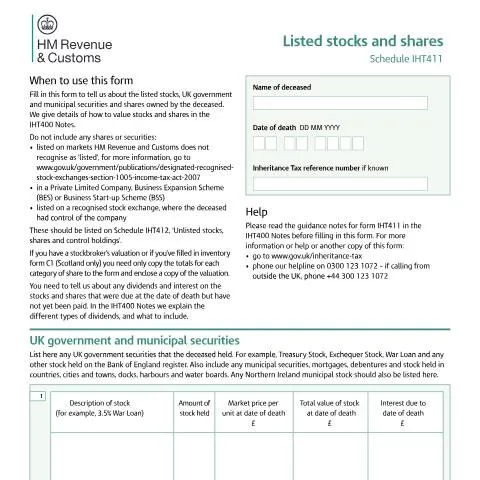
Schedule IHT411 serves as the dedicated reporting mechanism for these mainstream investment holdings, forming a crucial component of the broader IHT400 inheritance tax account. Yet this seemingly straightforward form conceals numerous technical distinctions that can significantly impact both the accuracy of your submission and the final tax liability of the estate.
The form's scope encompasses everything from War Loan certificates held since the 1940s to modern ISA portfolios containing OEIC units, but excludes private company shares and control holdings—distinctions that frequently catch executors off-guard. Understanding these boundaries, alongside the form's specific valuation requirements and dividend treatment rules, becomes essential for anyone navigating the inheritance tax process with substantial investment portfolios.
Defining the Investment Landscape: What Falls Within IHT411's Remit
The fundamental purpose of Schedule IHT411 centres on capturing listed investments that did not grant the deceased control over companies or entities. This distinction proves more nuanced than many executors initially appreciate, particularly given the form's specific exclusions and the parallel existence of Schedule IHT412 for unlisted holdings.
Government and Municipal Securities Coverage
The form's first section addresses UK government and municipal securities, encompassing a surprisingly broad range of instruments. Treasury Stock and Exchequer Stock represent the most common government holdings, alongside the historic War Loan certificates that many older investors retained throughout their lives. These government securities, held on the Bank of England register, require listing with their precise descriptions, amounts held, and market valuations at the date of death.
Municipal securities extend beyond simple local authority bonds to include mortgages, debentures, and stock issued by counties, cities, towns, and specialised bodies such as docks, harbours, and water boards. Northern Ireland municipal stock also falls within this category, reflecting the form's comprehensive approach to public sector investment instruments across the UK.
Listed Company Shares and Investment Vehicles
The second section captures the broader universe of listed investments, focusing on holdings that appear on the Stock Exchange Daily Official List. This includes traditional company shares, but extends significantly into modern investment structures that have transformed personal portfolios over recent decades.
Individual Savings Accounts (ISAs) require particular attention, as the form specifically includes share holdings within ISAs plus any uninvested cash balances, while excluding insurance policies or other non-investment cash held within the wrapper. This distinction requires executors to obtain detailed ISA statements showing the underlying investments rather than simply the overall account value.
Unit trusts demand full identification, including the complete legal name and specific unit type—for example, "Axa Equity and Law Unit Trust Managers, Pacific Basin Trust Accumulation Units." This level of detail reflects HMRC's need to verify valuations against published unit prices and distinguish between accumulation and income units for dividend treatment purposes.
| Investment Type | Include in IHT411 | Key Requirements |
|---|---|---|
| UK Government Securities | Yes | Full description, Bank of England register confirmation |
| Listed Company Shares | Yes (if no control) | Stock Exchange Daily Official List verification |
| ISA Holdings | Shares and uninvested cash only | Detailed ISA statement required |
| Foreign Shares | Only if UK exchange listed | London Stock Exchange or UK exchange confirmation |
| Private Company Shares | No - use IHT412 | Regardless of size or value |
The Control Holdings Exclusion: A Critical Boundary
One of IHT411's most significant limitations involves the control holdings exclusion, which redirects substantial shareholdings to Schedule IHT412 regardless of whether the shares trade on recognised exchanges. This boundary creates practical challenges for executors dealing with family businesses that achieved stock exchange listings while retaining family control.
The control threshold operates not merely on percentage ownership but on the deceased's ability to influence company decisions, either alone or in concert with connected persons. A deceased individual holding 25% of a listed company's shares might trigger the control provisions if other family members held additional stakes, requiring the entire holding's transfer to IHT412 despite the shares' listed status.
Foreign shares present another boundary consideration, as inclusion depends on their listing status on UK exchanges rather than their home market recognition. Shares trading on major international exchanges like New York or Frankfurt require UK exchange listing to qualify for IHT411 treatment, otherwise falling into the unlisted category regardless of their international prominence.
Recognised Exchange Definitions
HMRC maintains a specific list of designated recognised stock exchanges under Section 1005 of the Income Tax Act 2007, determining which markets qualify as "listed" for inheritance tax purposes. This list excludes various smaller exchanges and alternative trading platforms, potentially catching executors unaware when dealing with shares they assumed qualified as listed securities.
The exclusion of Business Expansion Scheme (BES) and Business Start-up Scheme (BSS) shares reflects these instruments' tax-advantaged status and different valuation methodologies, despite their potential listing on recognised exchanges. These historical tax shelter investments require separate treatment under IHT412 provisions.
Valuation Complexities and Market Price Determination
The form's market price requirements extend beyond simple closing prices to incorporate the specific valuation rules outlined in the IHT400 Notes. These rules account for the practical challenges of establishing precise values for inheritance tax purposes, particularly when dealing with thinly traded securities or market disruptions around the death date.
Date of Death Pricing Challenges
Establishing market prices at the exact date of death can prove problematic when the death occurred on weekends, bank holidays, or during periods of market suspension. The IHT400 Notes provide guidance on using the nearest available trading day's prices, but executors must document their approach and reasoning for HMRC's review.
Stockbroker valuations offer an alternative route, particularly valuable when dealing with complex portfolios or unusual securities. The form explicitly recognises professionally prepared valuations, allowing executors to attach the broker's report and transfer only the totals to IHT411 rather than itemising every holding. This approach proves especially beneficial for large portfolios or when dealing with securities requiring specialist knowledge for accurate pricing.
Scottish executors using the traditional inventory form C1 receive similar accommodation, reflecting the distinct legal framework for estate administration north of the border. This recognition of Scottish practice demonstrates HMRC's awareness of jurisdictional differences within the UK's inheritance tax system.
Dividend and Interest Accruals
The form's treatment of dividends and interest due at the date of death introduces additional complexity, requiring executors to distinguish between different types of distributions and their timing relative to the deceased's death. Ex-dividend dates become crucial, as shares trading ex-dividend at the death date exclude the pending dividend from the share price but require separate inclusion in the accrued income section.
Government securities often carry accrued interest calculations based on daily accumulation from the last payment date, requiring mathematical precision that many executors find challenging. Unit trusts may have distribution dates that don't align with the death date, necessitating pro-rata calculations for income accumulation units.
Submission Pathways and Professional Coordination
Schedule IHT411 operates as a subsidiary form to the main IHT400 inheritance tax account, meaning its submission follows the broader inheritance tax filing requirements rather than standalone deadlines. This integration affects both the timing and method of submission, with implications for professional coordination and overall estate administration efficiency.
The form's design assumes integration with professional stockbroking services, reflected in its accommodation of broker valuations and its technical terminology. Executors lacking investment experience may find the form's requirements overwhelming, particularly when dealing with complex investment structures or international holdings with UK exchange listings.
Digital Versus Paper Filing Considerations
While HMRC encourages online submission for inheritance tax accounts, the complexity of investment portfolios often necessitates paper filing to accommodate detailed supporting documentation. Stockbroker valuations, ISA statements, and foreign exchange calculations frequently exceed the capacity of online forms, making paper submission more practical despite longer processing times.
The form's cross-referencing to specific boxes on the main IHT400 requires careful coordination between schedules, particularly when multiple preparers work on different aspects of the estate. Professional executors often coordinate with stockbrokers, accountants, and solicitors to ensure consistent valuation approaches across all inheritance tax documentation.
Common Valuation Disputes and HMRC Enquiries
Investment valuations frequently attract HMRC scrutiny, particularly when dealing with substantial portfolios or unusual securities. Understanding the common areas of dispute helps executors prepare robust submissions and respond effectively to subsequent enquiries.
Control holding classifications represent the most frequent source of disagreement, especially involving family companies with public listings or investment vehicles where the deceased held significant but sub-majority stakes. HMRC may challenge the listed versus unlisted classification based on the deceased's overall influence rather than strict percentage ownership.
Foreign share valuations create another common dispute area, particularly when UK-listed depositary receipts represent underlying foreign securities. The form's requirement for UK exchange listing can conflict with the underlying economic reality of foreign investments, leading to valuation disagreements and classification disputes.
Professional Valuation Standards
HMRC expects professional valuations to meet recognised standards, particularly for complex securities or substantial holdings. Stockbroker valuations must demonstrate appropriate methodology and market knowledge, while unusual securities may require specialist valuation professionals with relevant expertise and professional indemnity coverage.
The timing of professional valuations becomes crucial, as market volatility around the death date can significantly impact values. HMRC may question valuations that appear inconsistent with broader market movements or that rely on outdated pricing information.
Integration with Broader Estate Planning Strategies
Schedule IHT411's role extends beyond simple tax compliance to encompass broader estate planning considerations that affect both current inheritance tax liabilities and future family wealth management. The form's detailed investment disclosure provides HMRC with comprehensive insight into the deceased's investment approach and risk profile.
Investment portfolio diversification patterns revealed through IHT411 can influence HMRC's assessment of other estate assets, particularly when business interests or property holdings suggest coordinated investment strategies. Executors should consider how the investment portfolio presentation aligns with overall estate planning narratives and tax mitigation strategies.
The form's dividend and interest accrual requirements also connect to income tax considerations for the estate's administration period, as these amounts often form the foundation for estate income calculations during the administration process. Accurate completion therefore supports both inheritance tax compliance and ongoing estate administration efficiency.
Beneficiaries inheriting investment portfolios benefit from the detailed documentation required by IHT411, as the form's comprehensive listing provides a clear foundation for subsequent portfolio management and capital gains tax base cost calculations. The professional valuations and detailed descriptions facilitate smooth asset transfers and ongoing investment administration.
Valuation Challenges for Complex Share Structures
While straightforward publicly traded shares present relatively clear valuation paths, certain share structures can complicate the IHT411 completion process significantly. Preference shares, for instance, require careful consideration of their specific rights and restrictions. These shares may carry fixed dividend entitlements, conversion rights, or redemption features that directly impact their inheritance tax value. The valuation approach differs markedly from ordinary shares, as you must account for the preferential treatment in dividend distributions and potential capital returns.
Convertible securities present another layer of complexity. When completing form IHT411, you'll need to determine whether to value these instruments as debt securities or potential equity, depending on conversion terms and market conditions at the date of death. If conversion seems likely based on current share prices relative to conversion terms, HMRC may expect you to reflect this probability in your valuation.
Shares subject to employee share schemes often carry specific restrictions that affect their open market value. Share Incentive Plan (SIP) shares, Enterprise Management Incentive (EMI) options, or Save As You Earn (SAYE) schemes may have vesting periods, exercise conditions, or forfeiture clauses that impact valuation. These restrictions typically reduce the value below the unrestricted share price, but quantifying this discount requires detailed analysis of the scheme rules and remaining restrictions at the date of death.
Partly paid shares represent another valuation challenge, where the deceased held shares with outstanding calls or instalments due. The inheritance tax value must account for both the market value of fully paid equivalent shares and the liability for unpaid amounts. This creates a net position that may be significantly lower than the apparent market value of the shareholding.
For shares in investment trusts trading at premiums or discounts to net asset value, you must use the actual market trading price rather than the underlying asset value. However, if the shares are subject to restrictions or the market is particularly illiquid, additional valuation adjustments may be necessary. Investment trust shares with unusual features, such as zero dividend preference shares or stepped preference shares, require specialist valuation approaches that account for their specific cash flow profiles.
International Taxation Implications and Cross-Border Complications
When the deceased held foreign-listed shares, form IHT411 completion involves additional considerations beyond simple currency conversion. Double taxation agreements between the UK and other countries may affect how these assets are treated for inheritance tax purposes. For shares listed on recognised overseas exchanges, you'll typically need to provide valuations in the original currency alongside sterling equivalents using exchange rates from the date of death.
American Depositary Receipts (ADRs) and similar instruments require careful treatment. While these trade on UK exchanges, they represent underlying foreign shares, and their valuation may need to account for the depositary arrangement and any associated fees or restrictions. The conversion ratio between ADRs and underlying shares must be clearly documented when completing the form.
Shares held in overseas investment accounts or foreign brokerages present additional complications. You may need to obtain formal valuations from the foreign institution, properly translated and certified. Currency fluctuations between the date of death and the form submission can create discrepancies that require explanation and documentation.
For individuals with non-UK domicile status, the treatment of foreign shares depends on their specific domicile position and any remittance basis claims. Shares that constitute excluded property may not require inclusion in form IHT411, but establishing this exclusion requires careful analysis of domicile rules and the specific nature of the shareholdings.
Offshore investment structures involving shares held through foreign companies or trusts require specialist advice. The form may need to capture not just the immediate shareholding but also any underlying UK assets or deemed UK situs assets. This is particularly relevant for shares in foreign companies that derive significant value from UK real estate or other UK-situated assets.
Tax-efficient structures such as offshore bonds that provide exposure to share portfolios need careful classification. While technically insurance products rather than direct share ownership, their treatment for inheritance tax purposes may require disclosure on form IHT411 if they're structured as share-linked investments rather than pure insurance contracts.
Record-Keeping Requirements and Supporting Documentation Standards
HMRC expects comprehensive documentation to support the share valuations reported on form IHT411. For quoted securities, you must retain evidence of the closing prices used, typically from recognised sources such as the London Stock Exchange Daily Official List or equivalent overseas publications. Screenshots or printouts from financial websites may be acceptable, but official exchange data provides stronger evidential support.
Dividend records require particular attention, especially for shares that have gone ex-dividend shortly before or after the date of death. You'll need to demonstrate whether any dividends declared but not yet paid at the date of death should be included as separate assets. This often involves obtaining detailed dividend history from the company registrar or share dealing platform.
For shares held in certificated form, you must provide evidence of legal ownership through share certificates or registry confirmations. Lost certificates create additional complications, as you'll need to obtain indemnities or replacement documentation before shares can be valued or transferred. The process for obtaining replacement certificates can delay estate administration significantly.
Corporate action histories must be thoroughly documented, particularly where shares have been subject to recent reorganisations, splits, or bonus issues. These events can affect the number and type of shares held, and failure to account for them properly can lead to significant valuation errors. You should maintain records of all corporate actions affecting the shareholding for at least the twelve months preceding death.
When shares are held through online trading platforms, obtaining suitable documentation can be challenging. Platform statements may not provide sufficient detail for HMRC's requirements, particularly regarding the exact legal title to shares held in nominee arrangements. You may need to request formal ownership confirmations or registry extracts to satisfy the documentation requirements.
Valuation reports for unquoted shares must meet specific professional standards. HMRC typically expects reports from chartered accountants, corporate finance specialists, or other recognised valuation professionals. The report should clearly explain the methodology used, comparable transactions considered, and any discounts or premiums applied. DIY valuations based on simple multiples rarely satisfy HMRC's scrutiny, particularly for significant shareholdings.
For shares subject to restrictions or special arrangements, you must document the exact nature and impact of these limitations. This includes shareholders' agreements, articles of association provisions, or statutory restrictions that affect transferability or value. Legal opinions may be necessary where the impact of restrictions on value is disputed or unclear.