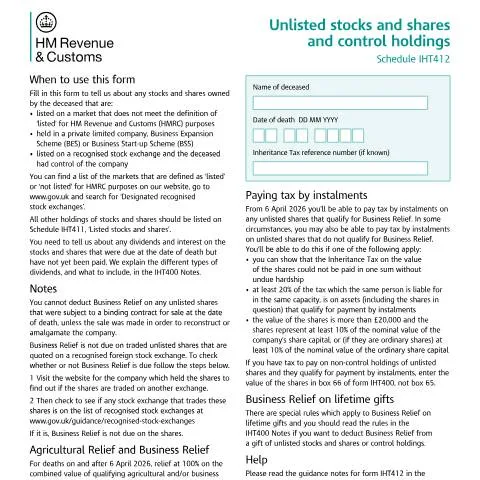
Navigating Inheritance Tax for Private Company Holdings: The IHT412 Complexity
When a loved one passes away owning shares in a private limited company or holding stakes in businesses traded on specialist markets like AIM, the inheritance tax implications become significantly more complex than standard listed securities. The IHT412 schedule emerges as a critical component of the estate's tax return, specifically designed to capture the nuances of unlisted stocks and control holdings that fall outside conventional market definitions.
Unlike straightforward listed shares handled through the IHT411 schedule, these holdings present unique valuation challenges and eligibility questions for Business Relief that can dramatically impact the final tax liability. The distinction between what HMRC considers 'listed' versus 'unlisted' often surprises executors, particularly when dealing with Alternative Investment Market shares or foreign exchange listings that don't qualify for standard treatment.
The Definitional Maze: What Constitutes Unlisted Holdings
The IHT412 captures three distinct categories of shareholdings that require specialised treatment. Traded unlisted securities include shares listed on markets that HMRC doesn't recognise as 'listed' for inheritance tax purposes, despite being publicly traded. This creates confusion when AIM-listed companies, for instance, require unlisted treatment despite their public profile.
Private company holdings encompass shares in limited companies not traded on any recognised exchange, including Business Expansion Scheme and Business Start-up Scheme investments. These typically require professional valuation given the absence of market pricing mechanisms.
The third category involves control holdings where the deceased owned sufficient shares in a listed company to exercise control, fundamentally altering the tax treatment despite the underlying company's public status. The threshold for control isn't explicitly defined in the form, requiring reference to broader inheritance tax legislation and case law.
Foreign Exchange Complications
Determining listing status becomes particularly intricate with international holdings. Shares traded on recognised foreign stock exchanges may still require IHT412 treatment if they don't meet HMRC's specific listing criteria. The form directs executors to cross-reference the government's designated recognised stock exchanges list, but this requires checking both the primary listing and any secondary trading venues.
Business Relief Calculations: The New Landscape from April 2026
The inheritance tax relief framework underwent substantial revision for deaths occurring from 6 April 2026 onwards, fundamentally altering the calculations required on form IHT412. The introduction of a £2.5 million combined limit for 100% Agricultural and Business Relief creates a two-tier system that executors must navigate carefully.
| Relief Category | Value Threshold | Relief Rate | Additional Considerations |
|---|---|---|---|
| Qualifying property (first £2.5m) | £0 - £2.5 million | 100% | Includes lifetime gifts within 7 years |
| Qualifying property (excess) | Above £2.5 million | 50% | Applies to all qualifying categories |
| AIM and similar unlisted shares | Any value | 50% maximum | Regardless of £2.5m threshold |
| Binding contract for sale | Any value | 0% | Unless company reconstruction |
This tiered approach requires executors to aggregate all qualifying business and agricultural property across the entire estate, including trust assets and lifetime transfers, before determining the appropriate relief rates for individual holdings listed on IHT412.
The AIM Share Anomaly
Alternative Investment Market shares face particularly restrictive treatment under the new rules. Despite potentially qualifying for Business Relief as unlisted securities, AIM shares can now only claim 50% relief maximum, regardless of other factors. This represents a significant departure from previous treatment and requires specific identification on the form.
Instalment Payment Elections: Strategic Timing Decisions
The form introduces new complexities around instalment payment options for inheritance tax on unlisted shares. From April 2026, executors gain broader flexibility to spread tax payments, but this requires strategic decision-making during the initial return preparation.
Three distinct pathways enable instalment payments on unlisted holdings. The undue hardship provision allows instalment arrangements where immediate full payment would create genuine financial difficulty, though this requires substantive evidence of the estate's liquidity constraints.
The 20% threshold rule permits instalments when at least one-fifth of the same person's total inheritance tax liability relates to instalment-qualifying assets. This calculation becomes complex when executors hold multiple capacities or when beneficiaries inherit different asset types.
The 10% Shareholding Gateway
For non-control holdings exceeding £20,000 in value, instalment payment becomes available when the deceased held at least 10% of the company's nominal share capital. This threshold applies differently for ordinary versus preference shares, requiring careful analysis of the company's capital structure.
Crucially, elections for instalment payments affect where values appear on the main IHT400 return. Instalment-eligible amounts transfer from box 65 to box 66, impacting the overall tax calculation timeline and creating potential cascading effects on other relief calculations.
Valuation Challenges and Professional Requirements
Unlike listed securities with readily available market prices, unlisted holdings demand sophisticated valuation approaches that often require professional input. The IHT412 schedule accommodates this complexity through its structured approach to capturing both market values and dividend entitlements.
For private company shares, executors must establish fair market value as of the date of death, considering factors including company performance, asset backing, dividend history, and market conditions. This process often involves engaging chartered business valuers or specialist accountants familiar with HMRC's valuation principles.
Dividend calculations present additional complexity, particularly for unlisted companies with irregular distribution patterns. The form requires disclosure of dividends declared but unpaid at the date of death, necessitating detailed review of company records and board resolutions.
Control Premium Considerations
When holdings confer control, valuations must reflect the premium typically associated with controlling interests. This requires analysis of the deceased's actual influence over company decisions, consideration of other shareholders' rights, and assessment of any restrictions on share transfers or voting rights.
Integration with the Broader IHT400 Return Process
The IHT412 schedule functions as a subsidiary document to the main IHT400 inheritance tax return, with specific cross-referencing requirements that executors must observe meticulously. Values from different sections of IHT412 populate distinct boxes on the main return, each carrying different tax implications and processing requirements.
Business Relief amounts calculated on IHT412 feed directly into box 64 of the IHT400, while gross values before relief appear in box 65 (or box 66 for instalment elections). This segregation enables HMRC to track both the underlying asset values and the relief claims separately, facilitating their compliance and audit processes.
The form's integration extends to dividend income calculations, which must align with other income disclosures across the estate. Executors must ensure consistency between IHT412 dividend entries and any corresponding income tax obligations or reliefs claimed elsewhere in the return.
Lifetime Gift Complications
When the deceased made lifetime gifts of unlisted shares within seven years of death, the IHT412 calculations become significantly more complex. The form must capture not only death estate holdings but also consider how lifetime transfers affect Business Relief availability and the new £2.5 million threshold calculations.
Special rules apply to Business Relief on lifetime gifts, requiring executors to trace the history of transferred shares and assess whether relief remains available. This often necessitates obtaining updated company information and confirming the continuing business nature of activities at both gift and death dates.
Common Pitfalls and Compliance Safeguards
The complexity of IHT412 creates numerous opportunities for costly errors that can trigger HMRC enquiries or result in additional tax charges. Misclassification between listed and unlisted status represents perhaps the most frequent error, particularly with AIM shares or foreign exchange listings where the classification isn't immediately obvious.
Executors frequently underestimate the documentation requirements for Business Relief claims. HMRC expects comprehensive evidence supporting the business nature of activities, the deceased's involvement level, and compliance with the minimum ownership periods. Inadequate documentation can result in relief being denied entirely, creating substantial additional tax liabilities.
The new relief limitation rules create additional compliance complexity. Executors must maintain detailed records showing how the £2.5 million threshold applies across all qualifying property, including lifetime gifts and trust assets that may not be immediately obvious from the death estate alone.
Professional Representation Considerations
Given the technical complexity and significant financial implications, many estates benefit from professional representation when completing IHT412. Specialist inheritance tax practitioners can navigate the valuation requirements, optimise relief claims, and ensure compliance with the increasingly complex regulatory framework.
The form's interaction with broader tax planning strategies also warrants professional input. Decisions around instalment payments, relief optimization, and compliance with the new threshold rules can have lasting implications for beneficiaries and may require coordination with ongoing business succession planning.
Post-Submission Procedures and HMRC Engagement
Following IHT412 submission, HMRC's processing approach varies significantly depending on the complexity and value of holdings disclosed. Straightforward cases with well-documented valuations and clear relief entitlements typically progress through standard processing channels, with clearance certificates issued within established timeframes.
Complex cases involving substantial unlisted holdings, novel business structures, or significant relief claims often trigger detailed HMRC review. This may involve specialist inheritance tax units requesting additional documentation, independent valuations, or detailed explanations of business activities and relief calculations.
The new relief limitation rules have intensified HMRC scrutiny of Business Relief claims. Estates claiming relief approaching or exceeding the £2.5 million threshold can expect detailed examination of qualifying criteria, lifetime gift history, and the aggregation calculations determining relief rates.
Executors should prepare for potential queries regarding valuation methodologies, particularly for private company shares where market comparables may be limited. HMRC increasingly challenges optimistic valuations and may commission independent professional opinions where significant discrepancies emerge.
The instalment payment elections also create ongoing compliance obligations. Executors must maintain accurate records of payment schedules and ensure timely submissions to avoid default interest charges that can significantly increase the total tax burden on complex estates involving substantial unlisted holdings.
Valuation Methodologies for Different Types of Unlisted Securities
The valuation approach for unlisted stocks and shares varies significantly depending on the specific type of security and the circumstances surrounding the shareholding. HMRC recognises that unlike listed securities with readily available market prices, unlisted investments require careful assessment using recognised valuation principles.
For ordinary shares in private limited companies, the earnings-based method often provides the most reliable foundation. This approach considers the company's maintainable earnings, applying an appropriate price-to-earnings multiple derived from comparable listed companies, adjusted for factors such as size, marketability, and specific risks. The net asset value method becomes particularly relevant when the company holds significant tangible assets or when earnings are volatile or non-existent.
Preference shares require distinct consideration, as their value typically depends on dividend yield and security of income rather than growth prospects. The valuation must account for any cumulative dividend rights, conversion features, or redemption provisions that could affect their worth.
Share options and warrant holdings present unique challenges, as their value depends on the underlying share price, exercise price, and time to expiry. The Black-Scholes model or similar option pricing methods may be appropriate, though adjustments for lack of marketability are often necessary.
When dealing with shares in holding companies, the sum-of-the-parts approach typically applies, valuing each underlying investment separately before aggregating to determine the holding company's worth. This method requires careful consideration of any holding company discount that might apply due to the additional layer of ownership.
For shares in companies with significant property holdings, a hybrid approach combining both earnings and asset-based valuations may be most appropriate. The choice of method should reflect how a hypothetical purchaser would likely approach the valuation in the open market.
Control Premiums and Minority Discounts in Estate Valuations
The level of control exercised through a shareholding fundamentally affects its valuation for inheritance tax purposes. HMRC's approach to control premiums and minority discounts reflects the principle that the value should represent what a willing buyer would pay a willing seller in the open market.
A controlling interest, typically defined as holding more than 50% of voting rights, commands a premium because it confers the ability to direct company policy, appoint directors, and determine dividend distributions. This control premium can range from 20% to 50% or more, depending on the specific rights attached and the company's circumstances. However, the premium must be justified by the actual benefits that control provides in the particular case.
Conversely, minority shareholdings usually suffer a discount reflecting their limited influence over company decisions. A 10% shareholding in a family company, for instance, might be discounted by 30-40% from its pro-rata share of the company's total value. The discount reflects not only the lack of control but also the reduced marketability of minority stakes in private companies.
Special considerations apply when valuing related holdings. If the deceased held 40% of shares and their spouse holds 30%, HMRC may argue that together they represent a controlling bloc, affecting the valuation of the deceased's holding. The concept of "related property" under Section 161 IHTA 1984 can significantly impact valuations where family members hold complementary shareholdings.
Articles of association play a crucial role in determining control rights. Pre-emption rights, drag-along provisions, and tag-along rights can all affect how much a potential purchaser might pay for shares. A minority holding with strong protective rights might suffer less discount than one with limited protection.
The timing of control transfer also matters. If the deceased's death triggers a change of control—perhaps through voting trust arrangements or specific provisions in a shareholders' agreement—this could affect the valuation of their holding at the date of death.
Professional Valuation Requirements and HMRC Acceptance Criteria
HMRC maintains specific expectations regarding professional valuations submitted with Form IHT412, recognising that the complexity of unlisted securities typically requires specialist expertise beyond that of general accountants or solicitors.
A professionally qualified valuer should hold relevant credentials, such as membership of the Royal Institution of Chartered Surveyors (RICS) for property-heavy companies, or the Institute of Chartered Accountants with specific corporate finance experience. For complex cases involving intellectual property or specialist sectors, industry-specific expertise becomes essential.
The valuation report must demonstrate a thorough understanding of the company's business, including its trading history, market position, competitive landscape, and future prospects. HMRC expects to see evidence of proper due diligence, including review of management accounts, cash flow projections, and any recent transaction evidence.
Methodology transparency is crucial. The report should clearly explain why particular valuation methods were chosen, how comparable companies were selected, and what adjustments were made for company-specific factors. Where multiple methods are used, the rationale for weighting them should be explicit.
HMRC pays particular attention to the discount rates applied. For earnings-based valuations, the cost of equity calculation should reflect the company's specific risk profile, including operational risks, financial leverage, and management depth. Generic discount rates without proper justification are likely to face challenge.
Recent transaction evidence carries significant weight when available. Sales of shares in the same company within the preceding 18 months provide strong evidence of value, though adjustments may be necessary for changed circumstances or different rights attaching to the shares sold.
The valuation date sensitivity analysis helps demonstrate robustness. HMRC appreciates seeing how the valuation might differ if key assumptions changed, particularly where the death occurred during a period of business uncertainty or market volatility.
Documentation supporting the valuation should be comprehensive but relevant. While HMRC doesn't require every piece of company information, they expect sufficient detail to verify the valuer's conclusions. This typically includes recent accounts, management information, board minutes discussing significant matters, and any professional advisers' reports that might affect value.
For significant valuations, HMRC may commission their own specialist review through the Valuation Office Agency or external experts. Having a well-documented, professionally prepared valuation report significantly improves the prospects of acceptance without lengthy correspondence or formal dispute procedures.