Understanding When Your Estate Requires a Full Inheritance Tax Account
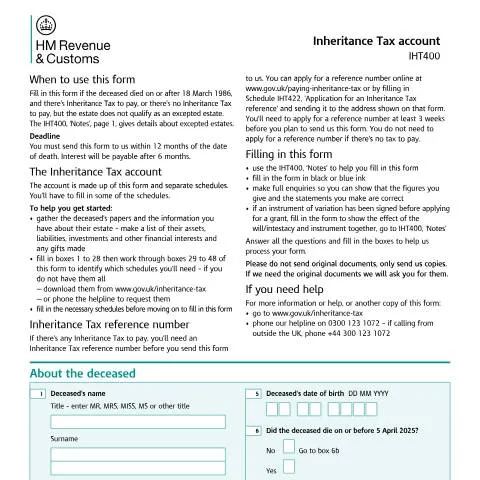
When someone dies in the UK, their estate typically needs some form of tax declaration to HMRC. However, not all estates face the same administrative burden. The IHT400 Inheritance Tax account represents the comprehensive route—a detailed disclosure required when an estate doesn't qualify as an "excepted estate" or when Inheritance Tax is actually payable.
This distinction matters enormously. Excepted estates—generally those valued under £325,000 or qualifying for spouse exemption—can often use simpler procedures. But if the deceased owned property, had significant investments, made substantial gifts in their lifetime, or if the estate's value hovers around or exceeds the nil-rate band, you'll likely find yourself completing this multi-schedule account.
The form serves as HMRC's gateway to understanding the complete financial picture of the deceased. It captures not just assets at death, but also gifts made within seven years, trust arrangements, foreign assets, and complex financial structures. For executors and administrators, it represents both a legal obligation and a practical necessity—no grant of probate or letters of administration can typically be obtained without HMRC's clearance.
The Critical Twelve-Month Window and Its Financial Implications
The IHT400 operates under strict statutory deadlines that carry real financial consequences. You must submit the completed account within twelve months of the date of death. This isn't merely an administrative target—it's a legal requirement with interest charges attached.
More immediately pressing, interest on any unpaid Inheritance Tax begins accruing after just six months from death. This creates a challenging timeline for executors, particularly when estates involve complex assets requiring professional valuation, such as unquoted shares, business interests, or property in need of detailed surveying.
The twelve-month deadline applies regardless of whether probate has been granted. Even if legal complications delay the grant, HMRC expects their account on time. This often means working with provisional valuations and later submitting corrective accounts if final figures differ significantly from initial estimates.
| Timeline | Requirement | Consequence of Delay |
|---|---|---|
| Within 6 months of death | Pay any Inheritance Tax due | Interest charges begin |
| Within 12 months of death | Submit completed IHT400 account | Potential penalties and continued interest |
| Before applying for grant | Obtain HMRC clearance (if tax payable) | Probate registry won't process application |
Navigating the Schedule System: Building Your Complete Account
The IHT400 form itself is merely the foundation of a potentially extensive filing. The real complexity lies in determining which of the numerous supplementary schedules apply to your specific estate. Each schedule captures different categories of assets, reliefs, or circumstances.
Common schedules include IHT405 for houses, land, and buildings, IHT406 for business assets, and IHT407 for household goods. More specialized situations trigger schedules like IHT409 for pensions, IHT418 for foreign assets, or IHT430 for agricultural relief claims.
The form's boxes 29 to 48 act as a diagnostic tool, helping you identify which schedules you'll need. This section requires careful attention because missing a relevant schedule can lead to incomplete disclosure and potential penalties. It's often wise to review all available schedules rather than relying solely on the form's prompts, particularly for estates with diverse asset portfolios.
Strategic Approach to Schedule Selection
Before diving into individual schedules, create a comprehensive asset inventory. List every bank account, investment, property, business interest, and significant personal possession. Don't forget less obvious items like outstanding loans to the deceased, accrued interest, or rights under insurance policies.
For gifts made by the deceased, you'll need details going back seven years from the date of death. This includes not just formal gifts but also any transfers at undervalue, such as selling property to family members below market rate.
Securing Your Inheritance Tax Reference Number
If your estate owes Inheritance Tax, you cannot simply submit the IHT400 and wait. You must first obtain an Inheritance Tax reference number, and this process requires advance planning. HMRC recommends applying at least three weeks before you intend to submit your main account.
The reference number application can be completed online through the government's digital service or by submitting schedule IHT422. This preliminary step serves multiple purposes: it establishes your estate in HMRC's system, provides the reference needed for tax payments, and begins the formal relationship between the estate and the tax authority.
Estates with no tax liability skip this requirement entirely—another reason why accurate preliminary calculations matter. However, if you're uncertain about the tax position, it's generally safer to apply for a reference number rather than risk delays later.
Payment Timing and Methods
The reference number becomes crucial for making payments. You'll need it to identify payments correctly, whether made by bank transfer, cheque, or through HMRC's online services. For large tax bills, consider whether the estate qualifies for paying by instalments—typically available for land, unquoted shares, or business assets that might take time to liquidate.
Completing the Core Form: From Personal Details to Asset Declaration
The IHT400's opening sections establish the deceased's identity and circumstances, but these apparently straightforward boxes can hide complexity. The domicile question in box 6a, for instance, isn't simply about where someone lived—it's a legal concept affecting which assets fall within the UK tax net.
Domicile determination can be particularly complex for individuals who've lived in multiple countries or who moved to the UK later in life. Someone might be UK resident for tax purposes but retain a foreign domicile, significantly affecting their Inheritance Tax liability. If there's any doubt, complete schedule IHT401 for foreign domiciled individuals.
The marital status questions connect to crucial reliefs. Surviving spouses and civil partners benefit from unlimited exemption for assets passing to them, while the transferable nil-rate band provisions can effectively double the threshold for couples where the first spouse didn't use their full allowance.
Property and Residence Rights
Box 12's question about property ownership catches many executors off-guard. It's not asking whether the deceased owned their home outright, but whether they had any ownership interest or right of residence. This includes joint tenancies, tenancies in common, life interests, or even informal arrangements where they contributed to purchase but weren't on the title.
The distinction matters because different ownership structures affect both valuation and available reliefs. Joint tenancies pass automatically to survivors outside the will, but the deceased's share still requires valuation for tax purposes.
Will Documentation and Variation Instruments
The will-related sections beginning at box 24 require careful attention to timing and documentation. If the deceased left a will, you must provide a copy, but the form also asks about instruments of variation—legal documents that can alter the will's effect for tax purposes.
Variations, sometimes called deeds of family arrangement, allow beneficiaries to redirect inheritances within two years of death. Crucially, if a variation has been executed before applying for probate, you must complete the IHT400 showing the effect of both the original will and the variation together.
This creates a practical challenge: variations often aim to optimize tax efficiency, but you need to calculate and declare the tax position before finalizing the variation. Professional advice becomes particularly valuable here, as the interaction between original bequests, variations, and available reliefs can be complex.
Power of Attorney Considerations
Box 16 addresses powers of attorney that operated during the deceased's lifetime. This isn't merely historical information—actions taken under lasting or enduring powers of attorney might affect the estate's tax position. Gifts made by attorneys, property transactions, or investment decisions could all impact the final account.
HMRC requires copies of relevant powers of attorney to understand the authority under which pre-death transactions occurred. This helps them assess whether such transactions represent legitimate estate planning or require closer scrutiny under anti-avoidance provisions.
Professional Representation and Contact Management
Boxes 17-23 establish who HMRC will communicate with throughout the process. This might seem administrative, but choosing the right representative and providing accurate contact details prevents costly delays. HMRC's correspondence often contains time-sensitive requests for additional information or clarification.
The bank account details in boxes 21-23 serve a specific purpose: facilitating refunds of overpaid tax through Faster Payments. While hoping for a refund might seem optimistic when facing a large tax bill, it's not uncommon for initial payments based on provisional valuations to exceed the final liability.
Professional representation often proves invaluable, not just for technical expertise but for managing HMRC relationships. Solicitors and specialist tax advisers understand HMRC's requirements and can navigate queries or challenges more efficiently than lay executors.
Record-Keeping and Ongoing Obligations
The IHT400 begins a relationship with HMRC that might extend years beyond submission. Keep detailed records of all supporting documentation, correspondence, and calculations. HMRC can enquire into returns for years after submission, particularly if they suspect incomplete disclosure or significant errors.
Remember that submitting the IHT400 isn't always the end of the process. Corrective accounts might be needed if asset valuations change, if additional assets emerge, or if HMRC challenges your initial figures. The account represents your best understanding at the time, but it must be honest, complete, and based on reasonable enquiries into the deceased's affairs.
Common Valuation Challenges and Professional Assessment Requirements
Accurate asset valuation forms the cornerstone of any IHT400 submission, yet executors frequently encounter complex scenarios that demand specialist expertise. Understanding when professional valuations become mandatory—and when they merely represent prudent practice—can significantly impact both compliance and potential disputes with HMRC.
For residential property, the 'date of death' valuation must reflect market conditions at that precise moment, not current values or purchase prices from years earlier. Properties in volatile markets, those with unusual features, or homes requiring significant repairs present particular challenges. HMRC expects executors to obtain formal valuations for properties worth over £500,000, though this threshold isn't absolute. Even modest properties may require professional assessment if they possess unique characteristics—period features in conservation areas, agricultural ties, or development potential that affects market value.
Business assets and shares in private companies demand especially careful treatment. Unquoted shares require specialist business valuers familiar with Revenue methodology, particularly where minority shareholdings or restrictions on transfer apply. The concept of 'related property'—where the deceased's shareholding must be valued alongside shares held by their spouse or civil partner—can dramatically alter valuations and potentially push estates over the nil-rate band threshold.
Foreign assets present additional complexity layers. Property abroad must be valued according to local market conditions, yet the IHT400 requires sterling equivalents using exchange rates from the date of death. Bank accounts in foreign currencies, overseas pensions, and international investment portfolios each carry specific reporting requirements. Executors must distinguish between assets subject to UK inheritance tax and those covered by double taxation treaties, ensuring proper relief claims where applicable.
Chattels and personal effects often prove more valuable than families initially anticipate. Jewellery, artwork, antiques, and collections require careful assessment. Items worth over £6,000 individually need professional valuation, but executors must also consider whether collections should be valued as single units. A deceased's extensive library might individually contain no valuable books, yet as a complete collection could command significant sums. Similarly, sets of furniture, china services, or stamp collections may warrant specialist attention even when individual pieces appear unremarkable.
Agricultural and Business Property Relief: Maximising Available Allowances
Agricultural Property Relief (APR) and Business Property Relief (BPR) represent two of the most valuable inheritance tax mitigations available, yet their application requires meticulous attention to qualifying conditions and potential pitfalls that can void relief entirely.
Agricultural Property Relief applies at either 50% or 100% rates, depending on occupation circumstances and the nature of agricultural use. The full 100% relief applies where the deceased occupied agricultural property for farming purposes throughout the two years before death, or where they owned the property and it was occupied by another for agricultural purposes for at least seven years before death. However, 'agricultural purposes' carries a specific legal definition that excludes many activities rural property owners might assume qualify. Livery stables, riding schools, farm shops selling predominantly non-farm produce, or land used primarily for horses kept for pleasure rather than breeding don't automatically qualify.
The 'working farmer' requirement demands active agricultural involvement rather than passive land ownership. HMRC scrutinises whether the deceased genuinely participated in farming activities or merely owned agricultural land let to others. Contract farming arrangements, where landowners retain significant control over farming operations while engaging contractors, may qualify, but share farming or straightforward lettings typically don't meet the occupation test for 100% relief.
Business Property Relief offers similar rates but applies to qualifying business assets, including sole trader businesses, partnerships interests, and shareholdings in unquoted trading companies. The 100% relief rate applies to most trading businesses, but investment companies—those whose activities consist wholly or mainly of making investments—qualify only for 50% relief or may be excluded entirely.
The 'wholly or mainly trading' test proves particularly challenging for property investment businesses, holiday letting operations, or companies with substantial cash reserves. A company deriving income primarily from property rentals won't qualify for BPR, but businesses providing substantial additional services—furnished holiday lets with significant ancillary services, or property development rather than mere investment—may meet the trading requirement.
Both reliefs demand minimum ownership periods—generally two years for most assets, though some require seven years. Replacement property provisions allow relief to continue where qualifying assets are sold and proceeds reinvested in other qualifying assets within three years, but executors must carefully track these transactions to maintain relief eligibility.
Mixed-use properties present particular complications. Farmhouses qualify for APR only to the extent they're occupied for agricultural purposes. Where substantial portions serve as family homes unconnected to farming activities, or where the property is disproportionately large relative to the agricultural operation, partial relief may apply. Similarly, business premises combining trading activities with investment elements require careful apportionment to determine qualifying proportions.
Instalment Payment Options and Cash Flow Management Strategies
Inheritance tax bills can create severe cash flow pressures for estates, particularly where assets comprise illiquid investments or family businesses that executors prefer not to sell immediately. HMRC's instalment payment facility provides crucial breathing space, though eligibility criteria and interest implications require careful consideration.
Instalment payments apply automatically to certain qualifying assets, primarily land and buildings, unquoted company shares, and business assets qualifying for Business Property Relief. The facility allows inheritance tax attributable to these assets to be paid in ten equal annual instalments, with the first payment due by the normal deadline and subsequent instalments falling due on the same date each following year.
However, instalment payments aren't interest-free. HMRC charges interest on outstanding balances, currently at rates that may exceed commercial borrowing costs. Executors must therefore weigh the convenience of deferred payments against interest charges, particularly where estates could access credit facilities or dispose of non-qualifying assets to meet immediate tax liabilities.
The instalment facility becomes particularly valuable where qualifying assets generate ongoing income. Rental properties, for instance, can continue producing rental income while inheritance tax is paid gradually. Similarly, family businesses can continue trading, potentially generating sufficient profits to service instalment payments without requiring asset sales that might damage business operations.
Where qualifying assets are sold before all instalments are paid, the outstanding balance becomes immediately due. This 'acceleration clause' requires careful timing of any planned disposals. Executors might prefer to sell non-qualifying assets first, retain qualifying assets until instalment payments are complete, or ensure sale proceeds are sufficient to discharge remaining tax liabilities.
Certain assets qualify for 'interest-free' instalment treatment, notably woodlands and some heritage assets. These provisions recognise the special nature of assets that shouldn't be forced into premature sale to meet tax liabilities. However, eligibility criteria are strict, and executors must demonstrate that assets genuinely qualify for this preferential treatment.
Payment timing strategies can significantly impact overall tax costs. Where estates comprise multiple asset types, executors might sequence asset realisations to maximise use of instalment facilities while minimising interest charges. Selling highly liquid investments first, retaining property assets to benefit from instalment treatment, and timing business asset disposals to coincide with final instalment payments can optimise cash flow management.
Direct debit arrangements for instalment payments reduce administrative burden and ensure payments are never missed, avoiding potential penalties. However, executors must ensure estate accounts maintain sufficient funds throughout the instalment period, particularly where rental income or business profits might fluctuate seasonally.