When Inheritance Crosses Paths: The IHT415 Form for Unresolved Estate Interests
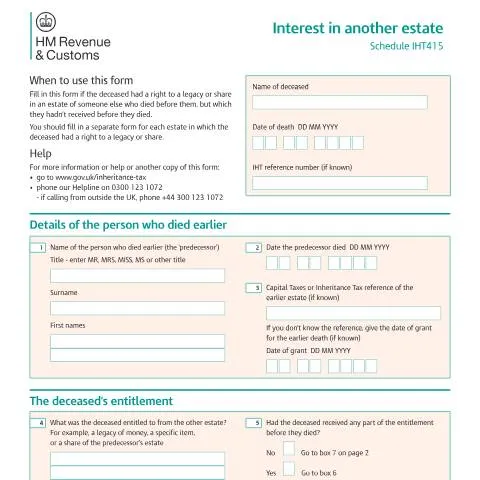
Estate administration becomes particularly complex when a deceased person held an interest in another person's estate that remained unresolved at the time of their death. This scenario—more common than many realise—creates a chain of inheritance obligations that requires careful documentation through form IHT415, HM Revenue & Customs' dedicated schedule for reporting interests in other estates.
Consider this situation: Margaret dies in 2019, leaving her estate to be divided among three children. Before the estate administration concludes, one of those children, David, dies in 2022. David's personal representatives must now account for his inheritance rights from Margaret's estate, even though he never actually received the assets. This is precisely where form IHT415 becomes essential—capturing the value of David's entitlement for inheritance tax purposes on his own estate.
The form addresses a fundamental principle in inheritance tax law: interests in property are valued at the date of death, regardless of whether the deceased had physically received or could access those assets. This ensures comprehensive tax assessment whilst preventing artificial arrangements that might otherwise reduce inheritance tax liability.
The Legal Framework Behind Unresolved Estate Interests
Under UK inheritance tax legislation, when someone dies with an outstanding interest in another person's estate, that interest forms part of their taxable estate for IHT purposes. The Data Protection Act 2018 and UK GDPR govern how personal information from multiple estates must be handled during this process, requiring careful coordination between different sets of personal representatives.
The timing of deaths creates different scenarios that affect how form IHT415 must be completed. If the predecessor (the person who died first) passed away before 13 March 1975, different valuation rules may apply. For deaths after this date, the standard inheritance tax framework applies, but the complexity increases when dealing with partially administered estates.
Personal representatives must distinguish between several types of interests when completing IHT415:
- Specific legacies: Fixed amounts of money or particular items bequeathed to the deceased
- Pecuniary legacies: Monetary gifts that may fluctuate based on estate administration costs
- Residuary interests: Shares in whatever remains after specific legacies and expenses
- Life interests: Rights to income or occupation that terminate on death but may have capital value
Each category requires different valuation approaches and supporting documentation, making accurate completion of form IHT415 crucial for compliance with HMRC requirements.
Identifying When Form IHT415 Becomes Necessary
The trigger for using form IHT415 is straightforward in principle but can be complex in application. The form is required whenever the deceased held any right to receive assets from another person's estate, regardless of the size or nature of that interest. This includes situations where the predecessor's estate administration was delayed, contested, or involved complex assets requiring extended valuation periods.
Common scenarios requiring IHT415 completion include:
| Situation | Form Required | Key Considerations |
|---|---|---|
| Deceased named as beneficiary in will, predecessor's estate not yet distributed | Yes - IHT415 | Value interest at deceased's death date |
| Partial distribution received, remainder outstanding | Yes - IHT415 | Report only unreceived portion |
| Interest in trust created by predecessor's will | Yes - IHT415 | May require specialist valuation |
| Right to claim against predecessor's estate under Inheritance Act | Possibly | Depends on likelihood of successful claim |
The form must be completed separately for each estate in which the deceased held interests. If someone was entitled to receive assets from three different predecessor estates, three separate IHT415 forms would be required, each detailing the specific entitlements from that particular estate.
Timing considerations also affect when the form becomes necessary. If the predecessor died many years earlier but estate administration continues, the deceased's interest must still be reported. Conversely, if the predecessor's estate was fully administered and all assets distributed before the deceased's death, no IHT415 would be required for that estate.
Complex Scenarios Requiring Additional Documentation
Certain situations demand particularly careful attention when determining IHT415 requirements. When the predecessor's estate included overseas assets, the deceased's entitlement may involve foreign tax implications that affect the UK inheritance tax calculation. Similarly, if the predecessor's estate is subject to ongoing litigation, the value of the deceased's interest may be uncertain, requiring estimated valuations with subsequent adjustments.
Business interests present another layer of complexity. If the deceased was entitled to shares in a family company through the predecessor's estate, reliefs such as business property relief might apply, but only if specific conditions are met at the time of the deceased's death, not when the predecessor died.
Navigating the IHT415 Structure and Content Requirements
Form IHT415 follows a logical progression from identifying the parties involved to quantifying the deceased's entitlement. The opening section requires details of both the deceased and the predecessor, including full names, dates of death, and any available reference numbers from previous HMRC correspondence or grant applications.
The predecessor identification section serves multiple purposes beyond simple record-keeping. HMRC uses this information to cross-reference with existing records and may contact the predecessor's personal representatives to verify details. The IHT reference number or Capital Taxes reference from the earlier death, if available, significantly expedites this process.
When these reference numbers are unknown, the date of grant for the predecessor's estate becomes crucial. This allows HMRC to locate the relevant records through the Probate Registry. If neither reference numbers nor grant dates are available, personal representatives should provide as much information as possible about the predecessor's estate, including the names of solicitors or other professionals involved in its administration.
Detailing the Nature of Entitlement
The form distinguishes between different categories of assets within the deceased's entitlement, reflecting the varying inheritance tax treatment these may receive. Houses, land and buildings require separate identification due to potential reliefs and the specific valuation requirements for real property.
Business interests and controlling shareholdings also receive separate treatment, recognising that business property relief might apply to reduce the inheritance tax liability. The form requires careful consideration of whether the deceased's entitlement would have constituted a controlling interest, as this affects both valuation and available reliefs.
All other assets—including cash, investments, personal possessions, and non-controlling shareholdings—are grouped together in the final category. This section often contains the most diverse range of assets and requires detailed description to enable accurate valuation.
Valuation Challenges and Estimation Procedures
Valuing interests in unresolved estates presents unique challenges that distinguish IHT415 from other inheritance tax forms. The fundamental principle requires valuation at the date of the deceased's death, not when the predecessor died or when assets might eventually be distributed. This creates practical difficulties when the predecessor's estate contains assets whose values fluctuate or remain uncertain.
For specific legacies, valuation is relatively straightforward. If the deceased was entitled to £10,000 from the predecessor's estate, that amount appears on form IHT415 regardless of whether the predecessor's estate ultimately has sufficient funds to pay it in full. However, if the legacy concerned specific assets—such as jewellery or artwork—those items must be valued at the deceased's death date, not their value when the predecessor died.
Residuary interests demand more complex calculations. Personal representatives must determine what remained in the predecessor's estate at the deceased's death date, value those assets at current prices, deduct any outstanding liabilities and unpaid legacies, then calculate the deceased's proportionate share.
Working with Estimates and Subsequent Adjustments
HMRC recognises that precise valuations may not always be available when IHT415 must be submitted, particularly when grant applications have statutory deadlines. The form specifically accommodates estimates, provided they are clearly identified as such and based on reasonable assumptions.
When using estimates, personal representatives should document their methodology and assumptions. For example, if estimating the value of shares in a private company within the predecessor's estate, the basis for that estimate—recent accounts, professional valuations, or comparable transactions—should be noted for future reference.
The use of estimates creates ongoing obligations. Personal representatives must monitor the actual administration of the predecessor's estate and notify HMRC if significant variances emerge. This might trigger amended inheritance tax calculations and additional payments or refunds.
Integration with Form IHT400 and Estate Administration
Form IHT415 operates as a supporting schedule to the main inheritance tax return, form IHT400. The totals from boxes 71 and 72 of IHT415 transfer directly to the corresponding boxes on IHT400, ensuring that interests in other estates are properly incorporated into the overall inheritance tax calculation.
This integration affects the timing of both forms' submission. IHT415 must be completed before IHT400 can be finalised, creating potential scheduling challenges when information about the predecessor's estate remains incomplete. Personal representatives may need to coordinate with multiple sets of executors or administrators to gather necessary information.
The relationship between IHT415 and IHT400 also influences relief calculations. Business property relief or agricultural property relief available on interests reported in IHT415 must be calculated based on the circumstances at the deceased's death, not the predecessor's death. This may require fresh professional valuations and eligibility assessments.
Record Keeping and Future Compliance
Completion of form IHT415 creates ongoing record-keeping obligations that extend beyond the initial inheritance tax assessment. Personal representatives must retain documentation supporting the valuations and entitlements reported, as HMRC may request verification during routine compliance reviews or specific enquiries.
These records become particularly important if the predecessor's estate administration concludes significantly after the deceased's death. The actual distribution may differ from the amounts reported on IHT415, requiring corrective action and potential adjustment to the inheritance tax liability.
When multiple IHT415 forms are required for different predecessor estates, maintaining clear segregation of records prevents confusion and ensures accurate responses to any HMRC queries. Cross-referencing systems linking each IHT415 to its supporting documentation facilitate efficient administration and reduce the risk of errors in subsequent correspondence.
Professional Support and Complex Estate Interactions
The intersection of multiple estate administrations often benefits from professional guidance, particularly when significant values or complex assets are involved. Solicitors specialising in probate work frequently coordinate between different sets of personal representatives to ensure consistent information and valuations across related IHT415 submissions.
Chartered accountants and tax advisers play crucial roles when business interests or investment portfolios form part of the deceased's entitlement in other estates. Their expertise becomes essential for calculating appropriate reliefs and ensuring compliance with the technical requirements governing different asset categories.
Professional involvement also helps navigate the practical challenges of obtaining information from predecessor estates. Formal requests for information, supported by appropriate legal authority, may be necessary when predecessor estate administrators are reluctant to share details or when complex trust structures complicate the analysis.
The HMRC Inheritance Tax Helpline on 0300 123 1072 provides guidance on specific technical issues, though personal representatives should prepare detailed questions and have relevant reference numbers available to maximise the effectiveness of these consultations. For callers from outside the UK, the international number +44 300 123 1072 provides the same service.
Submission Procedures and Post-Filing Obligations
Form IHT415 must be submitted alongside the main IHT400 return, sharing the same deadlines and submission requirements. For estates requiring grants of representation, this typically means submission within twelve months of the death, though earlier submission is often necessary to meet court deadlines for grant applications.
The form can be submitted electronically through HMRC's online services or by post, depending on the submission method chosen for the overall inheritance tax return. Electronic submission offers advantages in terms of processing speed and automatic validation checks, though the complexity of multiple estate interactions may favour postal submission with comprehensive supporting documentation.
Post-submission obligations continue until all related estates are fully administered and any adjustments finalised. Personal representatives must monitor developments in predecessor estates and report material changes that affect the values or entitlements reported on IHT415.
This ongoing monitoring becomes particularly important when predecessor estates involve lengthy administration periods due to complex assets, family disputes, or regulatory approvals. Changes in asset values, discovery of additional liabilities, or successful challenges to wills can all affect the deceased's entitlement and require corresponding adjustments to the inheritance tax calculation.
The interconnected nature of estate administrations involving IHT415 means that final closure may not occur until all related estates reach completion. This extended timeline requires careful record-keeping and may influence decisions about when to seek final HMRC clearance for the deceased's estate.