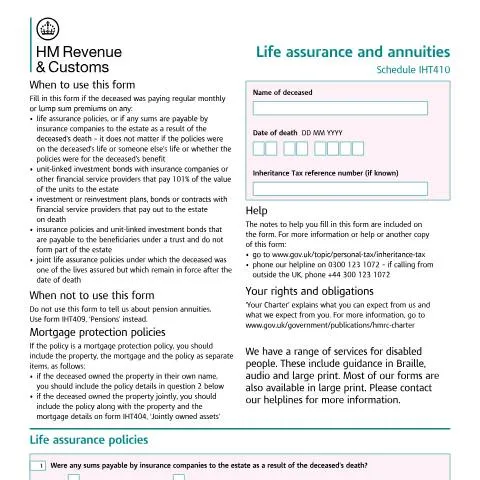
The Hidden Complexities of Insurance Products in Estate Valuations
When a death occurs, the personal representatives face the daunting task of calculating the deceased's estate value for inheritance tax purposes. While property and bank accounts might seem straightforward, life assurance policies and annuities present a labyrinth of valuation challenges that can catch even experienced executors off guard. The IHT410 schedule serves as HMRC's specialised tool for capturing these intricate financial arrangements, where the line between what belongs to the estate and what passes directly to beneficiaries becomes critically important.
This complexity arises because insurance products don't follow conventional ownership rules. A policy written in trust may have been paid for by the deceased but legally belongs to someone else entirely. Joint life policies continue paying out after one death, creating ongoing obligations that must be carefully assessed. Meanwhile, purchased annuities involve both capital and income elements that require separate treatment for tax purposes.
The stakes are considerable: misreporting these values can lead to significant underpayment of inheritance tax, triggering penalties and interest charges that can devastate an estate's final distribution to beneficiaries.
Decoding When IHT410 Becomes Essential
The schedule IHT410 isn't required for every death involving insurance - HMRC has established specific trigger points that determine when personal representatives must complete this detailed analysis. The form becomes mandatory when the deceased was paying regular monthly premiums or lump sum contributions on particular types of policies that result in payments to the estate upon death.
Life Assurance Policies Requiring Declaration
The most straightforward scenario involves traditional life assurance policies where sums become payable to the estate as a direct result of death. This encompasses policies taken out on the deceased's own life or on someone else's life, regardless of who originally established the policy or paid the premiums. Crucially, it doesn't matter whether the policies were intended for the deceased's benefit - what matters is the legal destination of the proceeds.
Unit-linked investment bonds with insurance companies fall into this category when they pay 101% of the unit value to the estate. These hybrid products combine investment growth with a minimal insurance wrapper, but that small insurance element brings them firmly within IHT410's scope.
Investment and Reinvestment Arrangements
More complex situations arise with investment or reinvestment plans, bonds, or contracts with financial service providers that trigger payouts upon death. These arrangements often blur the boundaries between pure investment products and insurance policies, but HMRC's focus remains on the practical outcome - whether death triggers a payment that forms part of the taxable estate.
Trust-Based Policies and Their Exclusions
Significantly, the form excludes insurance policies and unit-linked investment bonds that pay benefits directly to named beneficiaries under trust arrangements, as these don't form part of the deceased's estate for inheritance tax purposes. However, personal representatives must still be aware of these arrangements as they may need to be disclosed elsewhere in the IHT400 return for completeness.
Joint Life Policies: Navigating Continuing Obligations
Joint life assurance policies present one of the most intricate scenarios addressed by IHT410, particularly when they continue in force after one policyholder's death. These arrangements, common among married couples and business partners, create ongoing financial relationships that extend beyond the grave.
When the deceased was covered under a joint life policy that remains active, the continuing policy represents both an asset and a potential liability for inheritance tax purposes. The surviving policyholder maintains coverage, but the estate may have contributed to premiums that continue to provide benefits to others.
Valuation Challenges for Continuing Policies
The form requires detailed information about policies where the deceased was "one of the lives assured but which remain in force after the date of death". This creates a valuation puzzle: how do you quantify the deceased's interest in a policy that continues to protect someone else?
The insurance company's actuarial calculations become crucial here, as they must determine what portion of the policy's surrender value or ongoing premiums can be attributed to the deceased's participation. This often requires specialist valuations that consider factors such as:
- The deceased's age and health status at the policy's inception
- Relative premium contributions between the joint policyholders
- The remaining term and benefits structure of the continuing coverage
- Any guaranteed insurability options that were triggered by the death
Life Assurance on Another's Life: Third-Party Arrangements
Question 4 of IHT410 addresses a sophisticated estate planning scenario where the deceased held beneficial interests in life assurance policies written on other people's lives. These arrangements, often used in business succession planning or family wealth management, continue after the policy owner's death while still affecting their estate valuation.
Consider a business owner who took out life cover on a key employee or business partner. When the policy owner dies, the insurance policy itself becomes an asset of their estate, even though it insures someone else who remains very much alive. The policy continues in force, potentially for many years, creating an ongoing asset that must be valued and potentially managed by the deceased's personal representatives.
Valuation Methodology for Third-Party Life Policies
These policies require careful documentation because their value depends on factors entirely separate from the deceased's own mortality. The form requires specific details including the name of the person whose life remains assured, as this individual's age, health, and life expectancy directly impact the policy's current market value.
| Policy Information Required | Purpose for Valuation | Documentation Needed |
|---|---|---|
| Name of insured person | Actuarial life expectancy calculations | Policy schedule showing lives assured |
| Policy number and company | Obtaining current surrender values | Most recent annual statement |
| Death benefit amount | Determining maximum potential value | Original policy terms and conditions |
| Premium payment status | Assessing ongoing obligations | Payment history and future commitments |
Purchased Life Annuities: Separating Capital from Income
The final section of IHT410 tackles purchased life annuities, where the deceased bought an annuity contract that continued making payments after their death. Unlike pension annuities, which typically die with the annuitant, purchased annuities often include guarantees or joint-life features that create ongoing payment streams.
These arrangements require particularly careful analysis because annuity payments contain both capital and income elements. The capital portion represents the gradual return of the original purchase price, while the income element constitutes investment growth or interest. For inheritance tax purposes, only specific components may be relevant to the estate's valuation.
Distinguishing Purchased from Pension Annuities
HMRC explicitly excludes pension annuities from IHT410, directing personal representatives to use schedule IHT409 instead. This distinction matters enormously because pension annuities typically arise from occupational or personal pension schemes where the deceased accumulated benefits through employment or self-employed contributions, often with tax relief.
Purchased annuities, by contrast, represent personal investment decisions where the deceased used after-tax money to buy guaranteed income streams. These purchases often occur as part of retirement income planning, where individuals seek to balance investment risk with income security.
Calculating Guaranteed Payment Values
The form requires detailed information about ongoing payment streams, including repayment frequency, any increases built into the remaining guaranteed period, and the date when guaranteed payments will cease. This information enables HMRC to calculate the present value of future payments that will flow from the estate to beneficiaries.
Insurance companies typically provide guaranteed annuity calculators to help personal representatives determine these values, but the calculations can become complex when payments include inflation adjustments, step-ups, or other variable features.
Mortgage Protection Policies: Property-Linked Considerations
A specific guidance section addresses mortgage protection policies, which require careful coordination between IHT410 and other parts of the inheritance tax return. These policies, designed to pay off outstanding mortgage debt upon death, create interconnected valuations that affect both the property's net value and the estate's insurance proceeds.
When the deceased owned property solely in their name, the mortgage protection policy details belong in question 2 of IHT410, while the property itself and its associated mortgage debt appear elsewhere in the main IHT400 return. This separation ensures that both the asset (insurance proceeds) and the liability (mortgage debt) receive proper treatment without double-counting.
Joint property ownership complicates this arrangement significantly. The policy may need to be included alongside property and mortgage details on form IHT404 for jointly owned assets, rather than appearing on IHT410 at all. Personal representatives must carefully examine the policy terms to determine whether the insurance was arranged to protect joint interests or solely the deceased's share.
Cross-Border Implications and Scottish Variations
The form includes a notable reference to Scottish estates, where policies may be "listed on form C1, 'Inventory'" rather than requiring detailed repetition on IHT410. This reflects the different legal frameworks governing estate administration north of the border, where Scottish courts maintain their own inventory requirements for confirmation proceedings.
For Scottish estates, personal representatives must coordinate between the Sheriff Court's inventory requirements and HMRC's inheritance tax schedules, ensuring that insurance policies receive appropriate disclosure in both contexts without creating conflicting valuations or duplicate reporting.
International Insurance Arrangements
While not explicitly addressed in the form's visible sections, many deceased individuals hold insurance policies with overseas companies or policies that cover international risks. These arrangements may require currency conversion, foreign tax credit considerations, or treaty-based adjustments that complicate the straightforward valuation approach assumed by IHT410.
Personal representatives dealing with international insurance should contact HMRC's inheritance tax helpline for guidance on treatment of foreign policies, particularly where double taxation agreements might affect the UK tax liability or where foreign withholding taxes apply to insurance proceeds.
Integration with the Broader IHT400 Return
IHT410 functions as a supporting schedule to the main IHT400 inheritance tax account, with specific cross-references ensuring that insurance values flow correctly into the overall estate calculation. The total from box 6 (combining direct estate payments and third-party life policies) must be copied to box 57 of form IHT400, creating an audit trail that HMRC can verify during processing.
This integration becomes particularly important when estates approach the inheritance tax threshold, as insurance proceeds often push otherwise exempt estates into taxable territory. The precise valuation and categorisation of insurance products can determine whether an estate faces a substantial tax liability or qualifies for complete exemption.
Personal representatives should complete IHT410 before finalising their main IHT400 return, as the insurance valuations may reveal complexities requiring professional advice or additional documentation. The form's structured approach helps identify potential issues early in the estate administration process, allowing time for proper resolution before submission deadlines approach.
Pre-Death Planning Strategies and Policy Restructuring
Strategic planning around life assurance policies can significantly impact your Inheritance Tax liability, though any arrangements must comply with HMRC's anti-avoidance provisions. The timing and structure of policy modifications require careful consideration, particularly given the seven-year rule for potentially exempt transfers and the associated taper relief provisions.
When considering policy restructuring, the gift with reservation of benefit rules present particular challenges. If you continue to pay premiums on a policy you've gifted, HMRC may treat this as a reservation of benefit, potentially bringing the policy back into your estate for IHT purposes. However, there are legitimate structures where beneficiaries can assume premium responsibilities, though this requires proper documentation and genuine transfer of financial obligations.
Flexible whole of life policies offer particular opportunities for tax planning. These policies allow for premium adjustments and partial surrenders, enabling you to manage the policy's value and death benefit over time. For IHT410 purposes, you'll need to track any variations in coverage, as changes to sum assured or premium patterns can affect the policy's tax treatment and valuation methodology.
The concept of discounted gift trusts represents another sophisticated approach, though these require specialist advice. When you place a policy into trust whilst retaining rights to regular withdrawals, the initial gift value may be discounted to reflect your retained benefits. This creates an immediate reduction in your estate's value whilst preserving some income stream, though the discount calculation and withdrawal patterns must be carefully structured.
Loan arrangements can sometimes feature in advanced planning, where policies are used as security for borrowing. However, HMRC scrutinises such arrangements closely, particularly where loans are made between connected parties or where commercial terms don't genuinely apply. Any loan arrangements affecting policy ownership or benefits must be disclosed on form IHT410, with supporting documentation demonstrating the commercial nature of the arrangement.
For joint life policies, the survivorship element creates additional planning opportunities and complications. The policy typically pays out on the second death, which can provide funds specifically for IHT liabilities. However, the attribution of ownership and benefit between joint policyholders can affect how the policy is treated for IHT purposes, particularly where the policyholders have different domicile positions or where ownership shares don't reflect premium contributions.
International Dimensions and Cross-Border Complications
Cross-border elements significantly complicate both policy valuation and IHT liability, requiring additional documentation and often specialist professional advice. The interaction between UK Inheritance Tax and foreign tax systems creates layers of complexity that must be carefully navigated when completing form IHT410.
Overseas insurers present particular challenges for valuation and reporting. When policies are issued by non-UK insurance companies, you may need to obtain specialist valuations, particularly for policies that don't trade on recognised markets. Currency fluctuations add another layer of complexity, as you'll typically need to convert values to sterling using appropriate exchange rates, usually those prevailing at the date of death or relevant valuation date.
The remittance basis can significantly affect how overseas policies are treated for UK IHT purposes. Non-UK domiciled individuals may find that overseas policies fall outside the UK IHT net, provided certain conditions are met. However, this requires careful analysis of the policy's situs (location for tax purposes), which depends on factors including where the policy is issued, where premiums are paid, and where benefits are payable.
Double taxation treaties may provide relief where the same policy benefits are subject to both UK IHT and foreign death duties. However, treaty relief mechanisms vary significantly between different treaties, and some provide more comprehensive relief than others. You'll need to identify which treaty applies and understand its specific provisions, as this may affect both the IHT liability and the information required on form IHT410.
For policies held through offshore structures, additional disclosure requirements often apply. Where policies are owned by offshore companies or trusts, you may need to provide detailed information about the structure's ownership and control, particularly where UK beneficiaries have interests in the structure. The controlled foreign company and transfer of assets abroad provisions can bring overseas policy benefits back into the UK tax net in certain circumstances.
Pre-owned assets tax (POAT) considerations may also arise where overseas arrangements are involved. If you've transferred a policy to an offshore structure but continue to benefit from it, POAT charges may apply during your lifetime, and the policy may still be caught for IHT purposes. The interaction between POAT and IHT requires careful analysis, particularly where elections are available to bring assets back into the IHT net to avoid ongoing POAT charges.
Reporting currency considerations extend beyond simple conversion issues. Where policies provide benefits in foreign currencies, you may need to consider whether currency hedging arrangements affect the policy's value or create separate assets for IHT purposes. Forward contracts or options used to hedge currency exposure may themselves constitute assets requiring separate disclosure and valuation.
Compliance Challenges and Professional Responsibilities
The complexity of life assurance and annuity taxation creates significant compliance challenges, with severe penalties for errors or omissions. Understanding your responsibilities and the professional standards expected when completing form IHT410 is crucial for avoiding costly mistakes and potential disputes with HMRC.
Record-keeping requirements extend far beyond simply retaining policy documents. You should maintain comprehensive files including all policy variations, correspondence with insurers, valuation reports, and evidence of premium payments. Where policies have been gifted or placed in trust, documentation proving the transfer and its terms becomes crucial, particularly if HMRC later challenges the arrangement's effectiveness.
The reasonable care standard requires you to make reasonable efforts to obtain accurate information and provide complete disclosure. This doesn't necessarily require professional valuations for all policies, but where policy values are material or uncertain, failing to obtain appropriate advice could constitute a lack of reasonable care. The complexity of the policy and the deceased's overall estate value should guide your approach to obtaining professional input.
Disclosure obligations under the Data Protection Act 2018 and UK GDPR can complicate information gathering, particularly where multiple parties have interests in policies or where personal representatives need to access deceased persons' records. Insurance companies have their own disclosure protocols, and you may need to provide extensive documentation proving your authority to access policy information.
Where tax avoidance schemes are involved, additional disclosure requirements may apply under the DOTAS (Disclosure of Tax Avoidance Schemes) rules. Even legitimate tax planning arrangements may require disclosure if they fall within prescribed categories, and failure to make required disclosures can result in significant penalties regardless of whether the arrangements ultimately succeed.
Professional indemnity considerations become particularly important where complex valuations or tax advice are involved. If you're acting as a professional adviser, ensuring adequate professional indemnity cover for IHT work is essential, given the potential for large tax liabilities and the long-term nature of IHT compliance obligations. The personal liability of trustees and personal representatives can extend beyond the estate's value in certain circumstances.
The settlement opportunities available through HMRC's alternative dispute resolution procedures can provide valuable routes for resolving valuation disputes or technical issues without formal appeals. However, engaging with these procedures requires careful preparation and understanding of HMRC's approach to settlement negotiations, particularly where novel points of law or complex factual situations are involved.
Time limits for various actions create additional pressure points in the compliance process. While the basic time limit for HMRC enquiries is usually four years from the filing date, this can be extended where careless or deliberate errors are involved. Understanding these time limits helps in planning document retention and managing ongoing compliance risks, particularly where estate administration extends over several years.