Understanding Loss Relief Claims on Inherited Share Portfolios
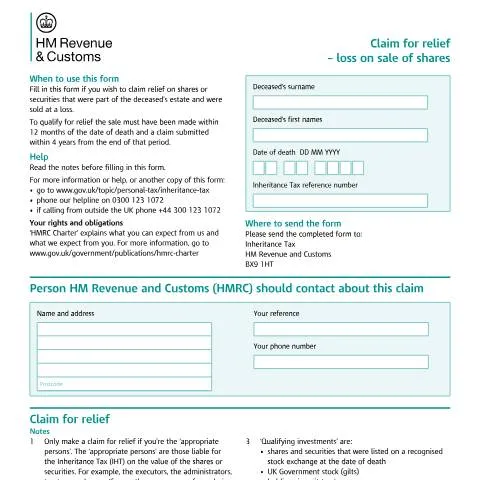
When executors or administrators face the unfortunate reality of inherited shares declining in value after death, the IHT35 form offers a crucial lifeline. This HMRC document enables appropriate persons to reclaim inheritance tax previously paid on shares that have subsequently lost value through market forces. The relief mechanism acknowledges that death valuations, whilst legally binding for initial inheritance tax calculations, may not reflect the true realisable value when estates require liquidation.
The form addresses a fundamental fairness issue within inheritance tax law: estates shouldn't bear the full tax burden on assets that prove impossible to realise at their death values. However, navigating this relief requires precise timing, meticulous documentation, and a clear understanding of which investments qualify for consideration.
Qualifying Investment Categories and Notable Exclusions
The IHT35 form applies exclusively to qualifying investments, a precisely defined category that encompasses listed shares and securities, UK Government gilts, and unit trust holdings. These must have been listed on recognised stock exchanges at the date of death, with HMRC maintaining specific guidance on which exchanges meet their recognition criteria.
Crucially, several investment types remain explicitly excluded from this relief mechanism:
- Unlisted company holdings - regardless of their subsequent performance
- Holdings on unrecognised markets - even if they appear to trade publicly
- Loan notes and debentures - despite potential significant losses
- Alternative Investment Market (AIM) shares - unless they meet specific listing criteria
Personal representatives must verify each holding's status at the death date, as subsequent listing changes cannot retrospectively qualify previously ineligible investments. This verification process often requires consultation with the original probate valuations and, where necessary, confirmation from investment platforms or registrars.
Recognising Stock Exchange Classifications
HMRC's definition of "recognised stock exchange" extends beyond the obvious London Stock Exchange listings. International holdings may qualify if they were listed on exchanges recognised under UK tax legislation at the relevant dates. However, this area requires careful verification, particularly for overseas investments where local market classifications may differ from UK recognition standards.
Critical Timing Requirements and Deadlines
The IHT35 claim operates within strictly enforced timeframes that leave no room for administrative delays. Sales qualifying for relief must occur within 12 months of the date of death, whilst the claim itself must reach HMRC within 4 years from the end of that 12-month period.
This creates a practical window where sales must complete by the first anniversary of death, but claimants have until the fifth anniversary to submit their relief application. The extended claim period recognises that estate administration often involves complex asset realisations and tax calculations that require professional input.
| Timeline Event | Maximum Deadline | Practical Considerations |
|---|---|---|
| Sale completion | 12 months from death | Contract date determines sale date, not settlement |
| Claim submission | 4 years from end of sale period | Allows time for final estate calculations |
| Provisional relief request | Within 12-month sale period | Available for urgent liquidity needs |
The provisional relief option deserves particular attention for estates facing immediate inheritance tax demands. HMRC may grant interim relief based on estimated losses, subject to later review and adjustment. This mechanism prevents estates from experiencing cash flow difficulties whilst awaiting final sale completions and relief calculations.
Contract Versus Settlement Date Complications
Share sales involve distinct contract and settlement dates, with the form requiring contract dates for relief calculations. This distinction becomes critical when sales occur near the 12-month deadline, as settlement delays cannot extend the qualifying period. Executors must therefore ensure adequate time margins for transaction completion, particularly during volatile market periods when settlement delays may occur.
Detailed Form Completion Requirements
The IHT35 demands comprehensive disclosure of all qualifying investment sales within the 12-month period, not merely those generating losses. This requirement ensures HMRC can verify the overall estate position and prevents selective disclosure of unfavourable transactions whilst concealing profitable disposals.
Section 1 of the form requires detailed investment descriptions, including precise share quantities or stock amounts held at death. The death value (Column A) must match probate valuations, whilst gross sale proceeds (Column B) should exclude dealing costs such as commission and fees. This gross proceeds approach prevents artificial loss inflation through the inclusion of normal transaction expenses.
Purchase Restriction Calculations
Where claimants have repurchased similar qualifying investments between death and two months after the latest relevant sale, the relief becomes subject to mathematical restrictions. The restriction formula (D × C ÷ B) prevents tax avoidance through artificial loss creation via immediate repurchase strategies.
This anti-avoidance measure requires careful consideration when executors need to maintain investment exposure whilst realising specific holdings. The two-month period extends beyond the immediate sale date, catching subsequent investment decisions that might otherwise manipulate the relief calculation.
Appropriate Person Requirements and Signing Authority
Only appropriate persons may submit IHT35 claims, defined as those legally liable for inheritance tax on the relevant shares or securities. This typically includes executors, administrators, trustees, or donees, depending on the specific estate structure and asset distribution arrangements.
HMRC explicitly prohibits agent signatures, requiring all appropriate persons to sign personally. This requirement can create practical challenges for estates with multiple executors or complex trust arrangements, particularly where beneficiaries reside overseas or face capacity issues.
- Executors - for assets passing under the will
- Administrators - for intestate estate assets
- Trustees - for assets held in relevant trust structures
- Donees - for lifetime gifts subject to inheritance tax
Where multiple groups bear tax liability, the paying parties become the appropriate persons for relief purposes. This distinction becomes crucial in complex estates with mixed asset ownership or where different inheritance tax rates apply to various estate components.
Corporate Executor Considerations
Professional executor firms must ensure authorised individuals sign the form in their corporate capacity. The form requires clear identification of the signing capacity, preventing confusion about whether individuals act personally or as corporate representatives. This clarity becomes essential for HMRC's verification processes and subsequent correspondence.
Special Circumstances and Complex Situations
Several specific circumstances require additional consideration when completing IHT35 claims. Bonus issues, rights issues, and capital reorganisations occurring after death create new holdings under capital gains tax legislation, potentially affecting relief eligibility and calculation methods.
The form addresses situations where shares satisfy pecuniary legacies with beneficiary consent, treating these arrangements as qualifying sales provided personal representatives lacked inherent power to make such distributions. This provision recognises the commercial reality of estate administration whilst maintaining relief availability.
International Considerations
Overseas beneficiaries and foreign-domiciled executors may face additional complications when claiming relief. Whilst the form itself doesn't exclude international parties, practical issues around signature witnessing, document authentication, and ongoing correspondence management require careful planning.
Currency fluctuations add complexity where foreign investments require conversion to sterling for form completion. HMRC typically requires consistent exchange rate application across death valuations and sale proceeds, preventing opportunistic rate selection to maximise relief claims.
Capital Payments and Rights Disposals
The form requires disclosure of capital payments received on sold investments, defined as money or money's worth that doesn't constitute income for tax purposes. This includes rights sale proceeds but excludes the main investment sale proceeds themselves.
Rights issues create particular complexity, as shareholders may choose between taking up rights, selling rights, or allowing them to lapse. Each option generates different tax consequences and potentially affects relief calculations, requiring careful documentation of all decisions and their financial outcomes.
Post-Submission Processes and HMRC Reviews
Following IHT35 submission, HMRC undertakes detailed verification of the claim, cross-referencing submitted information against original inheritance tax returns and probate valuations. This process may involve requests for additional supporting documentation, including broker statements, contract notes, and evidence of investment holding changes.
Where provisional relief was previously granted, HMRC conducts comprehensive reviews comparing estimated positions against actual outcomes. Overpaid provisional relief requires repayment with potential interest charges, whilst underpaid amounts generate additional refunds.
The review process typically extends several months, particularly for complex estates or where technical issues arise regarding investment classifications or calculation methodologies. Executors should maintain comprehensive records throughout this period and respond promptly to HMRC enquiries to avoid processing delays.
Relief awards generate amended inheritance tax calculations, potentially affecting other estate computations including business property relief, agricultural property relief, and spouse exemption utilisation. These cascading effects require careful consideration of the overall estate tax position and may necessitate professional advice to optimise the final outcome.
Strategic Timing Considerations for Share Sales and Relief Claims
The timing of your share sale and subsequent IHT35 relief claim can significantly impact the amount of relief available and the complexity of your application. Understanding these temporal considerations helps maximise your claim whilst avoiding common pitfalls that could delay processing or reduce your entitlement.
The Four-Year Time Limit: Critical Deadlines
HMRC imposes a strict four-year limit from the date of sale for submitting IHT35 claims. This deadline is absolute—missing it means forfeiting your right to relief entirely. However, determining the precise "date of sale" isn't always straightforward, particularly with complex transactions or phased disposals.
For straightforward share sales through a stockbroker, the sale date is typically the trade date when the transaction settles. However, complications arise with:
- Conditional sales where completion depends on regulatory approval or other conditions
- Share buybacks by the company, where the date might differ from initial agreement
- Forced sales through administration or liquidation proceedings
- Gifts or transfers at undervalue, where market valuation dates become crucial
If you're approaching the four-year deadline, submit your IHT35 form immediately, even if supporting documentation remains incomplete. HMRC typically accepts late documentation provided the initial claim is timely filed.
Market Timing and Valuation Strategies
The difference between probate valuation and sale proceeds forms the basis of your relief claim, making market timing considerations particularly relevant. Volatile market conditions can create opportunities for substantial relief claims, but also require careful documentation.
Consider the impact of dividend payments between death and sale. If shares pay dividends during the qualifying period, these payments don't reduce the loss calculation—only the net sale proceeds matter. However, you must account for any dividend income in the estate's overall tax position.
For shares in smaller companies or those with limited liquidity, timing becomes even more critical. A rushed sale to meet administrative deadlines might result in lower proceeds and higher relief, but could also attract HMRC scrutiny regarding whether best value was obtained.
Interaction with Other Estate Administration Timelines
Your IHT35 claim doesn't operate in isolation—it intersects with broader estate administration timelines that can create both opportunities and constraints. The requirement to pay inheritance tax within six months of death often pressures executors to sell assets quickly, potentially before optimal market conditions.
However, HMRC's instalment option for certain assets, including business shares and land, might allow more strategic timing. If shares qualify for instalment payments, executors can potentially delay sale until market conditions improve, though this strategy requires careful cash flow management and ongoing instalment obligations.
The interaction with estate accounts and final distributions also matters. Late relief claims might necessitate reopening estate accounts or adjusting distributions already made to beneficiaries, creating additional administrative complexity and potential disputes.
Complex Scenarios: Corporate Actions, Reorganisations, and Special Situations
Standard share sales represent just one scenario where IHT35 relief applies. Corporate actions, business reorganisations, and special circumstances create additional complexities that require careful analysis to determine eligibility and calculate appropriate relief amounts.
Rights Issues and Bonus Share Complications
When companies issue rights offerings or bonus shares after death but before sale, the relief calculation becomes more nuanced. The key principle is that you must compare like with like—the probate valuation should reflect the same number and class of shares as those eventually sold.
For rights issues, if you take up the rights using estate funds, the additional investment doesn't increase the probate valuation for relief purposes. Instead, calculate relief based on the original shareholding, with the rights subscription treated as a separate investment decision. However, if you sell the rights without taking them up, include the rights proceeds in your sale calculation.
Bonus issues present different challenges. Since bonus shares are issued free, they don't require additional investment but do increase the total shareholding. HMRC typically requires you to adjust the probate valuation proportionally—if a 1-for-10 bonus issue increases shareholding by 10%, increase the probate valuation by the same proportion before calculating relief.
Script dividends, where shareholders can elect to receive additional shares instead of cash, require similar adjustments. The election itself might be made by executors after death, creating questions about whether this represents a new investment decision or continuation of the deceased's investment strategy.
Mergers, Takeovers, and Scheme Arrangements
Corporate takeovers and merger activity can complicate or potentially invalidate IHT35 claims, depending on the specific transaction structure and timing. Understanding these implications helps executors make informed decisions about accepting offers or seeking alternative arrangements.
Cash takeover offers typically preserve IHT35 eligibility—the takeover consideration represents the sale proceeds for relief calculation purposes. However, mixed consideration offers involving cash and shares in the acquiring company create complexity. HMRC generally treats the cash element as a sale, while the share element might represent a reorganisation that could affect future relief claims.
Share-for-share exchanges under schemes of arrangement present particular challenges. These transactions might not constitute "sales" for IHT35 purposes, instead representing reorganisations where the original shares are exchanged for equivalent value in the acquiring company. In such cases, the IHT35 clock effectively resets, with the new holding period beginning from the reorganisation date.
Compulsory acquisition procedures, where majority shareholders acquire remaining minorities, generally preserve IHT35 eligibility since the minority shareholders have no choice in the transaction timing or terms.
Administration, Liquidation, and Insolvency Scenarios
When companies enter administration, liquidation, or other insolvency procedures after death, special considerations apply to IHT35 claims. These situations often result in significant losses that could generate substantial relief, but the procedural complexities require careful navigation.
Voluntary liquidations typically allow normal IHT35 claims based on distributions received. However, calculate relief based on total distributions throughout the liquidation process, not individual interim payments. This approach requires patience—final relief calculations might not be possible until the liquidation concludes, potentially years after commencement.
Administration procedures create different challenges. Administrator's sales of business assets might not directly translate to shareholder proceeds, particularly if the company emerges from administration as a going concern. In such cases, the pre-administration share value might bear little relationship to post-administration recovery, but IHT35 relief calculations must still follow prescribed methodologies.
Creditors' voluntary arrangements and company voluntary arrangements might affect share values without triggering formal IHT35 events. These procedures typically involve compromise arrangements with creditors that might reduce shareholder value, but don't constitute sales that activate relief provisions.
Documentation Requirements and Evidence Management
Successful IHT35 claims depend heavily on comprehensive documentation that substantiates both the original probate valuation and the subsequent sale details. HMRC's scrutiny of these claims has intensified, making thorough record-keeping essential for avoiding delays, additional queries, or potential challenges to your relief calculation.
Probate Valuation Documentation Standards
The foundation of any IHT35 claim rests on demonstrating that the original probate valuation was accurate and properly determined at the date of death. This requirement extends beyond simply stating a value—you must provide evidence of the methodology used and market conditions prevailing at the valuation date.
For listed shares, retain copies of Stock Exchange Daily Official List entries or equivalent pricing sources showing closing prices on the death date. If death occurred on a non-trading day, document the methodology used to determine the value, typically based on the last trading day's closing price or an average of prices immediately before and after the death date.
Professional valuations for unlisted shares require more extensive documentation. Retain the full valuation report, including assumptions made, comparable companies analysed, and any discounts applied for minority holdings or lack of marketability. If subsequent events suggest the original valuation was inappropriate, HMRC might challenge both the original IHT calculation and the relief claim.
Contemporary market analysis supporting the valuation proves particularly valuable if HMRC questions the original assessment. Industry reports, broker research, or economic analyses showing market conditions at the death date help demonstrate that valuations reflected available information rather than hindsight knowledge of subsequent developments.
Sale Transaction Documentation
Comprehensive sale documentation must demonstrate that the transaction was conducted at arm's length and achieved the best reasonably available price in the circumstances. This requirement is particularly important for unlisted shares or sales to connected parties, where HMRC might suspect artificial arrangements designed to inflate relief claims.
For listed share sales, retain broker statements showing trade confirmations, settlement details, and any dealing costs incurred. Document the decision-making process leading to the sale, particularly if timing considerations influenced the decision. Minutes of executor meetings discussing the sale strategy, market conditions, or professional advice received provide valuable context.
Unlisted share sales require more extensive documentation proving market value was achieved. This might include:
- Evidence of marketing efforts, such as approaches to potential purchasers or engagement of corporate finance advisers
- Comparable transaction evidence showing similar companies sold at similar valuations
- Professional advice received regarding transaction timing and pricing
- Any independent valuations obtained during the sale process
Where sales occur to company management, existing shareholders, or other connected parties, additional documentation proving the price reflects market value becomes essential. Independent valuations, fairness opinions, or evidence of competitive processes help demonstrate arm's length dealings.
Supporting Evidence for Complex Scenarios
Complex corporate situations require additional documentation layers to support IHT35 claims effectively. Standard transaction documents might not fully explain the circumstances leading to losses or the relationship between original valuations and sale proceeds.
For companies experiencing financial difficulties, retain evidence of the deterioration timeline and its relationship to the death date. Management accounts, audited financial statements, cash flow projections, and professional advice received about the company's prospects help establish whether losses resulted from post-death developments or pre-existing conditions not fully reflected in probate valuations.
Corporate action documentation becomes crucial where rights issues, reorganisations, or other events complicate the relief calculation. Shareholder circulars, scheme documents, court orders approving arrangements, and any professional advice received about participation decisions provide essential context for HMRC's review.
Market condition evidence supporting the timing and manner of sales proves particularly valuable. Economic analyses, sector reports, or expert opinions about market conditions during the relevant period help demonstrate that sale decisions were reasonable and achieved appropriate value in the circumstances.
Maintain organised files containing all relevant documentation, indexed and cross-referenced to support efficient HMRC queries response. Electronic document management systems prove particularly valuable for complex estates with multiple asset types and lengthy administration periods.