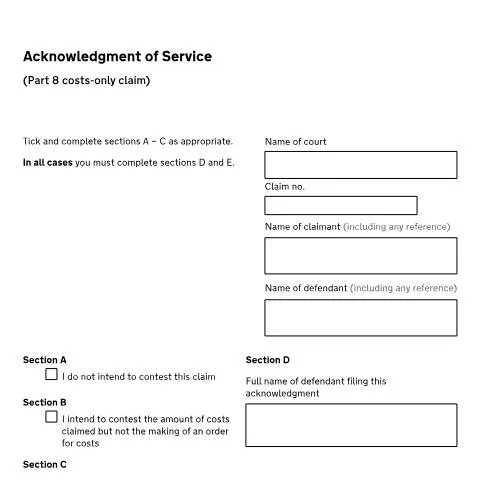
Understanding the N210A: When Legal Costs Claims Meet Formal Response Requirements
When a Part 8 costs-only claim lands on your desk, the clock starts ticking immediately. Unlike standard civil proceedings where defendants might have weeks to formulate their response, acknowledgment of service forms demand swift action – and the N210A represents your formal gateway into the costs assessment process. This document bridges the gap between receiving notification of a costs claim and mounting your defence, whether you're disputing the quantum, challenging the court's jurisdiction, or seeking an entirely different remedy altogether.
The N210A operates within a highly specific procedural framework where timing is everything. Legal representatives and litigants in person alike must navigate its checkbox structure with precision, as each section triggers different procedural consequences. More importantly, this form serves as your only opportunity to formally signal your intentions before the court proceeds with costs assessment – making it a critical juncture in what can become expensive litigation.
Navigating the Three-Path Structure: Sections A Through C Decoded
The N210A's genius lies in its mutually exclusive pathway system, where defendants must choose their stance through sections A, B, or C. This isn't merely administrative convenience – each selection fundamentally alters how the court will handle your case going forward.
Section A: The Strategic Surrender
Ticking Section A – "I do not intend to contest this claim" – represents more than simple capitulation. This option proves strategically sound when legal costs clearly fall within reasonable parameters, particularly where detailed assessment would likely cost more than any potential savings. Solicitors often advise this route when faced with well-documented costs schedules from reputable firms, especially in straightforward matters where hourly rates align with current guideline figures.
However, Section A demands careful consideration of timing. Once submitted, reversing this position becomes procedurally complex, requiring applications that may themselves attract adverse costs orders. Legal representatives must therefore ensure their clients fully understand the finality of this election.
Section B: Quantum Disputes Without Liability Challenge
Section B creates a middle ground: "I intend to contest the amount of costs claimed but not the making of an order for costs." This pathway acknowledges that some costs order is appropriate while reserving the right to challenge specific items or rates through detailed assessment.
This election proves particularly valuable in cases where:
- Hourly rates exceed current guideline figures for the relevant court tier
- Time entries appear excessive for routine tasks
- Disbursements include questionable items or inflated expert fees
- The receiving party claimed costs for unsuccessful applications or procedural missteps
Defendants choosing Section B must prepare for detailed assessment proceedings, where every line item faces potential scrutiny. The process demands forensic examination of time records, correspondence files, and billing practices – making early preparation essential.
Section C: The Full Challenge
Section C opens the broadest scope of challenge, encompassing disputes over the court's jurisdiction, the making of any costs order, or seeking different remedies entirely. This election proves essential where fundamental questions exist about the underlying proceedings or the court's power to make the costs order in question.
Crucially, the form warns that any application under Section C must be filed within 14 days of filing the acknowledgment. This compressed timeframe demands immediate preparation of supporting evidence and legal arguments, particularly for jurisdictional challenges that require detailed case law analysis.
The Statement of Truth: More Than Administrative Formality
Section E's Statement of Truth carries significant legal weight, backed by contempt of court sanctions for false statements made without honest belief in their truth. This provision elevates the N210A beyond simple procedural paperwork into sworn testimony territory.
The form provides three signing options, each carrying distinct obligations:
| Signatory Type | Authority Required | Key Considerations |
|---|---|---|
| Defendant personally | None – direct party | Must have personal knowledge of facts stated |
| Litigation friend | Court appointment or automatic qualification | Only where defendant lacks capacity (child/patient) |
| Legal representative | Specific authorisation from defendant | Must confirm authorisation and firm details |
Legal representatives signing under the third option must ensure their authorisation extends beyond general retainer terms to specific authority for this acknowledgment. The form requires confirmation of both the representative's belief in the stated facts and their authority to sign – creating dual liability exposure.
Service Address Requirements: Ensuring Continued Communication
The N210A's final section demands comprehensive service address details, extending beyond basic postal requirements to include modern communication channels. This information becomes the official contact point for all subsequent court communications, making accuracy essential.
The form accommodates various professional practices through multiple address options:
- DX numbers for firms using document exchange services
- Email addresses for electronic service (increasingly preferred by courts)
- Reference numbers enabling efficient internal case management
- Multiple phone numbers ensuring accessibility during court hours
Firms must consider whether to provide their general practice address or specialist litigation departments, particularly where costs disputes might continue for months. Changes to service addresses require formal notification, making initial accuracy preferable to subsequent amendments.
Timing Dynamics: The 14-Day Window and Its Implications
The N210A operates within strict temporal constraints that extend beyond simple filing deadlines. While acknowledgment of service generally allows more generous timeframes, Part 8 costs-only proceedings compress these periods significantly.
The critical 14-day limit for Section C applications creates particular pressure. This period runs from filing the acknowledgment, not from receiving the claim, meaning defendants must simultaneously complete the N210A and prepare any jurisdictional or substantive challenges. Legal teams often work backwards from this deadline, allowing sufficient time for evidence gathering and legal research before commitment to Section C.
Strategic Timing Considerations
Experienced practitioners recognise that filing timing can influence subsequent procedural advantages. Early acknowledgment demonstrates engagement with the process, potentially favouring applications for additional time or procedural accommodations. Conversely, last-minute filing may suggest procedural gamesmanship, influencing judicial attitudes toward subsequent applications.
The form's completion also triggers the court's case management systems, potentially accelerating listing for costs hearings or case management conferences. Defendants must therefore ensure readiness for immediate procedural steps following acknowledgment.
Electronic Versus Paper Filing: Practical Differences in the Digital Age
While the N210A appears straightforward on paper, its electronic filing through HM Courts & Tribunals Service systems introduces practical considerations that can affect case progression. Digital submission enables immediate processing but requires technical compliance with court IT systems that occasionally reject submissions for formatting issues.
Electronic filing advantages include:
- Immediate confirmation of receipt with timestamp evidence
- Automatic integration with case management systems
- Reduced postal delays and lost document risks
- Digital signatures acceptable under current court rules
However, technical difficulties can arise where firms use older document management systems or where signatories lack digital signature capabilities. Paper filing remains available as backup, though processing times may extend by several days.
Document Format and Attachment Considerations
Electronic submissions must comply with court specifications for file formats, sizes, and naming conventions. Supporting documents referenced in Section C applications require particular attention, as courts may reject submissions containing non-compliant attachments even where the main form meets requirements.
Common Pitfalls and Strategic Missteps in Form Completion
The N210A's apparent simplicity masks several procedural traps that can derail effective defence strategies. Multiple section selections represent the most frequent error, where defendants attempt to hedge their position by ticking multiple boxes. The form's structure explicitly prevents this approach, requiring clear strategic commitment.
Reference number mismatches create ongoing administrative problems, particularly where multiple defendants exist in the same proceedings. Each defendant requires separate N210A submission, but consistency in case references ensures proper court file management.
Signature Authority Issues
Legal representative signatures frequently generate disputes where partnership structures or corporate entities complicate signing authority. The form requires specific confirmation of authority, going beyond general retainer letters to explicit acknowledgment authorisation. Trainee solicitors or paralegal staff cannot sign unless specifically authorised, regardless of their involvement in case preparation.
Corporate defendants face particular challenges where authorised signatories lack detailed knowledge of the costs dispute. The Statement of Truth requires honest belief in stated facts, creating potential conflicts where company officers rely entirely on legal advice without independent knowledge.
Integration with Wider Costs Assessment Procedures
The N210A represents just the opening move in potentially complex costs assessment proceedings. Its completion triggers various procedural consequences that defendants must anticipate when formulating their response strategy.
Section A elections typically lead to summary assessment procedures, where courts determine reasonable costs based on submitted schedules without detailed examination. This process usually concludes within weeks, making it attractive where costs clearly fall within reasonable parameters.
Section B elections initiate detailed assessment tracks, potentially extending proceedings for months while costs officers examine individual items. This process demands extensive documentation, witness statements from fee earners, and detailed legal argument about reasonableness and proportionality.
Section C elections may require preliminary hearings to determine jurisdictional or substantive challenges before addressing costs quantum. These applications can substantially extend overall timescales while adding additional layers of legal costs – creating potential exposure where challenges ultimately fail.
Case Management Implications
Courts increasingly apply active case management to costs-only proceedings, particularly where multiple defendants file acknowledgments with different strategic approaches. The N210A provides courts with early indication of likely procedural complexity, influencing listing decisions and case management directions.
Defendants must therefore consider not only their immediate response but also the broader procedural landscape their acknowledgment creates. Strategic coordination between multiple defendants can prevent duplicate challenges while ensuring comprehensive coverage of available defences.
Challenging the Costs Assessment: Your Rights and Options After Filing Form N210A
Once you've filed your Form N210A acknowledgment of service, you retain several important rights to challenge the costs assessment if you believe the claimed amounts are excessive or unreasonable. Understanding these mechanisms is crucial, as costs disputes can significantly impact your financial liability in Part 8 proceedings.
Grounds for Challenging Costs Claims
The Civil Procedure Rules provide several bases for challenging costs in Part 8 proceedings. Proportionality remains the primary consideration under CPR 44.3, where costs must be proportionate to the sums in issue, the value of any non-monetary relief, the complexity of the litigation, any additional work generated by the conduct of the paying party, and any wider factors involved in the proceedings.
You may challenge costs on grounds of unreasonableness, particularly where the receiving party has incurred unnecessary expenses or adopted an overly complex approach to straightforward issues. This is especially relevant in Part 8 proceedings, which are designed for cases where there is unlikely to be a substantial dispute of fact.
Conduct-related challenges can be particularly effective. If the receiving party failed to comply with pre-action protocols, refused reasonable settlement offers, or pursued unnecessary applications, these factors can significantly reduce their entitlement to costs. The court will also consider whether parties complied with their duty to help the court further the overriding objective.
The Detailed Assessment Process
When costs cannot be agreed following your acknowledgment of service, the matter proceeds to detailed assessment. This process involves a line-by-line examination of the receiving party's bill of costs by a costs officer, typically a District Judge or Deputy District Judge with specialist costs experience.
The receiving party must serve a bill of costs in the prescribed format, usually within three months of the costs order. This document must provide sufficient detail for you to understand what work was done, by whom, when, and at what rate. Each entry should be clear enough to allow proper consideration of whether the costs were reasonably incurred and reasonable in amount.
You have 21 days from service of the bill to serve points of dispute, which must identify specifically which items you challenge and on what grounds. These points should be detailed and substantive – general assertions that costs are "too high" will not suffice. You must explain why particular items are unreasonable, unnecessary, or disproportionate.
Protective Costs Orders and Cost Capping
In certain Part 8 proceedings, particularly those with a public interest element, you may be eligible for protective costs orders that limit your liability for the other side's costs. These are particularly relevant in judicial review cases brought under Part 8 or cases involving environmental law under the Aarhus Convention.
The court can make costs capping orders under CPR 3.19-3.21, which limit the amount of future costs that a party may be ordered to pay. Applications for such orders must usually be made at an early stage, ideally before or shortly after filing your acknowledgment of service.
Special Considerations for Different Types of Part 8 Claims
The nature of your Part 8 proceedings significantly affects how costs are approached and what specific considerations apply when completing Form N210A. Different categories of Part 8 claims have developed distinct practices and judicial approaches to costs awards.
Trust and Estate Disputes
Part 8 claims involving trust administration or estate disputes often involve beneficiaries, trustees, and personal representatives with competing interests but shared concerns about proper administration. In these cases, costs are frequently ordered to be paid from the trust fund or estate, meaning that all parties effectively bear the costs collectively.
When acknowledging service in trust disputes, consider whether you're acting in a representative capacity. Trustees and personal representatives may be entitled to their costs from the fund they administer, but this doesn't automatically extend to costs incurred in defending their own conduct if breach of duty is alleged.
The court may make Beddoe orders (named after Re Beddoe [1893] 1 Ch 547) authorising trustees to defend proceedings at the expense of the trust fund, but these require careful consideration of whether the trustee's conduct was reasonable and in good faith.
Fill in your form directly online
No printing: type your details into the boxes of the official form, tick, then download the PDF ready to send.
- 1Type into the form boxes
- 2Tick in one click
- 3Save and download the PDF
Statutory Construction and Interpretation Claims
Part 8 proceedings seeking declarations on points of law or statutory interpretation present particular costs challenges. These cases often involve multiple parties with different perspectives on complex legal issues, where traditional winner-takes-all costs orders may be inappropriate.
The court frequently exercises its discretion under CPR 44.2 to make no order as to costs or to order that each party bears their own costs, particularly where the legal point was genuinely uncertain and required judicial clarification. This is especially common in cases involving regulatory interpretation or novel legal questions.
If you're a regulatory body or public authority joining proceedings to assist the court on matters within your expertise, you may be protected from adverse costs orders, but this protection isn't automatic and should be addressed in your acknowledgment of service.
Landlord and Tenant Applications
Part 8 claims under various landlord and tenant statutes, including applications under the Landlord and Tenant Act 1987 or Leasehold Reform Act 1967, have developed specific costs practices. These often involve technical valuation issues and statutory interpretation where the court's primary concern is reaching the correct legal and factual conclusions rather than penalising unsuccessful parties.
In lease extension or collective enfranchisement disputes proceeding under Part 8, costs orders often reflect the technical nature of the issues and the fact that both parties may have legitimate interests requiring protection. The receiving party's costs may be limited to specific issues where they were wholly successful.
Professional Negligence and Regulatory Matters
When Part 8 proceedings involve professional regulatory bodies or questions of professional standards, costs considerations become more complex. Regulatory bodies may seek their costs from regulated persons, but the court will consider whether the proceedings were necessary due to the regulated person's conduct or arose from genuine regulatory uncertainty.
Professional indemnity insurers often become involved in these proceedings, and coverage issues may affect costs liability. Your acknowledgment of service should clarify your status and any insurance position, as this may influence the court's approach to costs orders and case management directions.
Procedural Pitfalls and Strategic Considerations When Completing Form N210A
The apparently straightforward nature of Form N210A can mask several procedural complexities that may have significant consequences for your position in the proceedings. Understanding these nuances is essential for protecting your interests effectively.
The Implications of Admitting or Denying the Claim
Your decision whether to admit or contest the Part 8 claim in Section 3 of Form N210A carries immediate and long-term consequences beyond the obvious. If you admit the claim, you're not simply conceding liability – you're also potentially limiting your ability to challenge the basis for any costs order made against you.
A qualified admission may be more appropriate where you accept the basic facts but dispute the legal consequences or remedies sought. This approach preserves your right to argue that costs should not follow the event due to the conduct of the proceedings or the reasonableness of your position on disputed legal issues.
Consider the timing implications carefully. An early admission may limit costs liability by reducing the amount of work the claimant needs to undertake, but it may also prevent you from raising arguments that could lead to a more favourable costs order, such as the claimant's failure to follow proper pre-action procedures.
Case Management and Directions Requests
Section 4 of Form N210A allows you to propose case management directions, but many defendants underutilise this opportunity. Effective use of this section can significantly influence both the procedural course of the case and the eventual costs outcome.
Consider requesting early costs budgeting under CPR 3.12-3.18, particularly in complex Part 8 claims where significant expenditure is anticipated. While costs budgeting is not mandatory in all Part 8 proceedings, the court has discretion to order it where proportionate case management requires it.
You might propose split trials where liability and quantum issues can be separated, or request that certain preliminary issues be determined before substantive hearings. This can be particularly effective in reducing costs where early resolution of legal points might dispose of the entire case or significantly narrow the issues in dispute.
Alternative dispute resolution directions should be considered carefully. While mediation may seem inappropriate for pure points of law, many Part 8 claims involve underlying commercial or personal disputes where ADR could resolve the matter more cost-effectively than continued litigation.
Evidence and Disclosure Strategies
Part 8 proceedings are intended to be evidence-light, but this doesn't mean evidence is irrelevant. Your acknowledgment of service should consider what evidence issues might arise and how they could affect costs.
If you anticipate that expert evidence will be necessary, consider whether this can be dealt with by a single joint expert or whether the complexity of the issues requires separate experts. The costs implications of these choices can be substantial, and early identification of the approach may influence the court's case management decisions.
Disclosure obligations in Part 8 proceedings are typically limited, but where disclosure is necessary, consider requesting that it be conducted in stages or limited to specific categories of documents. Unnecessary or disproportionate disclosure can significantly increase costs for all parties.
Protective Measures and Insurance Considerations
Your acknowledgment of service is an opportunity to raise protective measures that may limit your costs exposure. This is particularly important if you're acting in a representative capacity or have limited financial resources.
Consider whether after-the-event (ATE) insurance is available and appropriate for your circumstances. While ATE premiums are no longer generally recoverable from unsuccessful opponents, they can provide valuable protection against adverse costs orders, particularly in cases involving complex legal issues with uncertain outcomes.
If you have before-the-event (BTE) insurance through household, commercial, or professional indemnity policies, ensure that you comply with any notification requirements and consider whether the insurer should be involved in the conduct of the proceedings.
In appropriate cases, consider applying for security for costs if you have grounds to believe the claimant may be unable to meet an adverse costs order. This application should typically be made early in the proceedings, and your acknowledgment of service may be an appropriate time to signal this intention.