When Probate Disputes Enter Court Proceedings
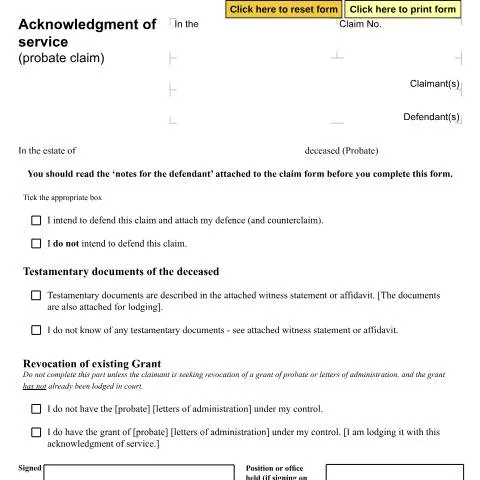
Probate claims represent some of the most emotionally charged disputes within the civil justice system, often arising when families disagree about the validity of a will, the distribution of an estate, or the appointment of personal representatives. The Acknowledgment of Service (Probate Claim) Form N3 sits at the heart of these proceedings, serving as the defendant's first formal response when faced with a probate-related court action.
Unlike straightforward debt or contract disputes, probate claims involve complex layers of family dynamics, testamentary capacity, and inheritance law. When someone initiates court proceedings challenging a will or seeking to remove an executor, all parties named as defendants must respond through this specific form. The stakes are often significant—not just financially, but in terms of family relationships and the deceased's final wishes.
The form's structure reflects the unique nature of probate disputes. Beyond the standard defence options available in other civil claims, it specifically addresses testamentary documents—any papers that might represent the deceased's final wishes—and the crucial matter of existing grants of probate or letters of administration that may need to be surrendered to the court.
Strategic Choices: Defending or Stepping Aside
The N3 form presents defendants with two fundamental paths, each carrying distinct implications for the subsequent proceedings. The choice between defending and not defending requires careful consideration of both legal merits and practical consequences.
Active Defence and Counterclaims
Ticking the first box—"I intend to defend this claim and attach my defence (and counterclaim)"—commits the defendant to active participation in what can become protracted litigation. This choice is appropriate when the defendant genuinely disputes the claimant's case, perhaps believing a will is valid when the claimant alleges forgery, or supporting the continued appointment of an executor whom the claimant seeks to remove.
The reference to counterclaims acknowledges that probate disputes rarely involve simple yes-or-no questions. A defendant might not only dispute the claimant's allegations but also raise their own challenges. For instance, if sued to revoke a 2020 will, a defendant might counterclaim that an even earlier 2018 will should be admitted to probate instead.
Non-Defence Strategies
Selecting "I do not intend to defend this claim" doesn't necessarily indicate agreement with the claimant's position. In probate matters, defendants sometimes choose not to defend because they have no direct interest in the outcome, lack sufficient evidence to mount a defence, or wish to avoid the costs and stress of litigation while allowing the court to determine the matter.
This approach can be particularly relevant for professional executors or trustees who find themselves named as defendants simply due to their formal role, rather than any wrongdoing. By not defending, they can step aside while preserving their position regarding costs and ensuring they're not personally liable for the litigation expenses.
Navigating the Testamentary Document Requirements
The form's treatment of testamentary documents reflects one of the most critical aspects of probate disputes: establishing exactly what documents exist that might represent the deceased's final wishes. This section requires defendants to make declarations that can significantly impact the proceedings' direction.
| Document Status | Required Action | Practical Implications |
|---|---|---|
| Documents known and available | Describe in witness statement; lodge if possible | Court can examine all relevant testamentary materials |
| No documents known | Confirm in witness statement or affidavit | May support intestacy proceedings |
| Documents suspected but not accessible | Detail circumstances in witness statement | Court may order disclosure or searches |
The Witness Statement Requirement
Both options regarding testamentary documents require attachment of a witness statement or affidavit. This isn't merely a formality—these statements become part of the court record and can be relied upon throughout the proceedings. The witness statement should provide comprehensive details about the defendant's knowledge of any wills, codicils, or other testamentary documents.
When describing testamentary documents, defendants should include details such as when they became aware of the documents, their physical condition, where they're currently located, and any circumstances surrounding their creation or discovery. If the defendant has only partial knowledge—perhaps knowing that a will exists but not having seen its contents—this should be clearly stated.
Document Lodging Procedures
The bracketed reference to lodging documents "[The documents are also attached for lodging]" indicates that where possible, actual testamentary documents should be filed with the acknowledgment. However, this isn't always feasible—original wills might be held by banks, solicitors, or other family members who aren't parties to the proceedings.
When original documents cannot be lodged, certified copies should be provided where available, with explanations for why originals aren't accessible. The court has powers to order production of documents from third parties if necessary, but initial disclosure through the N3 form helps establish the documentary landscape early in proceedings.
Grant Revocation: Surrendering Authority
The section addressing revocation of existing grants represents one of the most consequential aspects of probate litigation. When someone has already obtained probate or letters of administration, the court may need to revoke these grants before determining the substantive dispute. This process effectively strips the current personal representatives of their authority to administer the estate.
Control and Custody Requirements
The form distinguishes between having a grant "under control" and not having such control. This distinction matters because defendants who possess the physical grant document may be required to surrender it to the court immediately, preventing them from continuing to act as personal representatives while the dispute is resolved.
Having the grant under control typically means the defendant either holds the original grant document or has ready access to it through their solicitors or other representatives. The bracketed option "[I am lodging it with this acknowledgment of service]" allows for immediate surrender, which can sometimes help demonstrate good faith and avoid applications for urgent interim orders.
Not having control might occur when the grant is held by co-executors, professional advisers, or has been lost or destroyed. Defendants in this position should be prepared to explain the circumstances in their witness statement, as the court may require efforts to locate or obtain the grant.
Interim Administration Implications
Once a grant is lodged with the court or its revocation is sought, questions arise about who can lawfully administer the estate during litigation. The court has powers to appoint interim personal representatives, but until such appointments are made, the estate's administration may be frozen. This can create practical problems, particularly for estates requiring ongoing management of business interests or property maintenance.
Technical Compliance and Court Processing
The N3 form's completion requirements extend beyond the substantive legal choices to encompass technical compliance matters that can affect the proceedings' progress. Proper completion ensures the acknowledgment is accepted by the court and that subsequent case management proceeds smoothly.
Signature and Authority Requirements
The signature section accommodates various scenarios reflecting the complexity of probate disputes. Defendants may be individuals acting in person, represented by solicitors, or requiring litigation friends due to lack of capacity. Companies named as defendants—perhaps as beneficiaries under corporate structures—must ensure appropriate officers sign with their positions clearly stated.
When litigation friends are involved, typically for defendants who lack capacity due to age or mental incapacity, additional documentation proving the litigation friend's authority may be required. This commonly arises in probate disputes where elderly beneficiaries or those affected by dementia are named as defendants.
Service Address Specifications
The detailed service address section reflects the court's need for reliable communication throughout what can be lengthy proceedings. Unlike many other civil claims, probate disputes often involve multiple defendants with varying levels of engagement, making accurate service addresses crucial for case management.
Electronic communication details—email addresses, DX numbers for legal professionals, and fax numbers—facilitate efficient case management, particularly important given the document-heavy nature of probate litigation. Courts increasingly expect electronic communication where possible, and providing these details can help avoid delays in receiving court directions and other parties' communications.
Case Management and Procedural Consequences
Filing the N3 form triggers specific case management procedures that differ from standard civil litigation. Probate claims often require specialized case management due to their factual complexity, the number of interested parties, and the need to preserve estate assets during proceedings.
Directions and Timetabling
Once acknowledgments of service are filed, the court typically issues case management directions tailored to the specific dispute. These might include orders for disclosure of documents, witness statement timetables, and directions for expert evidence on issues such as testamentary capacity or the authenticity of signatures.
The court's approach to case management in probate claims recognizes that these disputes often involve families with limited litigation experience. Directions may therefore be more prescriptive than in commercial disputes, with clear deadlines and explanations of required steps.
Cost Implications and Protection
Probate litigation carries particular cost risks that defendants should understand when completing the N3 form. The "loser pays" principle applies, but courts have discretion to make different cost orders, particularly where defendants are estate beneficiaries acting reasonably to protect their interests.
Fill in your form directly online
No printing: type your details into the boxes of the official form, tick, then download the PDF ready to send.
- 1Type into the form boxes
- 2Tick in one click
- 3Save and download the PDF
Defendants who choose not to defend may still face cost exposure if they're found to have caused or contributed to the proceedings through their conduct as personal representatives. Conversely, defendants who actively defend but lose may sometimes avoid adverse cost orders if they can demonstrate they acted reasonably in the circumstances.
Strategic Timing and Limitation Considerations
The timing of N3 form submission intersects with various limitation periods and procedural deadlines that can significantly impact probate disputes. Understanding these temporal constraints helps defendants make informed decisions about their response strategy.
Acknowledgment Deadlines
Standard civil procedure rules require acknowledgment of service within 14 days of service of the claim form, but probate claims may involve service complications that affect these deadlines. International service on beneficiaries living abroad, difficulties locating all interested parties, or service on personal representatives of deceased defendants can extend these periods.
Late filing of acknowledgments doesn't automatically bar participation in proceedings, but may require applications for extensions of time with supporting evidence explaining the delay. Courts generally take a pragmatic approach in probate matters, recognizing that family disputes can involve communication difficulties and emotional distress that may affect procedural compliance.
Substantive Time Limits
While completing the N3 form, defendants should consider how limitation periods affect the underlying claim. Challenges to wills based on fraud or forgery may face different time limits than claims for removal of personal representatives for breach of duty. These considerations may influence whether active defence is worthwhile and what counterclaimsmight be available.
The six-year limitation period for most probate claims runs from different starting points depending on the specific cause of action. For claims against personal representatives for breach of duty, time typically runs from when the breach occurs or should have been discovered, while challenges to grants of probate may face different limitation rules.
Professional Representation and Self-Representation
The decision whether to instruct solicitors for probate proceedings often depends on the complexity of the issues, the value of the estate, and the defendant's familiarity with court procedures. The N3 form's structure accommodates both represented and unrepresented defendants, but the choice carries significant implications.
Benefits of Professional Representation
Probate litigation involves specialized legal principles that differ significantly from other areas of civil law. Issues such as testamentary capacity, knowledge and approval of will contents, and the duties of personal representatives require expertise that general practitioners may lack. Specialist probate solicitors understand the procedural nuances and can help defendants avoid strategic errors that might prejudice their position.
Professional representation also provides practical benefits in terms of case management. Solicitors can handle the substantial document disclosure typically required in probate disputes, coordinate with other parties' representatives, and present complex evidence in the most persuasive manner.
Self-Representation Considerations
Some defendants choose to represent themselves, particularly where their interest in the outcome is limited or where the costs of representation would be disproportionate to their potential recovery. The court system provides support for litigants in person, including simplified procedures and assistance from court staff within appropriate limits.
However, self-represented defendants should understand that courts cannot provide legal advice and that procedural errors can have serious consequences. The complexity of probate law means that seemingly straightforward disputes can involve subtle legal issues that significantly affect the outcome.
Defendants considering self-representation should assess their ability to handle document-heavy proceedings, their comfort with formal court procedures, and their emotional capacity to deal with what can be highly stressful family disputes played out in a public forum. The N3 form represents just the beginning of what may be a lengthy and complex process requiring sustained attention and strategic thinking.