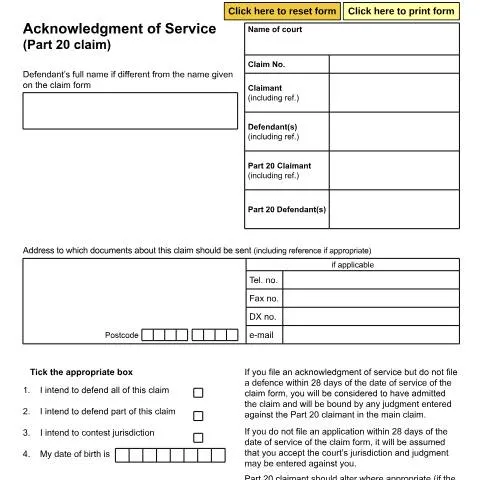
When Part 20 Claims Create Additional Defendants: Understanding Form N213
In the complex landscape of English civil litigation, not all legal disputes follow a straightforward claimant-versus-defendant structure. When defendants bring third parties into proceedings through Part 20 claims—whether seeking contribution, indemnity, or making entirely separate claims—those newly involved parties must formally acknowledge their position in the litigation. Form N213 serves as their initial response mechanism, providing crucial breathing space whilst they prepare their defence strategy.
Unlike the standard acknowledgment of service used in typical claims, Form N213 addresses the unique procedural requirements that arise when Part 20 claimants (usually the original defendants) pursue additional parties. This distinction proves vital because Part 20 defendants face different time constraints, jurisdictional considerations, and strategic options compared to those responding to original claims.
The Anatomy of Part 20 Proceedings and N213's Role
Part 20 claims encompass several distinct scenarios under the Civil Procedure Rules. A defendant might seek an indemnity from their supplier when facing a defective goods claim, pursue contribution from a co-tortfeasor in negligence proceedings, or make an entirely separate counterclaim against parties beyond the original claimant.
Form N213 acknowledges service specifically for these Part 20 defendants—those brought into litigation by the original defendant rather than the original claimant. The form's structure reflects this complexity, requiring identification of multiple parties: the original claimant, original defendant(s), Part 20 claimant, and Part 20 defendant(s).
| Party Status | Role in Proceedings | Typical Examples |
|---|---|---|
| Original Claimant | Initiated the main claim | Injured party, buyer of goods |
| Original Defendant | Responding to main claim, now Part 20 claimant | Retailer, service provider |
| Part 20 Defendant | Brought in via Part 20 claim | Manufacturer, subcontractor, insurer |
Critical Timing Distinctions
The 28-day timeframe referenced in Form N213 creates a strategic window. Part 20 defendants must file either an acknowledgment of service or a defence within 28 days of service of the Part 20 claim form. However, filing N213 extends the defence deadline by an additional 14 days—providing 42 days total from the original service date to file a substantive defence.
This extension proves particularly valuable in Part 20 scenarios where defendants often need time to understand their position within the broader litigation landscape, obtain relevant documentation from the original proceedings, and potentially seek their own legal advice distinct from any existing representation.
Navigating the Three Response Options
Form N213 presents Part 20 defendants with three distinct response pathways, each carrying different procedural consequences and strategic implications.
Full Defence Intention
Selecting "I intend to defend all of this claim" signals comprehensive resistance to the Part 20 claim. This choice typically applies when Part 20 defendants dispute both liability and quantum, or when they possess strong grounds to challenge the legal basis for their involvement.
For instance, a manufacturer brought into proceedings via a Part 20 claim might dispute both that their product caused the alleged harm and that they owe any contribution or indemnity to the retailer. This comprehensive defence stance requires careful preparation, as Part 20 defendants must address not only their relationship with the Part 20 claimant but potentially their position regarding the original claim's merits.
Partial Defence Strategy
The "I intend to defend part of this claim" option acknowledges some validity in the Part 20 claim whilst disputing specific elements. This nuanced approach often emerges in contribution claims where liability principles are accepted but quantum remains contested.
Consider a subcontractor acknowledging some responsibility for defective work but disputing the extent of damages or the proportion of fault attributed to them. This partial defence stance can facilitate more targeted litigation, potentially leading to earlier resolution of undisputed elements whilst preserving resources for genuinely contentious issues.
Jurisdictional Challenges
Selecting "I intend to contest jurisdiction" raises fundamental questions about the court's power to hear the Part 20 claim. Jurisdictional challenges in Part 20 proceedings can be particularly complex, especially when the Part 20 defendant is based outside England and Wales or when the Part 20 claim involves different legal principles from the main action.
The form specifically references CPR rules 6.35 and 6.37(5) regarding service outside the jurisdiction, highlighting the international dimensions that frequently arise in Part 20 proceedings. A Part 20 defendant contesting jurisdiction must file their application within the same 28-day timeframe, making the acknowledgment of service's breathing space even more crucial.
Strategic Considerations Beyond the Form
The Date of Birth Requirement
Form N213 includes a mandatory date of birth field—a requirement that extends beyond simple identification purposes. This information supports the court's case management systems and assists in distinguishing between parties with similar names, particularly relevant in Part 20 proceedings where multiple defendants may share common business relationships or industry connections.
For corporate Part 20 defendants, this field typically requires the incorporation date or registration date, depending on the entity type. Partnerships must provide formation dates, whilst sole traders use their personal date of birth.
Service Address Implications
The comprehensive address section in Form N213 establishes the formal communication channel for all subsequent court documents. Part 20 defendants must consider whether to use their business address, solicitor's address, or another appropriate service address.
This choice carries practical implications beyond mere convenience. Service addresses affect notification timing, document security, and the ability to respond promptly to court directions. Part 20 defendants operating from multiple locations must designate a single, reliable address where they can guarantee receipt and processing of court communications.
Consequences of Non-Response
The stark warning within Form N213 regarding default consequences reflects the serious implications of failing to engage with Part 20 proceedings. Part 20 defendants who neither file an acknowledgment of service nor a defence within 28 days face deemed admission of the Part 20 claim.
This automatic admission binds the Part 20 defendant to any judgment entered against the Part 20 claimant in the main proceedings. In practical terms, if the original claimant succeeds against the original defendant, and the original defendant has an undefended Part 20 claim against a third party, that third party becomes automatically liable for the contribution or indemnity sought.
The Jurisdictional Default
For Part 20 defendants who might otherwise contest jurisdiction, failing to file any response within 28 days results in automatic acceptance of the court's jurisdiction. This default proves particularly significant for international Part 20 defendants who might have valid grounds to challenge English court jurisdiction but lose this right through inaction.
Unlike substantive defences, jurisdictional challenges cannot typically be raised after the initial response period, making timely filing of Form N213 crucial for preserving these fundamental objections.
Preparation and Documentation Requirements
Completing Form N213 effectively requires gathering specific information that may not be immediately available to newly involved Part 20 defendants. The claim number, court details, and party references must match exactly with the Part 20 claim form served upon them.
Understanding Party Roles
Part 20 defendants must accurately identify their position within the litigation hierarchy. This proves particularly challenging in complex multi-party disputes where several Part 20 claims may be running simultaneously, creating chains of potential liability.
For example, in a construction dispute, the original claimant might sue the main contractor, who then brings in subcontractors via Part 20 claims, who in turn might seek to involve their suppliers through additional Part 20 claims. Each party must clearly understand their specific role and relationships when completing their respective acknowledgment forms.
Representative Capacity Considerations
The signature section of Form N213 accommodates various representative arrangements. Part 20 defendants may sign personally, through solicitors, or via litigation friends where appropriate. Corporate entities must identify the specific office holder signing and their authority to bind the organisation.
This representative aspect becomes particularly important in Part 20 proceedings where defendants may need to engage separate legal representation from any existing advisors, especially when potential conflicts of interest arise between their position as Part 20 defendants and other business relationships.
Filing Procedures and Court Interaction
Form N213 must be filed with the same court handling the main proceedings, maintaining centralised case management despite the additional complexity introduced by Part 20 claims. The standard court office hours of 10am to 4pm, Monday to Friday, apply for physical filing, though electronic filing options may extend these timeframes.
When filing, Part 20 defendants should ensure they reference the correct claim number—the same number used for the main proceedings rather than a separate Part 20 reference. This unified numbering system helps maintain procedural coherence whilst allowing the court to track the various claims and responses within the broader litigation.
Post-Filing Obligations
Filing Form N213 triggers specific obligations for Part 20 defendants. They must serve copies on all other parties to the proceedings, not just the Part 20 claimant. This service requirement ensures all parties remain informed of new entrants to the litigation and their intended response strategies.
The acknowledgment also establishes the Part 20 defendant's formal participation in case management procedures. They become subject to court directions, disclosure obligations, and other procedural requirements that may extend beyond their specific relationship with the Part 20 claimant to encompass the broader litigation strategy.
Understanding Form N213's role within the broader Part 20 framework enables newly involved defendants to make informed strategic decisions about their participation in proceedings. Whether choosing comprehensive defence, partial resistance, or jurisdictional challenge, the acknowledgment of service provides the essential foundation for effective engagement with England's complex civil litigation procedures.
Electronic Filing and Digital Case Management Systems
The acknowledgment of service process for Part 20 claims has been significantly streamlined through the implementation of digital filing systems across England and Wales. The HM Courts & Tribunals Service operates the CE-File system for professional users, whilst the Money Claim Online (MCOL) service handles specific types of additional claims electronically.
Fill in your form directly online
No printing: type your details into the boxes of the official form, tick, then download the PDF ready to send.
- 1Type into the form boxes
- 2Tick in one click
- 3Save and download the PDF
When filing Form N213 electronically, claimants must ensure their legal representatives possess valid CE-File credentials. The system automatically generates a unique case reference number upon successful submission, which differs from the original claim number but remains linked within the court's digital records. Electronic acknowledgments typically process within 24 hours during standard court business days, compared to postal submissions which may take 3-5 working days to appear on the court file.
The digital system requires PDF uploads of supporting documentation, with file size limits of 10MB per document. Practitioners should note that electronically filed acknowledgments cannot be amended once submitted—any corrections necessitate a formal application to the court with appropriate fee payment. The system sends automated email confirmations to all parties' nominated email addresses, providing real-time updates on filing status and any subsequent court directions.
For cases involving multiple Part 20 defendants, the electronic system allows bulk processing of acknowledgments, though each Form N213 must still contain individually tailored responses. The digital case management system automatically calculates relevant time periods from the electronic filing timestamp, eliminating potential disputes over postal delivery dates that occasionally arise with traditional paper filings.
Costs Implications and Fee Structure
Filing an acknowledgment of service for Part 20 claims carries distinct cost implications that vary considerably depending upon the nature and value of the additional claim. The court fee for issuing a Part 20 claim ranges from £154 for claims up to £1,000 to £10,000 for claims exceeding £200,000, with intermediate bands reflecting the proportionate complexity of higher-value disputes.
When a Part 20 defendant files Form N213 indicating an intention to defend, they should simultaneously consider whether to pursue their own Part 20 claim against co-defendants or third parties. This strategic decision impacts the overall costs structure, as separate court fees apply for each additional claim issued. The timing of such decisions proves crucial—raising additional claims after filing the acknowledgment may result in case management complications and potentially adverse costs orders.
Legal representatives must advise clients on the costs risks associated with Part 20 proceedings, particularly regarding the court's discretion in costs allocation between multiple parties. The Civil Procedure Rules provide that unsuccessful Part 20 claimants may face liability for costs incurred by all parties to the additional claim, not merely their direct opponent. This multi-party costs exposure requires careful consideration during the acknowledgment phase.
Fee remission applications remain available for eligible Part 20 defendants experiencing financial hardship. The remission assessment considers the defendant's financial circumstances independently of the main claim parties, though the court may require updated financial disclosure if circumstances have changed since any earlier remission applications. Practitioners should note that fee remission for Part 20 proceedings follows the same criteria as main claims, based on receipt of qualifying benefits or gross monthly income thresholds.
The acknowledgment of service itself incurs no separate court fee, but legal costs associated with its preparation and filing form part of the overall case costs that may be recoverable from unsuccessful parties. Solicitors should maintain detailed time records for acknowledgment preparation, particularly where complex multi-party scenarios require extensive case analysis and client consultation before filing appropriate responses.
Multi-Party Scenarios and Complex Litigation Management
Part 20 claims frequently involve intricate multi-party dynamics that significantly complicate the acknowledgment of service process. When multiple defendants face additional claims, or when Part 20 claimants pursue claims against numerous third parties simultaneously, the coordination of acknowledgment responses becomes a critical case management exercise requiring careful strategic planning.
The Civil Procedure Rules permit Part 20 claimants to join multiple additional defendants within a single additional claim, provided the claims arise from substantially the same factual matrix. Each joined defendant must receive individual service of the Part 20 claim and possesses independent rights to file Form N213 with distinct responses. Courts increasingly scrutinise such joinder applications to prevent inappropriate bundling of unrelated claims that could prejudice individual defendants' procedural rights.
Where Part 20 defendants share common interests or similar defences, the court may encourage coordinated acknowledgment responses to streamline subsequent case management. However, each party retains autonomous decision-making authority regarding their acknowledgment filing—one defendant's election to contest the claim does not bind co-defendants to adopt similar positions. Legal representatives must clearly advise clients about their independent procedural rights whilst highlighting potential efficiencies from coordinated responses where appropriate.
Complex construction disputes exemplify challenging multi-party scenarios where acknowledgment strategies require particularly careful coordination. Main contractors facing claims from employers may simultaneously pursue Part 20 claims against multiple subcontractors, each of whom may have separate disputes with their own sub-suppliers. The resulting web of interconnected claims demands sophisticated acknowledgment planning to avoid procedural conflicts and ensure all relevant parties receive appropriate notice of their potential liability exposure.
Professional indemnity claims present another common multi-party context where acknowledgment responses must account for potential contribution claims between co-professionals. Solicitors, surveyors, architects, and other professionals may find themselves joined as Part 20 defendants in property-related disputes, each requiring individual acknowledgment responses that preserve their distinct professional positions whilst recognising shared factual foundations.
The court's case management powers extend to consolidating acknowledgment time periods where multiple Part 20 claims arise within the same substantive dispute. This consolidation prevents procedural fragmentation but requires active judicial case management to ensure no party suffers prejudice from altered time limits. Practitioners should monitor case management directions carefully, as consolidated time periods may differ from standard acknowledgment deadlines applicable to standalone Part 20 claims.