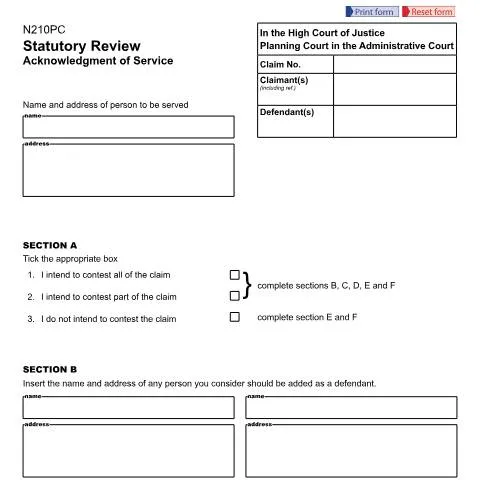
Understanding the Statutory Review: Form N210PC in Context
The Form N210PC, officially known as the Statutory Review - Acknowledgment of Service, plays a pivotal role within the administrative court's framework. This document is not merely a formality; it signifies a defendant's intention regarding a statutory review of a claim made against them. It is crucial for defendants to respond appropriately to claims, as their choices significantly impact the judicial process.
The Importance of Timeliness: Meeting Deadlines
Once served with a claim, defendants are given a specific timeframe to acknowledge it officially. According to the rules established by the HM Courts & Tribunals Service, you must submit the N210PC form within 21 days of receiving the claim. This deadline is critical; failure to comply may result in the court granting the claim without a hearing. Additionally, if your response involves contesting the claim in part or in full, it’s essential to serve copies of your acknowledgment to the claimant and any other defendants within 7 days.
Consequences of Missing Deadlines
- Automatic judgement in favour of the claimant.
- Potential implications for costs awarded against you.
- Limited options for appealing the decision thereafter.
Breaking Down Form N210PC: Sections Explored
The N210PC form is segmented into several sections, each requiring careful consideration and accurate information. Let’s delve into each section to elucidate what is required.
Section A: Your Intentions Regarding the Claim
This initial section necessitates the defendant to specify their stance:
- Contest all aspects of the claim
- Contest part of the claim
- Do not contest the claim
Your choice here sets the tone for subsequent sections. If you intend to contest any part of the claim, thorough and precise details must be provided in the following sections.
Section B: Additional Defendants
In cases where other individuals or entities should be included as defendants, this section prompts the submission of their details. It’s essential to consider the implications of adding more defendants, as it could affect liability and claims made against you.
Section C: Grounds for Contesting the Claim
This is a critical portion where you outline the reasons for contesting the claim, whether in totality or partially. A clear, cogent summary of your grounds is necessary to substantiate your position and guide the court on the basis of your dispute. Ensure that any legal precedents or relevant statutory provisions are referenced where applicable.
Section D: Directions from the Court
In this section, you can indicate if you are requesting specific directions from the court, or if you’ve attached a separate application notice. For instance, if you wish for the matter to be heard at a specific venue, this is the area to specify your request. The completion of this section demonstrates your engagement in the legal process and your proactive approach to managing your case.
Section E: Aarhus Convention Claims
Here, you address whether you deny the claim falls under the purview of the Aarhus Convention. If you believe that the claim is misclassified, you will need to articulate your grounds for denial effectively.
Section F: Verification and Signature
The final section serves for verification purposes. The defendant or their representative must sign, affirming that the information provided is accurate to the best of their knowledge. This serves as a formal declaration to the court, reinforcing the legitimacy of your submission.
Crafting a Comprehensive Response: Supporting Documents
When preparing your Form N210PC, it’s imperative to accompany it with relevant supporting documentation. The nature of your claim and the context of your response will dictate what additional documents may be necessary. Below is a guide to potential documents that can fortify your acknowledgment:
| Type of Document | Purpose |
|---|---|
| Affidavit | To strengthen your grounds for contesting the claim. |
| Correspondence | Any relevant communication supporting your position. |
| Previous Judgments | To illustrate legal precedents that may favour your case. |
| Expert Reports | To substantiate claims made within your acknowledgment. |
Addressing Challenges: What to Do in Case of Refusal or Errors
Should your acknowledgment of service face rejection, understanding the next steps is crucial. Common reasons for refusal include incomplete information or failure to comply with procedural rules. If rejected, you have the right to:
- Request clarification from the court on the specific reasons for refusal.
- Correct any deficiencies and resubmit the acknowledgment.
If errors are found post-submission, you may need to file a correction notice with the court promptly. Failure to rectify mistakes can lead to complications in your case, so maintaining transparency and accuracy is paramount.
Handling Complex Situations: Special Cases
Not all defendants fit into the standard model. Certain circumstances can complicate the use of Form N210PC:
Cases Involving Minors
When the defendant is a minor, a litigation friend must be appointed to act on their behalf. This individual assumes legal responsibility and must file the acknowledgment appropriately.
Foreign Defendants
For defendants outside the UK, additional considerations apply. You may need to provide proof of your identity and ensure that the acknowledgment is filed in accordance with international regulations regarding service of documents.
Fill in your form directly online
No printing: type your details into the boxes of the official form, tick, then download the PDF ready to send.
- 1Type into the form boxes
- 2Tick in one click
- 3Save and download the PDF
Urgent Matters
If your case is time-sensitive, such as issues involving property or public interest, it may be necessary to expedite the acknowledgment process. Contacting the court directly can provide guidance on how to prioritise your case.
The Bigger Picture: Understanding the Legal Framework
The N210PC form operates within a rich legal context, primarily governed by the Data Protection Act 2018 and UK GDPR regulations, which stipulate how personal data is managed within court proceedings. The integrity of the information shared through this acknowledgment form is paramount and must adhere to these legal stipulations.
This legal framework not only protects the rights of the individuals involved but ensures the public’s trust in the judicial system. It reflects the necessity to handle all court-related documents with care, thus preserving the confidentiality and security of sensitive information.
After Submission: What Comes Next?
Once your acknowledgment of service has been submitted, it enters a new phase of processing by the court. The following steps typically occur:
- The court registers your acknowledgment.
- All parties involved are notified of your submission.
- Directions are given for the next steps in the proceedings.
Maintaining communication with the court is vital. You can track the progress of your case through the court’s online services or by directly contacting the relevant court office. Should you need to make any further applications or respond to court orders, timely action is essential to ensure the smooth running of your case.
Conclusion: Empower Yourself with Knowledge
Engagement with the statutory review process, particularly through the Form N210PC, is integral to ensuring that your legal rights are protected. By comprehensively understanding the form's sections, the importance of timing, and the broader legal landscape, you can approach your case with confidence. Whether you're contesting a claim, seeking additional defendants, or navigating a complex situation, being informed will empower you to take the necessary steps in this critical legal process.