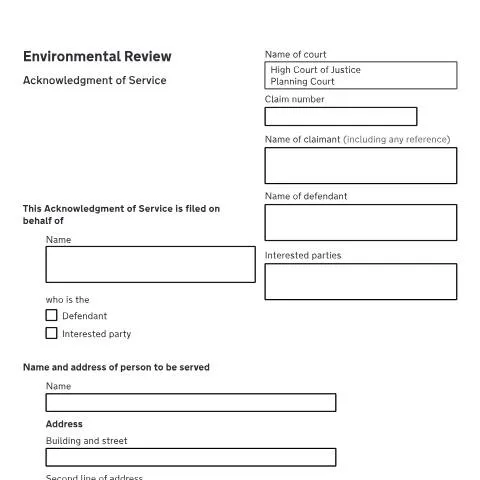
Navigating the N467PC: Your Essential Guide to Acknowledging an Environmental Review Claim
When an environmental review claim lands on your desk, the stakes are often high. Whether you are a defendant, an interested party, or simply a stakeholder in the issue at hand, understanding the intricacies of Form N467PC is crucial. This form, officially titled "Acknowledge service of an environmental review claim," serves as a pivotal point in the legal process surrounding environmental disputes in the UK. Your ability to accurately complete and submit this document can significantly influence the outcome of the case.
Understanding Your Role: Who Needs to Submit Form N467PC?
Form N467PC is primarily designed for defendants or interested parties involved in an environmental review claim filed in the High Court of Justice, Planning Court. Typically, this includes:
- Defendants: Individuals or organizations accused of causing environmental harm or failing to comply with environmental regulations.
- Interested Parties: Stakeholders who may be affected by the outcome of the claim, such as local residents, environmental groups, or businesses that could be impacted.
- Legal Representatives: Solicitors or barristers acting on behalf of defendants or interested parties must also be well-versed in the requirements of this form.
It’s vital to recognize that timelines and requirements may slightly vary depending on whether you contest the claim in full, in part, or do not contest it at all. The implications of each choice dictate not only how you fill out the form but also which sections are applicable to your situation.
Breaking Down Form N467PC: Section by Section
Form N467PC consists of several sections, each requiring specific information. Here’s a detailed look at what each part entails:
Section A: Intent to Contest
The first section is critical, as it establishes your stance on the claim. You must select one of the following options:
- I intend to contest all of the claim or to support it on additional grounds.
- I intend to contest part of the claim or to support it on additional grounds.
- I do not intend to contest the claim.
Each choice necessitates filling out different sections of the form. For instance, if you choose to contest the claim, you will need to complete Sections B, C, D, and E. Conversely, selecting to not contest requires only Section E to be filled out.
Section B: Interested Parties
If you are aware of other parties who should be involved in the proceedings, this section is where you disclose their names and addresses. It is critical to provide accurate information to ensure that all relevant voices are heard in the case.
Section C: Grounds for Contesting
This section requires a comprehensive statement detailing your grounds for contesting the claim. Failing to meet this requirement could result in your submission being rejected or weakened. It’s advisable to prepare a separate document titled “Detailed Grounds,” which should accompany your Form N467PC submission. This document must lay out:
- Which parts of the claim you are contesting if applicable.
- Any evidence supporting your position.
Section D: Directions to the Court
If you require specific directions from the court regarding how the case should proceed, Section D is the place to articulate those requests. For example, if you need the matter to be heard at a different venue, you must also complete and submit Form N464PC alongside your acknowledgment of service.
Section E: Statement of Truth
The final section of Form N467PC is akin to a declaration of honesty regarding the information provided. By signing here, you confirm that the details submitted are correct to the best of your knowledge. Given the legal implications of providing false information, this section is paramount and should not be taken lightly.
Common Pitfalls: What to Avoid While Completing Form N467PC
Filling out Form N467PC can be a straightforward process if you adhere to the guidelines. However, several common pitfalls can derail your case:
- Incomplete Information: Ensure every applicable section is filled out thoroughly; omissions can lead to delays or dismissal of your acknowledgment.
- Late Submission: Pay close attention to deadlines for submitting your acknowledgment. Missing these can jeopardize your position in the case.
- Misunderstanding Legal Terminology: Legal jargon can be confusing. If you are unsure about specific terms or sections, seek advice from a legal professional.
Recognizing these potential challenges can ultimately save you time and frustration as you navigate the complexities of environmental law.
Delivery Mechanisms: Paper vs. Digital Submissions
When it comes to submitting Form N467PC, there are several channels available. Each method has its own advantages and nuances:
Digital Submissions
Submitting your acknowledgment electronically is often the most efficient method. Using the HM Courts & Tribunals Service online portal, you can complete and submit the form seamlessly. Benefits of digital submissions include:
- Immediate receipt confirmation.
- The ability to easily track your submission status.
- Reduced risk of postal delays.
Paper Submissions
Should you opt for a traditional paper submission, ensure that you send the document via a reliable postal service. Key considerations include:
- Allow ample time for postal delivery to meet deadlines.
- Consider sending the form via recorded delivery for tracking purposes.
Regardless of the submission method chosen, ensure you retain copies of all submitted documents for your records. This practice can be invaluable if any disputes arise over the acknowledgment.
Handling Refusals and Missing Documentation
Should your acknowledgment be refused, or if you receive a request for additional documentation, it’s crucial to understand your next steps. Here’s how to navigate these situations:
In Case of Refusal
If your Form N467PC is denied, typically, the court will provide reasons for the refusal. The next steps generally include:
- Carefully reviewing the feedback provided by the court.
- Addressing any deficiencies noted in your submission.
- Resubmitting your acknowledgment as soon as possible, taking care to incorporate feedback.
Missing Documentation
If you are contacted regarding missing documents, prompt action is essential. Ensure you:
- Gather the requested documentation swiftly.
- Communicate with the court to understand submission deadlines.
Being proactive can significantly mitigate the potential negative impacts of these scenarios.
Situational Considerations: Special Cases Requiring Extra Attention
Certain circumstances may complicate the submission of Form N467PC. It’s essential to recognize these special cases:
International Parties
For defendants or interested parties located outside of the UK, provisions exist to accommodate your involvement. It’s advisable to consult with legal professionals well-versed in international law to ensure compliance with UK regulations.
Minors and Incapacitated Individuals
If a minor is a party in the case, or if an individual lacks the capacity to manage their legal affairs, special procedures must be followed. Often, a legal representative will need to act on their behalf, involving additional documentation and possibly court approval.
Tracking Your Submission: How to Stay Informed
After submitting your Form N467PC, maintaining awareness of its status is crucial. Here are several tips to ensure you stay informed:
- Utilize Online Portals: For digital submissions, regularly check the respective HM Courts & Tribunals Service portal for updates.
- Contact the Court: If you have submitted on paper, consider following up with the court to confirm receipt, especially as deadlines approach.
- Keep Records: Retain copies of all correspondence and submissions to support any queries you may have later.
The Bigger Picture: The Role of Form N467PC in Environmental Law
Form N467PC is not an isolated document but a part of a larger tapestry of environmental law in the UK. Understanding its significance in the broader context of environmental review claims can enhance your approach:
This acknowledgment of service is often the first step in a complex legal battle that may involve various other forms and submissions, potentially including:
- Judicial Reviews: If the environmental claim leads to a judicial review, other forms like N461 may be required.
- Evidence Submissions: A thorough understanding of what constitutes acceptable evidence can significantly impact the proceedings.
Ultimately, being informed about the larger legal framework enhances your effectiveness in navigating the complexities of environmental claim processes.
In the ever-evolving landscape of environmental law, the importance of accurate and timely submissions cannot be overstated. Whether you are contesting claims or supporting them, Form N467PC serves as a gateway to ensuring that your voice is heard in the legal arena.
Fill in your form directly online
No printing: type your details into the boxes of the official form, tick, then download the PDF ready to send.
- 1Type into the form boxes
- 2Tick in one click
- 3Save and download the PDF
Understanding the Environmental Review Claim Process
Filing an Environmental Review Claim under the Planning Act 2008 is a crucial step for individuals and organisations seeking redress regarding decisions that may affect the environment. The Form N467PC serves as the formal application to initiate this process. It is essential to understand the context and nuances involved in submitting this claim.
Typically, an Environmental Review Claim arises from decisions made concerning planning permissions and environmental assessments. Under the Act, claimants must show that they are 'aggrieved' by a decision made, which can range from the approval of a development plan to the issuing of a specific environmental permit. Understanding the intricacies of what constitutes an "aggrieved party" is vital, as only those directly impacted by a decision can initiate a claim.
The timeline for initiating a claim is also crucial. Claims must be submitted within six weeks following the publication of the decision. This timeline is stringent, and any delay can result in the forfeiture of the right to challenge the decision. Therefore, potential claimants are encouraged to maintain detailed records and notes regarding the decision timelines, including public announcements and documentation dates.
When completing Form N467PC, it’s important to provide comprehensive details that clearly establish the grounds for the claim. This includes identifying the specific decision being challenged, outlining any procedural errors or substantive issues, and detailing how the claimant has been affected. Evidence supporting the claim should be included where relevant, but it's essential to be concise yet thorough to facilitate proper consideration by the court.
The Role of Legal Representation
While it is possible to submit Form N467PC without legal representation, understanding the complexities of environmental law often necessitates professional legal guidance. A solicitor well-versed in environmental issues can provide invaluable assistance in navigating the legal framework surrounding environmental reviews.
Legal representation can enhance the quality of submissions made to the court. An experienced lawyer can help clarify the legal arguments presented in Form N467PC, ensuring they are cohesive and robust. They can also assist in gathering the necessary evidence and preparing the claimant for potential hearings, which may include cross-examination of witnesses or experts.
Moreover, legal professionals can advise on the implications of the Environmental Review Claim, including potential repercussions for future projects and the claimant's standing in environmental matters. They can also explore alternative options, such as mediation or negotiation with the relevant authorities, which may lead to more expedient resolutions than court proceedings.
Claimants should also consider the cost implications of legal representation. While legal fees can be substantial, many solicitors offer initial consultations to assess the viability of a claim. In some circumstances, claimants may be eligible for legal aid or other funding options, which can alleviate the financial burden associated with such claims.
Post-Submission: What Happens After Acknowledgment of Service?
Upon the acknowledgment of service of Form N467PC, claimants enter a critical phase in the environmental review process. The court will issue directions regarding the next steps, and it is essential to understand what to expect during this phase.
Typically, after the service is acknowledged, the defendant (often a local authority or governmental body) will be required to respond within a specified timeframe. This response is critical as it outlines their stance on the claim and includes any defences they wish to raise. Claimants should prepare for the possibility of counterarguments and should review the response thoroughly, noting any discrepancies or areas for further inquiry.
Once the defence is submitted, the court may schedule a case management hearing. During this hearing, both parties can present their positions, and the judge can provide instructions on how to proceed. This may include timelines for exchanging witness statements or expert reports, which can be pivotal in establishing the credibility of the claim. Claimants must ensure they adhere to these timelines meticulously to avoid procedural pitfalls.
Additionally, both parties may engage in disclosure. This process involves sharing relevant documents that support their respective claims or defences. It is crucial for claimants to be organised and prepared to share all pertinent information, as failure to disclose could adversely affect their case. The court may also require an Environmental Statement or an independent assessment to be submitted to support the arguments presented, necessitating further attention to detail and accuracy.
Following these stages, a trial date may be scheduled. At this point, preparation must intensify, as the trial will be the final opportunity to present the claim before the court. Claimants should work closely with their legal representatives to refine their arguments, anticipate the defendant’s position, and prepare for any potential outcomes.