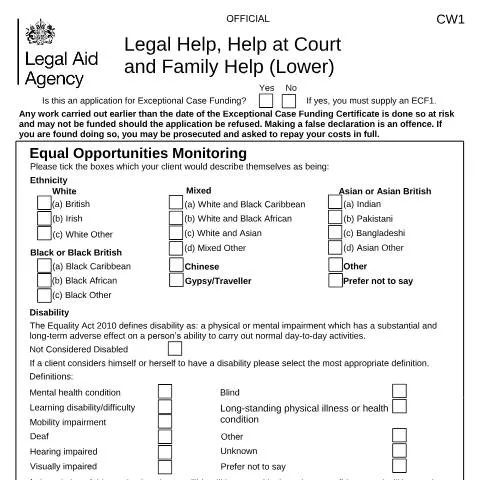
Understanding Financial Assessment for Legal Aid: The CW1 Form's Critical Role
When facing legal challenges that could lead to significant financial hardship, the CW1 form serves as the gateway to accessing publicly funded legal services in England and Wales. This comprehensive financial assessment document, managed by the Legal Aid Agency, determines whether individuals qualify for Legal Help, Help at Court, or Family Help (Lower) services based on their economic circumstances.
The form's significance extends far beyond a simple means test—it represents the intersection between legal necessity and financial reality for thousands of citizens each year. Whether you're dealing with housing disputes, family breakdown, immigration matters, or welfare benefit challenges, the CW1 assessment can mean the difference between having professional legal representation and facing complex legal proceedings alone.
Triggering Events and Case Categories
The CW1 process begins when solicitors or advice agencies identify that a client requires legal assistance but cannot afford private legal fees. The form covers three distinct service levels: Legal Help provides initial advice and assistance, Help at Court offers representation for specific court hearings, whilst Family Help (Lower) delivers more extensive support for family law matters without full representation.
Certain categories bypass the standard means assessment entirely. Clients receiving Section 4 or Section 95 asylum support automatically qualify for immigration-related legal aid, reflecting the particularly vulnerable position of asylum seekers. Similarly, individuals subject to Terrorism Prevention and Investigation Measures (TPIM) notices receive automatic eligibility, acknowledging the exceptional circumstances they face.
Navigating the Complex Means Assessment Framework
The CW1's financial assessment operates on a cascading logic that considers multiple variables before reaching a determination. The process begins with fundamental questions about the applicant's status—whether they are under 18, have a partner whose income must be aggregated, or fall into specific exempt categories.
For children under 18, the assessment follows a particularly nuanced approach. If the child's means are not aggregated with a maintaining adult, receives no regular income beyond pocket money or part-time earnings under 16 hours weekly, and possesses capital below £2,500, they automatically qualify without further assessment. This recognition reflects that children rarely control significant financial resources independently.
Partner Aggregation Rules
One of the most complex aspects involves determining when a partner's financial resources must be considered alongside the applicant's means. The Legal Aid Agency applies strict definitions here—married couples, civil partners, and those cohabiting as if married or in a civil partnership typically have their resources aggregated. However, separated individuals, even if still legally married, may be assessed independently if they can demonstrate genuine separation.
The aggregation rules can significantly impact eligibility outcomes. A person with minimal personal income might exceed the financial limits when their partner's earnings are included, potentially disqualifying them from legal aid despite their individual circumstances suggesting genuine need for assistance.
Documentation Requirements and Evidence Standards
The CW1 form demands comprehensive financial disclosure, requiring applicants to provide detailed evidence of their economic circumstances. This extends beyond simple income statements to encompass savings, investments, property ownership, and other valuable assets that might affect eligibility.
| Income Type | Required Evidence | Assessment Period |
|---|---|---|
| Employment earnings | Recent payslips, P60 certificates | Last 3 months |
| Benefits | Award letters, bank statements | Current entitlements |
| Self-employment | Accounts, tax returns, SA302 | Previous tax year |
| Savings and investments | Bank statements, investment portfolios | Current balances |
The evidence requirements reflect the Legal Aid Agency's need to prevent fraud whilst ensuring genuine cases receive appropriate support. Applicants must understand that making false declarations constitutes a criminal offence, potentially resulting in prosecution and demands for full cost repayment.
Special Circumstances and Asset Disputes
When legal proceedings concern ownership or possession of assets—such as property disputes or inheritance matters—the assessment takes on additional complexity. The form specifically addresses these situations, recognising that individuals might appear wealthy on paper whilst lacking access to disputed assets that form the subject of their legal case.
These circumstances require careful documentation, often involving detailed explanations of why apparently valuable assets cannot be accessed or liquidated to fund legal representation. Solicitors must present compelling evidence that their clients face genuine hardship despite nominal asset ownership.
Exceptional Case Funding and Alternative Routes
The CW1 form explicitly addresses Exceptional Case Funding (ECF) applications, which provide legal aid for cases falling outside standard scope criteria but where funding is necessary to prevent breaches of human rights or EU law. Applicants pursuing ECF must complete an additional ECF1 form alongside the CW1 assessment.
Crucially, any legal work undertaken before ECF approval occurs at the provider's risk. If the exceptional funding application fails, neither the client nor the Legal Aid Agency bears responsibility for costs already incurred. This creates significant pressure on legal professionals to carefully evaluate prospects before commencing work on potential ECF cases.
Non-Means Tested Categories
Several specific categories bypass the standard means assessment entirely, reflecting policy decisions about particularly vulnerable groups or situations where means testing would prove impractical or inappropriate:
- International maintenance obligations under the 2007 Hague Convention or EU Maintenance Regulation
- TPIM notice matters, including applications for permissions, variations, or revocations
- Foster carer advocacy for looked-after children's Special Educational Needs appeals
- Housing Loss Prevention Advice Service early intervention cases
These exemptions recognise that certain legal issues carry such significant public policy implications or affect such vulnerable populations that financial barriers should not prevent access to legal representation.
Equal Opportunities Monitoring and Data Protection
The CW1 form incorporates comprehensive equal opportunities monitoring, collecting voluntary demographic information about ethnicity, disability status, and other protected characteristics. This data serves crucial policy functions, enabling the Legal Aid Agency to identify potential barriers to access and ensure services reach all communities effectively.
The monitoring section follows Equality Act 2010 definitions, particularly regarding disability, which encompasses physical or mental impairments having substantial, long-term adverse effects on daily activities. Completion remains voluntary, with strict confidentiality protections under the Data Protection Act 2018 and UK GDPR requirements.
Clients can select from detailed ethnicity categories reflecting Britain's diverse population, whilst disability options cover mental health conditions, learning difficulties, mobility impairments, sensory disabilities, and long-standing health conditions. The "prefer not to say" option acknowledges that some individuals may feel uncomfortable disclosing personal information despite confidentiality assurances.
Provider Responsibilities and Professional Standards
Legal professionals completing CW1 forms bear significant responsibilities beyond simple form completion. They must ensure accurate financial assessment, provide appropriate guidance to clients about disclosure requirements, and maintain comprehensive records supporting their eligibility determinations.
The form requires detailed provider information, including contract numbers linking submissions to specific Legal Aid Agency contracts. This enables monitoring of provider performance and ensures accountability within the legal aid system. Providers must also understand when to use alternative forms—such as CW1 PL for public law family matters or CW1&2 for mental health cases—avoiding inappropriate form selection that could delay or compromise client assistance.
Cost Limit Extensions and Ongoing Management
The CW1 process extends beyond initial eligibility determination to ongoing case management. When legal work approaches prescribed cost limits, providers must submit extension applications incorporating relevant CW1 pages to demonstrate continued financial eligibility. This ensures that legal aid remains targeted at those genuinely unable to fund their own legal representation throughout case duration.
Extension applications require updated financial information if circumstances have changed since initial assessment. A client who secures employment or receives an inheritance during case progression might lose eligibility, requiring careful monitoring and transparent communication about potential funding implications.
Consequences and Next Steps Following Assessment
Successful CW1 assessment opens access to publicly funded legal services within defined parameters. However, this creates ongoing obligations for both clients and legal providers. Clients must promptly report material changes in financial circumstances that might affect continued eligibility, whilst providers must monitor case progression against approved cost limits and scope restrictions.
Failed assessments don't necessarily end legal aid prospects entirely. Circumstances change, and individuals may reapply when their financial situation deteriorates or when they face new legal challenges falling within different assessment criteria. Additionally, some cases initially failing standard means tests might qualify for Exceptional Case Funding if they demonstrate compelling human rights or EU law arguments.
The CW1 determination also influences case strategy and client expectations. Legal aid cases operate under tighter cost controls than privately funded matters, potentially affecting the depth of investigation possible or the range of expert evidence available. Clients must understand these limitations whilst appreciating the substantial value of professional legal representation that might otherwise remain completely inaccessible given their financial circumstances.
Income and Capital Assessment Thresholds Across Different Legal Aid Schemes
The CW1 form operates within a complex matrix of financial eligibility criteria that vary significantly depending on the specific legal aid scheme being assessed. Understanding these variations is crucial for accurate completion and realistic client expectations.
For civil legal aid under the Legal Aid, Sentencing and Punishment of Offenders Act 2012 (LASPO), the gross monthly income threshold typically stands at £2,657 for most applicants. However, this figure undergoes annual review each April, aligning with the tax year cycle. Practitioners must verify current thresholds via the Legal Aid Agency's online portal before submitting applications, as using outdated figures can result in automatic rejection.
The capital limits present additional complexity. Most civil matters impose a £8,000 capital limit, but exceptional cases—particularly those involving the Protection of Children Act 1999 or certain immigration matters—may allow higher thresholds. Property equity calculations exclude the first £100,000 of main residence value, though this exemption doesn't apply to second properties or investment portfolios.
Criminal legal aid follows entirely different parameters. The CW1 assessment here focuses on disposable income rather than gross figures. Weekly disposable income exceeding £37,500 annually (approximately £721 per week) typically disqualifies applicants, though Crown Court proceedings may have different thresholds depending on case complexity and potential sentences.
Family legal aid presents perhaps the most nuanced scenario. Domestic violence cases benefit from emergency provisions where immediate protection orders are sought, potentially bypassing standard financial assessments temporarily. However, the CW1 must still be completed within 20 working days of the emergency certificate being granted, with full financial disclosure required.
Mental Health Act proceedings maintain unique provisions where detained patients may qualify regardless of financial circumstances, though the CW1 documentation remains necessary for administrative completeness and potential contribution calculations.
Complex Financial Situations and Special Circumstances Documentation
The CW1 form must accommodate increasingly complex modern financial arrangements that don't fit traditional employment models. Self-employed applicants present particular challenges, especially those with seasonal income variations or recent business establishment.
For self-employed clients, the Legal Aid Agency requires three years of accounts where available, but newer businesses may submit management accounts or bank statements covering the most recent 12-month period. Crucially, business expenses must be clearly differentiated from personal expenditure. The CW1 requires specific documentation: SA302 tax calculations from HMRC, business bank statements showing clear transaction descriptions, and accountant-prepared profit and loss statements for the assessment period.
Property ownership creates additional documentation requirements. Joint ownership situations require Land Registry title documents (Form OC1 or OC2) clearly showing ownership percentages. Where properties are subject to charging orders, court documentation must accompany the CW1 to establish actual equity available to the client. Leasehold properties require lease documentation showing remaining term, as properties with less than 60 years remaining may be valued differently for capital assessment purposes.
Pension arrangements demand careful documentation, particularly with auto-enrolment workplace schemes becoming universal. The CW1 distinguishes between accessible pension funds (typically those where the client has reached normal retirement age) and protected funds. Documentation requirements include annual pension statements, HMRC pension credit certificates where applicable, and drawdown arrangement details for flexible access pensions.
Trust arrangements and inheritance situations require specialist documentation. Where clients are beneficiaries of discretionary trusts, the CW1 must include trust deed excerpts showing distribution powers and any current income entitlements. Recent inheritance cases require probate documentation and estate account summaries, as inherited assets may not immediately appear in standard financial statements but affect eligibility calculations.
Debt situations require comprehensive documentation beyond simple creditor lists. Priority debts (council tax, income tax, mortgage arrears) must be evidenced through demand notices or court documents. Non-priority debts require creditor statements showing current balances and payment arrangements. Debt Management Plan documentation or Individual Voluntary Arrangement (IVA) paperwork significantly impacts disposable income calculations and must be included with CW1 submissions.
Regional Variations and Devolved Administration Considerations
While the Legal Aid Agency operates across England and Wales, practitioners must navigate significant regional variations in both procedure and substance when completing CW1 assessments. These variations extend beyond simple administrative differences to encompass substantive eligibility criteria and documentation requirements.
Scottish legal aid operates under entirely separate legislation (Legal Aid (Scotland) Act 1986) with distinct financial criteria and application processes. However, cross-border cases—particularly family matters involving children or domestic violence situations—may require English practitioners to understand Scottish thresholds for comparative purposes or transfer procedures.
Northern Ireland maintains its own legal aid system under the Legal Aid, Advice and Assistance (Northern Ireland) Order 1981. While CW1 forms aren't directly applicable, practitioners handling cases with Northern Ireland elements must understand how financial assessments transfer between jurisdictions, particularly in family proceedings where one party relocates.
Within England and Wales, regional court variations affect CW1 processing timescales and requirements. London courts, particularly the Royal Courts of Justice, often handle cases with international elements requiring additional financial disclosure. Foreign income and assets must be converted using HMRC exchange rates current at the assessment date, with supporting documentation translated by certified translators where necessary.
Rural court areas may experience longer processing times for CW1 assessments, particularly where electronic submission isn't possible and postal services affect document transmission. Practitioners in these areas should factor additional time into case preparation and inform clients of potential delays in legal aid determination.
Housing cost variations across regions significantly impact disposable income calculations. London weighting and regional cost adjustments aren't automatically applied to CW1 assessments, but exceptional circumstances provisions may allow for higher living cost recognition in specific cases. Documentation supporting higher than average housing costs—particularly where clients cannot relocate due to employment, family, or health reasons—should accompany CW1 submissions in high-cost areas.
Regional variations in local authority support services can affect CW1 assessments where clients receive council-provided services. Supporting People payments, disabled facilities grants, and local welfare assistance schemes may constitute income for legal aid purposes, requiring careful documentation and regional knowledge to assess correctly.