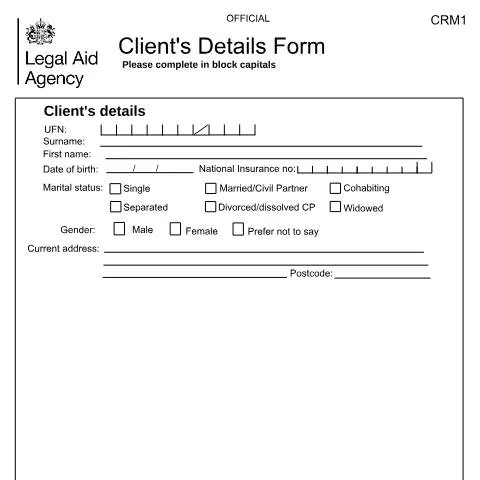
When Legal Aid Solicitors Must Capture Client Information: The CRM1 Gateway Form
Every legal aid case in England and Wales begins with a fundamental administrative requirement that determines whether public funding can proceed: the systematic collection of client details through the CRM1 form. This Client's Details Form serves as the initial gateway document that legal aid providers must complete before the Legal Aid Agency can process any application for publicly funded legal services, whether for criminal defence, civil matters, or family proceedings.
The CRM1 represents more than a simple data collection exercise. It establishes the legal framework for means testing, eligibility assessment, and ongoing case management throughout the duration of legal aid provision. Without this foundational document properly completed, no legal aid application can progress, regardless of how urgent or meritorious the underlying case may be.
Understanding when and how to complete the CRM1 becomes crucial for solicitors managing legal aid caseloads, particularly given the strict compliance requirements that govern publicly funded legal services. The form's apparent simplicity masks its critical role in triggering a complex administrative process that ultimately determines access to justice for thousands of individuals across the UK.
The CRM1's Position Within Legal Aid Application Procedures
The CRM1 operates as the mandatory first step in virtually every legal aid application process, but its timing and completion requirements vary significantly depending on the type of legal aid being sought. For criminal legal aid, the form must typically be completed at the earliest opportunity following initial client contact, often within the police station or immediately upon court appointment.
In civil legal aid cases, the CRM1 completion coincides with the initial client interview where means and merits assessments begin. The form establishes the client's basic identifying information that will be cross-referenced against various government databases during the eligibility verification process.
Integration with Other Legal Aid Documentation
The CRM1 data feeds directly into subsequent forms within the legal aid ecosystem. For criminal cases, information captured on the CRM1 transfers to CRM14 applications for representation orders, while civil cases see this data populate CRM1 and CRM2 applications for certificated work. This interconnected system means that accuracy at the CRM1 stage prevents cascading errors throughout the entire application process.
| Legal Aid Type | Primary Follow-up Form | Typical Timeline | Critical Dependencies |
|---|---|---|---|
| Criminal Defence | CRM14 (Representation Order) | Within 48 hours of charge | Court hearing dates, custody status |
| Civil Certificated | CRM1 Application | Within statutory limits | Means assessment, merits test |
| Family Proceedings | Family-specific applications | Case-dependent | LASPO Act exceptions, domestic violence evidence |
Completing Client Identification Fields: Beyond Basic Demographics
The CRM1's client identification section requires more precision than its straightforward appearance suggests. The National Insurance number field serves as the primary identifier for cross-referencing with HMRC and DWP databases during means testing, making accuracy absolutely critical. Incomplete or incorrect National Insurance numbers can delay applications by weeks while verification processes run their course.
The surname and first name fields must match exactly with official documentation that clients will be required to provide during the application process. This includes ensuring that any hyphenated surnames, multiple middle names, or culturally specific naming conventions are captured precisely as they appear on passports, driving licences, or other primary identification documents.
Address Requirements and Verification Challenges
Current address information on the CRM1 triggers automatic postcode validation against Royal Mail databases, but practitioners frequently encounter complications with clients in temporary accommodation, those experiencing homelessness, or individuals whose circumstances change rapidly during case progression. The form allows for current address capture but doesn't accommodate the fluid housing situations common among legal aid clients.
For clients without fixed addresses, practitioners must use care-of addresses or temporary accommodation details, but this requires careful documentation in case files to explain any apparent inconsistencies during subsequent LAA audits. The postcode field becomes particularly important as it determines regional funding calculations and can affect the speed of automated processing systems.
Marital Status Classifications and Their Financial Implications
The marital status section of the CRM1 directly impacts means testing calculations and determines whether partner financial information must be disclosed during the application process. Each classification carries specific implications for how the Legal Aid Agency assesses household income and capital resources.
Married/Civil Partner status automatically triggers partner means testing requirements, meaning that both parties' financial circumstances become relevant to legal aid eligibility. This extends beyond simple income aggregation to include complex calculations around capital thresholds, pension provisions, and property ownership structures.
Cohabiting Status: The Most Complex Classification
The 'Cohabiting' option presents the most challenging scenario for means assessment as it requires practitioners to establish whether clients meet the Legal Aid Agency's definition of financial interdependence. This goes beyond simple residence sharing to examine joint financial responsibilities, shared household expenses, and mutual support arrangements.
- Joint bank accounts or shared financial products
- Shared responsibility for rent, mortgage payments, or household bills
- Financial support arrangements between parties
- Shared ownership of vehicles, property, or significant assets
- Duration and stability of the cohabiting arrangement
Practitioners must be prepared to justify cohabiting classifications during LAA reviews, particularly where clients claim financial independence despite sharing accommodation. Documentation requirements often extend beyond the CRM1 to include detailed financial statements and supporting evidence.
Gender Information and Data Protection Considerations
The gender field includes a 'Prefer not to say' option reflecting contemporary data protection principles and equality considerations. This choice doesn't impact legal aid eligibility but demonstrates the LAA's commitment to inclusive data collection practices under the Equality Act 2010.
When clients select 'Prefer not to say', practitioners should ensure that this choice is respected throughout all subsequent documentation and correspondence. However, this selection may require additional consideration in cases involving gender-specific legal issues or where statistical monitoring requirements apply to particular types of proceedings.
Privacy Notice Implications
The comprehensive privacy notice accompanying the CRM1 establishes the legal framework for data processing throughout the legal aid case lifecycle. Clients must understand that their personal information will be shared with multiple agencies including HMRC, DWP, HMCTS, and potentially credit reference agencies during verification processes.
The privacy notice specifically addresses special category data processing, which becomes relevant in cases involving health information, criminal convictions, or other sensitive personal circumstances. Practitioners must ensure clients understand the scope of data sharing before completing the CRM1, particularly where ongoing monitoring or contribution collection may be required.
UFN Assignment and Case Tracking Systems
The Unique File Number (UFN) field on the CRM1 establishes the tracking identifier that will follow the case through all subsequent Legal Aid Agency interactions. This alphanumeric code becomes the primary reference for billing, correspondence, and audit purposes throughout the case lifecycle.
UFN assignment follows specific formatting requirements that incorporate the legal aid provider's account number, matter type codes, and sequential numbering systems. Incorrect UFN formatting can cause significant delays in payment processing and may trigger automatic rejection of subsequent claim submissions.
Version Control and Form Updates
The CRM1 Version 16 designation indicates the form's current iteration within the Legal Aid Agency's document management system. Practitioners must ensure they're using the most current version, as outdated forms are automatically rejected by electronic submission systems. The February 2025 date stamp provides the reference point for determining form currency.
Regular form updates typically reflect changes in data protection requirements, new fields for statistical monitoring, or modifications to accommodate legislative changes affecting legal aid provision. Practitioners should establish systems for monitoring form updates through official LAA communications channels.
Submission Pathways and Electronic Processing Requirements
CRM1 submission occurs through the Legal Aid Agency's electronic systems, with paper submissions accepted only in exceptional circumstances. The electronic submission process includes automatic validation checks that verify National Insurance numbers, postcodes, and UFN formatting before accepting the form into the processing queue.
Electronic submissions trigger immediate acknowledgment receipts that practitioners should retain as proof of submission timing. These receipts become crucial evidence in cases where submission deadlines are disputed or where technical issues may have affected the submission process.
Processing Timeframes and Follow-up Requirements
Once submitted, CRM1 data enters the Legal Aid Agency's automated processing systems where it undergoes initial validation against government databases. This process typically completes within 48 hours for straightforward cases but may extend significantly where discrepancies require manual investigation.
Practitioners receive notification when CRM1 processing completes successfully, allowing progression to subsequent application stages. However, processing delays or rejection notices require immediate attention as they can impact statutory deadlines for legal aid applications, particularly in criminal cases where representation orders must be obtained before specific court hearings.
Audit Trail Requirements and Compliance Monitoring
The Legal Aid Agency conducts regular compliance audits focusing on CRM1 completion accuracy and timing. These audits examine whether client information was captured appropriately, whether privacy notices were properly provided, and whether submission timing met relevant deadlines for the case type involved.
Practitioners must maintain comprehensive records demonstrating CRM1 completion processes, including evidence of client consent to data processing and documentation of any special circumstances affecting form completion. Audit failures can result in payment recovery demands and may impact future legal aid contracting arrangements.
The audit process also examines consistency between CRM1 data and subsequent application information, making initial accuracy crucial for avoiding compliance issues that may emerge months after case conclusion. Practitioners should implement systematic quality assurance processes for CRM1 completion to minimize audit risks while ensuring clients receive appropriate legal aid support when needed.
Handling Complex Client Circumstances and Vulnerable Individuals
The CRM1 form requires particular sensitivity when dealing with clients who fall into vulnerable categories or present complex personal circumstances. Legal aid practitioners must adapt their approach whilst maintaining compliance with statutory requirements and safeguarding obligations.
Mental Health Considerations demand careful documentation protocols. Where a client has disclosed mental health conditions that may affect their capacity to understand proceedings or provide instructions, practitioners should record this sensitively in the relevant sections. The form includes specific fields for noting whether alternative communication methods are required, such as simplified language or additional time for explanations. However, avoid clinical terminology unless provided by qualified professionals—focus instead on practical implications for case management.
For clients with learning disabilities, the CRM1 process may require reasonable adjustments under the Equality Act 2010. This could involve having a support person present during information gathering, using visual aids to explain concepts, or breaking the process into shorter sessions. Document any adjustments made and ensure all parties understand their roles and responsibilities. The Legal Aid Agency expects practitioners to demonstrate they have taken appropriate steps to facilitate meaningful participation.
Language barriers present another layer of complexity. Where an interpreter is required, their details must be recorded accurately on the form, including their qualifications and any professional registration numbers. Be particularly careful with technical legal terminology—ensure interpretations capture the precise meaning rather than literal translations. Family members should not typically serve as interpreters for sensitive legal matters, as this can compromise confidentiality and accuracy.
Clients experiencing domestic violence require heightened confidentiality measures. The form includes specific provisions for alternative contact arrangements where standard correspondence could place someone at risk. This might involve using a solicitor's office address, arranging telephone contact only during certain hours, or implementing coded communication systems. Document these arrangements clearly but ensure sensitive details are not visible to unauthorised personnel.
Homeless clients present practical challenges for standard contact procedures. The CRM1 allows for alternative arrangements, but practitioners must ensure ongoing communication remains possible throughout the case duration. Consider arrangements with hostels, day centres, or community organisations that can facilitate message passing. Regular review of contact arrangements is essential as circumstances may change rapidly.
For clients in custody, additional verification procedures apply. Prison identification numbers, wing locations, and expected release dates all require careful documentation. Correspondence restrictions may affect communication methods, and practitioners should familiarise themselves with specific establishment protocols. Video conferencing capabilities vary between institutions and may influence case management approaches.
Record Keeping and File Management Beyond Initial Completion
Proper CRM1 management extends far beyond the initial completion and submission. Effective file management practices ensure ongoing compliance whilst supporting efficient case progression and potential future reviews or appeals.
Version control becomes critical when dealing with amended or updated CRM1 forms. The Legal Aid Agency may request revisions based on initial assessment feedback, or client circumstances may change requiring form updates. Maintain clear records of which version was submitted when, including any correspondence explaining changes. Use consistent file naming conventions that include dates and version numbers to avoid confusion during busy periods.
Supporting documentation should be organised systematically with clear cross-references to relevant CRM1 sections. Create a checklist system that tracks which documents have been obtained, which are outstanding, and when follow-up actions are required. This becomes particularly important for complex cases involving multiple agencies or historical records that may take time to obtain.
Digital file management requires particular attention to security protocols. Ensure encrypted storage for all client data, with access controls that limit viewing to authorised personnel only. Regular backup procedures should be in place, but consider the implications of cloud storage for sensitive legal aid information. The Legal Aid Agency may audit file management practices as part of compliance reviews.
Retention periods vary depending on case outcomes and potential appeal timescales. Generally, legal aid files should be retained for at least six years after case conclusion, but certain circumstances may extend this period. Document destruction procedures must comply with data protection requirements whilst ensuring legitimate interests are protected.
Consider implementing diary systems that track key dates arising from CRM1 information. This might include benefit review dates that could affect ongoing eligibility, immigration status expiry dates, or medical appointments that might impact case strategy. Proactive monitoring can prevent situations where legal aid certificates lapse unexpectedly due to changed circumstances.
Cross-referencing systems become valuable when handling multiple cases for the same client or related parties. The CRM1 may reveal connections to previous cases that could affect current proceedings or provide useful precedent information. Maintain clear records of these connections whilst respecting confidentiality boundaries between different matters.
For ongoing cases, establish regular review procedures that assess whether CRM1 information remains current and accurate. Client circumstances can change rapidly, particularly in areas like housing, employment, or family composition. These changes may affect legal aid eligibility or case strategy, making periodic updates essential.
Integration with Court Procedures and Multi-Agency Working
The CRM1 form serves as a crucial interface between legal aid administration and broader court procedures. Understanding how this information flows through the justice system enables more effective case management and reduces potential delays or complications.
Court listing procedures often depend on information provided through the CRM1 process. Details about client availability, interpreter requirements, or accessibility needs can influence scheduling decisions. Ensure this information is communicated clearly to court staff, particularly where special arrangements are required. Some courts maintain their own databases that may need updating separately from Legal Aid Agency records.
When dealing with multi-track cases involving several parties, coordination becomes more complex. Each party's legal aid arrangements may be handled separately, but court procedures require integrated case management. Consider how CRM1 information might affect joint hearings, witness scheduling, or document disclosure timelines. Early communication with other representatives can prevent procedural complications later.
Expert witness arrangements often require advance approval through legal aid procedures that begin with CRM1 documentation. Where client circumstances suggest expert evidence may be necessary—such as medical conditions affecting capacity or technical issues requiring specialist input—flag this early in the process. The Legal Aid Agency needs sufficient time to assess and approve additional funding applications.
Integration with probation services becomes relevant in criminal cases where CRM1 information reveals existing supervision arrangements. Pre-sentence report preparation may be affected by information gathered during the legal aid application process. Ensure appropriate information sharing protocols are followed whilst respecting client confidentiality requirements.
Social services involvement may emerge from CRM1 disclosures, particularly in family cases or where vulnerable adults are involved. Legal aid practitioners should understand their responsibilities regarding information sharing and safeguarding procedures. Some information may need to be disclosed regardless of client preferences where statutory duties apply.
For immigration cases, CRM1 information often interfaces with Home Office procedures and timescales. Visa expiry dates, reporting requirements, or detention risks all affect case management strategies. Consider how legal aid procedures align with immigration deadlines and ensure sufficient time is built into case planning for potential complications.
Housing proceedings may involve multiple agencies including local authorities, housing associations, and environmental health departments. CRM1 information about client circumstances can be relevant to parallel proceedings or support applications. Maintain awareness of how different procedures interact and ensure client interests are protected across all forums.
When dealing with appeals procedures, original CRM1 information may need updating or supplementing. Changed circumstances since initial application could affect both legal aid eligibility and appeal prospects. Establish clear procedures for reviewing and updating information as cases progress through different levels of jurisdiction.