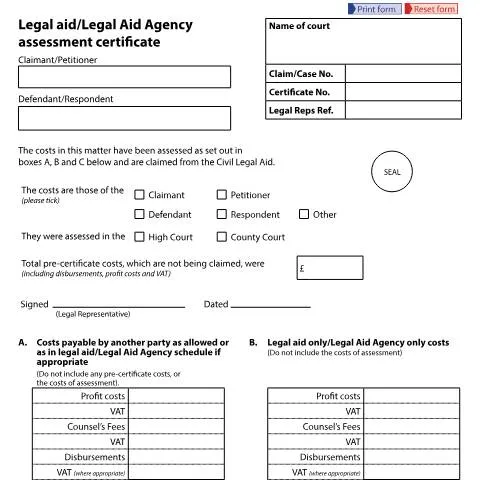
Understanding the Legal Aid Assessment Certificate EX80A: A Comprehensive Guide to Court-Assessed Legal Costs
When legal proceedings involving publicly funded representation reach their conclusion, the matter of costs assessment becomes paramount. The Legal Aid Assessment Certificate EX80A serves as the official court document that formally records the assessed legal costs in civil proceedings where legal aid has been granted. This certificate represents more than a simple accounting exercise—it establishes the definitive record of what the state will pay for legal representation and what opposing parties may be liable to contribute towards the successful party's costs.
The certificate emerges from the detailed process of costs assessment, where a court officer meticulously examines every aspect of the legal costs incurred during proceedings. Unlike standard commercial billing, legal aid cases require this formal assessment to ensure public funds are properly accounted for and that any costs recovery from other parties is accurately calculated.
The Court Assessment Process: From Application to Certificate
The journey towards obtaining an EX80A certificate begins when legal proceedings conclude and the question of costs arises. Legal representatives must first submit their detailed bill of costs to the appropriate court—either the High Court or County Court, depending on where the original proceedings took place. This submission triggers the formal assessment process, which operates under strict procedural rules designed to protect both public funds and the interests of all parties involved.
During assessment, court officers examine three distinct categories of costs with forensic attention to detail. Pre-certificate costs represent expenses incurred before legal aid was granted, which typically cannot be claimed from public funds but may be recoverable from other parties. Post-certificate costs cover the substantive legal work performed under the legal aid certificate, including solicitor fees, barrister fees, and necessary disbursements such as expert witness fees or court fees.
The assessment process also scrutinises VAT charges, applying different rules depending on whether the legal representative is VAT-registered and whether the costs are being claimed from legal aid or from other parties. This complexity requires careful documentation, as VAT treatment can significantly impact the final amounts certified.
| Cost Category | Assessment Focus | Recovery Source |
|---|---|---|
| Profit Costs | Hourly rates, time spent, reasonableness | Legal Aid Agency or opposing party |
| Counsel's Fees | Appropriateness of instruction, fee levels | Legal Aid Agency or opposing party |
| Disbursements | Necessity and proportionality | Legal Aid Agency or opposing party |
| Assessment Costs | Procedural compliance | Usually opposing party if costs awarded |
Timing and Procedural Requirements
The assessment typically occurs within three months of the conclusion of proceedings, though this timeframe can extend where complex issues arise or where there are disputes about the costs claimed. Legal representatives must ensure their bills comply with prescribed formats and include all necessary supporting documentation, including time records, correspondence files, and evidence of disbursements actually incurred.
Courts apply the principle of proportionality rigorously during assessment. Even where legal aid covers the costs, the court must satisfy itself that the work done was reasonable and proportionate to the issues involved in the case. This protection ensures that public funds are not used to subsidise excessive or unnecessary legal work.
Decoding the Certificate Structure: What Each Section Means
The EX80A certificate divides assessed costs into four distinct sections, each serving a specific purpose in the overall costs recovery framework. Section A records costs that are payable by another party—typically the losing party in litigation who has been ordered to pay the successful party's costs. These costs follow the standard litigation funding model where the unsuccessful party bears the winner's reasonable legal expenses.
Section A costs undergo particularly rigorous assessment because they directly impact third parties who may not have had legal aid themselves. The court applies the standard basis of assessment, which requires costs to be proportionate and reasonable, with any doubt resolved in favour of the paying party. This creates a natural tension with legal aid rates, which may be lower than the market rates that would be recoverable between private parties.
Section B captures costs that are recoverable only from the Legal Aid Agency—expenses that cannot be recovered from other parties, either because no costs order was made or because the assessed amount exceeds what can be recovered from opponents. These might include costs relating to unsuccessful applications, settlement negotiations that didn't result in costs orders, or simply the difference between legal aid rates and the higher amounts that might be recovered between private parties.
The distinction between Sections A and B reflects the fundamental principle that legal aid should act as a safety net rather than a first resort. Where possible, costs should be recovered from opponents rather than from public funds, but the legal aid system ensures that lack of means doesn't prevent access to justice when such recovery isn't possible.
Assessment Costs and Administrative Charges
Section C deals with the costs of the assessment process itself—the fees payable to the court for conducting the detailed examination of the bill of costs. These costs are typically modest compared to the substantive legal costs being assessed, but they represent an important principle that the assessment process should be self-funding rather than a burden on general court resources.
Assessment costs are usually recoverable from the same source as the underlying costs they relate to. Where Section A costs are being recovered from an opponent, the assessment costs relating to those items typically follow the same route. Similarly, assessment costs relating to Section B items are usually borne by the Legal Aid Agency as part of the overall cost of providing publicly funded legal services.
Certificate Validation and Legal Standing
The court seal on an EX80A certificate transforms it from a mere administrative document into a legally binding determination of costs entitlement. This seal represents the formal conclusion of the assessment process and creates enforceable rights and obligations for all parties involved. The certificate becomes the definitive record of what costs have been properly incurred and assessed, superseding any previous estimates or interim payments that may have been made during the proceedings.
Once sealed, the certificate serves multiple legal functions simultaneously. For the Legal Aid Agency, it represents the final accounting of public funds expended on the case and determines what additional payments, if any, are due to legal representatives. For opposing parties, it establishes their liability for costs and provides the basis for enforcement action if payment is not forthcoming voluntarily.
The certificate also protects legal representatives by providing official confirmation that their costs have been properly assessed and approved by the court. This protection is particularly valuable where there might otherwise be disputes about the reasonableness of costs incurred or the propriety of particular items of expenditure.
Enforcement Mechanisms and Recovery Procedures
Section A costs certified in an EX80A can be enforced against paying parties using the full range of court enforcement mechanisms available for money judgments. This includes attachment of earnings orders, third party debt orders, and charging orders against property. The certificate provides the necessary foundation for such enforcement action without requiring separate proceedings to establish the debt.
Where enforcement proves unsuccessful, the Legal Aid Agency may step in to meet the shortfall under its statutory charge provisions, but this creates a charge against any property recovered or preserved in the proceedings. This mechanism ensures that publicly funded clients don't lose the benefit of their legal victory due to an opponent's inability to pay costs, while protecting public funds through the charge mechanism.
Common Disputes and Resolution Mechanisms
Disagreements about EX80A certificates can arise from several sources, each requiring different resolution approaches. Computational errors in the arithmetic of the certificate can usually be corrected through straightforward application to the court that conducted the assessment. Such errors might include miscalculations of VAT, incorrect totalling of figures between sections, or transcription errors from the underlying bill of costs.
More substantive disputes about the assessment itself require formal appeal procedures. Legal representatives who believe their costs have been under-assessed can appeal to a costs judge within 14 days of the certificate being sealed. Such appeals must identify specific items that are said to have been wrongly assessed and provide detailed grounds for challenging the original assessment.
Paying parties who believe they have been overcharged can also challenge certificates, though their grounds for appeal are more limited. They must typically show that the court failed to apply the correct legal principles during assessment or made findings that were not supported by the evidence presented.
Correction and Variation Procedures
The court retains jurisdiction to correct clerical errors or omissions in certificates even after they have been sealed. This power extends to situations where items were inadvertently omitted from the original assessment or where mathematical errors affected the final figures. However, this power cannot be used to re-open the substantive assessment decisions themselves.
Where circumstances change after a certificate has been issued—for example, where additional costs are incurred in enforcement proceedings or where previously unknown disbursements come to light—supplementary assessment procedures may be available. These require fresh applications to the court and cannot simply be added to existing certificates.
Impact on Legal Aid Eligibility and Future Proceedings
The amounts recorded in an EX80A certificate can have significant implications for a client's ongoing legal aid eligibility and for the operation of the statutory charge. Where substantial costs are recovered from opponents, these may need to be taken into account in assessing means for future legal aid applications, particularly where the recovered amounts exceed the costs of the legal representation provided.
The certificate also establishes the baseline for calculating the statutory charge that attaches to property recovered or preserved in proceedings. This charge ensures that the Legal Aid Agency can recover its costs from successful outcomes, but its calculation depends critically on the accurate assessment of costs recorded in the EX80A certificate.
For legal representatives, the certificate provides important protection against subsequent challenges to their billing or conduct of the case. Once costs have been formally assessed and certified by the court, it becomes much more difficult for clients or opponents to challenge the reasonableness of the work done or the charges made for it.
Interaction with Other Court Orders
EX80A certificates must be read alongside other court orders made in the proceedings, particularly costs orders that determine liability for payment. Where a costs order provides that costs should be paid on the standard basis subject to detailed assessment, the certificate gives effect to that order by specifying the precise amounts payable.
The certificate may also need to take account of any Part 36 offers or other settlement offers that affect costs liability. Where such offers have costs consequences under the Civil Procedure Rules, these must be reflected in how the assessed costs are allocated between the different sections of the certificate.
Practical Implications for Legal Representatives and Clients
For solicitors and barristers, the EX80A certificate represents both validation of their work and the final determination of their remuneration for publicly funded cases. The certificate establishes not only what they will receive from the Legal Aid Agency but also what additional amounts they may be able to recover from opposing parties, making it a crucial document for practice cash flow and financial planning.
The detailed breakdown in the certificate also provides valuable intelligence for future case planning and costs budgeting. By understanding how different types of work and different levels of expenditure are treated in the assessment process, legal representatives can better advise clients about likely costs outcomes and structure their case preparation accordingly.
For clients, the certificate represents the final accounting of what their case has cost and who is liable to pay those costs. While legally aided clients are generally protected from adverse costs orders, they need to understand how the statutory charge operates and what impact any costs recovery might have on their financial position.
The certificate also provides important closure to the litigation process by establishing definitively what costs consequences flow from the case outcome. This certainty is valuable for all parties in planning their future financial arrangements and understanding their ongoing obligations to each other.