When Financial Remedy Proceedings Meet Transparency: The Critical Role of Costs Disclosure
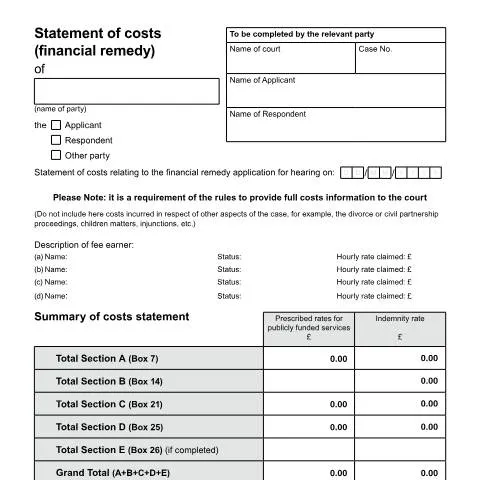
In the midst of divorce or civil partnership dissolution proceedings, when assets must be divided and financial settlements negotiated, parties often find themselves navigating complex legal terrain where costs can spiral unpredictably. The Statement of costs (financial remedy) Form H1 serves as the family court's primary instrument for ensuring complete transparency about legal expenses throughout these proceedings. Far from being merely administrative paperwork, this form represents a crucial checkpoint where all parties must lay their financial cards on the table regarding the true cost of seeking—or defending against—financial remedies.
Introduced under the Family Procedure Rules 2010, specifically rule 9.27, Form H1 creates a mandatory framework for cost disclosure that applies to virtually all financial remedy applications. Whether proceedings involve modest family savings or substantial business assets, the form captures the full spectrum of legal expenses incurred from initial advice through to final implementation of any court order. This comprehensive approach reflects the family court's recognition that costs themselves can become a significant factor in settlement negotiations and judicial decision-making.
The form's structure deliberately separates costs into distinct chronological phases, acknowledging that financial remedy proceedings typically unfold in predictable stages—each with its own cost implications. From pre-application preparation through to post-FDR hearing negotiations, Form H1 ensures that no legal expense remains hidden from the court or opposing parties.
Understanding the Five-Phase Cost Architecture
Form H1 employs a sophisticated sectional approach that mirrors the typical progression of financial remedy proceedings. This structure isn't arbitrary—it reflects decades of family court experience regarding when and how costs typically accumulate during these often protracted cases.
Section A captures all costs incurred before the formal commencement of proceedings through Form A submission. This phase often represents substantial expense as solicitors conduct initial asset investigations, gather financial disclosure, and attempt pre-application negotiations. Many parties underestimate these preliminary costs, which can include forensic accountancy fees, property valuations, and extensive correspondence with pension providers or business valuers.
Section B covers the period from Form A submission through to the Financial Dispute Resolution (FDR) appointment. This phase typically involves the most intensive preparation work: completing financial disclosure forms, responding to questionnaires, and preparing for what many consider the crucial settlement hearing. The FDR represents a key milestone because it's often where realistic settlement discussions begin in earnest.
Section C addresses post-FDR costs up to the form's completion date. These expenses often reflect either successful settlement negotiations or preparation for final hearing. Notably, this section excludes final hearing counsel fees, which are captured separately in Section D.
Section D provides forward-looking cost estimates through final hearing completion. This prospective element serves a crucial function: it allows the court to understand the full financial implications of proceeding to final hearing versus accepting settlement proposals.
Section E addresses implementation costs—often overlooked but potentially significant expenses required to give effect to any final order. These might include conveyancing fees for property transfers, pension sharing order implementation costs, or business valuation updates.
Distinguishing Between Prescribed Rates and Indemnity Costs
One of Form H1's most distinctive features is its dual-column approach to cost reporting, distinguishing between prescribed rates for publicly funded services and indemnity rates. This distinction reflects the complex intersection between public funding (legal aid) and private retainer arrangements that characterises modern family law practice.
The prescribed rates column applies to legally aided clients and reflects the standardised hourly rates that the Legal Aid Agency pays to solicitors and barristers. These rates are typically lower than market rates and are subject to regular review. For 2024, prescribed rates vary by experience level and geographic location, with senior solicitors in London commanding higher prescribed rates than newly qualified practitioners in other regions.
The indemnity rate column captures actual costs charged to privately paying clients. These rates reflect genuine market conditions and can vary dramatically between firms, geographic locations, and case complexity. High-net-worth cases involving international assets or complex business structures often command premium rates that significantly exceed prescribed rates.
This dual reporting serves multiple purposes. It ensures transparency about actual costs incurred, provides the court with realistic cost information for case management purposes, and enables accurate assessment of any eventual costs orders between parties.
| Professional Level | Typical Prescribed Rate Range | Market Rate Range (London) | Market Rate Range (Regional) |
|---|---|---|---|
| Trainee/Paralegal | £70-£90 | £200-£350 | £150-£250 |
| Newly Qualified (0-4 years) | £95-£120 | £350-£500 | £200-£350 |
| Senior Associate (4+ years) | £125-£165 | £500-£750 | £300-£500 |
| Partner/Senior Partner | £170-£220 | £750-£1,200+ | £400-£700 |
Navigating Fee Earner Disclosure and Hourly Rate Justification
The opening section of Form H1 requires detailed disclosure of all fee earners involved in the case, including their names, professional status, and claimed hourly rates. This seemingly straightforward requirement often proves more complex than anticipated, particularly in cases where multiple firms have been instructed or where work has been transferred between fee earners of different seniority levels.
Professional status disclosure must accurately reflect each fee earner's qualification level and experience. The family courts have developed sophisticated understanding of appropriate rates for different experience levels, and any significant deviation from market norms requires explanation. A newly qualified solicitor charging partner-level rates, or a paralegal conducting work typically reserved for qualified practitioners, will attract judicial scrutiny.
Cases involving multiple previous solicitors present particular challenges. Each firm's costs must be separately identified, and any work duplication between firms should be explained. The courts recognise that solicitor changes sometimes result from client dissatisfaction or strategic decisions, but they expect parties to minimise unnecessary cost duplication.
The form also captures counsel's fees separately from solicitor costs, reflecting the split profession structure of English legal practice. Barrister's fees often represent a substantial proportion of total costs, particularly in complex cases requiring senior counsel or Queen's Counsel (now King's Counsel). The form requires disclosure of all counsel fees, including those for advisory work, interim applications, and hearings.
Tackling Disbursements and Third-Party Costs
Beyond legal professional fees, Form H1 captures the often substantial disbursements that characterise financial remedy proceedings. These third-party costs frequently prove decisive in settlement negotiations, as they represent unavoidable expenses regardless of case outcome.
Expert witness fees typically represent the largest disbursement category. Forensic accountants examining business valuations might charge £10,000-£50,000 or more for comprehensive reports. Property valuers, pension specialists, and overseas legal advisors all contribute to mounting disbursement totals. The form requires VAT disclosure where applicable, as this often adds 20% to already substantial expert fees.
Court fees themselves form part of the disbursement total, including the £365 application fee for Form A proceedings and any subsequent hearing fees. For cases proceeding to final hearing, additional court fees may apply for bundle preparation and hearing time.
International elements introduce particular complexity. Cases involving overseas assets may require foreign legal advice, currency exchange costs, and international document authentication. These costs must be converted to sterling using appropriate exchange rates and clearly identified within the disbursement totals.
Document production costs in high-asset cases can prove surprisingly substantial. Copying thousands of pages of financial disclosure, preparing hearing bundles, and producing expert reports all generate costs that accumulate throughout proceedings. Electronic disclosure platforms, while efficient, often carry monthly subscription costs that must be captured.
Completion Responsibilities and Statement of Truth Requirements
Form H1 concludes with mandatory statement of truth provisions that create significant legal obligations for both parties and their legal representatives. These provisions reflect the family court's emphasis on complete candour regarding financial matters—an emphasis that extends beyond asset disclosure to encompass cost transparency.
For unrepresented parties, the statement of truth requires personal confirmation that cost estimates are accurate to the best of their knowledge and belief. This places considerable responsibility on litigants in person, who may lack detailed understanding of legal cost structures. The court recognises this challenge but maintains that all parties must take responsibility for their cost disclosure accuracy.
Legal representatives face enhanced obligations under their statement of truth. They must not only confirm accuracy but also certify that they have discussed the cost statement contents with their client. This requirement reflects professional conduct rules requiring solicitors to provide regular cost updates and ensures that clients understand their financial exposure throughout proceedings.
The form must be filed with the court and served on all other parties in accordance with rule 9.27 of the Family Procedure Rules 2010. This simultaneous disclosure ensures that all parties and the court have identical cost information, preventing any party from gaining unfair advantage through selective cost disclosure.
Fill in your form directly online
No printing: type your details into the boxes of the official form, tick, then download the PDF ready to send.
- 1Type into the form boxes
- 2Tick in one click
- 3Save and download the PDF
Failure to comply with Form H1 requirements can result in costs sanctions, including potential disallowance of costs or adverse costs orders. The family courts take cost transparency seriously and expect full compliance with disclosure obligations.
Strategic Timing and Tactical Considerations in Cost Disclosure
While Form H1 appears purely administrative, its timing and content can significantly influence settlement negotiations and judicial decision-making. Experienced family law practitioners understand that cost disclosure often proves as influential as asset disclosure in driving settlement discussions.
Pre-FDR disclosure serves a crucial function in encouraging realistic settlement discussions. When parties see the true cost of proceeding to final hearing—often representing 20-30% of available assets in modest cases—settlement incentives increase dramatically. The court actively uses cost information during FDR hearings to encourage pragmatic resolution.
The form's forward-looking elements in Sections D and E provide the court with essential case management information. Understanding likely future costs helps judges allocate appropriate hearing time and encourages parties to focus on proportionate dispute resolution. Cases where projected costs exceed realistic asset division margins often receive robust judicial case management.
Costs disparity between parties can influence judicial attitudes toward settlement proposals and eventual costs orders. A party whose costs significantly exceed their opponent's may face uncomfortable questions about proportionality and case conduct. Conversely, parties demonstrating cost-conscious approach to litigation often receive more favourable judicial consideration.
The dual-rate reporting system enables sophisticated costs analysis. Publicly funded parties may find their prescribed rate costs compared unfavourably to their privately funded opponent's actual expenditure, potentially influencing settlement dynamics and costs order prospects.
Implementation Costs and Post-Order Financial Planning
Section E of Form H1 addresses an often-overlooked aspect of financial remedy proceedings: the costs of implementing any final order. These implementation expenses can prove substantial and must be factored into settlement calculations and judicial decision-making.
Property transfer costs typically include conveyancing fees, stamp duty land tax (where applicable), and estate agent fees for any required sales. A family home worth £500,000 might generate £15,000-£25,000 in transfer and sale costs, representing a significant deduction from available proceeds.
Pension sharing implementation involves obtaining pension sharing orders from the court and instructing pension scheme administrators to implement the division. Many schemes charge substantial implementation fees—often £1,000-£3,000 per scheme—which must be factored into settlement calculations.
Business asset transfers may require updated valuations, legal documentation for share transfers, and potential corporate restructuring costs. Complex business arrangements involving multiple entities or international elements can generate substantial implementation expenses.
The form's note regarding conveyancing work reflects the reality that prescribed rates may not apply to routine property transfer work, even in publicly funded cases. This distinction ensures realistic cost planning for all parties regardless of funding arrangements.
Accurate implementation cost estimation proves crucial for effective settlement negotiation. Parties who underestimate these expenses may find themselves unable to complete agreed settlements, potentially requiring return to court for variation orders—generating additional legal costs in the process.