When Civil Legal Aid Requires Full Financial Scrutiny: Understanding the CIV MEANS 1 Assessment Process
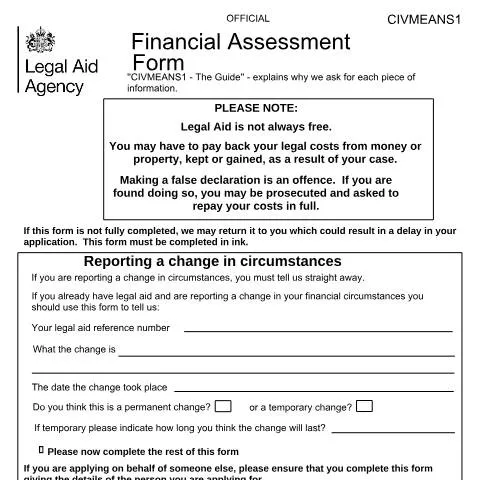
When facing legal proceedings without the safety net of automatic legal aid entitlement, the CIV MEANS 1 financial assessment form becomes your gateway to accessing publicly funded legal representation. Unlike those who qualify for "passported" benefits that guarantee eligibility, applicants completing this comprehensive document must demonstrate their financial need through detailed disclosure of income, assets, and expenditure.
This Legal Aid Agency form serves a dual purpose: initial applications for civil legal aid and ongoing reporting of changed financial circumstances for existing certificate holders. The distinction matters significantly, as the urgency and consequences differ between these scenarios. Those already receiving legal aid face potential withdrawal of funding if they fail to report changes promptly, whilst first-time applicants navigate a more extensive assessment process that can determine whether they receive any legal support at all.
Navigating the Eligibility Landscape: Who Faces Full Financial Assessment
The requirement to complete CIV MEANS 1 typically applies to individuals whose circumstances don't automatically qualify them for legal aid. This includes those earning above the lower income thresholds but potentially within the upper limits, those with modest savings or assets, and anyone whose benefit status doesn't provide passported eligibility.
Specific situations triggering this assessment include:
- Working individuals with variable income, part-time employment, or seasonal work patterns
- Self-employed applicants whose business accounts require detailed scrutiny
- Pension recipients with additional income sources or modest capital
- Students receiving maintenance loans or family support
- Separated partners where financial circumstances have recently changed
The form's complexity reflects the Legal Aid Agency's need to assess both gross monthly income and disposable income after allowable deductions. Importantly, if your partner is your opponent in the legal case, you complete the form for yourself only—a crucial distinction that affects the entire assessment calculation.
Special Circumstances Requiring Additional Documentation
Prison-based applicants must complete supplementary form CIVMEANS1P alongside the main assessment, except when held under immigration powers where different procedures apply. This reflects the unique financial circumstances of incarcerated individuals and the need for specialised assessment criteria.
Couples living apart due to work, illness, or imprisonment—but whose relationship hasn't broken down—must provide joint financial information. This catches situations where temporary separation doesn't constitute genuine financial independence for legal aid purposes.
Decoding Employment Income Requirements: Beyond Basic Wage Slips
The employment section demands precision in documenting all income sources. For monthly-paid employees, the last three wage slips suffice, whilst weekly or fortnightly-paid workers must provide six consecutive pay slips. This sliding scale reflects the need to establish consistent income patterns rather than capturing seasonal fluctuations.
When wage slips aren't available, the L17 form completed by payroll officers provides equivalent verification. This alternative proves particularly valuable for employees in small businesses or those whose payroll systems don't generate standard documentation.
| Employment Type | Required Documentation | Timeframe |
|---|---|---|
| Monthly salary | 3 consecutive wage slips | Most recent period |
| Weekly/fortnightly wages | 6 consecutive wage slips | Most recent period |
| Multiple employment | Wage slips for each job | As above per job |
| No wage slips available | L17 forms from each employer | Current position |
Capturing the Complete Employment Picture
Multiple job holders face additional complexity, requiring separate documentation for each position. The form specifically requests employer names and addresses in the "Extra Information" section, ensuring the Legal Aid Agency can verify income sources independently if necessary.
Work-related childcare costs receive special treatment, requiring monthly amounts highlighted on bank statements or supported by receipts. This recognises that childcare expenses directly impact disposable income calculations and may significantly affect eligibility determinations.
Benefits in kind often catch applicants off-guard, yet company cars, health insurance, or luncheon vouchers constitute taxable benefits requiring disclosure. The P11D tax form provides the definitive record, though recent payroll summaries may suffice for straightforward cases.
Benefits, Tax Credits, and State Support: Mapping Your Complete Income Profile
The benefits section requires comprehensive disclosure of all state support, from universal benefits like Child Benefit to targeted assistance such as Savings Credit. Each entry demands three key pieces of information: the amount received, frequency of payment, and the date you first became entitled.
This temporal element proves crucial for cases where benefit entitlement predates or postdates the legal proceedings. Recent changes in Universal Credit, Tax Credits, or pension entitlements can significantly affect eligibility calculations, particularly where income has fluctuated around the legal aid thresholds.
The form's structure accommodates both partners' benefit entitlements, recognising that household income assessment requires complete financial transparency. However, certain benefits—particularly those related to disability or caring responsibilities—may receive different treatment in the overall calculation.
Temporary Employment Gaps and Return Dates
For those temporarily absent from work, including maternity leave, the expected return date becomes a critical factor. The Legal Aid Agency assesses both current circumstances and reasonably anticipated changes, ensuring that temporary income reductions don't inappropriately trigger legal aid eligibility for those with secure employment prospects.
The 28-day threshold for short-term sickness absence acknowledges that brief illness doesn't constitute a fundamental change in financial circumstances warranting detailed reassessment.
Reporting Changes: The Ongoing Obligation for Existing Certificate Holders
Those already receiving legal aid face a continuing duty to report financial changes "straight away" using the same CIV MEANS 1 form. This obligation extends beyond major life events to encompass salary increases, new employment, inheritance, or any change affecting the original eligibility assessment.
The form requires specific details about each change:
- The exact nature of the financial change
- The precise date it occurred
- Whether you consider it permanent or temporary
- If temporary, your estimate of its likely duration
Permanent changes typically trigger immediate reassessment and potential adjustment of legal aid contributions or eligibility. Temporary changes—such as short-term unemployment or temporary salary reductions—may receive more flexible treatment, though documentation remains essential.
The Consequences of Late Reporting
Failure to report changes promptly can result in retrospective adjustments, demands for repayment of legal costs, or complete withdrawal of legal aid certificates. The Legal Aid Agency's guidance emphasises immediate reporting precisely because delayed disclosure complicates the assessment process and may suggest deliberate concealment.
For significant increases in income or capital, the Agency may require repayment of legal costs from the date the change occurred, not from when it was eventually reported. This makes timely disclosure a financial imperative rather than merely an administrative requirement.
Assembly and Submission: Preparing Your Complete Application Package
Successful CIV MEANS 1 submissions require meticulous preparation of supporting documentation. The form explicitly warns that incomplete submissions will be returned, causing delays that could jeopardise legal proceedings or funding continuity.
Bank statements require particular attention, with childcare payments highlighted and other relevant transactions clearly marked. The Legal Aid Agency prefers original statements or certified copies, though online statements may be acceptable if they bear official bank identifiers and cannot be easily manipulated.
The requirement for completion "in ink" reflects the form's legal significance and the need for permanent, unalterable records. Digital completion followed by printing and ink signature typically satisfies this requirement, though handwritten completion remains the safest approach.
Documentation Checklist by Circumstance
Employed applicants need wage slips or L17 forms, bank statements showing childcare payments (if applicable), and P11D forms for benefits in kind. Benefit recipients require award letters, bank statements showing benefit payments, and evidence of any additional income sources.
Mixed-income households—combining employment, self-employment, benefits, and other sources—face the most complex documentation requirements. Each income stream demands separate verification, whilst the overall household picture must demonstrate financial need for legal aid support.
Understanding Assessment Outcomes and Next Steps
The Legal Aid Agency processes CIV MEANS 1 forms through detailed financial calculations comparing your circumstances against current legal aid limits. This assessment determines not just eligibility but also any financial contributions required towards legal costs.
Full eligibility results in a legal aid certificate covering approved legal costs without client contribution. Partial eligibility may require monthly contributions towards ongoing legal costs, calculated according to disposable income levels. Ineligibility means seeking alternative funding for legal representation.
The assessment also considers the statutory charge—the potential requirement to repay legal costs from any money or property recovered through the legal proceedings. This charge applies even to those receiving free legal aid, creating a potential future liability that applicants must understand before proceeding.
Regular reassessment ensures that legal aid provision remains appropriate to changing circumstances. Annual reviews, triggered by the legal aid certificate renewal process, require updated financial disclosure even when no specific changes have occurred.
The interplay between civil legal aid assessment and other legal proceedings—particularly family cases involving financial remedy orders—can create complex situations where legal aid eligibility changes during the case progression. Understanding these dynamics helps applicants anticipate potential funding interruptions and plan accordingly.
Completing Your CIV MEANS 1 Form: Section-by-Section Guidance
The CIV MEANS 1 form follows a logical structure designed to capture your complete financial picture. Understanding each section's purpose helps ensure accurate completion and reduces the likelihood of queries from the Legal Aid Agency.
Personal Details and Case Information
The opening sections require standard identification details: full name as it appears on official documents, date of birth, and National Insurance number. Your case reference number, provided by your solicitor or the court, must be entered precisely as shown on your legal documents. Any discrepancy here can delay processing significantly.
If you're completing the form as a litigation friend for someone lacking mental capacity, additional sections become relevant. You'll need to provide evidence of your appointment and the protected party's financial circumstances, not your own.
Income Assessment Sections
Employment income requires gross figures before deductions. Include your basic salary, overtime payments, commission, and any bonuses received in the assessment period. The form typically asks for the last three months' income, though this may extend to six months for irregular earners.
Self-employed applicants face more complex requirements. You'll need to provide profit and loss accounts, bank statements, and evidence of business expenses. The Legal Aid Agency may require accountant-prepared figures for businesses with annual turnover exceeding £30,000, though this threshold can vary.
Benefits and pensions require careful categorisation. State pensions, private pensions, and annuity payments are assessable income. However, certain disability benefits like Personal Independence Payment (PIP) or Attendance Allowance may be disregarded in specific circumstances.
Capital and Assets Evaluation
The capital assessment covers all assets you own or have an interest in. Bank and building society accounts require average balances over the assessment period, not just current balances. The Legal Aid Agency may request statements covering several months to verify these figures.
Property ownership presents particular complexities. Your main residence is typically disregarded, but buy-to-let properties, holiday homes, or land holdings count as assessable capital. If you own property jointly, only your beneficial share is assessed, though establishing this share may require legal documentation.
Investment portfolios, including stocks, shares, bonds, and unit trusts, are valued at their current market worth. Premium Bonds are assessed at face value, regardless of any prizes won. Life insurance policies with surrender values contribute to your capital assessment, though term life insurance without cash value does not.
Common Pitfalls and How to Avoid Assessment Errors
Several recurring mistakes can significantly impact your legal aid assessment outcome. Understanding these pitfalls helps ensure your application proceeds smoothly and accurately reflects your financial circumstances.
Income Reporting Inconsistencies
One frequent error involves mixing gross and net income figures within the same application. The CIV MEANS 1 form consistently requires gross income before tax and National Insurance deductions. However, some sections may request net figures for specific benefit types. Reading each question carefully prevents this confusion.
Fill in your form directly online
No printing: type your details into the boxes of the official form, tick, then download the PDF ready to send.
- 1Type into the form boxes
- 2Tick in one click
- 3Save and download the PDF
Seasonal workers often struggle with income averaging. If your work follows seasonal patterns—such as agricultural work, tourism, or retail—the Legal Aid Agency may require income evidence covering a full twelve-month cycle rather than the standard three-month period. Construction workers with intermittent employment face similar scrutiny.
Pension income creates particular confusion for those receiving multiple pension sources. State pension, workplace pensions, and personal pension plans each require separate declaration. The form distinguishes between regular monthly pension payments and lump sum withdrawals, which receive different treatment in the assessment.
Capital Declaration Oversights
Joint account ownership frequently causes assessment complications. Many applicants assume joint accounts are automatically split 50/50 for assessment purposes. However, the Legal Aid Agency examines the source of funds and may attribute the entire balance to the primary account holder if evidence suggests unequal ownership.
Property valuations present another common stumbling block. Using outdated valuations from mortgage applications or council tax bands can significantly misrepresent your capital position. The Legal Aid Agency typically accepts recent estate agent valuations or online property portals, but these must be current within six months of application.
Overseas assets require careful consideration, particularly for applicants with international connections. Foreign bank accounts, property, or investments must be converted to Sterling using current exchange rates. The Legal Aid Agency may request additional documentation to verify overseas holdings, potentially extending assessment timescales.
Documentation and Evidence Gaps
Incomplete evidence packages cause the majority of assessment delays. Bank statements must cover the complete assessment period without gaps. If statements are missing, you must obtain replacements from your bank before submission rather than providing partial evidence.
Self-employed applicants frequently underestimate documentation requirements. Beyond profit and loss accounts, you may need to provide VAT returns, corporation tax computations, and evidence of business expenses. Sole traders without formal accounts face particular scrutiny and should maintain detailed income and expenditure records.
Benefit correspondence requires careful attention to dates and amounts. Universal Credit statements, pension award letters, and disability benefit decisions must align with the timeframe covered by your application. Outdated benefit letters may not reflect current entitlements and can skew your assessment.
Special Circumstances and Exceptional Funding Considerations
Certain situations fall outside standard means testing parameters, requiring exceptional consideration or alternative assessment approaches. Understanding these scenarios helps identify when standard CIV MEANS 1 procedures may not apply to your circumstances.
Domestic Violence and Financial Abuse Contexts
Victims of domestic violence often face unique challenges when completing financial assessments. If your abusive partner controlled household finances, you may lack access to complete financial records. The Legal Aid Agency recognises these circumstances and may accept alternative evidence forms.
Where financial abuse has occurred, your current financial position may not reflect your true means. Joint accounts may have been emptied, credit cards maxed out, or benefits redirected without your knowledge. In such cases, the assessment may focus on your independent financial capacity rather than joint resources.
Legal aid for domestic violence cases often qualifies for automatic passporting, bypassing detailed means testing. However, if your case involves additional legal issues beyond immediate protection, the CIV MEANS 1 form may still be required for those elements.
Mental Capacity and Litigation Friends
When a litigation friend acts for someone lacking mental capacity, the assessment focuses on the protected party's finances, not the litigation friend's means. This requires careful documentation of whose resources are being assessed and clear evidence of the mental capacity issues.
Court of Protection cases involving property and financial affairs present particular complexity. The assessment must distinguish between the protected party's assets and any funds held by deputies or attorneys under lasting powers of attorney. Professional deputies may need to provide detailed accounts of asset management.
Children's cases through litigation friends require age-appropriate assessment modifications. Child benefit, maintenance payments, and any assets held in trust for the child's benefit contribute to the assessment, even though the child cannot directly control these resources.
Corporate and Trust Structures
Business owners operating through limited companies face assessment of both personal and corporate assets. If you control a company with significant retained profits, these may be treated as assessable capital despite the corporate veil. The Legal Aid Agency examines substance over form in such arrangements.
Trust beneficiaries require careful assessment of their beneficial interests. If you're entitled to trust income or capital, this counts toward your means even if distributions are discretionary. Trust deeds and recent accounts help establish your potential entitlement level.
Family partnerships and profit-sharing arrangements need clear documentation of income allocation. The Legal Aid Agency may challenge arrangements that appear designed to minimise assessable income, particularly where family members receive disproportionate profit shares relative to their actual contribution.
Exceptional Funding Applications
Some civil cases may qualify for exceptional funding despite failing standard financial eligibility tests. These cases typically involve significant wider public interest, human rights implications, or situations where withholding legal aid would breach the European Convention on Human Rights.
Exceptional funding applications require separate forms beyond the CIV MEANS 1, but the financial assessment remains relevant to demonstrate the funding need. The Legal Aid Agency considers both the merits of exceptional funding and your ability to fund the case privately.
International law cases, complex judicial review applications, and certain Court of Appeal matters may qualify for exceptional consideration. However, the threshold for approval remains high, and applicants should not assume exceptional funding will be granted simply because standard legal aid is unavailable.