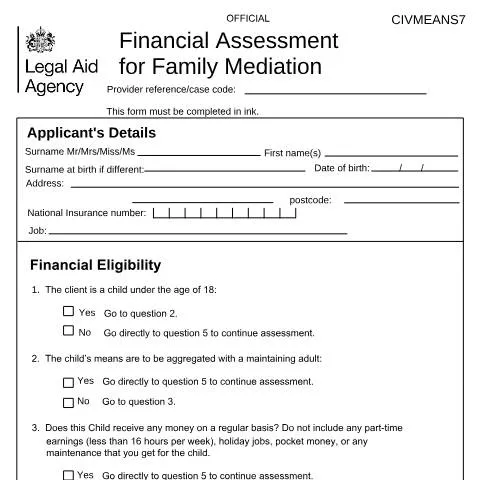
When Family Mediation Requires Financial Scrutiny: The CIV MEANS 7 Assessment
Family disputes involving property, finances, or children often reach a crossroads where legal aid becomes essential—but not everyone qualifies. The CIV MEANS 7 financial assessment form serves as the Legal Aid Agency's gatekeeper for family mediation funding, determining whether your financial circumstances warrant public assistance for resolving domestic disputes outside court.
This 7-page document goes far beyond simple income verification. It distinguishes between assets under dispute and those you retain, applies complex disregards for property equity, and considers whether a child's means should be assessed independently or aggregated with maintaining adults. The form's intricate logic reflects the nuanced nature of family law, where the very assets being fought over cannot fairly be counted against you when determining eligibility for help.
Navigating the Child Assessment Pathway
The form immediately branches based on whether the applicant is under 18, creating distinct assessment routes that can dramatically affect the outcome. Question 1 acts as the primary filter: if the client is a child, the form's logic shifts entirely, potentially bypassing the standard financial assessment altogether.
For children whose means are not aggregated with a maintaining adult (Question 2), the assessment becomes remarkably streamlined. If the child receives no regular income beyond part-time earnings under 16 hours weekly, holiday jobs, or pocket money (Question 3), and holds savings or investments below £2,500 (Question 4), no further financial scrutiny is required. This pathway recognises that children in family disputes—particularly those estranged from maintaining adults—should not be penalised for their limited financial resources.
However, the aggregation decision in Question 2 proves crucial. When a child's means are aggregated with a maintaining adult, the assessment continues through the full adult pathway, potentially making qualification more challenging if the maintaining adult has substantial assets or income.
| Child's Circumstances | Assessment Route | Key Considerations |
|---|---|---|
| Aggregated with maintaining adult | Full assessment required | Adult's income and capital included |
| Not aggregated, income under £2,500 | Direct to declaration | Minimal assessment burden |
| Not aggregated, income/capital above thresholds | Continue to Question 5 | Standard adult assessment applies |
The Partner Aggregation Decision Point
Question 5 determines whether a partner's financial means must be combined with the applicant's for assessment purposes. This decision fundamentally alters the scope of financial disclosure required and can significantly impact eligibility, particularly where one partner has substantial assets while the other does not.
When partner aggregation applies, both individuals' complete financial pictures must be provided throughout the form. This includes all property, savings, investments, and income streams. The Legal Aid Agency recognises that married couples and civil partners typically share financial responsibilities, making separate assessment potentially misleading.
However, certain circumstances may justify non-aggregation even within relationships. These might include financial separation pending divorce, domestic abuse situations where financial control has been exercised, or cases where partners maintain genuinely separate financial arrangements. The form doesn't explicitly detail these exceptions, requiring applicants to make reasoned judgements about their specific circumstances.
Decoding the Subject Matter of Dispute Framework
Questions 6 and 7 introduce the sophisticated Subject Matter of Dispute (SMOD) concept, which fundamentally distinguishes this assessment from standard legal aid means testing. This framework recognises the inherent unfairness of counting disputed assets against an applicant when determining eligibility for assistance in disputing those very assets.
Question 6 identifies cases involving "ownership or possession of assets and/or financial provision"—typically divorce proceedings, cohabitation disputes, or inheritance challenges. If answered "Yes," the assessment proceeds to Part A, where assets specifically claimed by the opponent receive special treatment through SMOD disregards.
Question 7 requires careful consideration: which assets has the opponent specifically claimed? This isn't about assets the opponent might theoretically claim, but those explicitly identified in legal proceedings, correspondence, or formal disputes. Assets not specifically claimed by the opponent must be included in Part B as standard capital, potentially affecting eligibility.
The SMOD disregard operates as a £100,000 allowance applied to disputed assets, recognising that these shouldn't count against the applicant's means. Crucially, this disregard must be applied to the main home first, with any remainder applied to other disputed property—the order cannot be reversed, which can significantly impact the final assessed amount.
Property Valuation and Equity Calculations
Both Part A and Part B require detailed property information, but the assessment methodology differs significantly. The form demands current market values, not historic purchase prices or outdated valuations. For family mediation cases, this often means obtaining professional valuations or estate agent assessments during emotionally charged circumstances.
The equity calculation process involves multiple steps that can create confusion. Current market value minus outstanding mortgages or secured loans provides the gross equity figure. However, the client's assessed share depends on ownership structure: 50% for joint ownership with the opponent, 100% for sole ownership or joint ownership with a partner, or a specified percentage where other parties hold interests.
For main homes in Part A (disputed property), two disregards apply sequentially: first the SMOD disregard (up to £100,000), then the standard equity disregard (£100,000). This can effectively shield up to £200,000 of main home equity from the assessment, though the exact interaction depends on the client's ownership percentage and the property's net equity value.
Part B properties receive only the standard £100,000 equity disregard for main homes. Other properties receive no equity disregard, making their full net equity value count towards the capital assessment. This distinction emphasises the form's focus on protecting primary residences while ensuring secondary properties are properly assessed.
Joint Ownership Complexities
Properties held in joint names with the opponent require particularly careful treatment. The form assumes equal shares unless evidence suggests otherwise, but family law frequently involves unequal contributions, beneficial interests, or constructive trusts that complicate straightforward percentage calculations.
Where property is jointly owned with the opponent, only the client's share enters the assessment, but determining that share may require legal advice or court declarations. The form cannot resolve underlying ownership disputes—it simply requires an assessment based on current understanding of legal entitlements.
Income Assessment and Qualifying Benefits
Part C shifts focus from capital to income, beginning with the crucial passporting provision. Clients receiving Income Support, Income-based Jobseeker's Allowance, Income-related Employment and Support Allowance, Guarantee Credit, or Universal Credit automatically qualify financially, bypassing detailed income assessment entirely.
This passporting recognises that these benefits already incorporate means testing, making further assessment redundant. However, applicants must be "directly or indirectly" in receipt—direct receipt is straightforward, but indirect receipt might include situations where a partner receives qualifying benefits that support the household.
For non-passported cases, the income assessment requires monthly figures covering both client and partner (where aggregated). The form specifically accommodates different pay frequencies: weekly figures multiplied by 52 and divided by 12, four-weekly figures multiplied by 13 and divided by 12. This standardisation ensures fair comparison regardless of payment patterns.
Gross monthly earnings include all employment income before deductions. "Other income" encompasses child benefit, pensions, maintenance payments, dividends, tax credits, and benefits not covered by the passporting provision. This comprehensive approach captures the full financial picture, including income streams that might not appear on payslips.
Evidence Requirements and Verification Standards
The Legal Aid Agency requires substantial documentary evidence to support CIV MEANS 7 declarations, though the specific requirements aren't detailed within the form itself. Standard evidence typically includes recent payslips, bank statements, property valuations, mortgage statements, and benefit award letters.
For disputed assets under SMOD treatment, evidence of the opponent's specific claims becomes crucial. This might include court papers, solicitor correspondence, or formal notices identifying claimed assets. Without clear evidence of opponent claims, assets may need to be assessed under Part B rather than benefiting from SMOD disregards.
Property valuations present particular challenges in family disputes. Professional valuations provide the strongest evidence, but estate agent assessments or online valuation tools might be acceptable depending on circumstances. The Legal Aid Agency may challenge valuations that appear unrealistic or outdated, particularly where significant equity is at stake.
Income verification requires recent documentation—typically three months of payslips and bank statements. For self-employed applicants, SA302 tax calculations or accountant-prepared figures may be necessary. Benefits evidence should include current award letters showing entitlement periods and payment amounts.
Strategic Considerations and Assessment Outcomes
Completing CIV MEANS 7 effectively requires understanding how different answers interact to produce the final assessment. The form's branching logic means that seemingly minor decisions—such as whether to aggregate partner's means or how to categorise disputed assets—can dramatically affect eligibility outcomes.
The interplay between SMOD disregards and standard equity disregards creates opportunities for strategic presentation of assets. Where substantial disputed property exists, ensuring correct classification under Part A rather than Part B can make the difference between qualification and rejection.
Timing considerations also affect strategy. Property values fluctuate, income may vary seasonally, and benefit entitlements can change. The assessment reflects circumstances at the time of application, but significant changes before the mediation concludes might require reassessment.
For cases involving both adults and children, careful consideration of aggregation decisions can optimise outcomes. Where maintaining adults have substantial means, demonstrating that a child's circumstances warrant separate assessment might preserve eligibility. Conversely, where adults have limited means, aggregation might be beneficial if it brings the child within qualifying thresholds.
The form's complexity reflects the nuanced nature of family financial disputes, where standard means testing might produce unfair results. By incorporating SMOD disregards, recognising the special position of children, and allowing for benefit passporting, CIV MEANS 7 attempts to ensure that financial eligibility assessment doesn't inadvertently deny assistance to those genuinely requiring help with family mediation.
Variation Orders and Changed Circumstances During Assessment
Financial circumstances can shift dramatically between submitting your CIV MEANS 7 and attending mediation sessions, potentially affecting your eligibility for legal aid funding. The Legal Aid Agency recognises that employment status, benefit entitlements, or household composition may change during the assessment period, requiring formal variation procedures.
If your gross monthly income increases beyond the eligibility thresholds after submission—perhaps due to securing new employment or receiving a pay rise—you must notify the Legal Aid Agency within five working days of the change. This notification triggers a reassessment using form CIV MEANS 7A (Variation Notice), which requires updated payslips, benefit award letters, or employment contracts reflecting your new circumstances.
Conversely, experiencing redundancy, reduced working hours, or benefit sanctions after your initial assessment may improve your eligibility position. The variation process works both ways, potentially qualifying you for legal aid where you were previously ineligible, or moving you from contributory to non-contributory funding. Document any income reduction immediately with P45 certificates, redundancy letters, or updated Universal Credit statements.
Property disposals present particular complexity during ongoing assessments. Selling your former matrimonial home whilst mediation proceedings continue could push your capital above the £8,000 threshold, even if the sale proceeds are earmarked for purchasing alternative accommodation. The Legal Aid Agency applies a "notional capital" assessment, considering what assets you would possess if you acted reasonably in your financial dealings.
Fill in your form directly online
No printing: type your details into the boxes of the official form, tick, then download the PDF ready to send.
- 1Type into the form boxes
- 2Tick in one click
- 3Save and download the PDF
Inheritance received during the assessment period requires careful handling, as it immediately affects your capital position regardless of when probate concludes. Similarly, lump sum pension withdrawals or insurance payouts must be declared promptly, as these can retrospectively affect your legal aid entitlement from the date of receipt.
The Legal Aid Agency may request interim reviews if your mediation extends beyond six months, particularly for complex financial remedy cases involving business valuations or overseas assets. These reviews don't require a full CIV MEANS 7 resubmission but do need supporting evidence of continued eligibility through bank statements and updated income documentation.
Special Considerations for Self-Employed Applicants and Business Owners
Self-employed individuals and business owners face unique challenges when completing the CIV MEANS 7, as their income assessment differs significantly from employed applicants. The Legal Aid Agency requires evidence spanning the most recent complete tax year, making Self Assessment returns (SA100) and accompanying SA302 calculations essential supporting documents.
Your assessment starts with profit figures from your latest SA100, but the Legal Aid Agency applies additional scrutiny to business expenses claimed against income. Legitimate business costs like office rent, professional insurance, or equipment purchases reduce your assessable income, whilst personal expenses incorrectly claimed through your business may be added back to your income calculation.
Seasonal businesses or those with irregular trading patterns require careful documentation to demonstrate typical income levels. If your most recent tax year was unrepresentative—perhaps due to business startup costs, major equipment investments, or pandemic-related closures—you can request assessment based on projected current year figures supported by management accounts or recent trading statements.
Partnership income presents additional complexity, as your share of partnership profits appears on your personal tax return regardless of whether you've actually drawn those funds. The Legal Aid Agency considers your profit share as assessable income even if it remains invested in the business, though you can claim relief if withdrawal would seriously prejudice the business's viability.
Company directors must distinguish between employment income (salary and benefits) and dividend distributions when completing their assessment. Dividend income receives different treatment, with the Legal Aid Agency applying the gross dividend figure before tax credits rather than the net amount received. This can significantly impact your assessable income, particularly if you've structured your remuneration to minimise National Insurance contributions.
Business assets complicate the capital assessment, as premises, equipment, and trading stock may qualify for disregards if essential for ongoing trading. However, excessive cash holdings in business accounts or investment properties held through your company structure will count towards your capital assessment unless you can demonstrate they're integral to business operations.
Contractors operating through limited companies or personal service companies must provide evidence of their actual income rather than company turnover. This typically requires director's loan account statements, dividend vouchers, and corporation tax computations to establish your personal financial position accurately.
Appeals Process and Challenging Adverse Decisions
When the Legal Aid Agency refuses your application or determines you're liable for contributions exceeding your financial capacity, you retain important appeal rights that can overturn these decisions. Understanding the appeals process proves crucial, as many initial refusals result from incomplete documentation or misunderstanding of your circumstances rather than genuine ineligibility.
The first stage involves requesting an internal review within 28 days of receiving your decision letter. Your request must specify the grounds for challenge—whether disputing income calculations, capital valuations, or the application of specific disregards. Supporting this request with additional evidence often proves decisive, particularly if your original submission lacked clarity on complex financial arrangements.
Common successful appeal grounds include incorrect treatment of child maintenance payments, failure to apply appropriate pension disregards, or miscalculation of housing costs in the disposable income assessment. The Legal Aid Agency's internal review process involves a fresh assessment by a different caseworker, providing opportunity to clarify misunderstood aspects of your financial position.
If the internal review upholds the original decision, you can escalate to an independent appeal before the First-tier Tribunal (Social Entitlement Chamber). This formal hearing allows you to present oral evidence, call witnesses if relevant, and challenge the Legal Aid Agency's interpretation of financial regulations directly.
Tribunal appeals require careful preparation, as you must demonstrate either factual errors in your assessment or incorrect application of legal aid regulations. Successful appeals often focus on technical issues—such as whether specific assets qualify for disregards, how irregular income should be averaged, or whether capital valuations reflect realistic market conditions.
The tribunal can substitute its own decision for the Legal Aid Agency's determination, potentially qualifying you for legal aid where previously refused or reducing contribution requirements significantly. However, tribunal decisions are final on factual matters, with further appeals to the Upper Tribunal available only on points of law.
Pending appeal outcomes, you may qualify for exceptional funding if your mediation case involves urgent issues like child welfare concerns or domestic abuse situations. This emergency provision ensures access to mediation services whilst your eligibility challenge progresses through formal channels.
Professional representation isn't required for appeals, but legal aid solicitors experienced in funding disputes can significantly improve your prospects of success. They understand common assessment errors and can frame your challenge in terms most likely to persuade reviewing officers or tribunal panels.