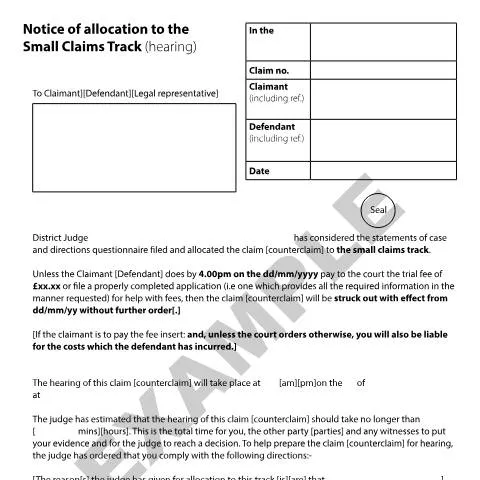
Diving Into Form N157: A Pathfinder for Small Claims Track Allocations
Understanding the small claims process in the UK can seem daunting, particularly when you receive official communications from HM Courts & Tribunals Service. One such document is the Form N157: Notice of Allocation to the Small Claims Track (Hearing). This notice plays a crucial role in outlining the next steps in your small claims case and ensuring that all parties are on the same page regarding what to expect during the hearing.
What to Expect from the Notice of Allocation
The Form N157 serves as a formal communication from the court that indicates your claim has been allocated to the small claims track. It is essential to grasp the significance of this notice, as it sets the stage for the hearing process. Essentially, the notice informs you that:
- Your case has been assessed by a District Judge based on the statements of case and directions questionnaire.
- The judge has confirmed that your claim (or counterclaim) is suitable for the small claims track.
- You are required to pay a trial fee or apply for help with fees by a specific deadline to avoid your claim being struck out.
This notice is vital in legal proceedings as it lays out the expectations and requirements for both claimants and defendants. Failure to comply with outlined instructions can lead to your claim being dismissed, making it crucial to pay attention to every detail.
Understanding Key Components of Form N157
Form N157 contains essential information regarding the allocation of your case to the small claims track. Understanding each component of the notice can help you navigate the process more effectively. Here's what you will typically find:
1. Details of the Hearing
Included in the notice is the date and time of your hearing. It's important to mark this date on your calendar, as attending the hearing is generally mandatory unless you notify the court otherwise at least 7 days in advance.
2. Trial Fee Requirement
The document states the trial fee you must pay by a specified deadline to proceed with your claim. If you don't pay this fee on time or file a correct application for help with fees, the court may strike out your claim, meaning it will no longer exist.
3. Directions from the Judge
The judge may set certain directions to help prepare your case for the hearing. This could include instructions on disclosing evidence, deadlines for submitting additional documents, or requirements for witness statements.
4. Attendance and Representation
Form N157 advises on the importance of attending the hearing. If you fail to attend and do not notify the court, your claim could be dismissed. Conversely, if the claimant attends but the defendant does not, the decision may be made based solely on the claimant's evidence.
Connecting the Dots: Form N157 and Other Relevant Documentation
Form N157 does not exist in isolation; it is part of a broader framework of documents that guide the small claims process. Here’s a look at how Form N157 interacts with other key documents:
- Directions Questionnaire (Form N180): This must be submitted prior to receiving the N157. It provides the court with information about your claim and any relevant circumstances that could affect its allocation to the small claims track.
- Claim Form (Form N1): The initial document you file to start your claim. The N157 is sent after you've completed this initial step, indicating that the case is moving forward.
- Witness Statements: Per the directions set by the judge, you may need to submit witness statements, which will support your case during the hearing.
Each of these documents is interlinked, and understanding how they relate to Form N157 is essential to navigating the small claims process successfully. Missing a step or misunderstanding these connections can lead to unnecessary complications.
Essential Concepts to Grasp for Effective Navigation
Familiarising yourself with the terminology and specific concepts outlined in Form N157 can help demystify the process. Here are a few key terms and ideas:
1. Small Claims Track
The small claims track is designed for straightforward claims valued at £10,000 or less. The court process is simplified in this track, allowing individuals to represent themselves without needing legal representation, although legal advice is always beneficial.
2. Trial Fee
The trial fee is a crucial aspect of the small claims process. The amount varies based on the value of your claim and must be paid by a specific date to avoid having your claim struck out. It's essential to be aware of the financial implications involved in proceeding with your claim.
3. Directions from the Judge
The directions from the judge are specific instructions that must be followed to effectively prepare for your case. These can include deadlines for submitting documents or requirements for how evidence should be presented.
Navigating Potential Pitfalls: Common Misunderstandings
While Form N157 provides critical information, several common misconceptions can arise. Addressing these can help avoid complications down the road.
1. Assumptions About Attendance
Many individuals mistakenly believe they do not need to attend the hearing if they have submitted all required documents. However, attendance is crucial. If you miss the hearing without notifying the court, your claim may be struck out.
2. Ignoring the Deadline for the Trial Fee
Some claimants overlook the importance of the deadline for the trial fee payment. Failing to pay within the stipulated timeframe can lead to the dismissal of your claim without further notice, which can be particularly disheartening after investing time and effort.
3. Misunderstanding Directions
Each direction provided by the judge is significant for the hearing's outcome. Misinterpreting or failing to follow these instructions can adversely affect your case. It is crucial to read and understand every detail outlined in the notice.
Practical Steps Following the Receipt of Form N157
Receiving Form N157 is a pivotal moment in your small claims process, and taking proactive steps can significantly influence your case's trajectory. Here are some useful actions to consider:
1. Confirm Your Hearing Date
As soon as you receive the notice, confirm your hearing date and time, marking it clearly on your calendar. This reminder will help you prepare adequately.
2. Manage Your Trial Fee
Check the specified trial fee and ensure you either pay it by the deadline or file for assistance with fees if you're eligible. This step is vital to keep your claim alive.
3. Prepare Required Documents
Review the judge's directions and prepare any required documents. This may include evidence, witness statements, or other relevant materials that support your position in the case.
4. Seek Legal Advice if Needed
While small claims can be pursued without legal representation, consulting with a professional can provide invaluable insights. Ensure you're adequately prepared for the hearing to present your case effectively.
Utilizing Available Resources to Strengthen Your Case
HM Courts & Tribunals Service provides various resources that can be beneficial as you navigate the small claims process. These include:
- Online Guides and Leaflets: Access detailed leaflets, such as leaflet EX306, available through the HMCTS Form Finder, which explain what to do after your case is allocated to the small claims track.
- Court Office Assistance: The court office can be a valuable source of information. They are available to answer questions and provide guidance on the procedures you need to follow.
- Mediation Services: If both parties are open to it, mediation can be a less confrontational way to resolve disputes before the hearing, saving time and resources for both sides.
Being aware of these resources can help you feel more confident as you approach your hearing, enabling you to focus on articulating your case effectively.
Conclusion: Empowering Your Small Claims Journey
Form N157 is more than just a notice; it's your roadmap through the small claims process. By understanding its contents, the context in which it operates, and the steps you need to take, you can navigate your small claims journey with greater clarity and confidence.
Equipped with the knowledge of how critical this document is and knowing what steps to take, you are not just a passive participant in the proceedings. You are empowered to advocate for your claim effectively, utilising every resource at your disposal.
Fill in your form directly online
No printing: type your details into the boxes of the official form, tick, then download the PDF ready to send.
- 1Type into the form boxes
- 2Tick in one click
- 3Save and download the PDF
Stay proactive, remain informed, and approach your hearing prepared. The small claims track is designed to offer access to justice; with the right preparation, you can ensure that your voice is heard, and your claim is taken seriously.
Understanding the Small Claims Track: An Overview
The Small Claims Track is a crucial component of the UK civil court system, designed to provide an accessible route for individuals and businesses to resolve disputes with lower value claims efficiently. Typically, claims of up to £10,000 fall under this track. However, certain exceptions exist; for instance, personal injury claims are generally limited to £1,000. The process is meant to be straightforward, allowing laypeople to represent themselves without needing legal representation.
The purpose of the Small Claims Track is to minimize costs and ensure that justice is served without the burden of extensive legal procedures or prohibitive fees. Claims are often resolved through a hearing, although many disputes can be settled beforehand through negotiation and mediation. The court's aim is to facilitate a fair resolution while expediting the process, reducing the overall time and financial commitment of all parties involved.
Once a claim is allocated to the Small Claims Track, the claimant will receive Form N157, which serves as the formal notice of allocation for the forthcoming hearing. This document outlines the necessary steps, the date and time of the hearing, and other essential instructions that claimants must follow. It’s critical for claimants to thoroughly understand the implications of receiving Form N157, as it marks a significant stage in their case.
Preparation for the Hearing: Key Steps and Considerations
Upon receiving Form N157, the claimant must take several important steps to prepare for the hearing. First and foremost, it is advisable to review the allocation notice carefully, paying close attention to any specific directions or deadlines specified by the court. Missing a deadline can adversely affect a case, potentially leading to dismissals or adverse judgments.
One of the first tasks involves gathering all relevant evidence. This includes any documents, photographs, contracts, or written correspondence pertinent to the claim. It is beneficial to create a clear and organized bundle of evidence that can be easily navigated during the hearing. Organizing evidence not only aids in presenting the case but also demonstrates to the judge that the claimant is prepared and professional.
In addition, preparing a concise statement outlining the key points of the case is crucial. This statement should clearly articulate the facts, the legal basis for the claim, and the remedy sought. Claimants should practice presenting their arguments, as clarity and confidence can significantly influence the judge's perception.
It may also be beneficial to familiarize oneself with court etiquette and procedures. Understanding how to address the judge, the order in which evidence will be presented, and how to handle cross-examinations can contribute to a more effective presentation. Finally, claimants should consider the possibility of engaging a legal advisor or representative for guidance, even if full representation is not pursued.
What to Expect During the Hearing: The Process Explained
The hearing itself is a pivotal moment in the small claims process, and knowing what to expect can help alleviate some anxiety. On the day of the hearing, claimants should arrive early to ensure they are prepared and to locate the correct courtroom. Attire should be professional, as this demonstrates respect for the court. Once inside the courtroom, all parties will be asked to introduce themselves, including the judge, who presides over the proceedings.
During the hearing, the judge will first outline the purpose of the meeting and the issues in dispute. The claimant is then given the opportunity to present their case, followed by the defendant's response. This exchange involves presenting evidence, questioning witnesses, and possibly cross-examination. It is essential for claimants to remain calm and composed throughout this process, as maintaining professionalism can positively influence the judge's perception.
After both sides have presented their cases, the judge may ask further questions to clarify any points. Once all evidence has been heard, the judge will make a decision, either immediately or at a later date. In some instances, the judge may encourage both parties to settle the dispute amicably before rendering a judgment, reflecting the court's preference for resolution without prolonged legal battles.
Ultimately, the experience of attending a hearing can be invaluable, regardless of the outcome. Participants gain firsthand insight into the judicial process, which can be beneficial for any future legal disputes.