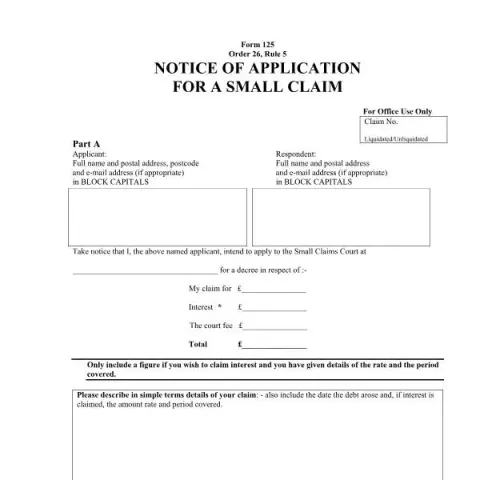
Understanding the Official Form 125: Notice of Application for a Small Claim in Northern Ireland
If you are involved in a legal dispute in Northern Ireland that involves a claim of a relatively small monetary value, you may need to complete an official document known as the Form 125. This form, issued by the Department of Justice Northern Ireland, serves as a formal notice of your intention to initiate a small claim through the court system. Properly understanding this form is essential for claimants and respondents alike, ensuring the process proceeds smoothly and in accordance with legal requirements.
What is the purpose of Form 125?
Form 125 is designed to notify the court and the other party involved in a dispute about your intention to seek a legal remedy for a claim that falls within the small claims category. This form acts as an initial step in the legal process, outlining the nature and amount of the claim, and providing relevant details about the parties involved. It is primarily used when a claimant wishes to recover a specific sum of money, whether due to unpaid debts, breach of contract, or other financial disputes.
When should you use Form 125?
This form is appropriate in situations where the claim involves a monetary amount that is considered small under the jurisdiction's limits. Examples include unpaid invoices, rent arrears, or minor contractual disagreements. It is important to note that the claim should be within the court’s monetary threshold for small claims, typically set by the relevant legal rules.
Before submitting Form 125, the claimant must ensure that the dispute is suitable for small claims court procedures, which are designed to be more straightforward and less formal than higher courts. If the claim exceeds the small claims limit, other legal procedures may be more appropriate.
Key information requested on the form
Completing Form 125 involves providing specific details about both parties and the claim itself:
- Part A: Details of the Claim
- Claimant and Respondent Information: Full names, postal addresses, and email addresses (if available), written clearly in BLOCK CAPITALS.
- Claim Details: The amount of money claimed, including any interest, court fees, and the total sum.
- Description of the Claim: A straightforward explanation of the dispute, including the date the debt arose, the nature of the claim, and details of any interest claimed (rate and period).
- Part B: Court Office Use
- Details about where the claim will be processed.
- Instructions for disputing, counterclaiming, or accepting liability.
- Deadline for the respondent to reply to the claim.
Filling out the form: tips and points of attention
When completing Form 125, accuracy and clarity are paramount. Here are some important points to consider:
- Use BLOCK CAPITALS to ensure legibility of all personal details.
- Be precise in describing your claim, including exact dates and amounts.
- Include all relevant financial details, such as the amount claimed, interest (if applicable), and the court fee.
- Double-check deadlines for submitting the form and any subsequent responses, as failure to respond may result in a default decree against you.
How to submit the form and what happens next
Once completed, the claimant must submit Form 125 to the appropriate Small Claims Court Office specified in Part B. The court will then process the application and notify the respondent of the claim. If the respondent wishes to dispute the claim, issue a counterclaim, or accept liability, they must lodge the relevant notices or forms with the court by the deadline specified on the form.
Fill in your form directly online
No printing: type your details into the boxes of the official form, tick, then download the PDF ready to send.
- 1Type into the form boxes
- 2Tick in one click
- 3Save and download the PDF
It is crucial for both parties to adhere to the deadlines indicated. Failure to respond may lead to a court ruling being made in the claimant’s favour without further notice or correspondence.
Final considerations
Using Form 125 correctly is essential for ensuring that small claims are handled efficiently and fairly. It provides a clear record of your claim and helps facilitate a resolution process that is less formal and quicker than traditional court proceedings. If you are unsure about any part of the form or the process, seeking legal advice or guidance from the court’s information services is advisable.