Understanding the RTASC L Form: A Guide for Claimants in Road Traffic Accident Liability Cases
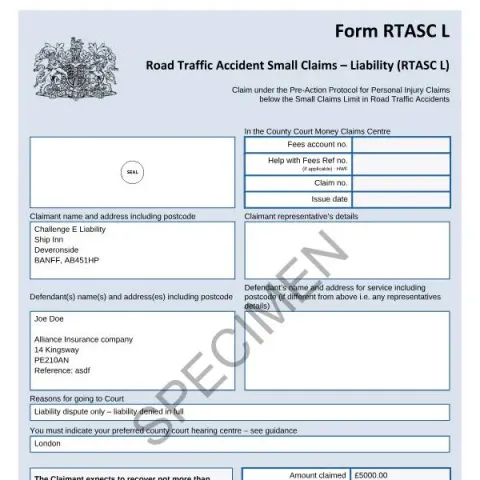
The Road Traffic Accident Small Claims – Liability (RTASC L) form is an official document issued by the County Court Money Claims Centre in the United Kingdom. It is designed for individuals involved in road traffic accidents who wish to initiate a claim solely related to liability, and where the amount in dispute does not exceed the small claims limit. This guide aims to clarify the purpose of the form, the information it requires, and how to correctly complete and submit it.
When to Use the RTASC L Form
The RTASC L form is applicable in cases where there is a dispute over who is legally responsible for a road traffic accident. It is typically used when the claimant wants to establish liability without pursuing claims for damages such as pain, suffering, or loss of amenity at this stage. This form is suited for claims expected to recover a value up to the specified limits (£5,000 for pain and suffering, and £10,000 in total). It is part of the pre-action protocol for personal injury claims, intended to facilitate early resolution of liability issues in small claims courts.
Key Sections and Their Purposes
Section A: Existing Proceedings and Support Needs
This section asks whether court proceedings have already begun under the RTA Small Claims Protocol, and if so, provides space for the existing claim number. It also allows claimants to specify any support they may require during court hearings, such as disabled access or language interpretation services.
Section B: Knowledge of Other Claims and Proceedings
Claimants must disclose any knowledge of other claims related to the same accident, including ongoing court proceedings or previous decisions. This ensures that the court has a complete picture of all related legal actions, which could influence the current case.
Section C: Evidence and Court Pack
This section emphasizes the importance of including all relevant evidence in the Court Pack, a collection of documents supporting the claim. Claimants are asked to confirm whether they have completed and sent this pack to the other party and whether any new evidence is being attached to the form. Proper documentation, such as dashcam footage or witness statements, is crucial for establishing liability.
Section D: Statement of Truth
The final section requires the claimant to declare that the information provided is true to the best of their knowledge. This declaration is legally binding, and making false statements can lead to contempt of court proceedings. The form must be signed and dated to verify its authenticity.
Fill in your form directly online
No printing: type your details into the boxes of the official form, tick, then download the PDF ready to send.
- 1Type into the form boxes
- 2Tick in one click
- 3Save and download the PDF
How to Complete and Submit the RTASC L Form
- Fill out all relevant sections accurately: Ensure that all details, such as claimant and defendant addresses, claim amounts, and court preferences, are correctly entered.
- Attach supporting evidence: Include all documents in the Court Pack, and ensure that any new evidence is properly referenced and attached.
- Sign and date the form: The declaration of truth must be signed by the claimant or their representative, confirming the accuracy of the information provided.
- Send the form to the County Court Money Claims Centre: The completed form, along with the Court Pack, should be submitted following the court’s procedures, either online or by post, in accordance with the court’s guidance.
Points of Attention and Practical Tips
When completing the RTASC L form, claimants should:
- Double-check all details: Incorrect or incomplete information can delay proceedings or affect the case outcome.
- Ensure comprehensive evidence inclusion: Missing documents may weaken the claim or lead to adjournments.
- Be aware of deadlines: The form must be submitted within the prescribed time limits, typically aligned with the court’s procedural timetable.
- Seek legal advice if uncertain: While the form is designed for straightforward liability disputes, consulting a legal professional can help ensure proper completion and improve the chances of a successful claim.
In summary, the RTASC L form is a vital step for claimants seeking to resolve liability issues in road traffic accidents within the small claims framework. Accurate completion, timely submission, and thorough evidence preparation are key to navigating the process effectively.