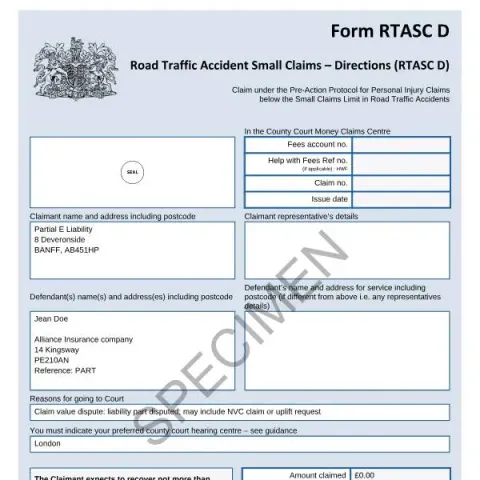
Understanding the RTASC D Form: Directions for Small Claims in Road Traffic Accidents
The Road Traffic Accident Small Claims – Directions (RTASC D) form is an official document used within the UK legal system to manage claims relating to road traffic accidents that fall below the small claims limit. Managed by the County Court Money Claims Centre, this form guides claimants through the process of submitting a claim for personal injury or property damage resulting from a road traffic collision.
Purpose and Scope of the RTASC D Form
This form is designed for claimants who are initiating or managing a claim under the Pre-Action Protocol for Personal Injury Claims, specifically those involving road traffic accidents where the total claim value does not exceed the prescribed limits (£5,000 for pain and suffering, and £10,000 overall). It helps streamline the process by providing clear directions on the necessary steps, evidence, and court procedures involved in small claims related to road traffic incidents.
Who Should Fill Out the RTASC D Form?
The RTASC D form must be completed by individuals or representatives involved in a claim concerning a road traffic accident. This includes:
- Claimants seeking compensation for personal injuries or damages
- Legal representatives acting on behalf of claimants
- Parties involved in ongoing proceedings or those preparing for court hearings
It is essential that the person filling out the form has detailed information about the claim, the involved parties, and the relevant evidence to ensure accurate processing.
How to Fill Out the RTASC D Form
Step 1: Basic Claim Details
Start by providing the claimant's full name, address, postcode, and contact details. Include the claim number if the case has already been initiated. Specify the defendant’s details, including their name and address for service, especially if different from the primary address.
Step 2: Claim Information and Dispute Details
Indicate the claim value, specifying whether it covers damages for pain, suffering, and loss of amenity, as well as any property damage. Clearly state the amount claimed and whether court fees or legal costs are involved.
Next, specify whether the claim is part of an ongoing case, and if so, provide the existing claim number and details about any previous proceedings or court decisions related to the accident.
Step 3: Selecting the Claim Type and Supporting Evidence
Claimants must choose the appropriate section based on the nature of their claim:
- Liability admitted in part, liability disputed, or liability not in dispute
- Claims involving non-protocol vehicle costs or uplift applications in exceptional circumstances
For each scenario, the form requires details about witnesses, the Court Pack list (a collection of relevant documents), and any objections or amendments made by the respondent (the party defending the claim).
Step 4: Evidence Submission and Court Pack
Claimants should confirm whether they have included all relevant evidence in the Court Pack, which supports their case. This includes documents such as photographs, witness statements, or video clips uploaded to the portal. If new evidence is to be attached, reasons and summaries should be provided.
Supporting Documents and Evidence
Accurate and complete evidence is crucial for the court to assess the claim effectively. The Court Pack must contain all relevant documents listed in the appropriate tables (A, B (1), B (2)).
Fill in your form directly online
No printing: type your details into the boxes of the official form, tick, then download the PDF ready to send.
- 1Type into the form boxes
- 2Tick in one click
- 3Save and download the PDF
Claimants must ensure that the Court Pack has been sent to the other party (the respondent) and that any objections or amendments have been addressed before submitting the final form.
Where and How to Submit the RTASC D Form
The completed RTASC D form, along with the Court Pack and supporting evidence, should be submitted to the County Court Money Claims Centre. Submission can be made via the court portal or by post, depending on the specific court’s procedures.
It is advisable to keep copies of all submitted documents and to follow any instructions provided in the guidance notes accompanying the form to ensure proper processing.
Common Errors to Avoid
- Failing to include all relevant evidence or attaching incomplete documents
- Incorrectly filling out the claim amount or court fee details
- Omitting details about previous proceedings or related claims
- Not specifying the correct support needs for court hearings
Careful completion of the RTASC D form ensures a smoother process and a clearer presentation of your claim, facilitating a fair and efficient resolution of road traffic accident disputes within the small claims framework.