Understanding the RPEC5 Notice of Application under the Landlord and Tenant Act 1954 for Telecommunications Infrastructure
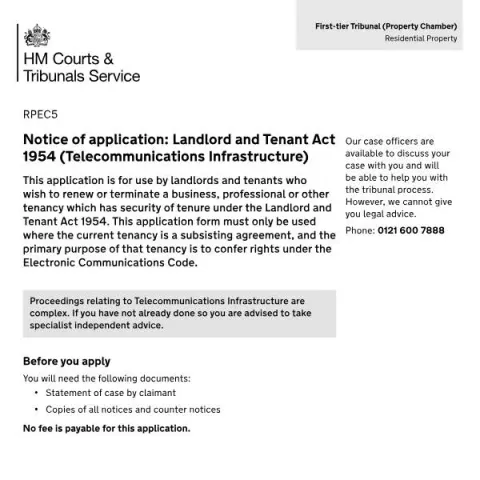
The First-tier Tribunal (Property Chamber) Residential Property provides a specific application form, designated as RPEC5, for landlords and tenants involved in disputes or proceedings relating to telecommunications infrastructure under the Landlord and Tenant Act 1954. This form is essential for parties wishing to renew, terminate, or address other issues concerning tenancies that confer rights under the Electronic Communications Code. Understanding when and how to use this form is crucial for navigating the complex legal landscape of telecommunications rights within residential and commercial properties.
When to Use the RPEC5 Application Form
The RPEC5 form is designed specifically for cases where the tenancy in question is a current, subsisting agreement that primarily grants rights under the Electronic Communications Code. It applies in situations such as:
- Landlords seeking to renew or terminate a tenancy that includes rights for telecommunications infrastructure.
- Tenants wishing to secure a new tenancy under section 24 of the Act.
- Parties involved in disputes over interim rent or compensation for exercising code rights.
It is important to note that proceedings involving telecommunications infrastructure are often complex, requiring careful legal consideration. Parties are advised to seek specialist independent advice before submitting an application.
Preparing Your Application: Necessary Documents and Information
Before completing the RPEC5 form, applicants should gather several key documents:
- A statement of case outlining the grounds of the application.
- Copies of all notices and counter notices exchanged between parties relevant to the dispute.
These documents help establish the context and legal basis of the application, ensuring the tribunal has all necessary information for a fair hearing.
Filing the Application: Key Sections and Details
Section 1 – Type of Application
This section requires you to specify the nature of your application, such as:
- Application by a tenant for a new tenancy under section 24.
- Application by a landlord for a new tenancy under section 24.
- Application by a landlord for termination of tenancy under section 29(2).
- Application for interim rent determination under section 24A.
- Application by a landlord for compensation related to exercising code rights under section 34B.
Section 2 – Details of the Applicant
Applicants must provide comprehensive contact information, including:
- Full name or company name.
- Capacity (whether acting as a landlord or tenant).
- Address and contact details (phone, mobile, email).
- Details of any representative, if applicable, including their contact information.
Section 3 – Details of Respondent(s)
Similarly, the respondent’s details must be clearly provided, including:
- Full name or company name.
- Address and contact details.
Accurate and complete information ensures the application is processed efficiently and reduces delays caused by missing or incorrect data.
Submitting the Application and Next Steps
The RPEC5 form can be submitted directly to the First-tier Tribunal (Property Chamber). No fee is payable for this application, but applicants should ensure all supporting documents are included. Once submitted, case officers at the tribunal are available to discuss the case and guide applicants through the process. However, they cannot provide legal advice.
Fill in your form directly online
No printing: type your details into the boxes of the official form, tick, then download the PDF ready to send.
- 1Type into the form boxes
- 2Tick in one click
- 3Save and download the PDF
Applicants should keep copies of all submitted documents and correspondence. The tribunal’s decision may impact the rights and obligations of both landlords and tenants concerning telecommunications infrastructure, so careful preparation is vital.
Points of Attention and Recommendations
Given the technical and legal complexities involved in proceedings related to telecommunications infrastructure, parties are strongly encouraged to seek expert legal advice. This is especially important when dealing with disputes over rights, rent, or termination under the Electronic Communications Code. Properly completing and submitting the RPEC5 form, along with comprehensive supporting documents, can significantly influence the outcome of your case.
For further assistance, contact the tribunal’s case officers at the provided phone number. They are there to clarify procedural questions but will not offer legal guidance.