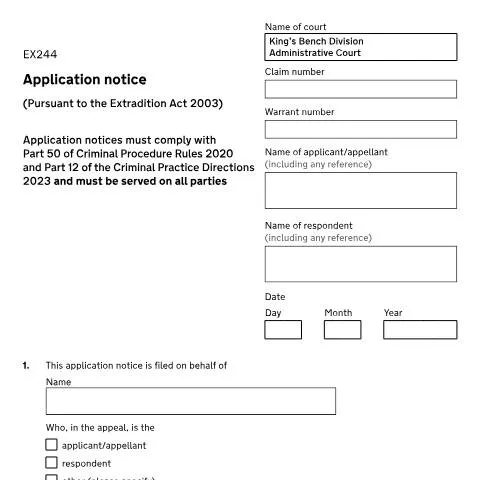
Overview of the Application Notice under the Extradition Act 2003
The Application Notice under the Extradition Act 2003 is a formal document used within the UK legal framework to initiate proceedings related to extradition requests. Managed by the Criminal Procedure Rule Committee and the Ministry of Justice, this notice ensures that all parties involved in extradition cases are properly informed and that the process adheres to the relevant procedural rules.
Purpose and Legal Context
This application notice serves to specify the court's directions regarding an extradition case, whether for requesting the surrender of an individual or responding to such a request. It is governed by Part 50 of the Criminal Procedure Rules 2020 and Part 12 of the Criminal Practice Directions 2023, which set out the procedural standards for such applications. The notice aims to streamline the process, ensuring clarity and fairness in accordance with the statutory requirements of the Extradition Act 2003.
Who Should Use This Application Notice
This document is primarily used by legal representatives, courts, and parties involved in extradition proceedings. It can be filed by the applicant or appellant seeking extradition or by the respondent opposing it. The notice must be served on all relevant parties to ensure transparency and proper legal process.
Key Components of the Application Notice
Identification Details
- Name of Court: The court where the application is filed, such as the High Court or Crown Court.
- Claim and Warrant Numbers: Unique identifiers for the case and warrant involved.
- Parties Involved: Names of the applicant, appellant, or respondent, including any relevant references.
- Date of Filing: The specific day, month, and year when the notice is submitted.
Nature of the Application
The notice requires the applicant or legal representative to specify the particular order they are requesting from the court and the reasons for this request. This could involve, for example, an application for the surrender of an individual or for specific procedural directions.
Supporting Evidence and Urgency
- Attachments: Drafts of the order or relevant supporting documents such as witness statements or statements of case.
- Urgency: Whether the application is urgent, requiring a decision within seven days, with reasons provided if applicable.
Hearing Arrangements and Evidence
- Hearing Preference: Whether the application should be dealt with at a hearing or without one.
- Estimated Duration: The expected length of the hearing, with confirmation of agreement among parties.
- Fixed Date: Any specific hearing date or period already arranged.
- Evidence: Details of the evidence relied upon, such as witness statements or case documentation.
Statement of Truth and Submission Details
All applications must include a statement of truth, confirming that the facts presented are true to the best of the applicant’s knowledge. The person signing the application must be authorized, and their signature must be accompanied by their full name, position, and date of signing.
Contact and Service Details
The notice must specify the address where documents should be sent, including contact details such as phone number, email, and any relevant reference numbers. This ensures proper communication throughout the proceedings.
Fill in your form directly online
No printing: type your details into the boxes of the official form, tick, then download the PDF ready to send.
- 1Type into the form boxes
- 2Tick in one click
- 3Save and download the PDF
Conclusion
The Application Notice under the Extradition Act 2003 is a critical procedural document that facilitates the orderly conduct of extradition cases in the UK. It ensures all parties are aware of the court’s directions and the evidence relied upon, while also providing mechanisms for urgency and specific hearing arrangements. Proper completion and service of this notice are essential to uphold the legal standards set out in the relevant legislation and procedural rules.