When Property Rights Collide: Navigating Restrictive Covenant Objections
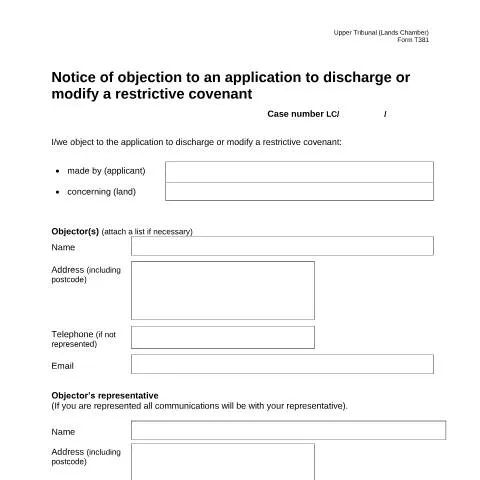
When a property owner seeks to discharge or modify a restrictive covenant through the Upper Tribunal (Lands Chamber), neighbouring landowners and other beneficiaries face a critical decision. The Form T381 Notice of Objection represents their formal mechanism to contest such applications, potentially preserving long-established property protections that maintain neighbourhood character, property values, or specific land use arrangements.
This objection process sits at the heart of English land law's delicate balance between individual property rights and collective interests. Unlike planning applications where local authorities make decisions, restrictive covenant modifications are determined by specialist tribunal judges who must weigh competing legal and practical considerations. The T381 form serves as the gateway for those who believe their interests would be adversely affected by proposed covenant changes.
Understanding when and how to deploy this objection mechanism requires grasping both the legal technicalities of covenant enforcement and the practical implications of tribunal proceedings. The stakes are often substantial—successful objections can preserve valuable property rights, whilst failed challenges may result in permanent loss of covenant protections.
Legal Standing: Who Can Object and Under What Circumstances
The fundamental prerequisite for filing a T381 objection is demonstrating legal entitlement to the benefit of the restrictive covenant. This requirement filters out speculative or vexatious objections, ensuring only parties with genuine legal interests can participate in proceedings.
Original Covenantees and Their Successors
The clearest basis for objection arises when the objector is the original covenantee—the party who originally received the covenant's benefit. This typically occurs when the original developer or landowner who imposed the restriction still owns adjacent property. However, most covenant disputes involve subsequent owners who must establish their entitlement through more complex legal chains.
More commonly, objectors must demonstrate that covenants were created to benefit land they now own and remain enforceable against the burdened property. This requires proving both the original covenant's validity and its continued enforceability through proper legal transmission to the current objector.
Evidence Requirements for Establishing Entitlement
The tribunal takes a rigorous approach to verifying legal standing. Objectors whose entitlement is disputed must provide comprehensive evidence including:
- Original covenant documentation showing the restriction's creation and intended beneficiaries
- Title deeds and Land Registry entries demonstrating the objector's current ownership of benefited land
- Legal chain of title establishing proper transmission of covenant benefits through successive owners
- Surveyor's reports or plans identifying the geographical relationship between burdened and benefited properties
Objectors uncertain about their legal entitlement face a strategic dilemma. Filing an objection without solid legal foundation risks costs exposure if the tribunal finds no valid standing. Conversely, failing to object may result in permanent loss of potentially valuable covenant rights.
Structuring Effective Grounds of Objection
The T381 form requires objectors to articulate their opposition to either covenant discharge, modification, or both. This distinction proves crucial because different legal tests apply to each type of application, and strategic considerations vary significantly between the two scenarios.
Objecting to Complete Discharge
When opposing total covenant removal, objectors must demonstrate that the restriction continues to serve a legitimate purpose and that discharge would cause material prejudice to their interests. Effective objection statements address several key elements:
Continuing practical utility of the covenant in protecting the objector's property or land use. This might include maintaining residential character in mixed-use areas, preserving sight lines or privacy, or protecting commercial interests from competing developments.
Quantifiable detriment that would result from discharge. While precise valuations are often impossible at the objection stage, objectors should provide realistic estimates of property value impacts, loss of amenity, or interference with existing or planned land use.
Response to the applicant's grounds for seeking discharge. The T381 form specifically requires objectors to address the applicant's stated reasons, forcing engagement with arguments about changed circumstances, obsolescence, or lack of practical benefit.
Modification Objections: A More Nuanced Approach
Objecting to covenant modification often requires more sophisticated legal analysis. Objectors must evaluate whether proposed changes would materially affect their interests whilst acknowledging that some modification might be acceptable.
| Modification Type | Key Objection Considerations | Potential Compromise Positions |
|---|---|---|
| Use restrictions | Impact on property values, neighbourhood character | Limited commercial use, specific hour restrictions |
| Building restrictions | Privacy, overshadowing, architectural harmony | Reduced scale, alternative positioning |
| Access limitations | Traffic generation, security concerns | Restricted vehicle types, time-limited access |
Compensation Claims: Balancing Opposition with Pragmatic Recovery
The T381 form includes provision for compensation claims, creating a strategic decision point for objectors. Claiming compensation does not preclude objecting to the application entirely, but it signals potential willingness to accept covenant modification in exchange for financial redress.
Calculating Provisional Compensation Amounts
The form requests an approximate amount of compensation claimed, explicitly noting this figure is provisional. This estimate serves multiple purposes in tribunal proceedings:
Establishing the scale of claimed prejudice helps the tribunal assess whether objections are proportionate to actual harm. Claiming £500,000 compensation whilst objecting to a minor covenant modification may undermine credibility, whilst nominal amounts might suggest objections lack substance.
Influencing settlement negotiations between parties often occurs before tribunal hearings. Realistic compensation claims can facilitate compromise solutions that avoid costly litigation whilst protecting objectors' essential interests.
Demonstrating commercial awareness of property impacts shows tribunals that objections rest on practical rather than purely obstructive grounds. Professional valuations, whilst not required at objection stage, strengthen compensation claims substantially.
Strategic Considerations Around Compensation
Objectors must weigh several factors when deciding whether to claim compensation:
- Finality concerns—accepting compensation typically results in permanent covenant modification or discharge
- Precedent effects—successful applications may encourage similar challenges to other covenants in the area
- Ongoing relationships—neighbourhood dynamics may influence whether monetary settlement or continued restriction better serves long-term interests
Procedural Requirements and Tactical Timing
The T381 objection process operates within strict procedural frameworks that can determine success or failure regardless of underlying legal merits. Understanding these requirements prevents technical failures that could invalidate otherwise valid objections.
Critical Time Limits and Extension Applications
Objections must reach the tribunal within one month of the publicity notice date or receipt of the application copy. This deadline is strictly enforced, though extensions may be granted in exceptional circumstances.
Late objectors face additional procedural burdens including formal extension applications supported by compelling reasons for delay. Common grounds for extensions include:
- Postal delays or communication failures preventing timely receipt of application notices
- Legal complexity requiring professional advice where objectors needed time to establish their entitlement
- Family circumstances or health issues preventing timely response to application notices
Electronic Filing and Professional Representation
The Upper Tribunal (Lands Chamber) increasingly emphasises digital case management through its E-Filing service. Professional representatives must use electronic submission, whilst unrepresented parties retain options for postal filing.
This dual system creates practical considerations for objectors deciding whether to engage professional representation. Self-represented parties avoid mandatory electronic filing but may lack expertise to navigate complex covenant law effectively.
Costs Implications and Risk Management
Understanding potential costs exposure proves essential for objectors weighing whether to contest covenant applications. The T381 form includes important guidance on costs principles that differ significantly from standard civil litigation.
Protected Position for Valid Objectors
Objectors with established entitlement to covenant benefits enjoy significant costs protection. The form explicitly states that such objectors will not be ordered to pay the applicant's costs unless they behave unreasonably during proceedings.
This protection encourages legitimate objections by removing the primary financial deterrent to contesting covenant applications. However, the "unreasonable behaviour" exception requires careful consideration of litigation conduct throughout proceedings.
Successful Objection Rewards
Successful objectors typically recover their reasonable legal costs from unsuccessful applicants. This creates positive incentives for well-founded objections whilst ensuring applicants bear the financial consequences of failed challenges to valid covenant protections.
The combination of costs protection for valid objectors and cost recovery for successful opposition creates a framework that encourages legitimate challenges whilst deterring frivolous applications.
Integration with Broader Covenant Modification Procedures
Form T381 objections operate within the larger framework of Upper Tribunal (Lands Chamber) procedures governing restrictive covenant disputes. Understanding this broader context helps objectors make informed strategic decisions about their participation level and objectives.
Relationship to Initial Applications
Covenant modification applications follow structured procedures including public notification requirements designed to identify potential objectors. The absence of objections can strengthen applicants' cases by suggesting covenant restrictions no longer serve practical purposes.
This dynamic creates pressure on potential objectors to participate actively in proceedings rather than remaining passive observers. Tribunals may interpret lack of objection as evidence supporting covenant discharge or modification applications.
Settlement and Alternative Dispute Resolution
Many covenant disputes resolve through negotiation following initial objection filing. The T381 process creates framework for structured discussions between applicants and objectors about acceptable compromise solutions.
Common settlement structures include:
- Partial covenant modification addressing applicants' core needs whilst preserving objectors' essential protections
- Compensation agreements providing financial redress for covenant relaxation without full discharge
- Replacement restrictions updating obsolete covenant terms whilst maintaining substantive protections
Documentary Evidence and Case Preparation
Whilst Form T381 provides the initial framework for objections, successful opposition typically requires substantial supporting documentation that builds compelling cases for covenant preservation or modification refusal.
Property-Specific Evidence Requirements
Effective objection cases combine legal entitlement evidence with practical demonstration of continuing covenant utility. This multi-layered approach addresses both threshold standing requirements and substantive merit considerations.
Photographic evidence showing current property conditions, neighbourhood character, and potential impact areas helps tribunals understand practical implications of proposed covenant changes. Before and after comparisons, sight line studies, and contextual neighbourhood views strengthen visual presentations.
Professional reports from chartered surveyors, planning consultants, or property valuers provide expert assessment of covenant modification impacts. These reports carry particular weight when addressing property value effects, planning policy compliance, or technical feasibility issues.
Neighbourhood consultation evidence demonstrating broader community support for covenant preservation can influence tribunal decisions, particularly where covenants protect established residential character or environmental amenities.
Coordinating Multiple Objector Responses
Covenant applications often generate multiple objections from different beneficiary landowners. Coordinating these responses can strengthen overall opposition whilst avoiding duplicative or contradictory arguments.
The T381 form accommodates multiple objectors through attached lists, but strategic coordination requires careful planning of complementary rather than repetitive objection grounds. Different objectors may emphasise distinct impacts—residential amenity, commercial interests, environmental protection—creating comprehensive opposition cases.
Specific Grounds for Objection and Legal Precedents
When submitting Form T381, the strength of your objection fundamentally depends on establishing valid legal grounds recognised by the Upper Tribunal (Lands Chamber). The most compelling objections typically fall into several established categories, each requiring specific evidence and legal arguments.
Obsolescence through changed circumstances represents one of the most frequently successful grounds. This applies when the character of the neighbourhood has fundamentally altered since the covenant's creation, rendering its original purpose meaningless. For instance, a covenant preventing commercial use becomes questionable when the surrounding area has transformed from residential to mixed-use development. The key test involves demonstrating that the covenant no longer serves any practical benefit to those it was designed to protect.
Documentary evidence proving neighbourhood change proves crucial here. This includes planning permissions granted for nearby properties, local authority development plans showing zoning changes, and photographic evidence spanning several years. Ordnance Survey maps from different periods can effectively illustrate how land use patterns have evolved, particularly when combined with Land Registry records showing property transactions and their approved uses.
Absence of practical benefit forms another strong foundation for objection. This ground succeeds when you can prove that removing or modifying the covenant would cause no genuine disadvantage to neighbouring properties. The legal test focuses on whether the covenant continues to protect something of real value rather than merely theoretical rights.
Expert valuation reports often support this argument by demonstrating that neighbouring properties derive no measurable benefit from the covenant's continuation. These reports should specifically address how the proposed development or covenant modification would affect property values and amenity in the immediate vicinity. The Upper Tribunal frequently considers whether alternative planning controls or building regulations provide adequate protection without the restrictive covenant.
Fill in your form directly online
No printing: type your details into the boxes of the official form, tick, then download the PDF ready to send.
- 1Type into the form boxes
- 2Tick in one click
- 3Save and download the PDF
Disproportionate impact provides grounds for objection when the covenant's enforcement would cause significantly greater harm to the applicant than benefit to those it protects. This balancing test requires careful quantification of both potential losses and gains. Financial evidence becomes particularly important, including development costs, projected returns, and the economic impact of covenant compliance.
The Upper Tribunal also recognises unity of ownership as grounds for covenant discharge. When the same person owns both the burdened and benefited land, the covenant may lose its purpose. However, this situation requires careful legal analysis, as subsequent sales might revive the covenant's enforceability depending on how the properties were marketed and sold.
Strategic Timing and Procedural Considerations
The timing of your Form T381 submission can significantly influence both the procedural aspects and ultimate success of your objection. Understanding the various stages of the Upper Tribunal process helps inform strategic decisions about when and how to present your case most effectively.
Early intervention advantages cannot be overstated. Submitting your objection promptly after receiving the application notice demonstrates serious intent and provides maximum time for case preparation. The Upper Tribunal typically allows 28 days for objections, but this deadline is strictly enforced. Late submissions require exceptional circumstances and formal applications for time extensions, which add complexity and potential costs.
However, timing considerations extend beyond mere deadline compliance. If you're aware of pending planning applications or local development proposals that might affect the covenant's relevance, coordinating your objection timeline with these processes can strengthen your position. For example, if the local planning authority is considering a development that would render the covenant obsolete, referencing this in your objection adds weight to arguments about changed circumstances.
Preliminary case management offers opportunities to shape how your objection proceeds. The Upper Tribunal typically holds case management conferences for complex matters, where procedural directions are established. These conferences allow you to raise concerns about evidence disclosure, expert witness requirements, and hearing schedules. Participating actively in case management can prevent later procedural disadvantages.
Consider requesting site visits during preliminary stages. The Upper Tribunal frequently benefits from seeing the physical context of covenant disputes, particularly when arguments involve visual impact, neighbourhood character, or practical development constraints. Early requests for site visits often receive more favourable consideration than last-minute applications.
Evidence preservation becomes critical once proceedings commence. The Upper Tribunal operates under strict disclosure rules, requiring parties to share relevant documents. Failing to preserve or disclose material evidence can seriously undermine your objection. This includes correspondence with the applicant, professional advice received, and any negotiations or discussions about the covenant's modification or removal.
Digital evidence requires particular attention in modern proceedings. Emails, text messages, and social media communications may become relevant, especially if they demonstrate the applicant's intentions or your reliance on the covenant's protection. The Upper Tribunal expects parties to conduct reasonable searches for electronic documents and to preserve data in appropriate formats.
Settlement negotiations often occur parallel to formal proceedings. The Upper Tribunal encourages alternative dispute resolution, and many covenant disputes resolve through negotiated agreements rather than full hearings. However, engaging in settlement discussions requires careful consideration of your long-term position. Any concessions made during negotiations might influence the Upper Tribunal's assessment if the case proceeds to hearing.
When considering settlement, evaluate whether partial modifications might address the applicant's needs while preserving your essential protections. For example, agreeing to relax certain restrictions in exchange for enhanced protections in other areas. Such arrangements often prove more durable than outright covenant removal and can maintain neighbourhood harmony while accommodating development needs.
Financial Implications and Compensation Mechanisms
Understanding the financial dimensions of restrictive covenant disputes proves essential for anyone considering Form T381 objections. The Upper Tribunal possesses broad powers regarding costs and compensation, making financial planning a crucial aspect of your objection strategy.
Compensation entitlements under Section 84 of the Law of Property Act 1925 provide important protection for successful objectors. When the Upper Tribunal modifies or discharges a covenant, it may award compensation to affected parties for any loss or disadvantage resulting from the decision. This compensation mechanism acknowledges that covenant removal might cause genuine harm even when modification serves the broader public interest.
Calculating appropriate compensation requires sophisticated analysis of property values, development potential, and amenity impacts. The Upper Tribunal typically considers the diminution in value of your property resulting from the covenant's modification or discharge. This assessment involves comparing your property's value with the covenant in place against its value following the Upper Tribunal's order.
Professional valuation evidence becomes indispensable for compensation claims. The Upper Tribunal expects expert evidence addressing both the current impact of the covenant on property values and the likely consequences of its modification. These valuations should consider not only immediate effects but also longer-term implications for property marketability and development potential.
Betterment considerations can complicate compensation calculations. If the Upper Tribunal's decision inadvertently benefits your property—perhaps by establishing precedents that enhance your own development rights—this betterment might offset compensation entitlements. The assessment requires careful analysis of how covenant modifications affect all parties' positions.
Legal costs exposure represents a significant financial risk in Upper Tribunal proceedings. Unlike some administrative tribunals, the Upper Tribunal can make costs orders against unsuccessful parties, particularly in cases involving unreasonable conduct or weak objections. Understanding when costs liability might arise helps inform strategic decisions about proceeding with objections.
The Upper Tribunal's costs jurisdiction follows general principles applied in courts, meaning that unsuccessful parties may face liability for both their own legal costs and those of successful opponents. However, the Upper Tribunal maintains discretion over costs awards and considers factors including the parties' conduct, the complexity of issues involved, and whether attempts at alternative dispute resolution were made.
Protective costs arrangements may be available in certain circumstances. If your objection raises issues of general public interest—such as important questions about neighbourhood conservation or planning policy—you might qualify for protective costs orders limiting your liability for opponents' costs. These arrangements require early application and demonstration of the public interest elements in your case.
Consider also the insurance implications of covenant disputes. Some buildings insurance policies provide legal expenses coverage that might assist with Upper Tribunal proceedings. However, coverage typically requires early notification and may exclude certain types of property disputes. Professional indemnity insurance for surveyors or solicitors involved in property transactions might also provide relevant coverage if covenant issues arise from professional advice.
Security for costs applications represent another financial consideration. If the applicant seeking covenant discharge demonstrates that you lack sufficient assets to meet potential costs liability, they might apply for security for costs orders. These orders require you to provide financial guarantees before proceeding with your objection, potentially through payment into court or insurance bonds.
The financial implications extend beyond immediate legal costs to encompass longer-term property implications. Successful objections preserve covenant protections that might prove valuable for future property transactions or development opportunities. Conversely, unsuccessful objections might establish precedents affecting similar covenants in your area, potentially influencing neighbourhood character and property values more broadly.