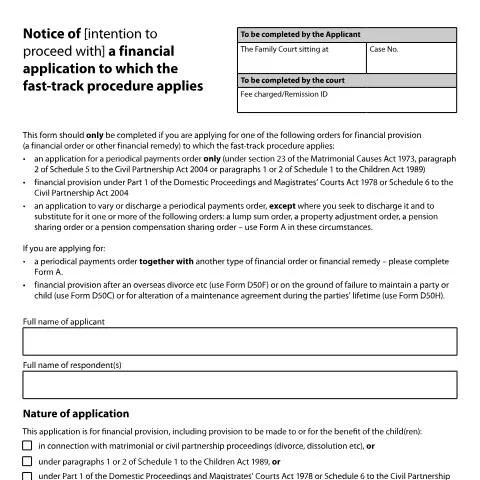
When Fast-Track Financial Applications Require Special Notice: Understanding Form A1's Strategic Role
In the complex landscape of family financial proceedings, certain applications benefit from an accelerated process designed to reduce both time and costs. Form A1 serves as the gateway to this fast-track procedure, but only for specific types of financial remedies that meet strict criteria. Unlike the comprehensive Form A used for most financial applications, this streamlined notice targets limited scope applications where the court can process claims more efficiently.
The form's primary function centres on periodical payments orders and specific variations to existing arrangements. This targeted approach reflects the Family Court's recognition that not all financial disputes require the full machinery of standard proceedings. When parties seek straightforward maintenance adjustments or discharge simple periodical payments, Form A1 provides a more proportionate procedural pathway.
Understanding when this form applies—and crucially, when it doesn't—can mean the difference between efficient resolution and costly procedural delays. The notice system also serves an important function in consent order applications, where parties have already reached agreement and simply need court approval for their financial arrangements.
Decoding the Fast-Track Eligibility Criteria
Form A1's scope is deliberately narrow, applying only to specific categories of financial remedy applications. The most common scenario involves periodical payments orders only, whether under section 23 of the Matrimonial Causes Act 1973, paragraph 2 of Schedule 5 to the Civil Partnership Act 2004, or paragraphs 1 or 2 of Schedule 1 to the Children Act 1989. This restriction ensures the fast-track procedure remains focused on relatively straightforward maintenance disputes.
The form also covers financial provision under Part 1 of the Domestic Proceedings and Magistrates' Courts Act 1978 or Schedule 6 to the Civil Partnership Act 2004. These provisions typically involve married couples or civil partners seeking maintenance without necessarily pursuing divorce or dissolution proceedings—situations where ongoing relationships require financial support arrangements.
Variation and discharge applications represent another key category, but with important limitations. You can use Form A1 to vary or discharge periodical payments orders, except where discharge involves substituting more complex orders like lump sums, property adjustments, or pension sharing arrangements. Such comprehensive changes require the full Form A procedure instead.
| Application Type | Fast-Track Eligible (Form A1) | Standard Procedure Required (Form A) |
|---|---|---|
| Periodical payments only | Yes | No |
| Periodical payments plus property adjustment | No | Yes |
| Simple variation of maintenance | Yes | No |
| Discharge with lump sum substitution | No | Yes |
Navigating Child Support Jurisdiction Complexities
When children are involved, Form A1 requires careful consideration of the Child Support Agency's jurisdiction. The form explicitly asks whether the CSA has made maintenance calculations for relevant children, recognising the general principle that child maintenance falls under the statutory child support scheme rather than court orders.
However, several exceptions allow court applications to proceed alongside or instead of CSA assessments. These include situations involving stepchildren, where the liable parent has no biological relationship requiring CSA involvement. Additional maintenance to "top up" CSA payments also remains within court jurisdiction, particularly for higher-earning parents whose circumstances exceed standard CSA calculations.
Disability-related expenses represent another important exception. When children require additional financial support due to disabilities, courts retain jurisdiction to order payments beyond standard child support. Similarly, education and training costs often justify court intervention, especially for private school fees or specialised training programmes that CSA assessments don't typically cover.
International elements add further complexity. When either the child, person with care, or absent parent lacks habitual UK residence, CSA jurisdiction may not apply, leaving court orders as the primary enforcement mechanism. Form A1's detailed questions help identify these jurisdictional boundaries early in proceedings.
Pre-1993 Agreement Protections
The form distinguishes between written agreements made before and after 5 April 1993, reflecting significant changes in child support legislation. Pre-1993 agreements often retain validity and enforceability through court procedures, while post-1993 agreements face different jurisdictional tests. This temporal distinction affects whether courts can make orders or whether parties must pursue CSA routes instead.
Strategic Considerations for Consent Order Applications
One of Form A1's most valuable applications involves consent order processing. When parties reach financial agreements independently, they often require court approval to create legally binding and enforceable orders. The form's specific question about consent orders—requiring attachment of draft terms—streamlines this approval process significantly.
Consent applications through the fast-track procedure offer several advantages over standard routes. Reduced court fees, shorter processing times, and minimal court involvement make this pathway attractive for amicable settlements. However, the consent order must fall within Form A1's scope limitations—complex property transfers or pension sharing arrangements still require full Form A procedures.
The draft order attachment requirement serves multiple purposes. It allows court staff to verify the proposed terms fall within fast-track parameters before formal processing begins. It also enables preliminary legal review, potentially identifying issues that might cause later complications or require additional procedural steps.
Importantly, consent orders processed through Form A1 carry the same legal enforceability as orders made through contested proceedings. This makes the fast-track consent route particularly valuable for parties prioritising certainty and finality in their financial arrangements.
Service and Representation Requirements
Form A1 includes detailed provisions for legal representation and service arrangements, reflecting the court's need to communicate effectively with all parties throughout proceedings. The form distinguishes between unrepresented applicants, those receiving limited solicitor advice, and fully represented parties, with different procedural consequences for each category.
Unrepresented applicants must provide comprehensive personal contact details, ensuring court correspondence reaches them directly. This includes not only postal addresses but also telephone numbers and email addresses where possible. The court's preference for electronic communication means email provision can significantly speed up procedural steps.
For parties receiving limited solicitor advice—common in straightforward financial applications—the form allows flexible arrangements. Documents typically still reach applicants directly, but solicitors can provide behind-the-scenes guidance without formal representation responsibilities. This hybrid approach often provides cost-effective legal support for fast-track applications.
Fully represented parties benefit from solicitor-to-court communication, potentially reducing procedural delays and ensuring proper legal format compliance. However, representation adds costs that may outweigh benefits in simple periodical payments cases, making the choice between representation levels a strategic consideration.
Respondent Service Obligations
The applicant bears responsibility for providing accurate respondent contact details, including current addresses for service. Service failures can cause significant delays in fast-track proceedings, where efficiency depends on prompt communication between all parties. The form's emphasis on complete address information, including postcodes, reflects standard service requirements under family court rules.
Previous Orders and Agreements: Building on Existing Foundations
Form A1 requires disclosure of any previous court orders or written agreements regarding financial provision. This requirement serves multiple functions: it helps courts understand the existing financial landscape, identifies potential conflicts with proposed orders, and ensures new applications build appropriately on established arrangements.
Previous periodical payments orders are particularly relevant for variation applications. Courts need to see original order terms to assess proposed changes fairly and ensure variations remain within appropriate bounds. Significant increases or decreases may require justification through evidence that wouldn't be necessary for initial applications.
Written agreements, even if not previously converted to court orders, can influence new applications significantly. They demonstrate parties' previous intentions and may establish precedents for ongoing financial arrangements. However, changed circumstances since agreement formation often justify departure from original terms.
The attachment requirement for previous orders or agreements ensures courts have immediate access to relevant history without requiring separate disclosure applications. This streamlines the fast-track process by avoiding procedural delays while maintaining proper judicial oversight of financial remedy applications.
Procedural Integration with Matrimonial and Civil Partnership Proceedings
Form A1 applications often arise within broader matrimonial or civil partnership proceedings, particularly during divorce or dissolution processes. The form allows applicants to specify whether they're making fresh applications or proceeding with existing applications within ongoing proceedings, reflecting the integrated nature of family law remedies.
When financial applications accompany divorce proceedings, timing becomes crucial. The form's structure accommodates applications made at various stages—from initial divorce petitions through to post-decree proceedings. This flexibility ensures parties can access appropriate financial remedies without being constrained by rigid procedural sequences.
For nullity and annulment proceedings, financial applications face different legal tests, particularly regarding the validity of underlying relationships. Form A1's generic structure accommodates these variations while ensuring courts receive necessary jurisdictional information from the outset.
Judicial separation cases present unique considerations, as parties remain married but require financial arrangements for separate living. The form's scope limitations work well for these situations, where ongoing maintenance is often the primary concern rather than comprehensive capital redistribution.
Integration with Children Act Applications
Schedule 1 to the Children Act 1989 provides an alternative route for child financial provision, particularly relevant for unmarried parents or situations where matrimonial jurisdiction doesn't apply. Form A1's coverage of these applications ensures unmarried families can access fast-track procedures where appropriate, promoting equal treatment across different family structures.
Document Management and Court Administration
The form includes specific sections for court completion, including case numbers and fee arrangements. This administrative framework ensures proper case tracking and fee management from application initiation. The remission ID field acknowledges that some applicants may qualify for reduced or waived court fees based on financial circumstances.
Fee charging mechanisms for fast-track applications typically cost less than full Form A procedures, reflecting reduced court time and administrative requirements. However, applicants must still meet standard fee payment or remission criteria, with financial eligibility assessments following normal court fee remission procedures.
Case number allocation connects Form A1 applications to broader court management systems, enabling efficient scheduling and judicial assignment. Fast-track cases often receive expedited listing, but this depends on local court capacity and case complexity factors that emerge during initial processing.
The form's completion checklist serves as a quality control mechanism, helping applicants avoid common omissions that cause processing delays. Complete applications typically receive faster initial review, while incomplete submissions may face administrative queries that extend overall timescales.
Crown Copyright 2024 protection ensures the form maintains official status and prevents unauthorised modifications that might compromise legal validity. This protection also guarantees that procedural updates reflect current legal requirements and judicial practice directions accurately.
Understanding the Legal Framework Behind Form A1
Form A1 operates within a complex web of family law provisions that have evolved significantly over recent decades. The form's foundation lies in Part 7 of the Family Procedure Rules 2010, which establishes the procedural requirements for financial remedy applications outside the traditional divorce framework. Unlike matrimonial financial orders governed by the Matrimonial Causes Act 1973, Form A1 addresses circumstances where parties seek financial remedies without the umbrella of divorce proceedings.
The distinction between financial orders and other financial remedies is crucial for applicants. Financial orders typically encompass spousal maintenance, property adjustment orders, and pension sharing orders within divorce proceedings. However, Form A1 covers scenarios such as applications under the Children Act 1989 for financial provision for children, cohabitation disputes involving beneficial interests in property, and claims under the Inheritance (Provision for Family and Dependants) Act 1975.
Schedule 1 of the Children Act 1989 provides particularly relevant context, as it enables unmarried parents or those whose children's parents were never married to seek financial provision. This includes periodical payments, lump sum orders, property adjustment orders, and orders for the settlement of property for the child's benefit. The court's jurisdiction extends beyond simple maintenance to encompass housing needs, education costs, and long-term financial security for children whose parents lack the formal legal relationship that would trigger automatic financial obligations.
Cohabitation disputes represent another significant category requiring Form A1. When unmarried couples separate and disputes arise over property ownership, beneficial interests, or constructive trusts, the family court's jurisdiction may be invoked through this form. The Trusts of Land and Appointment of Trustees Act 1996 provides the statutory framework, allowing courts to resolve disputes about property held on trust, determine beneficial interests, and order sales where necessary.
Recent case law has shaped how courts interpret the scope of financial remedies available through Form A1. The Supreme Court's decision in Jones v Kernott [2011] UKSC 53 refined the approach to quantifying beneficial interests in the family home for cohabiting couples, emphasising the need for clear evidence of common intention and detrimental reliance. Similarly, Mills v Mills [2018] UKSC 38 clarified the court's approach to variation of maintenance orders, establishing principles that directly impact how Form A1 applications are assessed.
Fill in your form directly online
No printing: type your details into the boxes of the official form, tick, then download the PDF ready to send.
- 1Type into the form boxes
- 2Tick in one click
- 3Save and download the PDF
International elements add further complexity to Form A1 applications. Where parties have connections to multiple jurisdictions, questions of forum non conveniens may arise, requiring careful consideration of which court system should hear the case. The Brussels IIa Regulation (recast) continues to apply in modified form post-Brexit, affecting jurisdiction in cross-border family disputes. Applicants with international assets or connections should consider whether English courts have jurisdiction and whether their chosen forum represents the most appropriate venue for resolution.
Strategic Considerations and Alternative Pathways
Before proceeding with Form A1, applicants must carefully evaluate whether court proceedings represent the most appropriate route to resolution. The family justice system increasingly emphasises alternative dispute resolution mechanisms, and judges expect parties to demonstrate genuine attempts at negotiation before court intervention. The Family Procedure Rules mandate consideration of mediation and other non-court dispute resolution methods, with potential cost consequences for parties who unreasonably refuse to engage.
Mediation through accredited family mediators offers a confidential, flexible approach to resolving financial disputes. The process allows parties to explore creative solutions that courts might not have power to order, such as phased property transfers or innovative arrangements for children's financial needs. Successful mediation can result in consent orders that carry the same legal weight as court judgments while avoiding the stress, cost, and unpredictability of contested proceedings.
Collaborative law presents another alternative, particularly suited to complex financial cases requiring specialist input. This approach involves both parties engaging solicitors trained in collaborative practice, committing to resolve disputes without court proceedings. Where cases involve business valuations, pension assessments, or complex trust structures, collaborative teams can include financial advisers, accountants, and other specialists working jointly toward resolution.
Arbitration through the Institute of Family Law Arbitrators provides a private, binding resolution mechanism with greater flexibility than court proceedings. Family arbitration can address most financial remedy disputes, with arbitrators having power to make binding awards on property division, financial provision, and related matters. The process offers confidentiality, speed, and the ability to choose arbitrators with relevant specialist knowledge.
However, certain circumstances make Form A1 proceedings unavoidable. Where one party refuses to engage with alternative processes, where urgent protective measures are needed, or where complex legal principles require judicial determination, court proceedings become necessary. Applications involving allegations of fraud, deliberate asset dissipation, or where one party lacks mental capacity typically require court oversight from the outset.
The timing of Form A1 applications requires strategic consideration. Limitation periods apply to many types of financial remedy claims, particularly those under the Inheritance Act 1975, where applications must generally be made within six months of probate being granted. Delay can prejudice claims, particularly where asset values fluctuate or where evidence becomes harder to obtain over time.
Pre-action protocols, while not formally applicable to all Form A1 scenarios, provide useful guidance on preparatory steps. Parties should typically exchange basic financial information, clarify the nature of their claims, and attempt negotiation before issuing proceedings. This approach not only demonstrates reasonableness to the court but may identify prospects for early resolution without the need for protracted litigation.
Funding considerations significantly impact strategic decisions around Form A1 applications. Legal aid availability for family financial cases is severely restricted, generally limited to cases involving domestic violence or child welfare concerns. Most applicants must either fund proceedings privately or explore alternative funding arrangements such as litigation loans or after-the-event insurance. The court's broad discretion over costs in family proceedings means that even successful applicants may not recover their legal expenses, making careful case evaluation essential before proceeding.
Procedural Safeguards and Court Management
Once Form A1 proceedings commence, the family court system employs various mechanisms to ensure fair, efficient case management while protecting vulnerable parties and children's interests. The overriding objective under Family Procedure Rule 1.1 requires courts to deal with cases justly, having regard to welfare issues, the importance of ensuring parties are on equal footing, saving expense, dealing with cases proportionately, and ensuring appropriate allocation of court resources.
Case management conferences represent crucial milestones in Form A1 proceedings, where district judges or circuit judges set directions for evidence gathering, expert instruction, and trial preparation. These hearings allow courts to identify key issues in dispute, eliminate peripheral matters, and establish realistic timetables for resolution. Judges increasingly use their case management powers to encourage settlement discussions and may direct parties to attend mediation or other dispute resolution processes even after proceedings have commenced.
Financial disclosure obligations in Form A1 proceedings mirror those in matrimonial cases, requiring full and frank disclosure of all relevant financial circumstances. The duty of disclosure is ongoing throughout proceedings, with parties required to update their positions if circumstances change materially. Failure to provide adequate disclosure can result in adverse inferences, cost penalties, or in extreme cases, findings of contempt of court.
Form E financial statements typically accompany or follow Form A1 applications, providing comprehensive details of income, capital, pension provision, and liabilities. The court may also require specific disclosure through questionnaires or requests for further information, particularly where parties dispute asset values or income levels. Recent technological developments have enhanced courts' ability to trace hidden assets, with judges increasingly willing to make Norwich Pharmacal orders requiring third parties to provide information about suspected undisclosed assets.
Expert evidence plays a vital role in many Form A1 cases, particularly those involving business valuations, property assessments, or pension calculations. The court's permission is required before instructing experts, with preference given to jointly instructed single joint experts where possible to reduce costs and avoid adversarial expert evidence. Specialist family finance experts can address complex issues such as loss of earnings calculations, future care costs for disabled children, or the impact of tax planning on proposed financial arrangements.
Interim applications provide mechanisms for urgent relief during Form A1 proceedings. These might include applications for interim maintenance pending resolution of the substantive case, orders preventing asset dissipation, or directions regarding children's immediate financial needs. The court's willingness to make interim orders depends on demonstrating a good arguable case on the merits and showing that interim relief is necessary to preserve the status quo or prevent irreparable harm.
Children's welfare considerations permeate all aspects of Form A1 proceedings where minors are involved. The Children and Family Court Advisory and Support Service (Cafcass) may be directed to prepare welfare reports where children's interests require separate representation. The court must consider whether proposed financial arrangements adequately provide for children's housing, education, and long-term security needs, with children's welfare being the court's paramount consideration in relevant cases.
Settlement negotiations often intensify as trial approaches, with many cases resolving at the court door through last-minute agreements. Financial Dispute Resolution (FDR) hearings provide a structured settlement process where judges give preliminary, non-binding views on likely outcomes to encourage realistic negotiations. The without prejudice nature of FDR discussions protects parties from having their negotiating positions used against them if settlement fails and the case proceeds to final hearing.
Final hearings in contested Form A1 cases typically involve oral evidence from parties and any experts, with cross-examination on disputed factual issues. Judges must make findings on asset values, income levels, and the parties' respective needs before determining appropriate financial provision. The court's broad discretion allows for creative solutions tailored to individual circumstances, though decisions must be based on clear legal principles and adequate reasoning to withstand potential appeals.