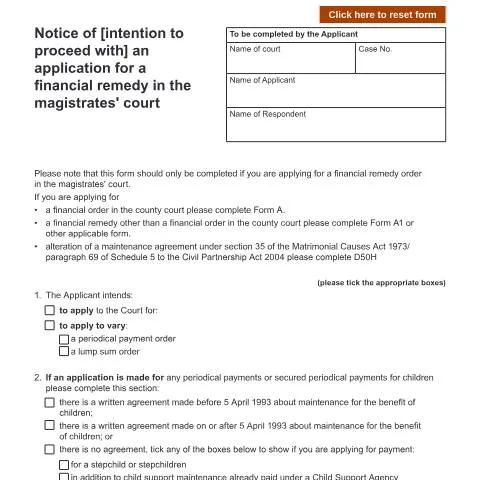
Understanding the Financial Remedy Application: A Practical Guide
Navigating the complexities of financial remedy applications in the magistrates' court can often be daunting. The "Notice of (intention to proceed with) an application for a financial remedy in the magistrates' court: Form A2" serves as a crucial document in this process. It's essential for applicants to grasp its contents, as well as the implications of submitting it. This guide aims to clarify the nuances of this notice, ensuring that individuals seeking financial remedies can approach their applications with confidence.Key Concepts Behind the Notice
The Form A2 is not merely a procedural requirement; it is a significant step in the legal journey towards securing a financial remedy. Here are the key concepts associated with this notice:The Purpose of the Notice
The primary aim of the Form A2 is to inform the court of an applicant's intention to seek a financial remedy, which can include:- Single lump sum orders: A one-off payment intended to settle financial disputes.
- Periodical payment orders: Regular payments made over time.
Scope and Limitations
While the Form A2 serves as a gateway to applying for a financial remedy, it is imperative to recognize its limitations. Notably:- This notice specifically pertains to applications made in the magistrates' court.
- If you are seeking a financial remedy in the county court, different forms such as Form A or A1 must be used.
- Alterations to existing maintenance agreements are addressed through separate forms (D50H).
Step-by-Step Approach to Using the Form A2
Submitting an application using the Form A2 is a process that requires careful attention to detail. Here's a structured approach to ensure that every necessary step is followed:Gathering Required Information
Before diving into the application, applicants should compile the following:- Applicant and Respondent Information: Full names, addresses, and contact details.
- Details of Previous Court Orders: If there were any prior agreements concerning financial arrangements, it is crucial to provide this information.
- Mediation Details: Confirm whether mediation information/assessment meetings have been attended, as mandated by the pre-action protocol.
Filling Out the Form A2
The Form A2 consists of various sections that must be completed accurately:- Intention to Apply: Clearly state the applicant's intent to seek a financial remedy.
- Details of Financial Orders: Specify whether it is a lump sum or periodical payment order.
- Child Support Payments: If relevant, indicate whether there’s an existing agreement regarding children's maintenance.
Finalizing the Application
Once the form is filled, ensure that it is signed and dated correctly. The statement of truth is a critical element, demanding that the applicant affirms the accuracy of the information provided. This seriousness highlights the importance of truthfulness in all legal documents.Interacting with Related Documentation
Successful navigation of the financial remedy application process often involves several related forms and documents. Understanding the relationship between these documents can streamline the experience.The Role of Other Forms
Different forms serve distinct purposes within the financial remedy landscape. Here’s a comparative overview:| Form | Purpose | Specific Use Case |
|---|---|---|
| Form A | Application for financial order in County Court | For lump sum or periodic payments in the County Court |
| Form A1 | Application for financial remedies other than financial orders | Specific financial remedies not covered by Form A |
| D50H | Alteration of maintenance agreements | To modify existing financial arrangements under specific acts |
Common Misinterpretations and Pitfalls
Misunderstandings can lead to significant setbacks in legal processes. Awareness of common pitfalls associated with the Form A2 can help avoid errors.Misunderstanding Jurisdiction
One of the most frequent misconceptions is regarding the court's jurisdiction. The Form A2 is strictly for matters in the magistrates' court. Applicants often mistakenly submit it for cases that belong in the county court, which can result in immediate rejection.Assuming Financial Remedy Application is Standalone
Another common misconception is that the Form A2 independently suffices for all matters surrounding financial remedies. It is essential to remember that this notice is part of a larger process that may require supplementary documents or forms.Overlooking Previous Orders
Failing to disclose previous court orders or agreements may not only delay proceedings but could also undermine an applicant's credibility. Full transparency is crucial, and a robust history of past arrangements must be documented accurately.The Applicant’s Perspective: Who Should Use Form A2?
The implications of the Form A2 extend to various individuals involved in financial disputes, particularly in the wake of a family separation or divorce.Who Can Apply?
The following groups are typically involved:- Individuals Seeking Financial Independence: Those who wish to secure financial support following a separation.
- Parents: Individuals needing adjustments in child maintenance agreements.
- Legal Representatives: Solicitors or advisors assisting clients through the legal maze.
Typical Scenarios Where Form A2 Becomes Essential
There are specific situations where submission of the Form A2 is not just beneficial, but essential:- A parent seeking to establish a formal arrangement for child support.
- Individuals needing to claim a lump sum following a divorce settlement.
- Parties looking to modify existing financial arrangements due to a change in circumstances.
Conclusion: Empowering Applicants Through Information
Navigating through the magistrates' court system regarding financial remedies does not have to be an overwhelming task. By understanding the nuances of the Form A2 and being aware of the associated processes, applicants can position themselves to make informed decisions. Whether it’s gathering necessary information, understanding related documents, or recognizing potential pitfalls, informed applicants are better equipped to advocate for their financial rights.Understanding the Financial Remedy Process in Magistrates' Court
When it comes to financial remedies, particularly in the context of family law, understanding the process is crucial. In the magistrates' court, the application for financial remedy—often initiated by completing Form A2—serves as a pivotal moment for parties involved in proceedings related to divorce or separation. This form signifies the intention to seek financial orders such as maintenance, property adjustment, or capital payments.
A comprehensive understanding of the financial remedy process begins with the recognition of the jurisdiction of the magistrates' court. Generally, this court deals with less complex cases compared to the High Court, making it a more accessible option for individuals who may be representing themselves rather than engaging legal counsel.
Once you file Form A2, a notice of intention to proceed, the magistrates' court will outline a timetable for hearings, which may include a first appointment. Here, both parties will have the chance to present their case and any supporting documentation. It’s advisable to prepare thoroughly, gathering all relevant financial information and evidence, to strengthen your application.
Moreover, various considerations will inform the court’s decision, including the financial needs of both parties, contributions made during the relationship, and the children’s welfare if applicable. Understanding the elements that the court takes into account can significantly impact the outcome.
Preparing for Court Hearings: Tips and Best Practices
Preparation for hearings in the magistrates' court can greatly influence the proceedings’ outcome. Here are essential tips to ensure you are well-prepared:
- Documentation: Gather all necessary financial documents, including bank statements, income details, and any existing agreements. It’s important to provide a clear picture of your financial situation.
- Legal Representation: While you can represent yourself, consider obtaining legal advice. A solicitor specializing in family law can offer insights into the nuances of your case and help navigate the complexities of financial remedy applications.
- Practice Your Presentation: Whether you are presenting evidence or responding to questions, practice articulating your position clearly. This will help reduce anxiety and ensure you are concise and persuasive.
- Know the Rules: Familiarize yourself with the court’s procedures and rules. This includes understanding how to address the bench, the format of presenting your case, and the etiquette expected in court.
- Be Prepared for Questions: Anticipate that magistrates may ask probing questions regarding your financial situation and needs. Being prepared can help you respond effectively.
Additionally, consider attending a court hearing in advance to observe proceedings. This firsthand experience can demystify the process and provide useful context for your own case.
Post-Hearing Actions: Next Steps After Obtaining a Financial Remedy
After the magistrates' court has made a decision regarding your application for a financial remedy, it’s vital to understand the next steps. If the ruling is in your favor, you will receive a court order detailing the specific terms of the financial arrangement.
Fill in your form directly online
No printing: type your details into the boxes of the official form, tick, then download the PDF ready to send.
- 1Type into the form boxes
- 2Tick in one click
- 3Save and download the PDF
Once you have obtained a financial remedy, you should:
- Comply with the Order: Ensure that you adhere to the terms set out in the court’s order. This is crucial to prevent any legal repercussions and can affect future applications.
- Monitor Changes in Circumstances: If your financial situation changes significantly—whether due to a new job, loss of income, or changes in living arrangements—you may need to return to court to seek a modification of the financial remedy.
- Consider Mediation: If ongoing disputes arise concerning financial arrangements, mediation can be a constructive approach to resolving issues amicably. This often involves a neutral third party who can assist in negotiating terms that are agreeable to both parties.
- Seek Legal Advice for Enforcement: If the other party fails to comply with the order, you may need legal advice on enforcement actions. Courts have specific procedures for enforcing financial orders, and understanding these can help in ensuring compliance.
Recognising your obligations and the potential for future changes is vital in maintaining both parties’ financial stability following the court's decision.