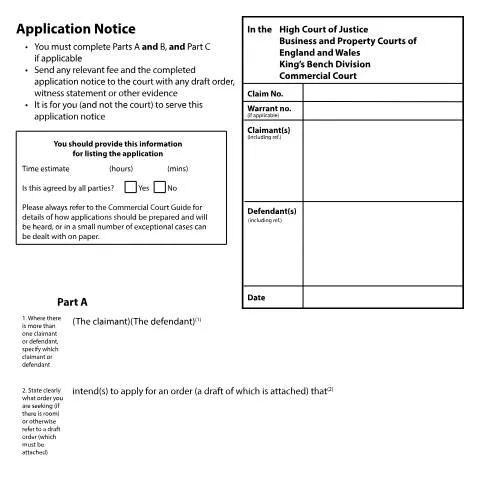
When Commercial Litigation Requires Judicial Intervention: Understanding the N244(CC) Application Process
In the fast-paced world of commercial litigation, circumstances frequently arise where parties need the court's immediate attention before the final hearing. Whether seeking urgent injunctive relief, requesting case management directions, or challenging procedural decisions, the Form N244(CC) serves as the gateway to judicial intervention in Commercial Court proceedings. This specialised application notice, tailored specifically for England and Wales' premier commercial jurisdiction, differs significantly from its counterparts in other divisions of the High Court.
The Commercial Court's unique position within the Business and Property Courts demands a sophisticated understanding of both procedural requirements and commercial realities. Unlike standard county court applications, Commercial Court matters typically involve substantial financial stakes, complex international elements, and tight commercial timelines that require judicial expertise in business affairs.
Distinctive Features of Commercial Court Applications
The N244(CC) reflects the Commercial Court's specialised nature through several key characteristics that distinguish it from general civil applications. Most notably, the form emphasises time estimation requirements, recognising that commercial disputes often involve urgent matters requiring swift judicial resolution.
The application notice specifically requires parties to indicate whether their time estimate is agreed by all parties—a reflection of the Commercial Court's collaborative approach to case management. This requirement stems from the court's expectation that commercial litigants, typically represented by experienced practitioners, should engage constructively in procedural matters.
Integration with the Commercial Court Guide
The form's explicit reference to the Commercial Court Guide underscores the importance of this supplementary guidance document. The Guide provides detailed directions on application preparation, hearing procedures, and the limited circumstances where applications might be determined on paper without a hearing. This integration reflects the Commercial Court's philosophy of providing comprehensive procedural guidance while maintaining flexibility for complex commercial scenarios.
Applications in the Commercial Court are generally heard orally, with paper determinations reserved for truly exceptional cases. This preference for oral hearings acknowledges the complexity of commercial disputes and the value of judicial engagement with counsel on intricate legal and factual issues.
Strategic Timing and Commercial Court Listing Practices
The Commercial Court operates under distinctive listing arrangements that reflect the commercial imperative for swift resolution. Unlike other High Court divisions, the Commercial Court maintains specialist listing procedures designed to accommodate the urgent nature of many commercial applications.
| Application Type | Typical Listing Timeframe | Special Considerations |
|---|---|---|
| Interim injunctions | Same day or next working day | Out-of-hours arrangements available |
| Case management conferences | 2-4 weeks | Coordinated with court's commercial diary |
| Summary judgment applications | 6-8 weeks | May require extended hearing slots |
| Security for costs | 4-6 weeks | Often heard with other interim matters |
The Admiralty and Commercial Registry's operating hours—10 am to 4.30 pm, Monday to Friday—reflect the court's administrative efficiency while accommodating the international nature of many commercial disputes. The Registry's location at 7 Rolls Building places it at the heart of London's legal district, facilitating access for the international commercial legal community.
Evidence Requirements and Commercial Complexity
Part B of the N244(CC) offers three distinct options for supporting evidence: witness statements, affidavits, or evidence contained within Part C of the form itself. This flexibility recognises that commercial applications vary enormously in complexity and urgency.
For straightforward procedural applications, such as requests for time extensions or directions for expert evidence, the evidence section within Part C may suffice. However, substantive applications—particularly those involving interim relief or challenges to jurisdiction—typically require detailed witness statements that can properly address the factual complexities inherent in commercial disputes.
The choice between witness statements and affidavits carries particular significance in Commercial Court practice. While witness statements are generally preferred for their efficiency, affidavits may be required where the application involves serious allegations of impropriety or where the court needs the enhanced solemnity that sworn evidence provides.
Navigating Multi-Party Commercial Disputes
Commercial litigation frequently involves multiple parties with varying interests, and the N244(CC) acknowledges this reality through its provisions for identifying which specific party is making the application. This seemingly straightforward requirement becomes complex in multi-jurisdictional disputes where parties may have different legal representatives or where corporate structures involve multiple entities.
The form's requirement to specify whether the applicant is a claimant or defendant reflects the Commercial Court's need to understand the procedural posture of applications quickly. In complex commercial disputes with multiple claims, counterclaims, and additional parties, this identification helps the court assess the application's impact on overall case management.
Draft Orders and Commercial Court Expectations
The Commercial Court's requirement for draft orders attached to applications reflects its pragmatic approach to case management. Unlike some other jurisdictions where courts formulate orders from scratch, the Commercial Court expects parties to provide precisely worded draft orders that can be adapted as necessary following judicial consideration.
This requirement serves multiple purposes: it focuses the parties' minds on exactly what relief they seek, assists the court in understanding the practical implications of the proposed order, and facilitates swift implementation once the court reaches its decision. In commercial contexts where timing is often critical, this efficiency can make the difference between effective and worthless relief.
Service Requirements and Commercial Urgency
The N244(CC) explicitly states that service of the application notice is the applicant's responsibility, not the court's. This reflects the Commercial Court's expectation that commercial litigants will manage procedural steps efficiently through experienced legal representation.
Service requirements in Commercial Court matters often involve international considerations, with parties located across multiple jurisdictions and time zones. The court's emphasis on applicant responsibility for service acknowledges these complexities while maintaining procedural momentum.
Emergency Applications and Out-of-Hours Procedures
While the N244(CC) itself does not detail emergency procedures, its use within the Commercial Court system connects to sophisticated arrangements for urgent applications. The Commercial Court maintains provisions for applications requiring immediate attention, including arrangements that can accommodate different time zones for international commercial disputes.
Emergency applications typically require direct contact with the Listing Office, often involving senior court staff who understand the commercial imperatives driving urgent relief requests. These procedures recognise that commercial disputes—particularly those involving international trade, financial markets, or time-sensitive transactions—may require judicial intervention outside normal court hours.
Statement of Truth and Commercial Litigation Standards
The statement of truth requirement in Part C carries particular weight in Commercial Court proceedings, where the stakes are typically substantial and the potential for strategic behaviour is significant. The form's warning about contempt proceedings reflects the court's serious approach to ensuring evidence integrity in high-value commercial disputes.
Commercial litigants and their representatives must navigate the tension between zealous advocacy and the obligation to present truthful evidence. The statement of truth requirement serves as a crucial safeguard, particularly in applications for interim relief where the court must make rapid decisions based on potentially incomplete information.
Legal Representative Authorisation
The provision for legal representatives to sign statements of truth on behalf of applicants reflects commercial litigation's practical realities. Senior commercial lawyers often have detailed knowledge of their clients' businesses and transactions, enabling them to verify factual statements with appropriate authority.
However, this convenience comes with significant responsibility. Legal representatives signing statements of truth must ensure they have proper instructions and sufficient knowledge to verify the accuracy of factual assertions. The Commercial Court's sophisticated user base means that procedural shortcuts or careless verification practices are likely to be identified and may result in serious consequences.
Integration with Modern Commercial Court Practice
The N244(CC) operates within an increasingly digital Commercial Court environment, though the form itself maintains traditional paper-based elements. The court's growing emphasis on electronic case management and digital document handling affects how applications are prepared, filed, and managed throughout their lifecycle.
The form's requirement for comprehensive contact information, including email addresses and DX numbers, reflects the court's expectation of efficient communication between all parties. In fast-moving commercial disputes, the ability to coordinate hearings, share documents, and communicate urgent developments depends on reliable contact information.
Commercial Court users increasingly expect sophisticated case management that matches the complexity and value of their disputes. The N244(CC) serves as an entry point into this system, requiring applicants to demonstrate their readiness to engage with the court's high standards for procedural efficiency and substantive analysis.
The form's emphasis on precise time estimation, detailed evidence, and clear identification of the relief sought reflects the Commercial Court's evolution toward more streamlined procedures that nevertheless maintain the thoroughness required for complex commercial disputes. As commercial litigation continues to evolve with changing business practices and international considerations, the N244(CC) provides a stable procedural foundation while allowing flexibility for diverse commercial scenarios.
Special Considerations for Interim Applications and Emergency Relief
The Commercial Court frequently handles urgent applications requiring immediate judicial intervention, making Form N244(CC) a critical tool for securing interim relief. When applying for emergency orders such as freezing injunctions, search orders, or interim injunctions, specific procedural requirements apply beyond the standard application notice process.
For without notice applications (ex parte), you must demonstrate exceptional urgency and provide full and frank disclosure of all material facts, including those that might favour your opponent. The duty of candour extends to matters you reasonably ought to know, even if not directly within your knowledge. Failure to meet this standard can result in the discharge of any order obtained, potential costs sanctions, and damage to your case's credibility.
When seeking a freezing injunction, your N244(CC) must address the Mareva requirements: a good arguable case on the merits, evidence of assets within the jurisdiction (or permission to serve out), and real risk of dissipation. The application should specify the maximum sum to be frozen and include a detailed breakdown of your claim's value, including interest and costs estimates. Standard exceptions for ordinary living expenses and legal costs must be clearly defined, typically referencing weekly amounts and specific categories of permitted expenditure.
For search orders (formerly Anton Piller orders), the application must demonstrate an extremely strong prima facie case, potential serious damage to your interests, and clear evidence that relevant material exists and would likely be destroyed before standard disclosure. The proposed order must include detailed safeguards: independent supervising solicitor appointment, restrictions on seized material examination, and clear protocols for privileged documents.
Applications for interim mandatory injunctions require meeting the American Cyanamid test's modified approach, considering whether damages would provide adequate remedy and where the balance of convenience lies. Given their intrusive nature, you must show a strong case likelihood and that refusing the injunction would cause greater injustice than granting it.
Expedition applications often accompany urgent interim relief requests. Your N244(CC) should explain why standard Commercial Court timetables (typically 10-12 weeks from issue to trial) are inadequate, providing specific prejudice evidence if normal timescales applied. Consider seasonal factors affecting your business, regulatory deadlines, or deteriorating asset values that justify expedition.
Fill in your form directly online
No printing: type your details into the boxes of the official form, tick, then download the PDF ready to send.
- 1Type into the form boxes
- 2Tick in one click
- 3Save and download the PDF
Multi-Party and Complex Commercial Disputes Procedures
Commercial Court cases often involve multiple defendants, third parties, or complex corporate structures requiring careful consideration of procedural applications through Form N244(CC). Understanding how to navigate these multi-dimensional disputes effectively can significantly impact your case's trajectory and cost exposure.
When applying to join additional parties, your application must demonstrate necessity rather than mere convenience. The court considers whether the new party's presence is required to resolve matters in dispute effectively, whether their absence would leave important questions unanswered, or whether separate proceedings would risk inconsistent judgments. Applications made after statements of case are served face higher scrutiny, particularly if they appear tactical rather than necessary.
For Part 20 claims (additional claims against co-defendants or third parties), timing becomes crucial. Applications made without permission are generally allowed until acknowledgment of service or defence filing, but later applications require demonstrating good reason for delay. Consider whether your additional claim seeks contribution, indemnity, or raises entirely separate issues that might complicate trial management.
Consolidation applications under CPR 3.1(2)(g) require showing that separate proceedings involve common questions of law or fact, or arise from the same transaction or series of transactions. However, consolidation isn't automatic even when these conditions are met – the court considers case management efficiency, potential prejudice to parties, and whether consolidation would complicate rather than simplify proceedings.
Applications for separate trials of different issues can significantly impact case strategy and costs exposure. Common applications include splitting liability and quantum trials, trying preliminary legal issues, or separating claims against different defendants. Your N244(CC) must demonstrate that separation would save costs and court time, not merely delay difficult issues or create tactical advantages.
When multiple parties seek similar relief, consider whether a representative action under CPR 19.6 might be appropriate. This requires showing that parties have the same interest and that representation would fairly and adequately advance that interest. Representative actions can significantly reduce costs but limit individual parties' control over proceedings.
Group litigation orders (GLOs) provide another mechanism for managing multiple related claims, particularly in commercial contexts involving defective products, financial services disputes, or regulatory breaches affecting numerous parties. Applications for GLOs require demonstrating common or related issues of fact or law, numerical significance justifying group treatment, and that GLO management would provide benefits over individual case handling.
International and Cross-Border Application Considerations
The Commercial Court's international jurisdiction requires specific attention to cross-border enforcement, service requirements, and conflict of laws when preparing Form N244(CC) applications. These considerations become particularly complex post-Brexit, with different rules applying to EU and non-EU jurisdictions.
Applications for service out of the jurisdiction under CPR 6.36 must satisfy gateway requirements in Practice Direction 6B and demonstrate that England and Wales is the appropriate forum. Your N244(CC) must identify the specific gateway relied upon – whether contractual jurisdiction clauses, tort claims with UK connections, or property-related disputes concerning UK assets. Each gateway has distinct requirements that must be precisely addressed.
When seeking service out, you must also satisfy the forum conveniens test established in Spiliada Maritime Corp v Cansulex Ltd. This requires showing England is clearly the most appropriate forum, considering factors including witness locations, applicable law, party connections to different jurisdictions, and practical issues like document location and language.
For enforcement applications concerning foreign judgments, different regimes apply depending on the judgment's origin. EU judgments obtained before 31 December 2020 may still benefit from Brussels I bis Regulation recognition, while newer EU judgments fall under the Hague Convention 2005 (for exclusive jurisdiction clauses) or common law recognition rules. Non-EU judgments require meeting common law requirements: final and conclusive nature, competent court jurisdiction, and no fraud or public policy breaches.
Anti-suit injunctions represent powerful tools for preventing foreign proceedings that breach English jurisdiction clauses or constitute vexatious parallel litigation. Your application must demonstrate that foreign proceedings are vexatious or oppressive, that England has sufficient interest in preventing them, and that an injunction wouldn't cause injustice. Post-Brexit, these applications face increased scrutiny when targeting EU proceedings, given the loss of Brussels I bis mutual trust principles.
Applications concerning arbitration-related matters often involve international elements requiring careful jurisdictional analysis. The court's supervisory jurisdiction under the Arbitration Act 1996 extends to arbitrations seated in England and Wales regardless of parties' nationalities. Applications might seek tribunal appointment, jurisdiction challenges, or interim measures pending arbitral proceedings.
When dealing with sovereign immunity issues, applications must carefully navigate the State Immunity Act 1978's exceptions. Commercial transaction exceptions require showing the foreign state acted in a commercial rather than sovereign capacity, while property-related exceptions depend on specific use and ownership structures. These applications often require detailed evidence concerning the state entity's exact status and transaction nature.
Disclosure applications in international cases must consider territorial limitations and foreign law restrictions. Norwich Pharmacal orders against third parties require demonstrating facilitation of wrongdoing and necessity for obtaining information not available through other means. However, enforcement may be problematic if documents are located abroad or subject to foreign blocking statutes or banking secrecy laws.