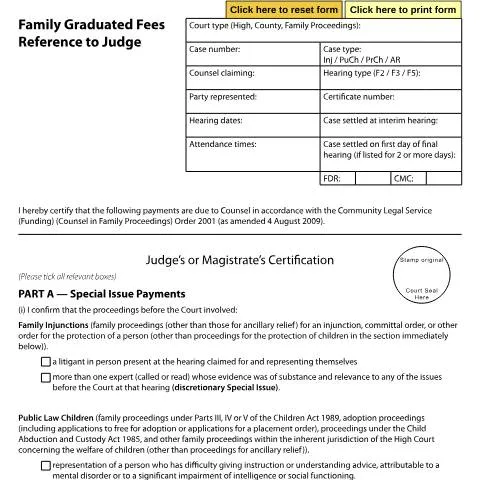
Navigating the Graduated Fees Reference to a Judge: Form EX504
When cases arise within the family court system, the financial implications for legal representation can be significant. The Graduated Fees Reference to a Judge: Form EX504 serves as an essential component in the financial aspect of family proceedings, ensuring that counsel is compensated fairly for their services. This document is crucial for solicitors and barristers involved in cases that qualify under the graduated fees scheme, allowing them to claim specific fees based on the nature of the case and the work performed. By understanding the multifaceted role of this form, legal professionals can better navigate the complexities of the family court system.
Understanding the Context: How EX504 Fits Within Family Proceedings
Family proceedings encompass a diverse range of legal issues, including child custody, divorce, and protective orders. The EX504 form is specifically designed for use in family cases that require legal representation, particularly under the Community Legal Service (Funding) Order 2001 and its subsequent amendments. It is important to note that this form is distinct from other documents used in family law, such as financial disclosure forms or child arrangement orders, which do not pertain to fee claims.
The form is primarily utilized when counsel seeks to certify that certain payments are due based on the nature of the proceedings and the specific complexities involved. Understanding this context is essential for all parties involved in family law cases, as missteps in documentation can lead to delays or denials of payment.
Key Players: Who is Required to Complete Form EX504?
Various individuals play a role in the completion and submission of Form EX504. These include:
- Barristers and Solicitors: Primary users of the form, they must accurately complete it to claim fees.
- Judges and Magistrates: They validate the claims made in the form by signing and certifying it.
- Litigants in Person: Individuals representing themselves may also be involved if they require legal representation, influencing the financial considerations in the case.
Understanding who is involved in the process can help clarify the responsibilities of each party and highlight the importance of precise documentation.
Breaking Down EX504: An In-Depth Look at Each Section
Form EX504 comprises multiple parts, each intended to capture specific information regarding the legal proceedings and the corresponding fees. Below is a breakdown of its main sections:
Part A: Special Issue Payments
This section requires a certification of various circumstances that may justify additional payments to counsel. It includes conditions such as:
- Family injunction proceedings.
- Cases involving litigants representing themselves.
- Representation of parties with mental disorders affecting their ability to provide instruction.
- Cases involving multiple experts or allegations of significant harm to children.
Filling out this part accurately is crucial, as it establishes the basis for any special payments due to the complexities involved in the case.
Part B: Court Bundle Payment
In this section, information is provided about the length of the court bundle. The following criteria determine the payment level:
| Bundle Length | Payment Type |
|---|---|
| 176 to 350 pages | Payment 1 |
| 351 to 700 pages | Payment 2 |
Counsel must ensure that the page count is accurate; discrepancies can lead to payment issues.
Part C: Special Preparation Fee
Counsel may claim this fee if their case involves exceptionally complex issues. To complete this section, counsel must specify the basis for their claim. There are three key situations that justify this fee:
- Exceptional complexity of law or fact.
- In public law children proceedings where a significant gap occurred between hearings.
- A court bundle exceeding 700 pages.
Supporting documentation must be attached to substantiate claims, making it imperative for lawyers to keep meticulous records of preparation time and complexity throughout the case.
Preparation of Supporting Documents: Ensuring Completeness
When submitting Form EX504, the quality and completeness of supporting documents are crucial. Depending on the specifics of the case, counsel may need to prepare several different types of documentation. Common requirements include:
- Written Evidence of Basis for Special Preparation Fee: This should outline in detail the reasons for the claim.
- Case Documentation: Including case numbers, hearing dates, and parties involved must all be accurately listed.
- Expert Reports: If more than one expert is involved, their reports must be attached to substantiate claims for additional payments.
Each of these supporting documents must be thoroughly checked for accuracy and relevance. Failure to do so can result in delays or outright rejections of the fee claim.
Special Considerations: Unique Circumstances in Family Law
Family law can present a myriad of unique circumstances that affect the filing and approval of Form EX504. For example:
- International Elements: Cases involving parties from different jurisdictions may complicate matters significantly.
- Minors: If children are involved in the proceedings, additional regulations apply that may affect fee claims.
- Urgent Cases: Situations requiring expedited handling may necessitate additional documentation to highlight the urgency.
Legal professionals must remain aware of such nuances, as they can dramatically influence the proceedings and the fees that can be claimed.
Chronological Journey: From Submission to Decision
The process involving Form EX504 encompasses several steps, which can be mapped out chronologically:
- Preparation of Supporting Documents: Counsel gathers relevant documentation, including expert opinions and detailed notes on preparation time.
- Completion of Form EX504: All necessary sections are filled in accurately, ensuring alignment with the case's specifics.
- Submission to the Judge: The form, along with supporting documents, is submitted for consideration.
- Judicial Review: The judge reviews the claims, verifying that all criteria are met and that the information is coherent and justified.
- Decision and Notification: Once a decision is made, counsel is notified of the outcome, including any approved payments.
Understanding the chronology is essential for legal practitioners, as it allows them to manage timelines and expectations efficiently.
The Impact of the Data Protection Act on Form EX504
Compliance with the Data Protection Act 2018 is essential when processing the information included in Form EX504. Legal practitioners must ensure that any personal data contained within the form and its supporting documentation is handled appropriately, adhering to the principles outlined in the UK GDPR. Key considerations include:
- Data Minimization: Only the necessary information should be included in the submission.
- Storage Limitations: Personal data should not be retained for longer than necessary.
- Security Measures: Appropriate measures must be in place to protect sensitive information from unauthorized access.
Understanding these legal requirements is vital for ensuring compliance and avoiding potential breaches that could have serious ramifications.
Final Insights: The Importance of Thoroughness and Accuracy
Completing Form EX504 is a meticulous process that requires attention to detail and an understanding of the complexities inherent in family law. Each part of the form serves a specific purpose, and any inaccuracies can lead to financial consequences for legal representatives and their clients. Proper preparation of supporting documents and awareness of unique case circumstances will significantly enhance the chances of a successful fee claim.
By navigating the intricate landscape of Form EX504 with diligence and a thorough understanding of the procedural requirements, legal professionals can not only ensure their rightful compensation but also contribute to a smoother judicial process in family law matters.
Understanding Graduated Fees in the UK Legal System
Graduated fees are a structured way of charging for legal services in specific cases, primarily within the realms of family and civil law. The concept is designed to provide a predictable cost framework for both litigants and legal practitioners. Fees are scaled according to the complexity and stages of the legal process, which allows for greater transparency and potentially easier access to justice.
In the context of Form EX504, it is important to note that this form is closely related to the Genral Rule of Costs within the UK legal system, which stipulates that the unsuccessful party may be required to pay the legal costs of the successful party. This is particularly relevant in cases where graduated fees are applicable, as the allocation of costs can be influenced by the complexity of the case and the effectiveness of the representation provided at each stage.
The graduated fees system encourages legal representatives to be strategic about the stages of litigation they pursue, as certain actions may incur higher fees. Solicitors must be diligent in calculating their fees based on the expected duration and complexity of the case, ensuring that clients are fully informed before proceeding. This is a critical aspect of maintaining legal compliance under the Legal Aid Agency's guidelines.
How to Complete Form EX504: A Step-by-Step Guide
Form EX504 is essential for parties seeking to appeal to a judge regarding graduated fees. Completing this form accurately is crucial. Here’s a detailed step-by-step guide on how to fill out Form EX504:
- Section 1: Case Information
- Section 2: Applicant’s Details
- Section 3: Grounds for Appeal
- Section 4: Supporting Documents
- Section 5: Declaration and Signature
In this section, provide the case number and details regarding the court where the proceedings took place. It is imperative to ensure that all information aligns with the records held by the HM Courts & Tribunals Service. If you are uncertain about any details, consult the court documentation or your solicitor.
Fill in your personal details as the applicant. This includes your full name, address, and contact information. If you are representing a client, make sure to include their details and your professional credentials. Remember, ensuring accuracy is vital, as any discrepancies could delay your application.
This section requires you to state the specific reasons for your appeal relating to the graduated fees. Be clear and concise, providing any relevant evidence to support your claims. If applicable, refer to specific case law or precedents that bolster your appeal. This may necessitate some research into previous rulings or the application of graduated fees in similar cases.
Attach any necessary supporting documents that substantiate your appeal. This may include invoices, previous judgments, and any correspondence with the court or legal representatives. Ensure all documents are legible and correctly referenced within your application.
Finally, read through your application thoroughly before signing. Your signature confirms that all information provided is true to the best of your knowledge. Be aware that any false information can lead to significant legal repercussions.
Once completed, ensure you submit Form EX504 as per the court’s instructions, either in person or via the prescribed electronic submission method. Always keep copies of your submitted forms and any correspondence for your records.
Potential Outcomes of Submitting Form EX504
After submitting Form EX504, parties should prepare for various possible outcomes. The appeal process can vary significantly based on the complexity of the case and the specifics of the request made in the application.
1. Granting of Appeal: If the judge finds sufficient grounds to support your appeal regarding graduated fees, they may determine a new fee structure or order a revision of the earlier ruling. It’s essential to be prepared for a follow-up hearing where you may be asked to provide additional evidence or clarification.
2. Refusal of Appeal: Conversely, if the judge does not find sufficient grounds, your appeal may be denied. In this case, you should receive written reasons for the refusal. Understanding these reasons is crucial if you consider further actions, such as seeking a review of the decision or potentially pursuing a higher court.
3. Adjournment: Sometimes, the judge may choose to adjourn the matter, requiring further evidence or considerations before a decision can be made. Be prepared to respond to any requests for additional documentation or further clarifications.
These outcomes highlight the importance of a well-prepared application and the strategic approach to managing appeals regarding graduated fees.