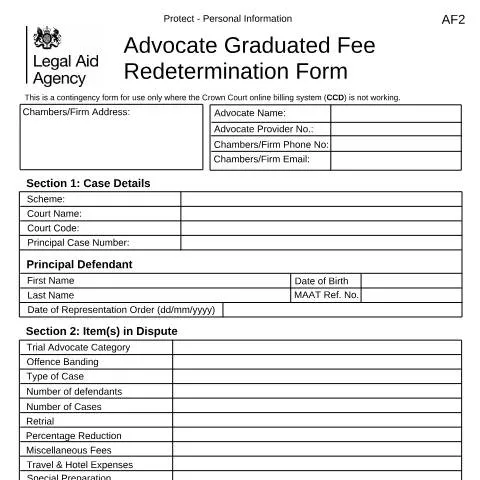
Navigating the Advocate Graduated Fee Redetermination Form: Insights and Steps
In the complex landscape of legal aid in the UK, the Advocate Graduated Fee Redetermination Form, abbreviated as AF2, plays a pivotal role in ensuring that advocates receive the appropriate remuneration for their services. This document is integral for barristers seeking a review of fees following changes in case circumstances or disputes over fees already claimed. Whether you are a seasoned advocate or new to the process, understanding the nuances of this form is crucial.
Understanding the Context: Legal Framework Surrounding AF2
The Advocate Graduated Fee Redetermination Form is part of the system established under the Legal Aid, Sentencing and Punishment of Offences Act 2012 (LASPO). This Act introduced significant reforms to the legal aid landscape, fundamentally altering how advocate fees are structured and compensated.
Historically, advocates were compensated based on fixed fees; however, variations in case complexity and preparation led to disputes. The AF2 form was introduced as a remedy for situations where advocates believe the initially awarded fees do not reflect the work undertaken. This allows for a fairer review process, enabling advocates to submit claims for adjustments effectively.
Who Should Utilize the AF2 Form: Profiles and Scenarios
The AF2 form is designed for use by barristers and solicitors who represent clients in criminal cases where legal aid has been granted. To effectively utilize the form, one must identify specific circumstances that may necessitate a fee reassessment.
Common Scenarios for Submission
- Disputed Fees: When the amount paid does not match the effort and resources expended, advocates can seek redetermination.
- Wasted Preparation: If substantial work was done that ultimately did not result in a trial, advocates may claim compensation for those efforts.
- Special Preparation: Complex or sensitive cases may require additional preparation time, justifying a request for increased fees.
- Travel and Hotel Expenses: Advocacy often involves travel; thus, any incurred expenses can be included in the claim.
Step-by-Step Guide to Completing the AF2 Form
Completing the AF2 form requires careful attention to detail. Missing information or inaccuracies can lead to delays and complications. Below is a systematic approach to filling out the form.
Section 1: Case Details
- Principal Defendant Details: Enter the first name and last name of the defendant. These details should align strictly with the information on the representation order.
- Date of Representation Order: Record the date the representation order was issued using the format (dd/mm/yyyy).
- Date of Birth: Input the defendant's date of birth accurately.
- MAAT Reference Number: Ensure the MAAT reference number is included, as it is a critical identifier in legal aid claims.
Section 2: Items in Dispute
This section allows advocates to detail the specific components of the claim in question. Each item in dispute must be itemised clearly:
- Trial Advocate Category: Specify the advocacy category relevant to the case.
- Offence Banding: Select the appropriate banding based on the offence.
- Number of Defendants: Indicate how many defendants were involved in the case.
- Other Items: Detail any miscellaneous fees incurred, including wasted preparation or travel expenses.
Filing the AF2 Form: Submission Procedures
Upon completion of the AF2 form, the next step is submitting it to the appropriate legal aid agency. This step is crucial to ensure that the request for fee reassessment is logged and processed timely.
Submission Process
- Review the Completed Form: Before submission, do a thorough review to ensure all information is accurate and complete.
- Signature Requirement: The trial advocate must sign the form, attesting to the correctness of the information provided.
- Submission Address: Submit the form to the relevant office of the Legal Aid Agency. Make sure to check the latest submission addresses as they may change.
What Happens Next? Understanding the Review Process
Once submitted, the Legal Aid Agency will begin processing the application. The time frame for processing can vary, but generally, it can be expected to take several weeks. Advocates should keep track of their submissions and follow up if they do not receive confirmation of receipt within a reasonable timeframe.
Outcomes of the Review
| Decision | Typical Reasons for Outcome |
|---|---|
| Paid in Full | The claim is fully substantiated and aligns with the guidelines. |
| Paid in Part | Some elements of the claim were accepted while others were not. |
| Refused | The claim did not meet the necessary criteria, often due to lack of supporting evidence. |
Addressing Challenges: What to Do in Case of Refusal
Receiving a refusal can be discouraging, but there are steps an advocate can take to address the situation. Understanding the reasons behind the refusal is key to moving forward.
Steps to Take After Refusal
- Request Detailed Reasons: Contact the Legal Aid Agency to obtain a detailed explanation of the refusal.
- Gather Additional Evidence: If the refusal was based on insufficient evidence, work quickly to gather supporting documentation.
- Consider Resubmitting: If new information or evidence has come to light, consider resubmitting the form along with the additional materials.
- Seek Legal Advice: In complex cases, it may be worthwhile to obtain legal advice on the best course of action.
Common Pitfalls: Mistakes to Avoid During Submission
Even experienced advocates can make mistakes when filling out the AF2 form. Here are common pitfalls and how to avoid them:
- Incomplete Information: Double-check that all required fields are filled out accurately.
- Incorrect Dates: Ensure all dates are entered in the correct format to avoid processing delays.
- Missing Supporting Documents: Attach any necessary documentation that supports your claim to bolster your request.
Final Thoughts: The Importance of Keeping Records
In conclusion, maintaining comprehensive records related to your legal aid claims and submissions is crucial. This not only aids in tracking your applications but also assists in any future disputes or clarifications that may arise.
Being proactive and informed about the advocate graduated fee redetermination process can significantly impact your practice. Advocates who understand the intricacies of this administrative procedure are better equipped to ensure they receive appropriate compensation for their work, ultimately benefiting their clients and the legal profession.
Understanding the AF2 Form: When to Request a Fee Redetermination
The AF2 form, formally known as the Advocate Graduated Fee Redetermination form, is primarily used by advocates in the legal field to request a review of their graduated fees. This process is critical when an advocate believes that the fees awarded for their work in criminal cases do not reflect the complexity or nature of the case undertaken. Understanding when and how to request a fee redetermination using the AF2 is essential for advocates seeking fair compensation for their services.
There are specific circumstances under which an advocate can submit an AF2 form. Firstly, if an advocate believes that their case merited additional work or complexity that was not adequately considered in the initial fee assessment, this form can be used to highlight those factors. Secondly, if there have been significant developments during the trial that required increased input from the advocate, such as unforeseen legal arguments, they may also cite these as reasons for a fee redetermination.
It's important to note that while the AF2 is a valuable tool for advocates, there are strict guidelines and timelines for submission. Advocates must submit their AF2 requests within 28 days of receiving notification of the initial fee decision. Delays beyond this window may result in the inability to challenge the fee decision, emphasizing the importance of timely action.
The Process of Completing and Submitting the AF2 Form
Completing the AF2 form accurately is vital to ensure that a fee redetermination request is considered. The form requires detailed information about the case, including the case number, the original fee awarded, and clear justification for the additional fees sought. Advocates should be prepared to include a breakdown of hours worked, specific tasks performed, and any complexities involved in the case. This level of detail is crucial for the review panel to understand the rationale behind the fee increase request.
Alongside the completion of the AF2 form, advocates are encouraged to attach supporting documents such as court transcripts, case notes, and any correspondence that highlights the additional work undertaken. These documents serve to strengthen the case for a higher fee and provide evidence that the advocate's work exceeded what was initially assessed.
Once completed, the AF2 form must be submitted to the appropriate legal funding authority, typically the Legal Aid Agency (LAA). It's advisable to keep a copy of the submitted form and any accompanying documents for personal records. Advocates can also track the status of their request through the LAA’s online portal or by contacting their office directly. This proactive approach can help ensure that advocacy efforts are recognized and appropriately compensated.
Common Challenges and Considerations in Fee Redetermination
While the AF2 form provides a pathway for advocates to seek fair remuneration, several challenges can arise during the fee redetermination process. One common issue is the lack of clarity in the fee structure, which can lead to disputes over what constitutes reasonable fees for particular case aspects. Advocates should familiarize themselves with the guidelines set forth by the LAA regarding graduated fees, ensuring that their requests align with these standards.
Moreover, advocates may encounter difficulties in articulating the complexities of their cases in a manner that resonates with the reviewing authority. It may be beneficial to engage with other experienced advocates or legal professionals who have successfully navigated the AF2 process. Their insight can provide valuable perspectives on how to effectively present a case for fee redetermination.
Furthermore, it's important to be aware of the potential for delays in the processing of AF2 requests. The review process can take several weeks, during which advocates should remain patient and continue to monitor the status of their requests. Understanding this timeline can help advocates manage their expectations and plan accordingly, especially if they rely on these fees for their livelihood. Maintaining open lines of communication with the LAA can also aid in expediting the review process.