Understanding the Upper Tribunal Lands Chamber's Reference System
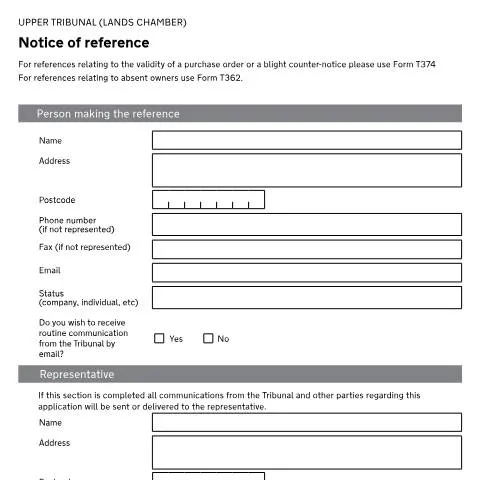
When property disputes escalate beyond local negotiations—whether involving compulsory purchase orders, land compensation claims, or Electronic Communications Code disputes—the Upper Tribunal (Lands Chamber) becomes the judicial arena where these complex matters find resolution. The Notice of reference Form T371 serves as the gateway document that transforms a property disagreement into a formal tribunal proceeding, setting in motion a structured legal process that can determine compensation amounts running into millions of pounds.
This comprehensive notice document operates within a sophisticated framework of land law, where precision in initial submission can significantly influence both procedural efficiency and final outcomes. Unlike standard court applications, the Lands Chamber specialises exclusively in property-related disputes, requiring applicants to navigate specific procedural pathways that reflect the technical complexity of land valuation and statutory compensation schemes.
Distinguishing Between Reference Types
The T371 notice immediately establishes clear boundaries through its opening guidance, directing specific dispute categories to alternative forms. References concerning purchase order validity or blight counter-notices require Form T374, whilst absent owner situations necessitate Form T362. This preliminary sorting mechanism reflects the tribunal's recognition that different property dispute categories demand tailored procedural approaches.
The form's structure accommodates both represented and unrepresented parties, acknowledging that whilst many land compensation disputes involve professional representation, individual property owners may choose to present their own cases. This dual approach requires careful attention to communication preferences, particularly regarding electronic correspondence, which has become increasingly central to tribunal administration.
Navigating Capacity Classifications and Statutory Frameworks
The notice's capacity section reveals the tribunal's sophisticated understanding of property law's multiple stakeholder environment. Applicants must identify their precise legal standing, whether as acquiring authorities exercising compulsory purchase powers, landowners defending property rights, or Electronic Communications Code operators seeking infrastructure access.
Each capacity classification triggers different procedural expectations and evidential requirements. Acquiring authorities typically reference specific statutory powers under legislation such as the Town and Country Planning Act 1990 or Transport and Works Act 1992, whilst landowners may invoke compensation rights under the Land Compensation Act 1961 or Planning and Compensation Act 1991.
| Capacity Type | Common Statutory Basis | Typical Claim Nature |
|---|---|---|
| Acquiring Authority | Compulsory Purchase Act 1965 | Possession rights, development consent |
| Land Owner/Occupier | Land Compensation Act 1973 | Compensation assessment, disturbance claims |
| Electronic Communications Code Operator | Digital Economy Act 2017 | Infrastructure access, rent determination |
Professional Representation Requirements
The form's treatment of professional representation reflects modern tribunal practice, where solicitors maintain automatic rights of audience whilst other professionals—surveyors, land agents, planning consultants—must provide signed authority documentation. This distinction becomes particularly significant given the mandatory e-filing requirements for professional representatives, which streamline case management whilst ensuring consistent communication standards.
Non-solicitor representatives face additional scrutiny regarding their professional qualifications, with the tribunal expecting clear identification of relevant expertise. A chartered surveyor handling a land valuation dispute, for instance, would reference their RICS membership, whilst a planning consultant might cite their RTPI qualification.
Decoding Property Description and Compensation Categories
The property description section demands precision that extends far beyond simple postal addresses. The tribunal requires comprehensive identification including approximate areas, land use classifications, and precise location descriptions that enable accurate site identification during expert witness inspections and tribunal visits.
The claim categorisation system reflects the tribunal's jurisdiction across diverse property dispute types. Compulsory purchase compensation represents the most common category, typically involving local authorities or statutory undertakers acquiring land for infrastructure projects. These claims often encompass both land value compensation and consequential losses including disturbance, severance, and injurious affection.
Electronic Communications Code references have gained prominence following legislative changes that strengthened operator rights whilst establishing clearer compensation frameworks. These disputes frequently centre on rent determinations for telecommunications infrastructure, where landlords and operators struggle to agree appropriate consideration for site access.
Critical Timing and Possession Issues
The form's emphasis on entry dates and possession timing reflects fundamental procedural requirements that affect both compensation calculations and interest entitlements. When acquiring authorities take possession before compensation determination, landowners become entitled to advance payments and interest on delayed settlements, making accurate entry date recording financially significant.
The "nature of interest" classification—freehold, leasehold, business tenancy—directly influences compensation methodologies. Freehold owners typically receive full market value compensation, whilst leaseholders face more complex calculations involving lease terms, rental values, and potential marriage value considerations.
Procedural Pathway Selection and Case Management
The tribunal's four-tier procedural system acknowledges that property disputes vary enormously in complexity, value, and technical requirements. This structured approach enables appropriate resource allocation whilst ensuring procedural fairness across different case types.
Standard procedure accommodates the majority of substantial compensation disputes, providing comprehensive case management including expert witness coordination, site inspections, and detailed evidential review. These cases typically involve significant property values or complex legal issues requiring full judicial consideration.
Simplified procedure targets cases where expedited determination serves both parties' interests, often involving straightforward valuation disputes or agreed factual matrices requiring limited judicial intervention. The procedure's emphasis on speed and economy makes it particularly suitable for smaller commercial disputes or residential compensation claims.
Expert Witness Considerations
The form's detailed expert witness provisions reflect the tribunal's understanding that property valuation disputes typically require specialist evidence. The general single expert witness rule acknowledges that most compensation assessments benefit from focused professional opinion, whilst specific exceptions for mineral valuations and business disturbance claims recognise these areas' particular technical complexity.
Mineral valuation cases often require both geological and commercial expertise, justifying dual expert representation. Similarly, business disturbance claims may necessitate separate accounting and property professionals to address operational losses and relocation costs respectively.
Documentary Evidence Requirements and Supporting Materials
The comprehensive checklist system ensures complete case files whilst highlighting the interconnected nature of compulsory purchase documentation. Notices to Treat, Compulsory Purchase Orders, and General Vesting Declarations form the statutory foundation for most compensation references, establishing both legal authority and procedural compliance.
The requirement for statements of case reflects modern civil procedure emphasis on early issue identification and factual clarity. Claimant statements must articulate compensation grounds comprehensively, whilst responding parties' issue statements enable focused dispute resolution by identifying areas of agreement and contention.
- Notice to Treat: Establishes formal acquisition notice and compensation negotiation commencement
- Notice of Entry: Confirms possession timing and triggers interest entitlements
- Notice of Claim: Details specific compensation elements and quantum sought
- Certificate of Appropriate Alternative Development: Addresses planning assumption disputes in compensation calculations
Financial and Administrative Considerations
The £313 reference filing fee represents a significant procedural threshold that ensures serious case presentation whilst remaining accessible for legitimate compensation disputes. The tribunal's acceptance of both cheque and bank transfer payments reflects practical accommodation for different organisational payment systems.
The mandatory e-filing requirement for professional representatives signals the tribunal's commitment to digital case management, enabling efficient document handling and improved communication tracking. However, the retained postal option for unrepresented parties ensures continued access for individual landowners who may lack technical resources or professional support.
Strategic Considerations for Reference Preparation
Successful T371 submission requires careful consideration of procedural choices that influence case trajectory and resource requirements. The initial procedure selection—standard, special, simplified, or written representations—establishes expectations for hearing duration, expert witness requirements, and overall case complexity.
Parties must balance thoroughness against efficiency, recognising that comprehensive initial submissions often facilitate faster resolution whilst incomplete documentation typically generates additional procedural steps and associated costs. The tribunal's case management powers enable significant direction variation, but initial choices influence scheduling and resource allocation.
The identification of all interested parties becomes particularly crucial in complex property situations involving multiple ownership layers, easements, or restrictive covenants. Failure to identify relevant stakeholders can result in procedural delays or, in extreme cases, determination challenges based on inadequate representation.
Integration with Wider Tribunal Practice
The T371 notice operates within the Upper Tribunal's broader administrative framework, connecting with established practice directions, fee structures, and case management protocols. Understanding these connections enables more effective case preparation and realistic timeline expectations.
The tribunal's website resources, including step-by-step procedure flowcharts and detailed practice directions, provide essential guidance for navigating the reference process effectively. These materials complement the T371 notice by offering procedural context and practical guidance for different dispute categories.
Modern tribunal practice increasingly emphasises alternative dispute resolution and early settlement discussions, with many references resolving through mediation or direct negotiation once formal proceedings commence. The T371 notice establishes the procedural framework that often encourages productive settlement discussions by clarifying each party's position and evidential basis.
Completing Form T371: A Step-by-Step Breakdown
Form T371 requires methodical completion to ensure your reference reaches the Upper Tribunal successfully. The document is structured in distinct sections, each serving a specific procedural purpose within the tribunal system.
Section A: Case Details and Parties forms the foundation of your reference. You must provide the exact case name as it appeared in the First-tier Tribunal decision, including all parties listed. Any discrepancy in naming could delay processing or result in rejection. The tribunal reference number from your original case is essential – this typically follows the format of tribunal type, year, and sequential number (for example, EA/2023/0156 for an Immigration and Asylum Chamber case).
When identifying the respondent, distinguish between the original decision-maker (such as HMRC or the Home Office) and any other parties who participated in the First-tier Tribunal proceedings. If your case involved multiple respondents or interveners, list all parties exactly as they appeared in the tribunal's decision notice.
Section B: Grounds for Permission represents the most critical component of Form T371. Here, you must articulate why your case merits Upper Tribunal consideration. The grounds must demonstrate either an error of law in the First-tier Tribunal's decision or that the decision involved a point of law of general public importance.
Legal errors might include misapplication of statutory provisions, failure to consider relevant evidence, procedural irregularities that affected the outcome, or incorrect interpretation of case law. When citing legal authorities, provide full references including neutral citations where available. For instance, reference R (on the application of Smith) v Secretary of State for Work and Pensions [2023] UKUT 45 (AAC) rather than simply "the Smith case".
Avoid rehashing factual disputes already determined by the First-tier Tribunal unless you can demonstrate that the tribunal's factual findings were based on a misunderstanding of law or lacked evidential support to a degree that no reasonable tribunal could have reached the same conclusion.
Fill in your form directly online
No printing: type your details into the boxes of the official form, tick, then download the PDF ready to send.
- 1Type into the form boxes
- 2Tick in one click
- 3Save and download the PDF
Section C: Supporting Documentation requires careful attention to mandatory attachments. You must include a complete copy of the First-tier Tribunal's decision, any written reasons provided, and copies of all documents you intend to rely upon in your Upper Tribunal reference. If the First-tier Tribunal provided oral reasons only, request written reasons before submitting Form T371, as these may be essential for the Upper Tribunal's consideration.
Additional evidence not previously before the First-tier Tribunal generally cannot be introduced at the Upper Tribunal stage, as the Upper Tribunal's jurisdiction focuses on questions of law rather than fact-finding. However, in exceptional circumstances where fresh evidence demonstrates a fundamental error in the original proceedings, the Upper Tribunal may consider such material.
Strategic Considerations for Different Tribunal Jurisdictions
Form T371 applications vary significantly in their strategic approach depending on the originating tribunal jurisdiction. Each chamber of the First-tier Tribunal operates under distinct procedural rules and legal frameworks, influencing how you should frame your reference grounds.
Immigration and Asylum Chamber references often involve complex human rights considerations under the European Convention on Human Rights, incorporated through the Human Rights Act 1998. When referencing decisions involving Article 8 (right to private and family life), demonstrate how the First-tier Tribunal may have failed to properly balance competing interests or misapplied the five-step approach established in Razgar. Immigration cases frequently turn on country guidance determinations, so ensure any challenge addresses whether the tribunal properly applied or departed from relevant Country Guidance cases.
Appeals involving deportation decisions require particular attention to the automatic deportation provisions under the UK Borders Act 2007 and the Immigration Act 2014. If challenging a deportation decision, identify whether the First-tier Tribunal correctly applied the statutory exceptions or misconstrued the public interest considerations set out in Part 5A of the Nationality, Immigration and Asylum Act 2002.
Social Entitlement Chamber cases typically involve detailed statutory interpretation of social security legislation. Universal Credit appeals may hinge on the Universal Credit Regulations 2013, while Employment and Support Allowance cases often involve the Work Capability Assessment regulations. When challenging these decisions, focus on whether the tribunal correctly interpreted the relevant descriptors or applied the appropriate legal tests.
Disability Living Allowance and Personal Independence Payment references frequently involve the tribunal's assessment of care and mobility needs. While these determinations are primarily factual, legal errors may arise where the tribunal misunderstood the legal definitions of care requirements or failed to properly consider fluctuating conditions as recognised in Moyna v Secretary of State for Work and Pensions.
Tax Chamber references present unique challenges given the technical nature of tax legislation. HMRC penalty cases often involve consideration of reasonable excuse provisions, where the tribunal must apply both statutory tests and established case law principles. When challenging penalty determinations, identify whether the tribunal properly considered all relevant circumstances or misapplied the objective test for reasonable excuse.
VAT appeals may involve complex questions of supply classification or input tax recovery. These cases often require detailed analysis of EU-derived principles, even post-Brexit, where domestic legislation continues to reflect European jurisprudence. Corporation Tax disputes frequently involve transfer pricing or controlled foreign company legislation, where technical interpretation errors may provide grounds for Upper Tribunal reference.
Procedural Safeguards and Alternative Options
Before committing to Form T371, consider whether alternative remedies might address your concerns more efficiently. The tribunal system provides several mechanisms for addressing potential errors without requiring Upper Tribunal intervention.
Applications for correction under rule 37 of the Tribunal Procedure Rules allow the First-tier Tribunal to correct clerical mistakes, errors arising from accidental slips or omissions, or ambiguities in their decision. This procedure is particularly valuable when the tribunal's decision contains obvious errors in dates, figures, or party names that don't affect the substantive determination. Correction applications must typically be made within 28 days of the decision being sent to parties.
Set aside applications provide another avenue where procedural irregularities may have affected the fairness of proceedings. Rule 38 allows the First-tier Tribunal to set aside their decision if it's in the interests of justice to do so, particularly where a party was not present at a hearing due to circumstances beyond their control. However, set aside applications require demonstration that non-attendance was due to circumstances beyond the party's control and that attendance would likely have resulted in a different outcome.
Review applications are available in some jurisdictions where the tribunal may reconsider their decision if there are compelling reasons to do so. This is particularly relevant in asylum cases where fresh evidence emerges that could not reasonably have been available at the original hearing.
When Form T371 represents your chosen route, consider the broader implications of your reference. Judicial review proceedings in the Administrative Court may run parallel to tribunal proceedings in exceptional circumstances, particularly where procedural impropriety or jurisdictional challenges arise. However, the Administrative Court generally expects parties to exhaust tribunal remedies before seeking judicial review.
Costs considerations differ markedly between jurisdictions. While the First-tier Tribunal rarely makes costs orders except in cases of unreasonable behaviour, the Upper Tribunal has broader costs jurisdiction. Consider whether your reference has reasonable prospects of success, as unsuccessful references in some chambers may result in costs liability, particularly if the Upper Tribunal considers the reference to have been brought unreasonably.
The starred decision procedure offers another strategic consideration. Where your case raises points of law with broader application, the Upper Tribunal may designate successful references as starred decisions, creating binding precedent for future First-tier Tribunal cases. While you cannot request starred status, highlighting the broader implications of legal points raised in your reference may influence the Upper Tribunal's approach to case management and the detail of their eventual determination.