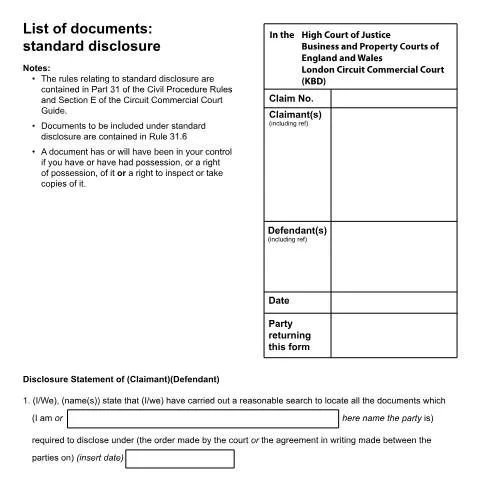
Navigating the N265(LCC): Your Essential Guide to Standard Disclosure in the London Commercial Court
Engaging in legal proceedings can often feel overwhelming, especially when it comes to navigating the myriad forms and requirements set forth by the courts. Among these is the N265(LCC) form, which plays a crucial role in the process of standard disclosure of documents within the London Commercial Court. Understanding the intricacies of this document is vital for claimants and defendants alike, as it directly impacts the flow of litigation and the obligations of the parties involved.
The Context of Standard Disclosure: Why the N265(LCC) Matters
The N265(LCC) form is embedded in the larger framework of the Civil Procedure Rules (CPR), specifically Part 31. The concept of 'disclosure' is fundamental to civil litigation, ensuring that parties have access to the documents necessary to fairly pursue their claims or defences. This form serves as the official declaration of compliance with disclosure obligations and outlines the extent of the search conducted for relevant documents.
Understanding the Role of Disclosure in Litigation
Disclosure is not merely a procedural hurdle; it plays an essential role in promoting transparency and fairness in legal proceedings. When a party submits the N265(LCC), they certify that they have conducted a reasonable search for documents that are pertinent to the case. This transparency helps prevent surprises at trial, enabling all parties to prepare adequately.
Distinguishing the N265(LCC) from Similar Forms
It is crucial to delineate the N265(LCC) from other forms that may serve similar purposes but operate under different rules or contexts. For instance, the N263 is another disclosure form, yet it is typically used in different circumstances or jurisdictions. Understanding these distinctions can help parties avoid confusion and ensure that they are submitting the correct documentation in their specific situation.
Key Differences to Note
- Jurisdiction Specificity: While the N265(LCC) pertains specifically to the London Commercial Court, other forms may apply to different courts or jurisdictions.
- Scope of Disclosure: The N265(LCC) requires a detailed statement regarding the search for documents, whereas other forms may not provide such detailed requirements.
- Legal Standards: The obligations surrounding disclosure can differ, with the N265(LCC) firmly grounded in the CPR and the Circuit Commercial Court Guide.
Breaking Down the N265(LCC): A Step-by-Step Examination
Completing the N265(LCC) requires a meticulous approach, as the form consists of several sections that demand careful attention. Each part is designed to elicit specific information that reflects the party's compliance with disclosure obligations.
Section by Section Overview
- Disclosure Statement: This section requires the party to declare their name and confirm they have conducted a reasonable search for documents.
- Extent of Search: Here, parties must detail how the search was conducted, including any limitations or specific categories that were not searched.
- Certifications: This section involves a declaration that the disclosed documents are complete and accurate, reinforcing the party's duty of disclosure.
- Inspection of Documents: Parties must identify which documents are available for inspection and which are subject to objections, providing reasons for those objections.
- Document Control: A comprehensive list of all documents in control, including those no longer available, is critical for maintaining transparency.
Common Pitfalls When Filling Out the N265(LCC)
Completing the N265(LCC) is not without its challenges. Common pitfalls include:
- Inadequate Search: Failing to conduct a thorough search may lead to the court questioning the credibility of the disclosure.
- Vague Descriptions: Generic language when describing documents can create ambiguity and hinder the inspection process.
- Omissions: Not including all relevant documents can have serious consequences, including potential sanctions.
Timelines and Next Steps: The Calendar of Disclosure
Understanding the timelines associated with the N265(LCC) form is essential for all parties involved. The initiation of disclosure typically follows a court order or an agreement between parties. Once the form is submitted, several key milestones occur.
Important Dates to Keep in Mind
| Milestone | Date |
|---|---|
| Submission of N265(LCC) | As ordered by the court or agreed upon by parties |
| Deadline for Further Disclosure | Before the conclusion of the case |
| Inspection of Documents | As agreed upon or directed by the court |
After the N265(LCC) is filed, parties should expect a period of further communication regarding the documents disclosed. This may include requests for inspection or further elaboration on specific items.
The Practical Implications: Rights and Obligations
Filing the N265(LCC) is not just a procedural formality; it carries significant implications for the parties involved. It establishes a clear framework for what documents must be disclosed and sets expectations for the ongoing obligations of both claimants and defendants.
Your Rights Following Submission
- Right to Inspect: Once the N265(LCC) is filed, parties have the right to inspect the disclosed documents as specified.
- Challenge Disclosure: If a party believes that relevant documents have been withheld, they have the right to challenge the disclosure in court.
- Responsibility to Update: Any new documents that come into a party's control before the conclusion of the case must be promptly disclosed.
Special Circumstances: Unique Situations and Considerations
While the N265(LCC) applies broadly, certain situations may require additional considerations. Parties involved in cross-border disputes, for example, may face unique challenges that necessitate deeper examination of their disclosure obligations.
Addressing Complex Cases
- International Parties: Claimants or defendants from outside the UK may have different legal standards to consider, and they should ensure compliance with both UK rules and their jurisdictions.
- Minor Claimants: In cases involving minors, additional protections and considerations come into play, affecting how disclosure is handled.
- Urgent Cases: Situations that require expedited hearings may also change the timeline and nature of disclosure obligations.
The Legal Framework: Historical Context and Regulatory Basis
The N265(LCC) form is not simply a bureaucratic requirement; it exists within a rich legal framework aimed at fostering fair and just proceedings. Understanding the legislation that underpins this form can enhance compliance and awareness.
The Evolution of Disclosure Requirements
The principles of disclosure in the UK are rooted in both common law and statutory provisions. These requirements have evolved over time, reflecting changing views on transparency and fairness in legal processes. The Data Protection Act 2018 and the UK GDPR play pivotal roles in regulating how personal data is handled within disclosure processes, underscoring the importance of adhering to these frameworks when completing the N265(LCC).
Conclusion: Your Path Forward with the N265(LCC)
Completing the N265(LCC) is an essential step in the litigation process within the London Commercial Court. By understanding the nuances of this form, the timelines involved, and the implications of disclosure, parties can navigate their obligations confidently and effectively. Remember, the stakes are high; thoroughness and accuracy in this process can significantly influence the course of legal proceedings. Whether you are a claimant or a defendant, taking the time to familiarize yourself with this form will pay dividends in the long run.
Understanding Form N265(LCC): Purpose and Importance
Form N265(LCC) is specifically designed for parties involved in proceedings at the London Commercial Court who are required to make a standard disclosure of documents. This process is integral to ensuring transparency and fairness in legal proceedings, as it allows both parties to see the evidence that may be used against them or in their defense. The London Commercial Court is known for handling complex commercial disputes, and the proper use of Form N265(LCC) can significantly impact the course and outcome of a case.
The purpose of Form N265(LCC) extends beyond merely listing documents; it establishes a framework for the disclosure process. By requiring parties to disclose certain categories of documents, the court aims to promote efficiency in the litigation process. Understanding which documents must be disclosed is paramount. This includes not only documents that a party intends to rely on but also those that may harm their case or support the opponent’s claims. This open exchange of information is dictated by the principles of the Civil Procedure Rules (CPR), which the Commercial Court follows. The key here is the need for parties to comply fully and accurately with the disclosure requirements to avoid potential sanctions, as failure to do so can lead to adverse inferences being drawn by the court.
Exemptions and Special Considerations When Using Form N265(LCC)
While the expectation is that all relevant documents must be disclosed via Form N265(LCC), there are specific exemptions and considerations that can affect this requirement. For instance, documents that are protected by legal professional privilege do not need to be disclosed. Legal professional privilege applies to communications between a lawyer and their client that are made for the purpose of obtaining legal advice or in the context of litigation.
Moreover, data protection laws, particularly the Data Protection Act 2018 and the UK GDPR, must also be considered when disclosing documents. If a document contains personal data, the party disclosing it must ensure they comply with the relevant data protection principles. This means that if disclosing a document would violate an individual's rights under data protection legislation, the document may not be disclosed in its entirety. It is advisable to review the contents of any document carefully to determine what can be disclosed without breaching privacy laws.
In certain cases, the court may grant specific directions regarding the disclosure process. This may include limiting the scope of the documents to be disclosed or providing alternative methods of disclosure, such as a summary of the information within the documents. These directions are particularly relevant in complex cases where the volume of documents is extensive. Parties should ensure they are familiar with these nuances to prepare their disclosure adequately.
Practical Steps for Completing Form N265(LCC)
Filling out Form N265(LCC) may seem daunting, but following a structured approach can ease the process. Here are practical steps to consider when completing the form:
- Gather Relevant Documents: Begin by collecting all documents that pertain to the dispute. This includes emails, contracts, correspondence, reports, and any other relevant material. Organizing these documents chronologically or by category may streamline the process.
- Review the Categories: Understand the categories of documents that must be disclosed as stipulated in the form. This understanding helps in identifying which documents fall under the disclosure obligation. Be aware of any exemptions, such as privileged documents or those protected under data protection laws.
- Complete the Form Accurately: Fill in Form N265(LCC) meticulously. Ensure that all required fields are completed and that you provide clear descriptions of the documents listed. Where applicable, specify the date range for the documents to help the court and the other party understand the context of the disclosure.
- Use Proper References: When referencing documents, include any relevant exhibit numbers or codes that can assist in cross-referencing during the proceedings. This practice aids in maintaining clarity throughout the litigation.
- Sign and Date the Form: Before submission, ensure that you sign and date the form as required. This signature affirms that the information provided is complete and truthful to the best of your knowledge, which is a legal declaration that can have implications if proven otherwise.
- Submit the Form to the Court: Following completion, submit Form N265(LCC) to the London Commercial Court as part of your court documents. Ensure you also serve a copy to the opposing party in compliance with the relevant rules of service.
By approaching the completion of Form N265(LCC) with organization and attention to detail, parties can facilitate a smoother disclosure process and uphold the integrity of the court proceedings.