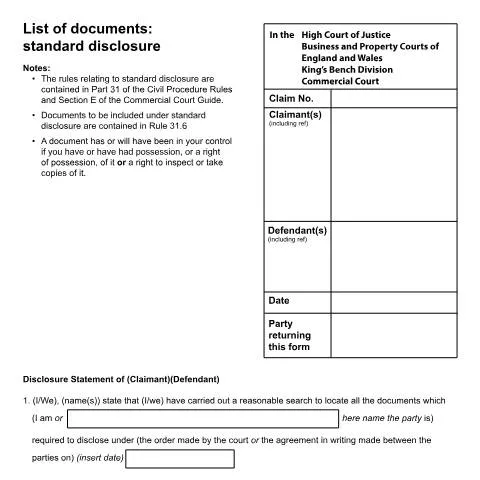
Understanding the N265(CC) Form: Essential Insights for Users
Navigating the legal landscape in the UK can sometimes feel overwhelming, particularly concerning the procedural requirements in the Commercial Court. One pivotal document in this process is the N265(CC) form, a key component in the standard disclosure of documents. This form not only facilitates the exchange of pertinent information between parties in a legal dispute but also ensures compliance with the obligations set out in the Civil Procedure Rules. Engaging with this form effectively can significantly impact the outcome of a case, making it essential for users to grasp its intricacies and requirements.Navigating Key Sections of the N265(CC) Form
The N265(CC) form comprises several critical sections, each designed to elicit specific information from the parties involved. Understanding what each section entails is crucial for accurate completion.The Disclosure Statement
At the forefront of the N265(CC) form is the Disclosure Statement, where the party disclosing documents certifies that a reasonable search has been conducted to locate all relevant documents. Here, the following must be addressed:- Identity of the Party: Clearly state whether the claimant or defendant is making the disclosure.
- Date of the Court Order: Include the date on which the court order was made or when the parties agreed in writing about disclosure obligations.
- Search Description: Detail the extent of the search conducted. This section is prone to ambiguity, as parties sometimes underestimate the scope of documents required.
Limiting the Search: Justifications and Implications
A unique feature of the N265(CC) form allows parties to limit their document search. While this can streamline the disclosure process, it requires careful justification. Users should consider:- Pre-dating Limitations: If documents predating a certain date are excluded, explain why.
- Location Restrictions: Specify any geographical limitations in the search for documents.
- Category Restrictions: Clearly outline any categories of documents that were not searched.
Document Control: Certification and Obligations
The section concerning document control is critical. In this part of the N265(CC) form, the disclosing party must certify their understanding of the duty of disclosure. It includes affirmations such as:- Comprehensive List: The disclosure statement must include a complete list of documents in the party’s control.
- Ongoing Duty: If new documents come to light after submitting the form, the party is obligated to inform the court and other parties immediately.
The Timeline of the Disclosure Process
Understanding the timing associated with the N265(CC) form is crucial for effective legal proceedings. The disclosure process, governed by the Civil Procedure Rules, follows a structured timeline.Key Dates and Deadlines
The timeline for filing the N265(CC) begins with the court's order. Generally, parties are expected to serve the completed form within a specified period, often outlined in the court's directions. Key checkpoints include:- Initial Disclosure Deadline: Typically set by the court, this date marks when parties must submit their disclosure statements.
- Follow-Up Disclosures: If new documents are identified post-filing, the party must disclose these as they come into control.
Consequences of Delays or Omissions
If a party fails to meet the prescribed deadlines for submitting the N265(CC) form, several consequences may arise:- Sanctions: The court may impose penalties, including adverse inferences against the non-compliant party.
- Potential Dismissal: In severe cases, the failure to disclose can lead to the dismissal of the claim or defence.
Processing and Tracking Your N265(CC) Submission
Once the N265(CC) form is submitted, it enters a processing phase that’s essential to understand for effective follow-up and compliance.How the Courts Handle Disclosure
The HM Courts & Tribunals Service manages the processing of submitted N265(CC) forms. Upon submission, several important steps occur:- Verification: Court staff will verify that the form is completed accurately and that all necessary documents are included.
- Communication: The court may contact parties regarding compliance issues or additional requirements.
Tracking Your Submission
After submitting the N265(CC), parties often want to track its progress. While direct tracking isn't typically available, there are strategies for staying informed:- Maintain Open Communication: Regularly check in with the court and other parties involved to ensure there are no outstanding issues.
- Document Everything: Keep records of all submissions and correspondence related to the N265(CC). This is invaluable for future reference.
Implications of Disclosure: Rights and Responsibilities
Completing the N265(CC) form has ramifications beyond merely submitting a document. It establishes a legal framework involving both rights and responsibilities.Your Rights in the Disclosure Process
Filing the N265(CC) form grants certain rights to the disclosing party, including:- Inspection Rights: Parties have the right to inspect documents disclosed by the opposing party, provided they are not objected to.
- Challenge Objections: If objections to document inspection arise, the disclosing party can challenge those objections through the court.
Responsibilities Following Disclosure
Conversely, filing the N265(CC) also comes with considerable responsibilities:- Maintaining Document Control: Parties must remain diligent about the documents they disclose and must notify the court and other parties about any new documents that come to their control.
- Responding Promptly: Any requests from the other party for additional documents or clarifications must be addressed in a timely manner.
Complex Situations: Tailoring Your Approach
Certain situations may complicate the disclosure process and necessitate a more nuanced approach. Users should be prepared for these variations.International Parties and Jurisdictional Issues
When parties involved in a legal dispute are based outside the UK, the N265(CC) form can present unique challenges. For international parties, consider the following:- Jurisdictional Compliance: Ensure that the disclosure complies with both UK law and the laws of the party's home jurisdiction.
- Language Considerations: Ensure documents provided are translated accurately if they are not in English, as this may impact their admissibility in court.
Handling Minors or Vulnerable Parties
Cases involving minors or vulnerable individuals require heightened sensitivity, particularly concerning the N265(CC) form. Considerations in such cases include:- Guardian Ad Litem: Appoint a guardian ad litem to represent the minor's interests, especially in disclosure matters.
- Confidentiality Protections: Ensure that sensitive information is adequately protected to prevent exposure of vulnerable parties to undue harm.
Addressing Common Challenges: Errors and Missing Information
Even with meticulous preparation, parties may encounter issues after submitting the N265(CC) form. Understanding how to address these challenges is key to navigating the process effectively.What to Do If Errors Arise
Errors in the N265(CC) form can result in significant complications. If a mistake is identified post-submission, follow these steps:- Amend the Form: If possible, submit a corrected version of the form to the court, detailing the nature of the error and the correction made.
- Notify Other Parties: It’s vital to inform all other parties involved in the case about the error to maintain transparency.
Handling Missing Documentation
If documents required for disclosure are missing, the disclosing party must take immediate action:- Search Again: Conduct a comprehensive search for any missing documents, documenting the efforts made.
- Inform the Court: If documents cannot be located, notify the court and the opposing party about the situation, along with details of the search efforts.
Conclusion: The Importance of Diligence in the N265(CC) Process
Completing the N265(CC) form isn’t merely a procedural formality; it’s a critical step in ensuring that all relevant documents are exchanged in a legal dispute. By understanding the detailed requirements of the form, the timelines involved, and the implications of disclosure, parties can navigate the complex legal landscape more effectively. Being diligent in completing the form, addressing potential pitfalls, and staying informed throughout the process will significantly enhance the chances of a successful outcome in the Commercial Court. In an environment where documentation can make or break a case, the effort put into mastering the N265(CC) form is undoubtedly worthwhile. Remember, each detail matters, and robust preparation can lead to a more streamlined and effective legal process.Understanding the Purpose of Form N265(CC)
The N265(CC) form is crucial for parties involved in litigation within the UK Commercial Court as it serves a dual purpose: it facilitates the disclosure process and promotes transparency in legal proceedings. Disclosure is an essential aspect of litigation wherein parties must share relevant documents that may influence the outcome of the case. The primary aim of using Form N265(CC) is to provide the court with a comprehensive overview of the documents a party considers pertinent, ensuring that all evidence is available for review during hearings.
The form is not just a procedural requirement; it embodies the principle of fair play in the legal system, allowing both sides to prepare effectively. Understanding which documents to include is vital, as the court expects parties to exercise due diligence in identifying relevant materials. Generally, this encompasses any documents that both support and undermine a party's case. Notably, failing to disclose relevant documents can significantly affect the court's judgement and potentially result in penalties or adverse inferences.
Common Challenges Faced When Completing Form N265(CC)
Filling out Form N265(CC) can pose several challenges, particularly for those unfamiliar with legal proceedings. One significant hurdle is determining the scope of disclosure. Parties often grapple with understanding what constitutes a 'relevant document.' The Commercial Court employs a broad definition, meaning that any document potentially impacting the case should be considered. This ambiguity can lead to either over-disclosure or under-disclosure, both of which have ramifications.
Another challenge is maintaining compliance with the Data Protection Act 2018 and UK GDPR. Parties must ensure that personal data included in the disclosure is processed lawfully. This compliance means redacting sensitive information and understanding what data can be shared without infringing on privacy rights. Missteps in this area can lead to legal repercussions, making it essential to approach disclosure with caution.
Additionally, the time constraints associated with the completion and submission of Form N265(CC) can create pressure. The court typically sets deadlines for disclosure, and the meticulous nature of identifying and compiling documents can lead to stress. It's crucial for parties to start the process early, thoroughly review their documentation, and seek legal advice if uncertainties arise.
Best Practices for Effective Document Disclosure
To navigate the complexities of completing Form N265(CC) efficiently, several best practices can be implemented. Firstly, it is advisable to create a comprehensive list of all documents relevant to the case before filling out the form. This list should be categorized based on their significance, such as documents that support your claims or contradict the opposing party's assertions. This strategic approach simplifies the process and enhances the clarity of your submission.
Secondly, utilizing a document management system can greatly facilitate the organization of materials. Such systems allow for easy retrieval of documents and help maintain a clear audit trail of what has been disclosed. This practice not only aids in meeting the disclosure obligations but also serves as proof of compliance should questions arise later in the proceedings.
Moreover, seeking legal counsel during the preparation of Form N265(CC) can provide invaluable insights. An experienced solicitor can offer guidance on what constitutes relevant documents and help ensure that all procedural requirements are met. They can also assist in formulating a strategy for redacting sensitive information in compliance with data protection laws.
Finally, it's important to maintain open lines of communication with the opposing party. Effective negotiation can lead to mutually agreed-upon disclosure parameters, reducing the likelihood of disputes over what documents should be shared. This collaborative approach can foster a more amicable litigation process and lead to a smoother resolution.