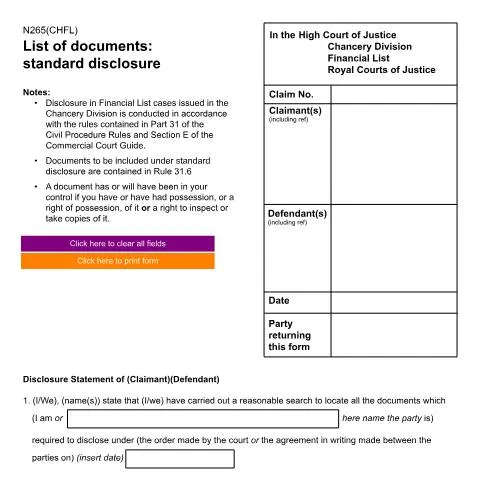
Unpacking the N265(CHFL): A Crucial Document in Chancery Division Cases
In the landscape of legal proceedings in the United Kingdom, the N265(CHFL), or the List of Documents: Standard Disclosure, plays an integral role, particularly within the High Court of Justice, Chancery Division, Financial List. This form is essential for parties involved in litigation as it sets the stage for the disclosure of documents relevant to the case at hand. Understanding its nuances is critical for claimants and defendants alike, as it dictates how information is shared between parties and the court.
Who Needs to Submit the N265(CHFL)?
The N265(CHFL) is typically required from both the claimant and defendant in a financial dispute under the Chancery Division. This includes cases where financial matters such as trust disputes, wills, and commercial disagreements are involved. However, the obligation to submit this form can vary based on specific circumstances:
- Individuals versus Corporations: Both individuals and corporate entities involved in the litigation must adhere to the same disclosure rules, though corporations may have a larger volume of documents to disclose.
- Legal Representatives: Solicitors representing clients are responsible for ensuring the N265(CHFL) is accurately completed and submitted, as it reflects on their duty to the court.
- Foreign Parties: If one of the parties is a foreign entity, they must comply with the same rules, but may need additional advice regarding document handling and disclosure under UK law.
The Framework Behind the N265(CHFL)
Understanding the context of the N265(CHFL) involves delving into the Civil Procedure Rules (CPR), particularly Part 31, which governs disclosure. This framework ensures that all parties are transparent about the documents they possess that are pertinent to the case, promoting fairness and efficiency. The guidelines state that:
- Each party must undertake a reasonable search for all documents required for disclosure.
- Disclosure is not merely about providing requested documents but about ensuring all relevant information is shared.
- Failure to comply can lead to sanctions, including adverse inferences or costs penalties.
Navigating the N265(CHFL): Step-by-Step Completion Guide
Completing the N265(CHFL) involves careful attention to detail. Each section of the form serves a specific purpose and demands precise information for effective processing. Here’s how to navigate through the form:
Section 1: Disclosure Statement
The opening statement requires the party to affirm that a reasonable search for documents has been conducted. This places a burden on the party to detail the nature and extent of their search:
- What to Include: Specify the methods used for searching, including personnel involved and any electronic databases consulted.
- Common Pitfalls: Be cautious not to overstate the extent of the search; claims of a comprehensive search without supporting details can be challenged.
Section 2: Limitations of the Search
In this section, the form allows parties to outline any limitations they imposed during their search for documents. This can include:
- Time Constraints: Mention if the search was limited to documents created after a specific date.
- Type of Documents: Clearly state what categories were excluded and justify why these limitations were reasonable.
Section 3: Certifying the Duty of Disclosure
This pivotal section implies that the party understands their obligations regarding disclosure. A firm declaration of compliance reinforces the party's credibility:
- What to Watch For: Ensure that the language used is clear and unambiguous. Phrases such as "to the best of my knowledge" can help mitigate legal risks.
- Consequence of Errors: Misrepresentation in this section can lead to severe penalties, including losing the right to present certain evidence.
The Chronology of the N265(CHFL) Submission Process
Understanding the timeline from the moment the N265(CHFL) is triggered until the court reaches a decision is essential for all parties involved. Here’s how the process flows:
- Trigger: The need for disclosure is triggered either by a court order or an agreement between parties.
- Preparation: Parties gather documents and complete the N265(CHFL) form, which typically needs to be submitted within 14 days of the court order.
- Submission: The completed form must be filed with the court and served on all parties involved in the case.
- Disclosure Review: Once submitted, the opposing party reviews the disclosed documents and may request further information or challenge the disclosure.
- Resolution: Any disputes related to disclosure can be addressed through court hearings, where judges may impose further orders on document disclosure.
Understanding the Differences: N265(CHFL) Versus Similar Forms
The N265(CHFL) is often confused with other forms related to disclosure within the court system. Understanding these differences can prevent missteps:
| Form Code | Title | Primary Use |
|---|---|---|
| N265(CHFL) | List of Documents: Standard Disclosure | Used in financial disputes to disclose relevant documents. |
| N266 | Disclosure by Care Order | Specifically related to care proceedings. |
| N267 | Standard Disclosure List | General disclosure list not limited to financial matters. |
Each form serves distinct purposes, and using the incorrect one can lead to significant delays and complications in judicial proceedings. It is vital for solicitors and self-representing litigants to ensure they use the right form for their specific situation.
Submitting the N265(CHFL): Channels and Their Implications
With technological advancements, submitting the N265(CHFL) can be done through various channels, each with its nuances:
Online Submission
Filing the N265(CHFL) online through the HM Courts & Tribunals Service (HMCTS) portal is often the most efficient method. This option allows for:
- Speed: Instantaneous confirmation of submission.
- Accessibility: 24/7 access to submit forms, avoiding postal delays.
Paper Submission
While online submission is encouraged, parties may still opt for paper forms. This traditional method requires:
- Mailing: Documents must be sent to the specified court address with postal time considered.
- Handling Time: Expect delays due to processing times in court registries.
In-Person Filing
Submitting the N265(CHFL) in person may be preferable for individuals who want immediate interaction:
- Direct Confirmation: Receive immediate feedback from court staff.
- Assistance: Gain support from court personnel if there are questions or clarifications needed about your submission.
Conclusion: Navigating the N265(CHFL) with Confidence
Completing and submitting the N265(CHFL) is a critical step in any case within the Chancery Division's Financial List. Whether you are a seasoned solicitor or a self-represented litigant, understanding the intricacies of this form and the surrounding obligations can significantly impact the outcome of your case. By carefully adhering to the outlined procedures and being mindful of the potential pitfalls, parties can ensure they fulfill their disclosure obligations effectively and transparently.
Understanding the Standard Disclosure Process in the Chancery Division Financial List
The Standard Disclosure process is a critical component in financial litigation within the Chancery Division of the High Court of Justice. This procedure serves to ensure all parties involved in litigation share relevant documents, which can significantly influence case outcomes. In financial disputes, where transparency and full disclosure are paramount, understanding the nuances of this process is essential.
Under the Civil Procedure Rules (CPR), particularly Part 31, the parties must disclose documents that are in their possession and that are relevant to the matters in issue. This includes documents that support one’s case and those that may undermine it. The Form N265(CHFL) specifically caters to the disclosure requirements for financial cases under the Chancery Division, differentiating it from disclosures in other divisions of the court.
The key steps in the Standard Disclosure process include:
- Identification of Documents: Each party must carefully identify and list all relevant documents in their possession. This includes emails, contracts, financial records, and any other pertinent documentation.
- Review and Preparation: Parties are required to review their documents thoroughly to ensure compliance with the duty of disclosure. It is prudent to prepare a disclosure report that outlines the process undertaken to identify and collate documents.
- Completion of Form N265(CHFL): This form serves as the formal declaration of whether any documents are withheld and the reasons for such withholding, if applicable. Parties must ensure that this form is compliant with the guidelines set forth in the CPR.
A failure to comply with disclosure obligations can lead to severe repercussions, including sanctions or adverse inferences drawn by the court. Therefore, understanding the standard disclosure requirements and the use of Form N265(CHFL) is vital for litigants in the Chancery Division Financial List.
Common Challenges and Pitfalls in Preparing Form N265(CHFL)
While preparing and submitting Form N265(CHFL) might seem straightforward, several challenges often arise that can complicate the disclosure process. Navigating these challenges requires diligence and attention to detail.
One common pitfall is failing to identify all relevant documents. This oversight can occur during the initial stages of document gathering. It is advisable to take a systematic approach, possibly even employing a checklist to ensure that no documents are overlooked. Utilizing legal technology and document management systems can also streamline this process.
Another challenge is the misinterpretation of relevance. Some parties may incorrectly assume that only documents that directly support their case need to be disclosed. However, the duty of disclosure also encompasses documents that could be detrimental to one's claim. Misunderstanding this can lead to partial or inadequate disclosures and potential penalties from the court.
Furthermore, confidentiality issues can arise. When disclosing sensitive documents, parties must consider the implications of sharing such information. If a document contains confidential information, it may be necessary to seek a protective order or redaction to limit the exposure of sensitive data.
Additionally, the timing of disclosure is crucial. Delays in preparing Form N265(CHFL) can lead to missed deadlines or delays in the litigation process. Parties must be organized and proactive in their approach to ensure that all required documents are disclosed within the stipulated timeframes as indicated by the court.
Lastly, there is the challenge of managing electronic documents. In today’s digital age, many documents exist in electronic form, and properly managing these can be complex. Parties should ensure they have robust systems for organizing and retrieving electronic documents to meet disclosure obligations effectively.
The Importance of Legal Representation in the Standard Disclosure Process
Engaging legal representation when navigating the Standard Disclosure process, especially in the context of financial disputes within the Chancery Division, can be immensely beneficial. Experienced solicitors understand the nuances and complexities of the legal framework and can provide invaluable assistance throughout the process.
One significant advantage of having legal counsel is that they can help in accurately identifying which documents need to be disclosed. Their expertise in the law can guide parties on the relevant criteria for disclosure, ensuring compliance with the rules while protecting the party’s interests.
Legal representatives are also adept at assembling and organizing documentation. They can assist clients in conducting thorough document reviews and employing best practices for effective disclosure. This includes creating comprehensive disclosure logs and documenting the steps taken during the disclosure process.
Moreover, solicitors can provide strategic advice regarding potential pitfalls and challenges, helping clients navigate complex issues. For instance, they can assess the relevance of documents and help in deciding what to disclose or claim as confidential.
Additionally, legal counsel plays a crucial role in ensuring that the completion and submission of Form N265(CHFL) is done correctly. They can ensure that all necessary details are included, thus minimizing the risk of complications or legal repercussions arising from improper disclosure.
Moreover, having legal representation provides an added layer of protection during potential disputes regarding disclosure. An experienced solicitor will know how to respond to challenges from opposing parties and can advocate for their client’s rights effectively. In cases where disputes arise over the adequacy of disclosure, a solicitor can represent the client’s interests in court, ensuring that the client’s position is effectively articulated.
In summary, while it is possible to navigate the Standard Disclosure process independently, the complexities and potential pitfalls make it wise to consider legal representation. Experienced solicitors bring expertise that can simplify the process and mitigate risks, ensuring that disclosures are handled correctly within the Chancery Division.