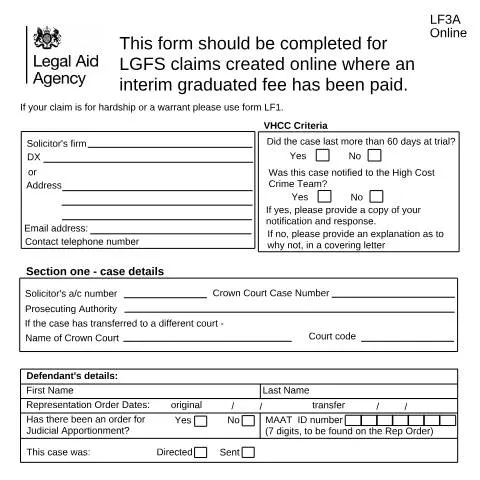
Understanding the LF3A Form: A Practical Guide for Solicitors
The LF3A form is a vital document for solicitors dealing with cases that have required an interim fee payment. It specifically applies to claims for final litigator fees when an interim graduated fee has already been settled. This form connects the financial aspects of legal aid with the administrative framework set up by the Legal Aid Agency (LAA), ensuring that solicitors are compensated appropriately for the services rendered. Understanding the nuances of this form can significantly impact the financial outcome of legal proceedings and the management of legal aid funds.
Historical Context and Regulatory Framework
The Legal Aid Agency, under the Ministry of Justice, administers legal aid in England and Wales. The LF3A form falls within a broader legislative framework aimed at providing fair and equitable access to legal representation. The establishment of the Legal Aid, Sentencing and Punishment of Offenders Act 2012 (LASPO) marked a significant turning point, reshaping how legal aid is processed and funded.
With increasing demands for transparency and accountability in legal expenditures, the LF3A form serves both solicitors and the LAA. It enables legal practitioners to claim fees while ensuring that taxpayer money is used appropriately. The form adheres to the stringent guidelines set out in the Legal Aid regulations, requiring solicitors to provide precise details about the case and the fees being claimed.
Timeline for Submission: Key Dates and Expectations
Knowing when to submit the LF3A is as critical as understanding how to complete it. The claim needs to be submitted promptly following the conclusion of the interim fee payment. Solicitors should be aware of the following timeline:
- Start Date: Claims can be initiated as soon as an interim fee is paid.
- Final Submission Deadline: The completed LF3A form should be submitted as soon as the case has concluded, ideally within one month to avoid any delays in processing.
- Processing Time: After submission, the LAA generally processes claims within 10 weeks; however, this can vary depending on complexity and completeness of the documentation.
Failure to adhere to these timelines can jeopardize the claim, potentially leading to financial loss for the solicitor and the firm. Therefore, maintaining a strict schedule and monitoring the submission process is essential for successful claims.
Essential Components of the LF3A Form: Navigating the Sections
The LF3A form is divided into several sections that solicitors must complete with meticulous care. Each section is designed to gather specific information pertinent to the claim. Here’s a brief overview of what each section entails:
Case Details
The first section requires comprehensive case details including:
- Crown Court Case Number
- Solicitor's account number
- Prosecuting Authority
Accurate details here are crucial as they directly link the claim to the appropriate legal proceedings.
Declaration of Supporting Evidence
In this section, solicitors must confirm the inclusion of various supporting documents. It is essential to keep detailed records as documentation can reinforce the legitimacy of the claims made. Key documents include:
- Original disbursement vouchers for claims above £20
- Prior authority confirmations for any disbursements made
- Evidence of hardship if applicable
Breakdown of Travel Costs
Travel costs often form a significant part of claims. The LF3A requires a detailed breakdown of travel expenses, including:
| Date | Destination | Reason for Travel | Mileage (Public Transport Rate) | Mileage (Private Transport Rate) | Amount Claimed (£) |
|---|---|---|---|---|---|
| dd/mm/yyyy | Location | Purpose | Distance | Distance | Amount |
Each entry must clearly outline the reason for travel and be supported by receipts where applicable, reinforcing the claim's legitimacy.
Special Circumstances: Navigating Complex Cases
There are instances where the claim circumstances may diverge from the norm. For example:
Fill in your form directly online
No printing: type your details into the boxes of the official form, tick, then download the PDF ready to send.
- 1Type into the form boxes
- 2Tick in one click
- 3Save and download the PDF
- High-Cost Crime Team Notifications: If the case was particularly complex or high-cost, it should have been notified to the High Cost Crime Team. Failure to do so must be explained in a covering letter.
- Hardship Claims: For cases claiming hardship, specific evidence such as bank statements or letters from financial institutions will be essential.
Handling these cases requires additional care in documentation and justification to ensure that the claim can withstand scrutiny.
Integrating the LF3A within the Larger Legal Aid Process
The LF3A form is just one piece of a larger puzzle in the legal aid application and claim process. Solicitors must understand how this form fits into the broader context of legal aid funding, which includes:
- Initial Application Process: Before reaching the LF3A stage, solicitors must ensure that the client is eligible for legal aid and that the right forms (such as the LF1 for hardship) have been submitted initially.
- Interim Payments: The processing of interim payments is pivotal, as the LF3A is contingent upon these payments being made correctly.
- Final Claims Review: Once submitted, the claim undergoes a rigorous review process by the LAA to ensure compliance with legal aid regulations.
Anticipating Outcomes: Understanding the Claims Process
Once the LF3A form is submitted, several outcomes are possible, and solicitors should be prepared for each scenario:
- Approved Claims: If the claim is approved, the solicitor will receive the final fee along with any allowed disbursements.
- Rejection Reasons: In instances where claims are rejected, the LAA will provide reasons that could include lack of supporting evidence or misalignment with legal aid regulations.
Effective communication with the LAA can be key in successfully navigating any issues that arise during the claim review process.
Final Considerations for the LF3A Process
Completing the LF3A form accurately and thoroughly is not merely an administrative task; it is a critical component of ensuring that solicitors are compensated for their work in legal aid cases. Attention to detail, understanding of the necessary documentation, and adherence to timelines will pave the way for smoother processing and successful claims. Solicitors are encouraged to develop a robust system for managing documentation and tracking claims to optimize their practice's efficiency. In the ever-evolving landscape of legal aid in the UK, staying informed and prepared can significantly impact the sustainability of legal practices reliant on public funding.