When Litigators Navigate the Maze of Graduated Fee Claims
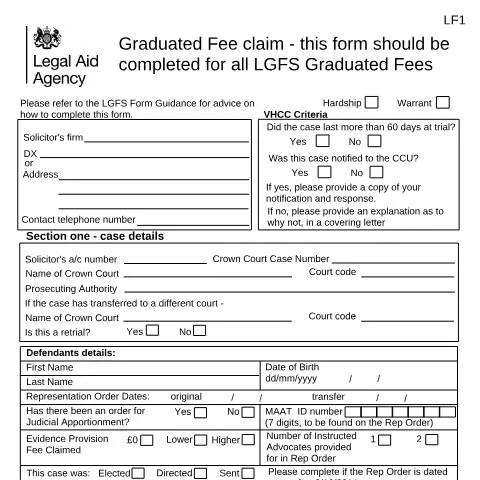
Criminal defence work operates under tight financial constraints, where every hour spent on a case must be meticulously documented and justified. For solicitors handling Crown Court cases under the Legal Aid Agency's Litigators' Graduated Fee Scheme (LGFS), the LF1 form represents the crucial bridge between completed legal work and payment. This isn't simply a billing document—it's a comprehensive claim that requires precise calculation of fees based on case complexity, duration, and the volume of prosecution evidence served.
The graduated fee system operates on a fundamentally different principle from hourly billing. Rather than charging for time spent, solicitors receive predetermined fees calculated according to the offence class, trial length, and pages of prosecution evidence (PPE). This creates a unique challenge: the LF1 form must capture not just what work was done, but how that work fits into the LAA's complex fee structure that can vary dramatically based on seemingly minor case details.
Decoding the Graduated Fee Architecture Through Form Structure
The LF1 form's eight sections reflect the intricate calculations underlying the LGFS payment system. Each section serves a specific purpose in building the fee calculation, starting with fundamental case identification and progressing through increasingly complex financial elements.
Case Foundation Elements
Section one establishes the case's basic parameters, but these details carry significant financial implications. The Crown Court location and case number link to specific court codes that can affect processing times. More critically, the prosecuting authority—whether Crown Prosecution Service, Serious Fraud Office, or another body—can influence both the complexity of evidence handling and potential fee enhancements.
The representation order details require particular attention to the MAAT ID number, a seven-digit identifier that connects the case to the Legal Aid Agency's central database. Errors in this number can delay payment for weeks. The number of instructed advocates specified in the representation order directly impacts fee calculations, as cases with multiple advocates may qualify for different payment rates.
Evidence Volume and Trial Dynamics
The prosecution evidence pages count forms the backbone of graduated fee calculations. However, the form distinguishes between different evidence types—statements, exhibits, photographs, transcripts, and other materials—because each category may be weighted differently in fee calculations. The critical question about electronic service of evidence reflects the LAA's recognition that digital case files can be searched more efficiently than paper bundles, potentially affecting preparation time allowances.
Trial length calculations must account for actual sitting days, excluding weekends and adjournments that don't involve substantive proceedings. A case lasting 61 days triggers Very High Cost Case (VHCC) criteria, fundamentally changing the fee structure and requiring notification to the Costs Case Unit—a detail that can transform a straightforward graduated fee claim into a complex individually-assessed case.
Navigating Disbursement Claims and Prior Authority Requirements
Disbursement claims within the LF1 form operate under strict evidential requirements that reflect the LAA's attempts to control costs while ensuring adequate case preparation. The £20 threshold for voucher submission creates a practical administrative burden, requiring solicitors to maintain detailed records of relatively small expenses while providing substantial documentation for larger outlays.
| Disbursement Type | Prior Authority Required | Voucher Threshold | Additional Requirements |
|---|---|---|---|
| Medical reports | Usually yes | £20+ | Expert qualifications |
| Psychiatric assessments | Always | £20+ | Court direction evidence |
| Forensic analysis | Case-dependent | £20+ | Prosecution evidence gaps |
| Translation services | Rarely | £20+ | Language certification |
The prior authority system creates a tension between thorough case preparation and cost control. Solicitors must often make tactical decisions about whether to seek expensive expert evidence without guarantee that prior authority will be granted. The form's requirement to indicate whether prior authority was granted, applied for, or received creates an audit trail that the LAA uses to identify patterns of unauthorised expenditure.
Travel Cost Justification Framework
Section three's travel cost breakdown reflects the LAA's policy tension between ensuring adequate representation and controlling geographic cost variations. The requirement to justify visits to clients when local providers wouldn't incur such costs addresses the fundamental question of whether legal aid should subsidise solicitors' business location choices.
Public transport rates form the default calculation basis, with private transport requiring specific justification. This might include client security concerns, medical equipment transport, or timing constraints that make public transport impractical. The distinction between public and private transport rates can significantly impact total claims, particularly for firms serving large geographic areas or clients in secure facilities.
Hardship and Warrant Claims: Emergency Financial Mechanisms
The graduated fee system's standard payment timing can create cash flow crises for solicitors handling lengthy cases. Hardship claims, covered in section five, provide interim payments but require substantial financial disclosure that many firms find intrusive. Bank statements, overdraft letters, and detailed cash flow projections must demonstrate genuine financial distress rather than mere inconvenience.
The three-month threshold for hardship claims reflects the LAA's assessment of reasonable business cash flow management. Cases likely to conclude within three months shouldn't generate hardship claims, but this creates difficulties when trial dates are uncertain or frequently postponed. Solicitors must often make speculative hardship applications based on estimated trial schedules that may prove incorrect.
Warrant Work Recognition
Warrant claims acknowledge that significant work occurs before formal case conclusion, particularly when defendants abscond. The warrant issue date becomes crucial for calculating fees, as work continuing after warrant issue may qualify for additional payment once the warrant is executed. This creates complex timing issues when defendants surrender or are arrested months or years after warrant issue.
The form requires clear documentation of warrant execution dates because this triggers the final fee calculation. Cases with multiple warrants—common in multi-defendant cases where some defendants abscond—require careful tracking of individual warrant dates and their impact on fee entitlements.
Committal Provisions and Transitional Arrangements
The form's treatment of committal for trial hearings reflects significant changes in Crown Court procedure following the Legal Aid, Sentencing and Punishment of Offenders Act 2012. Cases with representation orders granted before October 2011 may qualify for separate committal fees, creating a complex transitional arrangement that requires careful date tracking.
Committal hearing dates and offence descriptions serve multiple purposes: they establish fee calculation bases for older cases, provide audit trails for LAA reviews, and help identify cases that may have been incorrectly processed under newer fee arrangements. The requirement to specify relevant statutes and offence descriptions reflects the detailed categorisation underlying graduated fee calculations.
Transfer Complications and Documentation
Court transfers create particular complexity because fee calculations may depend on work done at different locations with different case management systems. The form requires identification of both original and transfer courts, with corresponding court codes that link to different administrative processes.
When cases transfer between solicitors, the documentation requirements multiply. Original representation orders, transfer documentation, and clear identification of whether the claiming solicitor is original or successor all affect fee calculations and payment authorisation. Transfer timing can also impact evidence page counts if additional material is served after transfer.
Special Preparation Claims and Enhanced Fee Structures
The reference to special preparation claims on form LF1-Special prep acknowledges that some cases require work beyond standard graduated fee assumptions. This might include cases with unusually complex evidence, novel legal points, or exceptional procedural requirements. However, special preparation claims operate under strict criteria and require separate application processes.
The threshold for special preparation varies according to case type and offence class, but generally requires demonstration that case preparation significantly exceeds normal expectations. This creates tension between thorough case preparation and cost control, particularly in cases involving new technology, complex financial arrangements, or multiple expert witnesses.
Electronic Evidence and Modern Case Management
The form's specific question about electronic evidence service reflects the legal profession's gradual adaptation to digital case files. Electronic service can dramatically reduce printing and storage costs while enabling more sophisticated evidence analysis. However, it also creates new challenges around evidence verification, metadata preservation, and cross-referencing between electronic and physical exhibits.
Electronic evidence counting for fee calculation purposes remains somewhat uncertain, as the graduated fee system was designed around physical document bundles. Large electronic files might contain thousands of pages but require different analytical approaches than traditional paper bundles, creating ongoing debates about appropriate fee calculations.
VAT Treatment and Financial Declaration Requirements
The form's detailed VAT tracking reflects the complex tax treatment of legal aid work. Different elements of claims may have different VAT implications: graduated fees are VAT-exempt, but some disbursements carry VAT that can be reclaimed from the LAA. This creates administrative complexity that requires careful separation of VAT-bearing and VAT-exempt elements.
Section seven's total claim calculation serves as both summary and verification tool. The LAA's payment systems cross-reference these totals against individual section calculations to identify discrepancies or errors. Mathematical errors can delay payment while administrative queries are resolved, making accuracy crucial for cash flow management.
Declaration and Supporting Evidence Requirements
The final declaration section creates legal obligations extending beyond mere form completion. By signing the declaration, solicitors confirm not just mathematical accuracy but compliance with all LAA requirements and the authenticity of supporting documentation. This creates potential professional conduct implications if errors are discovered during LAA audits.
The supporting documentation requirements—representation orders, prior authority confirmations, disbursement vouchers, hardship evidence, and prosecution bundles—create substantial administrative burdens. However, they also provide the evidential foundation for LAA payment decisions and subsequent audits. Missing documentation can result in claim rejection or payment delays that may extend for months while additional evidence is gathered.
Understanding these requirements helps solicitors prepare comprehensive claims that minimise processing delays and maximise the likelihood of prompt payment. The LF1 form represents more than administrative compliance—it's the primary mechanism through which criminal defence solicitors secure payment for essential legal services within the legal aid system's complex financial architecture.
Regional Variations and Specialist Court Requirements
The application of LF1 claim procedures varies significantly across different jurisdictions within the UK, with each region maintaining distinct administrative frameworks that can materially affect your fee recovery prospects. In England and Wales, the Legal Aid Agency processes claims through its centralised assessment unit, whilst Scotland operates under the Scottish Legal Aid Board (SLAB) with markedly different criteria and payment scales. Northern Ireland maintains its own Legal Services Agency, creating a third distinct pathway for litigator fee recovery.
Crown Courts across England and Wales apply standardised graduated fee schemes, but local administrative practices can introduce subtle variations in processing times and documentation requirements. The South Eastern Circuit, for instance, has developed streamlined digital submission protocols that can accelerate assessment by 15-20% compared to paper-based submissions still accepted in some northern circuits. Manchester Crown Court has pioneered electronic case file integration, allowing real-time verification of hearing attendance and case complexity factors that directly impact fee calculations.
Specialist courts present unique challenges for LF1 claims that require careful navigation. The Central Criminal Court (Old Bailey) applies enhanced security protocols that can delay document verification, whilst complex fraud cases heard at Southwark Crown Court often involve multiple defendants and extended hearing schedules that necessitate detailed time recording beyond standard requirements. Commercial courts hearing serious fraud matters may require expert witness coordination logs and technical evidence handling documentation to support enhanced fee claims.
High Court proceedings involving litigator representation create additional complexity layers, particularly where cases transfer between different court centres during proceedings. The Royal Courts of Justice maintains separate administrative channels for different case types, with the Queen's Bench Division applying distinct documentation standards compared to the Administrative Court. Cases involving judicial review or commercial litigation may require demonstration of specialised legal research time and expert consultation that standard Crown Court fee structures don't automatically accommodate.
Fill in your form directly online
No printing: type your details into the boxes of the official form, tick, then download the PDF ready to send.
- 1Type into the form boxes
- 2Tick in one click
- 3Save and download the PDF
Regional Legal Aid Agency offices maintain varying interpretation approaches to "exceptional circumstances" that can qualify cases for enhanced fee rates. The Birmingham office has established precedents for recognising complex multi-defendant drug conspiracy cases as qualifying for uplift payments, whilst the Leeds office applies more restrictive criteria for similar case types. Understanding these regional nuances can significantly impact your strategic approach to fee maximisation within legitimate parameters.
Technology Integration and Digital Submission Protocols
The Legal Aid Agency's progressive digitisation of the LF1 submission process has created both opportunities and challenges for legal practitioners seeking efficient fee recovery. The Client and Cost Management System (CCMS) now handles the majority of new applications, but legacy cases may still require hybrid submission approaches combining digital forms with paper-based supporting documentation. Understanding which pathway applies to your specific case type can prevent costly delays and resubmission requirements.
Digital submission through the Legal Aid Portal offers real-time validation of National Insurance numbers, case reference numbers, and court identifiers, reducing common rejection causes by approximately 60% compared to paper submissions. However, the system's automated validation protocols can flag legitimate variations in defendant name formatting or address details that require manual intervention. Preparing submissions with standardised formatting protocols—particularly for defendant names matching court records exactly—significantly improves first-time acceptance rates.
Electronic time recording integration allows direct import of case management system data, but requires careful mapping of activity codes to Legal Aid Agency categories. Many case management platforms use proprietary coding systems that don't directly translate to LAA requirements, necessitating manual reconciliation processes. The system recognises specific time entry formats, with detailed narrative descriptions improving approval likelihood compared to generic activity codes.
Document upload protocols within the digital system accept multiple file formats but apply strict size limitations that can complicate submission of comprehensive case files. Large hearing bundles or extensive correspondence files may require strategic splitting across multiple upload sessions, with careful cross-referencing to maintain case coherence. The system's optical character recognition capabilities can extract relevant case details from uploaded documents, but handwritten notes or poor-quality scans may require manual data entry backup.
Mobile accessibility features allow practitioners to submit time entries and expenses in near real-time, particularly valuable for cases involving extensive travel or multiple court attendances across different locations. The mobile interface supports photograph capture of receipts and mileage logs, automatically geo-tagging submissions with location data that can support travel expense claims. However, mobile submissions require subsequent desktop verification to ensure complete data capture and proper categorisation.
Integration with court listing systems provides automated hearing date verification and attendance confirmation, reducing administrative burden whilst improving accuracy of fee calculations based on actual court time. The system can cross-reference your submitted attendance records with official court logs, identifying discrepancies that might otherwise lead to fee reductions or claim rejections.
Advanced Fee Maximisation Strategies and Expert Considerations
Sophisticated practitioners employ strategic approaches to legitimate fee enhancement that require deep understanding of Legal Aid Agency assessment methodologies and precedent decisions. The graduated fee scheme contains numerous discretionary elements where careful case presentation can materially impact final payment levels, particularly in cases involving unusual complexity factors or extended preparation requirements that exceed standard assumptions.
Case complexity assessments consider multiple overlapping factors that skilled practitioners can effectively highlight through strategic documentation approaches. Multi-defendant cases with varying plea positions create enhanced preparation requirements that justify detailed time recording across different case aspects. Where defendants face charges spanning multiple time periods or geographical locations, comprehensive case mapping can demonstrate preparation complexity that supports enhanced fee applications beyond basic graduated rates.
Expert witness coordination represents a frequently underutilised fee enhancement opportunity, particularly in cases requiring technical evidence or specialist knowledge areas. The time invested in expert briefing, evidence review, and court preparation often exceeds standard fee assumptions, but requires detailed documentation of specific activities and their necessity to case preparation. Medical expert consultations, forensic evidence review, and technical exhibit preparation can justify substantial additional time allocations where properly documented and linked to case requirements.
International elements within cases create additional complexity layers that can support enhanced fee applications, particularly where foreign law research, translation requirements, or international evidence gathering becomes necessary. Cases involving defendants with limited English proficiency may require extensive interpreter coordination and cultural briefing that exceeds standard preparation assumptions. Cross-border evidence gathering or mutual legal assistance procedures can justify enhanced fee rates where properly documented and linked to case progression requirements.
Vulnerable defendant considerations create legitimate grounds for enhanced preparation time claims, particularly where mental health assessments, capacity evaluations, or specialist support coordination becomes necessary. The additional time required for appropriate client consultation, family liaison, and multi-agency coordination often substantially exceeds standard case assumptions but requires careful documentation linking activities to effective representation requirements rather than general case management.
Appeals and post-conviction proceedings present distinct fee recovery opportunities that require different strategic approaches compared to initial case preparation. Sentence review applications, Criminal Cases Review Commission submissions, and Court of Appeal proceedings each maintain separate fee structures with specific documentation requirements. Understanding the transition points between different fee schemes ensures comprehensive recovery across all case phases whilst avoiding double-claiming prohibited activities.
Judicial criticism or case management directions that require additional preparation or representation can provide strong justification for exceptional fee applications beyond standard rates. Where courts identify case complexity requiring enhanced legal input, or impose additional reporting or compliance requirements, these factors can support successful applications for discretionary fee enhancements that recognise the additional professional input required to meet judicial expectations.