When Every Day Counts: Navigating Urgent Judicial Review Applications
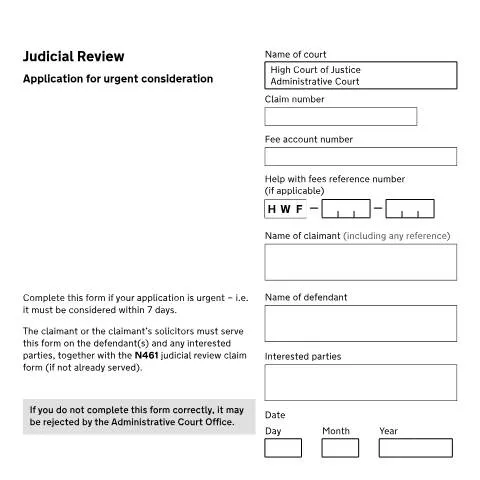
In the High Court's Administrative Court, certain legal challenges cannot wait for the standard judicial review timetable. When public bodies make decisions that require immediate court intervention—perhaps a deportation scheduled for tomorrow, a planning permission about to destroy a protected site, or a school closure announced days before term—the Form N463 Application for urgent consideration becomes the claimant's lifeline. This specialised procedure compresses what might normally take months into a matter of days or even hours, but demands rigorous justification and meticulous preparation.
The N463 sits at the intersection of administrative law and emergency procedure, requiring applicants to demonstrate not merely that their underlying judicial review has merit, but that time itself has become a critical factor. Unlike routine applications, urgent consideration transforms the Administrative Court's standard rhythm, potentially requiring out-of-hours judicial attention and expedited service on defendants.
The Anatomy of Genuine Urgency in Administrative Law
The Administrative Court Office receives numerous N463 applications, yet genuine urgency remains legally distinct from mere convenience or anxiety. True urgency typically involves imminent, irreversible consequences that would render any eventual judicial review victory meaningless. The form specifically requires consideration within seven days—applications needing longer timescales should use the general Form N244 for interim applications.
Consider these scenarios that frequently justify urgent treatment:
- Removal or deportation cases where the Home Office has set departure dates within days
- Planning and environmental matters where demolition or development work is scheduled to commence imminently
- Licensing decisions affecting businesses where delay would cause irreparable financial harm
- Educational or healthcare service closures announced with minimal notice
- Electoral boundary or voting arrangements where elections approach rapidly
The court scrutinises each application against established precedent, particularly considering whether interim relief could adequately protect the claimant's position pending a full hearing. Section 1 of the N463 demands detailed explanation of why standard timescales prove inadequate—generic assertions about "serious consequences" rarely suffice.
Distinguishing Emergency from Preference
Administrative Court judges regularly reject N463 applications where claimants conflate desirable speed with legal necessity. The form's Section 2 specifically probes when the applicant first recognised urgency might be required and demands justification for any delays in application. A claimant who knew about a problematic decision weeks ago but delayed seeking legal advice cannot typically claim genuine urgency when consequences finally loom.
The court expects applicants to demonstrate they have exhausted reasonable alternatives—whether through direct negotiation with the public body, seeking voluntary undertakings, or exploring other interim measures. This principle reflects the Administrative Court's reluctance to disrupt public administration without compelling justification.
Tactical Considerations in Expedited Timescales
Section 3 of the N463 requires precise specification of required timescales, creating strategic decisions that can determine success or failure. Applicants must choose between consideration within three days (specifying hours) or between three and six days, but these choices carry different implications for both judicial availability and defendant response time.
| Timescale Requested | Typical Scenarios | Defendant Response Period | Judicial Implications |
|---|---|---|---|
| Within 24-48 hours | Imminent removal, immediate demolition | Same day or next day | May require out-of-hours judge |
| 2-3 days | School closures, urgent licensing | 1-2 working days | Standard judicial availability |
| 4-6 days | Planning permissions, policy implementations | 2-3 working days | Allows fuller consideration |
The form's Section 3.2 offers multiple categories of relief: interim injunctions, abridged time for Acknowledgment of Service, expedited permission decisions, and accelerated substantive hearings. Experienced practitioners often seek combinations of these remedies—for instance, requesting interim relief within 24 hours while seeking expedited permission consideration within four days.
The Strategic Dimension of Multiple Relief Types
Claimants frequently underestimate the tactical complexity inherent in Section 3.2's options. Requesting interim relief creates immediate judicial focus but may prompt defendants to file robust opposition that could prejudice the eventual permission decision. Conversely, seeking only expedited permission consideration might leave the claimant vulnerable to irreversible consequences during the decision period.
The option to request substantive hearings by specific dates proves particularly valuable in cases involving regulatory deadlines or seasonal considerations—planning applications affecting agricultural operations, for example, often require resolution before planting or harvesting seasons.
Constructing Compelling Legal and Factual Foundations
Section 4 of the N463 demands comprehensive exposition of both factual and legal grounds supporting the application. This section often determines success, as judges must rapidly assess not merely whether urgency exists, but whether the underlying judicial review claim possesses sufficient merit to justify expedited consideration.
The Administrative Court expects applicants to address the established judicial review criteria—illegality, irrationality, and procedural impropriety—while demonstrating how delay would undermine the court's eventual ability to provide effective relief. Effective N463 applications typically structure Section 4 chronologically, establishing the decision-making timeline, identifying specific legal failures, and connecting these to the urgency justification.
Consider this approach for complex cases:
- Chronological foundation: Establish when key decisions were made and communicated
- Legal framework identification: Specify applicable statutory duties, policy guidance, or procedural requirements
- Breach specification: Detail precisely how the defendant failed to meet these requirements
- Consequence analysis: Demonstrate how delay renders eventual relief inadequate or meaningless
- Precedent citation: Reference relevant case law supporting both the substantive claim and urgency justification
Evidential Standards Under Time Pressure
Urgent applications create particular evidential challenges. Unlike standard judicial review applications, claimants may lack time for comprehensive document disclosure or detailed witness statements. The Administrative Court recognises these constraints but expects applicants to provide the best available evidence within the circumstances.
The form's statement of truth provisions carry particular weight in urgent contexts. Claimants must confirm that "all relevant facts have been disclosed"—a requirement that becomes challenging when working to compressed timescales. Experienced practitioners often include explicit caveats about information that remains outstanding while confirming the accuracy of facts currently available.
Mastering the Draft Order Requirement
Section 5 mandates attachment of a draft order specifying exactly what relief the court should grant. This requirement often separates successful applications from failures, as imprecise or overly broad draft orders suggest inadequate preparation or unclear legal thinking.
Effective draft orders typically include:
- Specific interim relief with clear temporal limitations
- Provisions for defendant response and further hearings
- Case management directions for expedited proceedings
- Costs provisions reflecting the urgent application
- Liberty to apply clauses allowing subsequent modifications
The draft order must align precisely with the relief sought in Section 3.2 while providing sufficient flexibility for judicial modification. Courts frequently grant partial relief or impose conditions not specifically requested, making comprehensive draft orders essential for protecting claimant interests.
Balancing Ambition with Achievability
Claimants often err by requesting either excessively broad relief that courts consider disproportionate, or overly narrow orders that fail to provide adequate protection. The optimal draft order demonstrates proportionality—seeking sufficient relief to preserve the claimant's position without unnecessarily disrupting public administration.
For example, in planning cases, requesting complete cessation of all development work might prove excessive where prohibiting specific demolition or tree removal would adequately protect the claimant's interests. Similarly, in immigration cases, requesting indefinite postponement of removal typically proves less successful than seeking specific short-term delays pending expedited judicial review consideration.
Service Requirements and Procedural Compliance
Section 6 addresses service requirements that become particularly complex in urgent contexts. The N463 must be served on all defendants and interested parties alongside the main N461 judicial review claim form (if not previously served). This requirement creates logistical challenges when working to compressed timescales, particularly for cases involving multiple government departments or numerous interested parties.
The form provides options for service by personal delivery or email, but each method carries different implications for proof and timing. Email service offers speed and creates automatic delivery records, but may encounter out-of-office responses or server failures at critical moments. Personal service provides certainty but may prove impossible during evenings, weekends, or holidays when urgent applications often arise.
Service obligations extend beyond mere document delivery—the Administrative Court expects applicants to provide defendants with realistic opportunity to respond within the compressed timescales. Applications seeking consideration within 24 hours while serving defendants late on Friday afternoon rarely succeed unless truly exceptional circumstances exist.
Fill in your form directly online
No printing: type your details into the boxes of the official form, tick, then download the PDF ready to send.
- 1Type into the form boxes
- 2Tick in one click
- 3Save and download the PDF
Managing Multi-Party Service Complexities
Cases involving numerous interested parties—common in planning, licensing, and policy challenges—create particular service difficulties under urgent timescales. The court expects reasonable efforts to notify all relevant parties but may proceed with partial service where comprehensive notification proves impossible within the required timeframe.
Applicants should document their service efforts meticulously, including unsuccessful attempts and reasons for any omissions. The Administrative Court Office maintains email addresses for various government departments and agencies, facilitating rapid service on common defendants, but private interested parties may require more creative approaches.
Administrative Court Office Procedures and Regional Variations
The N463 must be submitted to specific Administrative Court Office locations based on geographical jurisdiction or case allocation. Each office—London, Birmingham, Cardiff, Leeds, and Manchester—maintains dedicated email addresses for urgent applications, but processing procedures and judicial availability can vary significantly.
The London Administrative Court Office typically handles the highest volume of urgent applications and maintains the most comprehensive out-of-hours procedures, but also faces the greatest pressure on judicial resources. Regional offices often provide more personalised attention but may have limited judicial availability for truly urgent matters requiring weekend or evening consideration.
| Administrative Court Office | Email Address | Typical Specialisations | Out-of-Hours Capability |
|---|---|---|---|
| London | [email protected] | Immigration, central government, complex commercial | Full weekend and evening coverage |
| Birmingham | [email protected] | Planning, local government, Midlands cases | Limited weekend availability |
| Cardiff | [email protected] | Welsh devolution, planning, local authority | Standard hours primarily |
| Leeds | [email protected] | Northern England, local government | Limited weekend availability |
| Manchester | [email protected] | North West England, commercial licensing | Standard hours primarily |
Understanding Judicial Assignment Patterns
Different types of urgent applications tend to be assigned to judges with relevant expertise—immigration cases often go to judges experienced in Home Office challenges, while planning matters typically reach judges familiar with environmental and development law. Understanding these patterns can influence application strategy, particularly regarding the level of legal detail appropriate for different judicial backgrounds.
The Administrative Court Office maintains duty judge rotas for urgent applications, but individual judges may have different approaches to urgent relief. Some favour narrow, time-limited orders that preserve the status quo, while others may be willing to grant broader relief where the legal case appears particularly strong.
Post-Application Dynamics and Ongoing Case Management
Successful N463 applications typically generate immediate case management directions that compress standard judicial review timescales dramatically. Defendants may be required to file Acknowledgments of Service within days rather than weeks, and permission decisions often follow within days of the defendant response.
The compressed timescales create ongoing procedural complexities. Standard judicial review practice allows extensive document disclosure and detailed evidence preparation, but urgent cases may proceed to substantive hearings with limited documentary evidence and abbreviated witness statements. This creates strategic tensions between speed and thoroughness that require careful navigation.
Claimants should anticipate that urgent applications often generate conditional relief—orders that provide temporary protection while requiring ongoing compliance with specific conditions or further applications as circumstances develop. These interim orders frequently include:
- Undertakings regarding costs if the eventual judicial review fails
- Requirements for regular updates on factual developments
- Provisions for defendants to apply for variation if circumstances change
- Expedited timetables for all subsequent procedural steps
The urgency that justifies initial N463 relief rarely dissipates immediately, creating ongoing case management challenges that extend well beyond the initial application. Successful urgent judicial review requires sustained attention to compressed timescales and evolving factual circumstances that may affect the continuing justification for expedited treatment.