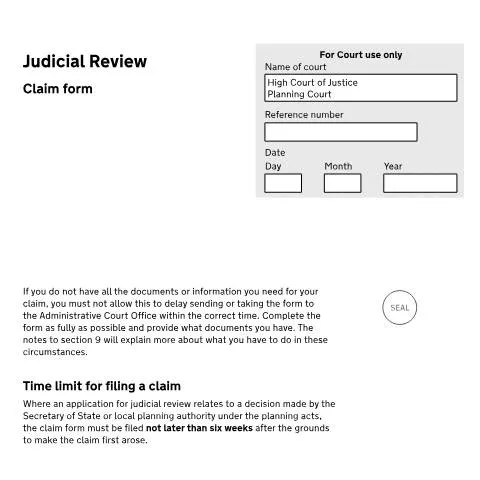
Understanding the Judicial Review Framework in Planning Matters
When local planning authorities or the Secretary of State make decisions that fundamentally affect property rights, community interests, or procedural fairness, the Form N461PC serves as the gateway to challenge these determinations through the High Court's Planning Court. This specialised judicial review claim form operates under significantly tighter timeframes than standard administrative law challenges, reflecting the commercial urgency often surrounding planning disputes.
The Planning Court, established as part of the Administrative Court within the Queen's Bench Division, handles cases where planning decisions allegedly breach statutory duties, exceed legal powers, or fail to follow proper procedures. Unlike general judicial review applications that typically allow three months for filing, planning-related challenges must be lodged within six weeks of the grounds arising, creating a compressed timeline that demands immediate legal assessment and swift preparation.
Form N461PC differs markedly from the standard judicial review form N461 in its specific focus on planning legislation. The accelerated procedure recognises that planning decisions often trigger significant financial commitments, development timelines, and community impacts that require prompt judicial scrutiny rather than extended litigation periods.
Navigating the Critical Six-Week Limitation Period
The most distinctive feature of planning judicial review lies in its compressed timeframe. Where standard administrative challenges operate under a three-month limitation period, planning cases demand filing not later than six weeks after the grounds to make the claim first arose. This creates particular complexity in determining the precise trigger date.
The limitation period typically begins when the decision notice is received, but several scenarios can complicate this calculation:
- Deemed refusals: Where planning applications are not determined within statutory periods, the refusal date becomes the trigger point
- Conditional approvals: Complex permissions with multiple conditions may create uncertainty about when challengeable decisions crystallise
- Reserved matters: Outline permissions followed by detailed submissions can generate multiple potential challenge points
- Enforcement notices: These carry their own statutory timescales that may differ from the six-week judicial review period
The court maintains strict adherence to these deadlines. Even compelling cases on their merits will typically fail if filed outside the limitation period, making early legal assessment essential. The form explicitly warns against delaying submission while gathering supporting documentation, emphasising that incomplete applications filed within time are preferable to comprehensive submissions filed late.
Identifying Parties and Managing Complex Relationships
Planning judicial review cases often involve intricate webs of interested parties, requiring careful consideration of who must be named as defendants versus interested parties. The form provides space for multiple defendants and interested parties, reflecting the multi-party nature of many planning disputes.
Primary defendants typically include the local planning authority that made the decision and, where relevant, the Secretary of State if the challenge relates to a called-in application or planning appeal decision. The form requires complete contact details, including legal representatives where known, ensuring proper service of proceedings.
Interested parties present more complex considerations. These may include:
| Category | Examples | Notification Requirements |
|---|---|---|
| Applicant developers | Companies or individuals who secured the challenged permission | Mandatory inclusion as their interests are directly affected |
| Objecting parties | Neighbouring landowners, community groups, parish councils | Include if they participated significantly in the original process |
| Statutory consultees | Environment Agency, Historic England, highway authorities | Include if their advice was central to the challenged decision |
| Appeal parties | Original appellants in planning appeal cases | Mandatory where challenging appeal decisions |
The form's notes specifically address court and tribunal proceedings, requiring that any parties to original proceedings be named as interested parties. This ensures all affected parties receive proper notice and can participate in defending decisions they supported.
Articulating Grounds for Challenge in Planning Context
Section 3 of Form N461PC requires detailed articulation of the decision being challenged and the legal basis for the challenge. Planning judicial review grounds typically fall within established administrative law principles but require careful application to planning-specific contexts.
Procedural impropriety commonly arises where planning authorities fail to follow statutory consultation requirements, consider mandatory factors, or provide adequate reasons for decisions. The Town and Country Planning Act 1990 and associated regulations create extensive procedural frameworks that authorities must observe.
Illegality challenges focus on whether decisions exceed statutory powers or misinterpret relevant planning policy. This might include:
- Misapplication of National Planning Policy Framework provisions
- Failure to have proper regard to development plan policies
- Incorrect interpretation of statutory tests for listed building consent or conservation area consent
- Ultra vires conditions attached to planning permissions
Irrationality arguments require demonstrating that no reasonable planning authority could have reached the challenged decision on the available evidence. Given the wide discretion afforded to planning authorities, successful irrationality challenges typically require clear evidence of fundamental flaws in reasoning or consideration of irrelevant factors.
The form emphasises completing Section 3 as fully as possible even where documentation remains incomplete. This reflects the reality that planning decisions often involve extensive technical reports and correspondence that may take time to obtain through Freedom of Information requests or informal disclosure.
Procedural Requirements and Civil Legal Aid Considerations
Section 4 of Form N461PC addresses permission requirements and legal aid eligibility, reflecting the two-stage nature of judicial review proceedings. All judicial review claims require permission to proceed before substantive hearings can take place, creating an initial filter to prevent unmeritorious claims from consuming court resources.
The permission stage operates on a lower threshold than final determination, requiring claimants to demonstrate arguable grounds rather than prove their case conclusively. However, planning cases face particular scrutiny given the compressed timescales and potential for significant economic impact on development projects.
Civil Legal Aid for judicial review cases operates under exceptional funding provisions, requiring demonstration that cases raise issues of general public importance or that private funding would be unreasonably difficult to obtain. Planning cases may qualify where they involve:
- Significant environmental or heritage protection issues
- Community rights against major development proposals
- Procedural challenges that could establish important precedents
- Cases where individual claimants face disproportionate legal costs relative to their means
The form requires early declaration of legal aid status, as this affects cost protection arrangements and may influence case management directions. Legal aid certificates must typically be obtained before filing, though emergency applications may be possible in exceptional circumstances.
Documentary Evidence and Supporting Materials
Unlike many administrative forms, Form N461PC operates within a framework where complete documentation may not be immediately available. Planning decisions often generate substantial paper trails involving technical reports, consultation responses, committee reports, and correspondence that claimants may not initially possess.
The form's guidance explicitly states that incomplete documentation should not delay filing within the six-week deadline. This creates a distinctive approach where initial claims may be relatively sparse, with detailed evidence following through subsequent court directions or disclosure processes.
Essential documents for initial filing typically include:
- The decision notice or committee resolution being challenged
- The original planning application or relevant documentation
- Any statutory notices (enforcement, listed building, etc.)
- Key correspondence demonstrating procedural failures
- Relevant planning policies or guidance allegedly misapplied
Supplementary materials may be obtained through various routes after filing, including formal court-ordered disclosure, Freedom of Information Act 2000 requests to public authorities, or voluntary disclosure from other parties. The Planning Court's case management procedures accommodate this phased approach to evidence gathering.
Expert evidence often proves crucial in planning judicial review, particularly where technical matters like transport impact, environmental assessment, or heritage significance are disputed. However, expert reports are typically commissioned after permission is granted rather than for initial applications, reflecting cost management considerations and the permission stage's lower evidential threshold.
Filing Procedures and Court Administration
Form N461PC must be filed with the Administrative Court Office, which maintains specialist registries for different types of administrative law challenges. Planning judicial review cases are typically allocated to the Planning Court, a specialist jurisdiction within the Administrative Court that handles planning, environmental, and local government cases.
The form can be filed through multiple channels, each with distinct practical implications:
Electronic filing through the Administrative Court's online system provides immediate confirmation of receipt and typically faster processing. The system accepts PDF versions of completed forms along with supporting documents, though file size limitations may require multiple submissions for document-heavy cases.
Postal submission to the Administrative Court Office requires careful timing to ensure arrival within limitation periods. The court recommends recorded delivery for time-critical applications, though postal delays remain a risk factor that electronic filing eliminates.
Personal delivery to the Royal Courts of Justice provides certainty of timely filing but requires attendance during court office hours. This option may be essential for last-minute applications where electronic or postal filing cannot guarantee deadline compliance.
Filing fees for judicial review applications are substantial, reflecting the court resources required for these complex cases. Fee remission may be available for applicants meeting financial eligibility criteria, though applications must be submitted alongside the main claim form to avoid processing delays.
Post-Filing Procedures and Case Progression
Once Form N461PC is filed, the case enters the Administrative Court's case management system with specific procedural tracks designed for planning cases. The compressed timescales that characterise the initial filing period extend into subsequent case management, with courts typically seeking to resolve planning challenges more rapidly than general administrative law cases.
Initial case management involves several key stages. The court serves the claim form on all named defendants and interested parties, triggering their obligation to file acknowledgments of service within specified periods. These acknowledgments indicate whether parties intend to contest the claim and may include summary grounds for resistance.
Permission decisions typically follow within 4-6 weeks of filing, though complex cases may require oral permission hearings where initial paper consideration proves insufficient. The court may grant permission on all grounds, on limited grounds, or refuse permission entirely. Refused applications may be renewed to oral hearings, providing a second opportunity to demonstrate arguable grounds.
Where permission is granted, substantive case management begins with directions for evidence, expert reports, and hearing preparation. Planning cases often require site visits, particularly where physical site conditions, visual impact, or heritage significance are disputed. The Planning Court maintains particular expertise in managing such practical arrangements.
The ultimate substantive hearing determines whether the challenged decision should be quashed, requiring the decision-maker to reconsider the matter, or whether the challenge fails and the original decision stands. Planning judicial review remedies are typically mandatory orders requiring reconsideration rather than the court substituting its own decision, respecting the primary responsibility of elected planning authorities for planning decisions within their legal powers.
Strategic Considerations for Different Types of Public Body Decisions
The scope of judicial review under Form N461PC extends across various categories of public bodies, each presenting distinct procedural considerations and legal frameworks. Understanding these nuances proves crucial for determining whether your challenge falls within the Administrative Court's jurisdiction and how to frame your grounds effectively.
Central Government Department Decisions
When challenging decisions made by government departments such as the Home Office, Department for Work and Pensions, or HM Treasury, particular attention must be paid to the decision-making hierarchy. Often, the named defendant should be the Secretary of State rather than the department itself, though this varies depending on the statutory framework governing the specific decision.
Immigration decisions present a common example where judicial review may be appropriate, particularly where the Upper Tribunal lacks jurisdiction or where the challenge concerns policy guidance rather than individual case decisions. However, the Immigration and Asylum Act 1999 and subsequent legislation create specific statutory review mechanisms that must typically be exhausted before judicial review becomes available.
For DWP benefit decisions, the Social Security Act 1998 establishes a mandatory appeal route through the First-tier Tribunal, then potentially to the Upper Tribunal. Judicial review of these decisions is generally only permitted where there are exceptional circumstances, such as fundamental procedural irregularities or where the decision-maker has acted outside their statutory powers entirely.
Local Authority Decision Challenges
Local authority decisions encompass a vast range of functions, from planning applications and licensing to social care assessments and housing allocations. Each area often has its own statutory appeal mechanisms that must be considered before judicial review.
Planning decisions demonstrate this complexity well. While many planning refusals can be appealed to the Planning Inspectorate, certain decisions—such as enforcement notices or certificates of lawful development—may require judicial review as the primary challenge mechanism. The Town and Country Planning Act 1990 sets out these various routes, and selecting the wrong procedure can result in your challenge being struck out.
Social care decisions present another intricate area. The Care Act 2014 establishes complaint procedures and, in some cases, appeal rights to the Local Government and Social Care Ombudsman. However, where fundamental procedural failures have occurred—such as failure to carry out a proper needs assessment or failure to consider relevant factors—judicial review may be the appropriate route.
Regulatory Body and Quasi-Judicial Decisions
Professional regulatory bodies such as the General Medical Council, Solicitors Regulation Authority, or Financial Conduct Authority exercise statutory powers that may be subject to judicial review. These bodies often have internal appeal processes, but where procedural unfairness or jurisdictional errors are alleged, direct judicial review may be appropriate.
The key consideration is whether the body exercises public functions. Private bodies can become subject to judicial review where they exercise statutory powers or perform functions of a public nature. The test established in cases such as R v Panel on Take-overs and Mergers, ex parte Datafin plc focuses on the source of power and the nature of the functions exercised.
Procedural Safeguards and Case Management Directions
The Administrative Court operates under specific case management principles designed to ensure efficient resolution of judicial review claims while maintaining procedural fairness. Understanding these mechanisms can significantly impact the progress and outcome of your case.
Fill in your form directly online
No printing: type your details into the boxes of the official form, tick, then download the PDF ready to send.
- 1Type into the form boxes
- 2Tick in one click
- 3Save and download the PDF
The Permission Stage Filter
The permission stage serves as a crucial filter, requiring claimants to demonstrate that their case has sufficient merit to warrant full consideration. This two-stage process—initial paper consideration followed by potential oral renewal—demands careful strategic thinking about how to present your case most effectively.
At the paper stage, the judge considers your claim form N461PC, grounds, and supporting evidence without hearing oral argument. The threshold is whether your case is "arguable"—a lower standard than the ultimate merits test, but still requiring a realistic prospect of success. Approximately 60-70% of applications are refused at this stage, making the quality of your initial submission critical.
Where permission is refused on paper, you have seven days to request an oral renewal hearing. This provides an opportunity to address the judge's concerns directly and expand on arguments that may not have been clear from the written materials. Success rates at oral renewal are typically higher, making this a valuable opportunity even where initial refusal seems comprehensive.
Interim Relief Applications
Where urgent action is required to prevent irreversible harm pending determination of your judicial review, interim relief may be sought. This can include interim injunctions to prevent implementation of a decision or mandatory orders requiring specific action to be taken.
The test for interim relief follows the American Cyanamid principles, requiring you to demonstrate: a serious issue to be tried; that damages would not be an adequate remedy; and that the balance of convenience favours granting relief. In judicial review context, particular weight is given to the public interest, which may weigh against interfering with administrative decisions pending full determination.
Applications for interim relief must usually be made at the same time as your substantive claim, using Form N244 alongside Form N461PC. The urgency of such applications means they are often heard within days of filing, requiring rapid preparation of comprehensive evidence and legal argument.
Case Management and Directions
Following grant of permission, the court will typically give case management directions tailored to the specific issues in your case. Standard directions include timetables for filing detailed grounds, acknowledgment of service by defendants, and any expert evidence.
The Administrative Court encourages early resolution where possible, and case management conferences may be directed where complex issues arise. These hearings allow the court to identify the key issues in dispute, determine what evidence is needed, and set realistic timetables for preparation.
Where your case involves complex factual disputes, the court may direct that witness statements be filed or, in exceptional cases, that oral evidence be given at the substantive hearing. However, judicial review remains primarily a review of the decision-making process rather than a rehearing of the merits, so extensive factual inquiry is unusual.
Financial Implications and Cost Protection Mechanisms
The financial aspects of judicial review proceedings extend well beyond the initial court fees, encompassing potential liability for the other side's costs, your own legal representation expenses, and various protective mechanisms designed to facilitate access to justice.
Comprehensive Cost Exposure Assessment
Understanding your potential cost exposure proves essential for informed decision-making about whether to proceed with judicial review. Beyond the court fees of £154 for the application and £770 if permission is granted, you face potential liability for the defendant's legal costs if your case fails.
Government departments typically instruct the Government Legal Department, whose costs can range from £150-400 per hour for solicitors and £200-600 per hour for barristers, depending on seniority. For a straightforward case reaching substantive hearing, defendant costs might range from £15,000-30,000, though complex cases can exceed £100,000.
Your own legal costs present another significant consideration. Solicitor rates vary considerably depending on location and expertise, typically ranging from £200-600 per hour in London and £150-400 per hour elsewhere. Barristers' fees depend on experience and case complexity, with junior barristers charging £100-300 per hour and leading counsel £300-1,000 per hour or more.
Protective Costs Orders and Aarhus Claims
The Civil Procedure Rules provide several mechanisms to limit cost exposure in appropriate cases. Protective Costs Orders (PCOs) can be sought where the case raises issues of general public importance, limiting your liability for the other side's costs even if you lose.
For environmental cases falling within the Aarhus Convention, special cost protection applies automatically. These cases—covering areas such as environmental information, planning decisions with environmental implications, and challenges to environmental permits—benefit from caps on both liability for defendant's costs (£5,000 for individuals, £10,000 for groups) and cross-undertakings in damages for interim relief applications.
The Aarhus regime also provides that if you succeed, you can recover your costs in the normal way, creating an asymmetric cost structure that facilitates access to environmental justice. However, determining whether your case qualifies for Aarhus protection requires careful analysis of both the subject matter and the specific legal framework governing the challenged decision.
After the Event Insurance and Litigation Funding
After the Event (ATE) insurance can provide protection against liability for the other side's costs, though premiums can be substantial—often 20-40% of the cover provided. The availability and cost of ATE insurance may itself indicate the strength of your case, as insurers conduct their own merits assessment before providing cover.
For cases with significant public interest elements, charitable organizations or campaign groups may provide financial support. The Good Law Project, ClientEarth, and similar organizations occasionally fund strategic cases, though competition for such funding is intense and decisions are made based on wider strategic considerations beyond individual case merits.
Conditional Fee Arrangements (CFAs) with your legal team can limit upfront costs, though you remain liable for ATE insurance premiums and potential adverse costs. The success fee payable to your lawyers if you win is no longer recoverable from the losing party, making careful financial planning essential.
Legal Aid Exceptional Funding
Although legal aid for judicial review was largely abolished by the Legal Aid, Sentencing and Punishment of Offenders Act 2012, exceptional funding remains available in cases where failure to provide legal aid would breach human rights or EU law rights, or where exceptional circumstances make funding appropriate.
The Legal Aid Agency applies strict criteria for exceptional funding, requiring demonstration that your case has general public importance and reasonable prospects of success. The application process itself is complex, requiring detailed financial assessment and legal merit evaluation. Even where granted, exceptional funding may not cover all costs, and you may face contributions based on your financial circumstances.
For immigration and asylum cases, legal aid remains more widely available, though eligibility criteria and scope limitations apply. The Immigration and Asylum Act 1999 and subsequent regulations define the circumstances where legal aid can be provided for judicial review challenges to immigration decisions.