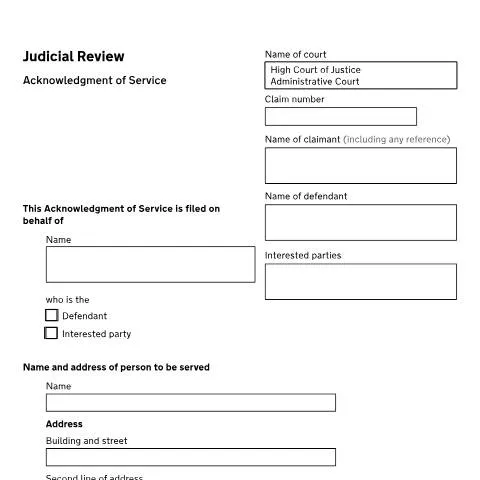
When the Courts Come Calling: Understanding Your Response Obligations in Judicial Review
The Administrative Court has accepted a judicial review application, and suddenly you find yourself named as a defendant or interested party in proceedings that could fundamentally challenge a public body's decision. The Form N462 Acknowledgment of Service now sits before you, demanding a response within strict timeframes that could determine your entire involvement in what may become a landmark case.
This isn't merely administrative housekeeping. Your response through Form N462 shapes the court's understanding of the dispute, influences case management directions, and can even determine whether you'll face an adverse costs order if the challenge succeeds. For public bodies, this represents the crucial first opportunity to defend their decision-making process. For interested parties—those who benefit from the contested decision—it may be their only chance to ensure their voice is heard before the court reaches its judgment.
The stakes are particularly high because judicial review operates under compressed timeframes designed to resolve public law disputes swiftly. Miss the deadline for filing your acknowledgment, and you risk being shut out of proceedings that could overturn decisions worth millions of pounds or affect thousands of citizens.
Navigating the Strategic Crossroads: Your Response Options Under Section 1
Form N462's opening section presents what appears to be a simple multiple-choice question, but each tick box represents a fundamentally different litigation strategy with distinct procedural consequences. The court requires absolute clarity about your intentions because this determines everything from case management directions to the evidence you'll be permitted to file.
Contesting all of the claim commits you to a full defence, requiring completion of the detailed grounds in Section 3 and potentially triggering substantial legal costs. This option suits defendants confident in their decision-making process or interested parties whose entire position depends on the contested decision remaining intact. However, it also means you'll be expected to file comprehensive evidence and detailed witness statements within the court's demanding timetable.
Contesting part of the claim offers more nuanced positioning, particularly valuable when the claimant challenges multiple grounds or seeks various remedies. You might accept that one aspect of the decision was flawed whilst defending the core determination. This approach requires surgical precision in Section 3, clearly delineating which elements you contest and why.
The option to not contest the claim doesn't necessarily signal defeat. Sometimes public bodies recognise that their decision cannot withstand scrutiny and prefer to concede rather than incur substantial legal costs defending the indefensible. This can be strategically sound, particularly when you can remedy the identified flaws through a fresh decision-making process.
For courts and tribunals named as defendants, special provisions recognise their unique position. They may choose to file neutral submissions explaining their decision-making process without defending it, or simply provide the case file to assist the Administrative Court's judicial function. This reflects the principle that lower courts and tribunals shouldn't normally be required to defend their decisions like other public bodies.
The Aarhus Convention Dimension
When claimants invoke the Aarhus Convention—covering access to environmental justice—costs protection may apply, fundamentally altering the financial dynamics. If you're named in such a claim, you must respond to specific questions in Section 5 about whether you accept the Aarhus characterisation and whether exceptional circumstances justify varying the usual costs limits.
Challenging the "No Difference" Defence: Section 31(3C) Strategic Considerations
One of Form N462's most significant developments addresses the Senior Courts Act 1981 section 31(3C), which allows defendants to argue that the outcome would have been substantially the same even without the alleged procedural failings. This represents a fundamental shift in judicial review litigation, potentially offering defendants a complete defence even where procedural errors are established.
Invoking this defence requires careful consideration. You're essentially conceding that something went wrong whilst arguing it made no practical difference to the final outcome. The court expects robust grounds supporting this position, typically involving evidence that:
- The same decision would inevitably have resulted from proper procedures
- No other reasonable decision-maker could have reached a different conclusion
- The procedural flaw was genuinely inconsequential to the substantive outcome
- The claimant suffered no real prejudice from the identified error
This defence has proven particularly valuable in planning cases where authorities can demonstrate that applications would have been refused regardless of consultation flaws, or in licensing decisions where the substantive criteria clearly weren't met.
Section 2 Intelligence: Identifying Additional Interested Parties
Your obligation to identify other interested parties serves both procedural fairness and case management efficiency. The Administrative Court expects you to consider not just obvious stakeholders, but anyone whose legal rights or legitimate interests might be affected by the proceedings' outcome.
This assessment requires genuine strategic thinking. In planning cases, you might identify neighbouring developers, local resident groups, or statutory consultees. In licensing matters, consider competitors who might benefit from refusal, or industry bodies with regulatory interests. In procurement challenges, other tenderers often have crucial perspectives on the process.
| Case Type | Typical Additional Interested Parties | Strategic Considerations |
|---|---|---|
| Planning decisions | Neighbouring landowners, parish councils, statutory consultees | May strengthen defence or provide local knowledge |
| Procurement challenges | Other bidders, subcontractors, trade associations | Could support procurement process or reveal additional issues |
| Licensing matters | Competitors, residents' associations, regulatory bodies | May provide evidence of proper consultation or precedent |
| Immigration decisions | Sponsors, family members, representative bodies | Often crucial for understanding individual circumstances |
Remember that identifying additional parties doesn't guarantee they'll participate. Some may choose not to engage, whilst others might file their own acknowledgments with different strategic positions.
Crafting Your Defence: The Critical Section 3 Summary
Section 3 demands a comprehensive yet concise summary of your grounds for contesting the claim. This isn't the place for detailed legal argument—that comes later in your detailed grounds—but it must provide sufficient substance for the court to understand your defence and make appropriate case management decisions.
Effective summaries typically address each of the claimant's grounds systematically, demonstrating that you understand the challenge and have substantive responses. Avoid generic denials; instead, identify the specific factual or legal basis for your position. If you're contesting procedural fairness allegations, outline the consultation that did occur. If the challenge concerns the interpretation of policy, indicate the interpretative approach you'll defend.
For public bodies defending substantive decisions, focus on demonstrating that proper procedures were followed, relevant considerations were taken into account, and the decision fell within the range of reasonable responses. Reference specific evidence you'll rely on, such as committee minutes, expert reports, or consultation responses.
For interested parties, your grounds might emphasise the benefits you derive from the contested decision, the prejudice you'd suffer if it were quashed, or additional factors supporting the decision that the original decision-maker might not have fully articulated.
Courts and tribunals filing submissions should clearly indicate this status and focus on explaining their decision-making process rather than defending it. This might include outlining the evidence considered, the legal framework applied, and the reasoning leading to the contested decision.
The Art of Strategic Ambiguity
Sometimes, you may wish to reserve your position on certain issues pending disclosure of the claimant's evidence or legal authorities. This is permissible provided you give fair notice of the general nature of your defence. Phrases like "pending sight of the claimant's evidence" or "subject to further consideration of the legal authorities" can preserve flexibility whilst meeting disclosure obligations.
Case Management and Procedural Applications: Section 4 Tactical Opportunities
Section 4 provides your first opportunity to influence case management directions, potentially shaping the entire litigation process to your advantage. This isn't merely about administrative convenience—strategic case management can determine whether you face a paper hearing or oral argument, the timeframe for evidence exchange, and even the court venue.
Venue applications using Form N464 can be particularly significant. Moving proceedings from London to a regional Administrative Court centre might suit your witnesses and legal team, reduce costs, or provide practical advantages. Cardiff Administrative Court, for instance, often provides faster listing for Welsh public body cases, whilst Manchester may be more convenient for northern local authorities.
Evidence directions deserve careful consideration. You might seek extended time limits if your case involves complex technical evidence, multiple departments, or international elements. Alternatively, you might propose expedited directions if delay would cause ongoing uncertainty or administrative difficulties.
Protective costs orders become crucial in environmental cases or matters involving individual claimants with limited resources. If you're confident in your position, opposing such orders can create pressure for early settlement, though this must be balanced against potential adverse publicity.
Consider whether any preliminary issues might dispose of the case efficiently. Jurisdiction challenges, limitation defences, or academic arguments can sometimes resolve matters without engaging with substantive merits, saving considerable time and costs.
Interlocutory Applications Strategy
Filing interim applications with your acknowledgment can catch claimants off-guard and establish early procedural advantages. Applications for summary dismissal, striking out for academic challenges, or protective disclosure orders can fundamentally alter case dynamics. However, unsuccessful applications may damage your credibility and increase costs exposure.
Environmental Cases and Costs Protection: The Aarhus Convention Framework
The Aarhus Convention fundamentally alters judicial review dynamics in environmental cases by providing claimants with costs protection that can reach £5,000 for individuals and £10,000 for groups. This protection means that even unsuccessful claimants face limited liability for your legal costs, potentially encouraging speculative litigation.
Your response in Section 5 requires careful calibration. Disputing Aarhus status demands robust grounds, typically arguing that the case doesn't genuinely concern environmental information, public participation in environmental decision-making, or access to environmental justice. Courts apply these criteria broadly, so challenges often fail unless the environmental connection is genuinely tenuous.
Varying costs limits represents a more nuanced strategy. You must demonstrate exceptional circumstances justifying departure from standard protection, such as:
Fill in your form directly online
No printing: type your details into the boxes of the official form, tick, then download the PDF ready to send.
- 1Type into the form boxes
- 2Tick in one click
- 3Save and download the PDF
- The claimant's conduct has been unreasonable or vexatious
- Complex technical issues require extensive expert evidence
- The case involves substantial commercial interests beyond environmental protection
- Multiple defendants face disproportionate costs due to the claimant's approach
Success in varying costs limits can transform case dynamics, potentially encouraging settlement or more focused pleadings. However, unsuccessful applications may damage relationships with the court and suggest defensive uncertainty about your substantive position.
The Statement of Truth: Legal Responsibilities and Practical Implications
Section 6's statement of truth carries serious legal consequences extending far beyond mere formality. Your signature confirms not just the accuracy of factual statements, but your honest belief in their truth. This creates potential contempt of court liability if statements prove false, regardless of whether you intended to mislead.
For legal representatives, signing requires confidence that your client has provided accurate instructions and that you've taken reasonable steps to verify key facts. This might involve reviewing decision-making files, confirming procedural steps with relevant officers, or seeking clarification on disputed factual matters.
Litigation friends acting for protected parties bear particular responsibilities, as they must ensure not only accuracy but also that the protected party's best interests are served by the litigation strategy adopted.
The choice between personal signature and authorised representative signature affects liability distribution. Public body officers signing personally become individually responsible for statement accuracy, whilst authorised signatures may limit personal exposure whilst maintaining corporate responsibility.
Contact Details and Service Requirements
Your address for service determines where all future court documents and opponent correspondence will be sent. Choose carefully: this should be somewhere that can receive urgent documents reliably and forward them promptly. Many practitioners prefer their legal representative's address to ensure professional handling, though this isn't mandatory.
Electronic service addresses are increasingly important as courts move toward digital-first procedures. Your email address will receive case management directions, listing notifications, and potentially urgent court orders. Ensure it's monitored regularly and has adequate storage capacity.
Providing counsel details facilitates direct communication about hearings and case management, though remember that counsel cannot generally accept service of formal court documents without specific authorisation.
Timing, Filing, and Strategic Follow-up Actions
Form N462 must be filed within 21 days of service of the claim form, with this deadline being strictly enforced. Late filing requires court permission and compelling reasons, with the court considering factors including the delay length, explanation provided, prejudice to other parties, and the merit of your proposed defence.
Filing triggers several immediate consequences. The court will serve copies on all parties, potentially prompting applications for directions or interim relief. Your acknowledgment may encourage other potential interested parties to join proceedings, particularly if you've identified them in Section 2.
Consider your post-filing strategy carefully. Will you seek early case management conference to establish favourable directions? Do you need to file evidence promptly to support any interim applications? Are there parallel procedures—such as statutory appeals or ombudsman complaints—that might affect the judicial review's progress?
Filing acknowledgment doesn't end your strategic options. You retain the ability to file detailed grounds of resistance, seek amendments to case management directions, or even make further applications using Form N244. However, each subsequent step must build logically on the foundation established in your acknowledgment.
The Administrative Court expects consistent positioning throughout proceedings. Contradicting your acknowledgment or adopting fundamentally different arguments later may damage your credibility and prompt adverse costs orders. Ensure your acknowledgment provides sufficient flexibility for your defence to develop whilst maintaining strategic coherence.
Remember that judicial review remains an exceptional remedy requiring both legal error and practical significance. Your acknowledgment should demonstrate not just that proper procedures were followed, but that the contested decision serves legitimate public purposes worthy of the court's protection. This broader perspective often proves more persuasive than technical legal argument alone.